








Earn More, Retire Sooner: The Earning Side of FI (UK)
Spend all of a £5,000 pay rise and your FI date moves further away. Bank all of it and you retire about six years sooner. Same rise, opposite result.
Cite this article
Alex Fletcher-Barnes (2026) Earn More, Retire Sooner: The Earning Side of FI (UK). Available at: https://freedomisntfree.co.uk/articles/earn-more-reach-fi-faster (Accessed: 22 November 2026).
Italicise the article title in your bibliography. Accessed date set to today.
TLDR
- Your savings rate is what you keep divided by what you take home. You can raise it by spending less, or by earning more and not spending the extra.
- On £35,000, banking all of a £5,000 rise takes about six years off your FI date. Spending all of it pushes your FI date back by about two and a half.
- Your earnings follow the value you create, and that's something you can build on purpose.
- Contracting can speed things up, but compare it properly: a day rate isn't a salary, and whether you're inside or outside IR35 changes both your take-home and your pension.
What a £5,000 pay rise does to your FI date
| What you do with the rise | Savings rate | Years to FI |
|---|---|---|
| Before the rise (£35,000, saving 25%) | 25% | 32 |
| Spend all of it | 22% | 34.5 |
| Bank half | 28% | 29.7 |
| Bank all of it | 33% | 25.7 |
Illustration: 2026/27 rUK tax, 5% real return, pot of 25x spending.
The Earning Side of FI: Your Savings Rate Has Two Levers
Guest post by Alex Fletcher-Barnes, a former finance contractor and the author of a book on raising your earnings, which is linked in his bio at the end.
Contents
- Why earning more belongs in your FI plan
- The maths: what a pay rise does to your FI date
- Where higher earnings actually come from: the value chain
- What that means for the roles you pick
- Permanent or contracting? The maths
- Permanent or contracting? Beyond the maths
- Bringing it together
- Frequently Asked Questions
Why earning more belongs in your FI plan
Savings and investments have been shown to be the biggest element of a solid FIRE approach. High earners saving smaller amounts will have to retire later than lower earners with higher savings rates (see How to FIRE Without Being a High Earner by Mike McGettrick, who runs this site, for the detail on that). The reasons behind the maths are twofold:
- The higher amount going directly to savings can begin compounding and growing faster.
- Saving more by default means that you are spending less. The less you spend now, the lower your retirement income will need to be to give you a similar lifestyle.
Both points are obvious on their own, but people often forget that both apply together, especially when your earnings increase. This article is championing increasing your earnings (through being more valuable in your outputs) and then directing a high percentage of your increased earnings towards saving, as opposed to earning more and just increasing your lifestyle (lifestyle inflation, in other words), which in effect can lower your savings percentage and push FI further away.
I speak from personal experience. I went from average earnings and no idea at all about FIRE to a more relaxed and comfortable work-life balance, and I'm on course to be able to retire when I hit whatever the minimum pension age will be by then. I did that through a disciplined, self-imposed improvement programme, examining my skills and outputs and how to improve them, coupled with learning about FIRE to get my lifestyle and savings goals into the right balance.
That's not for everybody. I did the whole up-at-5am thing, two hours of learning before my family woke up, endless books and podcasts at 2x speed on the commute, side hustles, and picking apart my working life to find ways of contributing more. So in this post I'm going to give you the highlights of how you might earn more, ultimately with more flexibility, and show how that can change the FI maths. I'll also show some permanent vs contractor comparisons to see what difference that can make (there's a bit more to it than the maths) and finish up having hopefully given you some food for thought.
Put simply, your savings rate has two levers: spend less, or earn more and keep the difference. This post is about the second one.
The maths: what a pay rise does to your FI date
Let's start with someone on £35,000, saving 25% of their take-home pay. After tax and National Insurance that's £28,720 a year, so they're saving £7,180 and, on the same basis as Mike's table, they're about 32 years from financial independence.
Now they get a £5,000 pay rise. After tax and NI it's worth £3,600 a year. Here's what happens to their FI date depending on what they do with it:
| What you do with the rise | Saved a year | Savings rate | Years to FI |
|---|---|---|---|
| Spend all of it | £7,180 | 22% | 34.5 |
| Bank half | £8,980 | 28% | 29.7 |
| Bank all of it | £10,780 | 33% | 25.7 |
The first row is the one that catches people out. Spend the whole rise and your FI date moves further away, from 32 years to 34.5, because you've raised the lifestyle your investments will one day have to pay for. Bank half and you take about two years off. Bank all of it and it's about six.
A £10,000 rise, fully banked, takes the same person from a 25% saver to a 40% saver in one move: Mike's schoolteacher, without the decade of budgeting.
One catch for higher earners. Above £50,270 you keep only about 58p of each extra pound (40% income tax plus 2% NI), so the same rise does less: £10,000 more on a £50,000 salary is about £5,800 more take-home. That's where your pension earns its keep. Pension contributions get tax relief at your top rate: through work they usually come out of your pay before tax (and with salary sacrifice, before NI too), and if you pay into a SIPP yourself, the provider adds the basic-rate relief and higher-rate taxpayers claim the rest back through their tax return. Mike covers the detail in ISA vs Pension and Salary Sacrifice Pension UK. The point here isn't how to save, just that a rise you bank is worth far more than one you spend.
Illustrations only, not advice. England, Wales and NI tax rates for 2026/27; Scottish bands differ. Years to FI assume a 5% real return and a pot of 25 times annual spending. You can work out your own target with the FI number calculator.
Where higher earnings actually come from: the value chain
Most advice about earning more comes down to "work harder" or "negotiate better". Working harder helps a bit, and negotiating helps up to a point, but neither gets to the root of it. The way I think about it is a chain, where each link feeds the next:
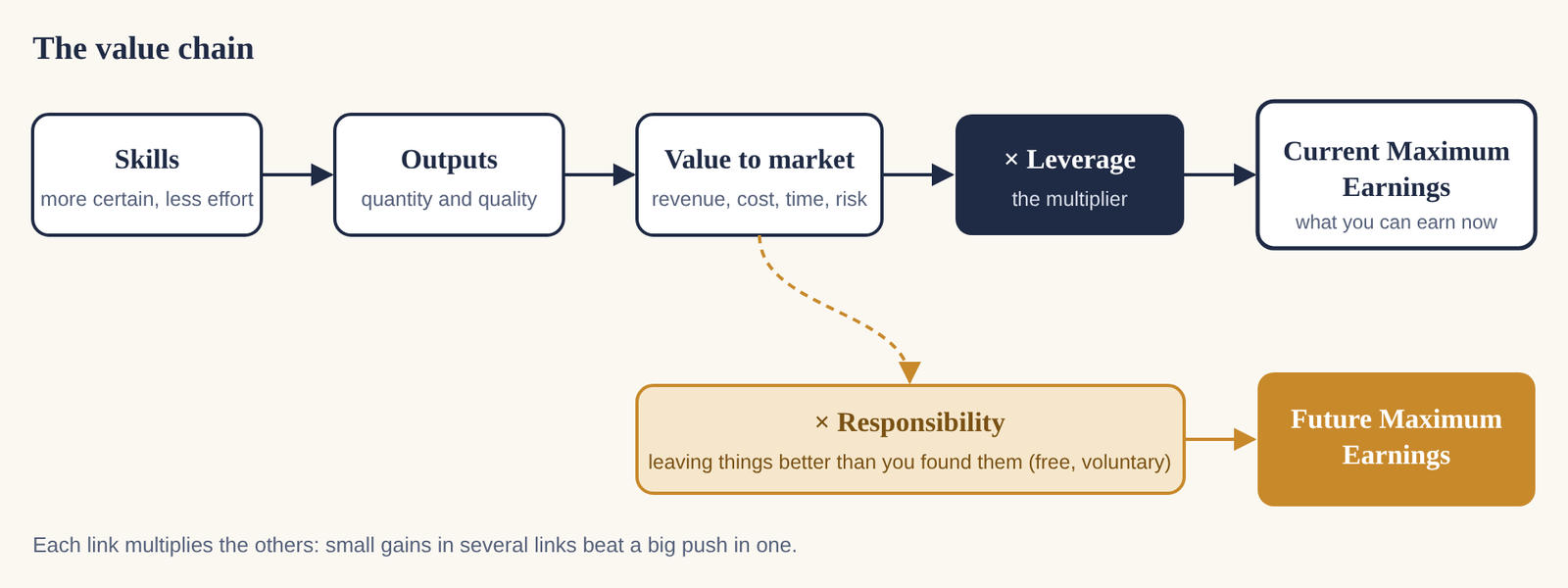
Skills: your ability to create a result you decided on in advance. A skill isn't something you know about. It's being able to bring about a particular result, reliably and on demand. When a skill improves, two things happen: you're more certain of the outcome before you start, and you get there using fewer resources (less time, effort, money or people). The spreadsheet that took you three days the first time you designed one would now take you three hours, after you've done a few and learned from the feedback, and you know it's right before you send it. Working harder is the opposite: more resources for the same (or proportionately more) result. That's why effort on its own doesn't move your pay much. And equally, skilful production of superb work won't earn you more if that work isn't giving more value to the business.
Outputs: what you actually produce. Reports, analysis, decisions, code, designs, sales calls, a reorganised team, an improved process: these are all examples of outputs. Better skills increase your outputs in two ways: quantity (more in the same time) and quality (each one is better). But not all outputs are equal. Ten mediocre presentations don't do what three excellent ones do, and eight hours on the one problem everyone's been stepping around for months usually beats twenty hours spread across small tasks. A lot of people get stuck here: they get faster and faster at producing things without asking whether those things matter.
Value: the benefit your outputs create. If you're employed, "the market" for your work is mostly your employer; if you contract, it's your client. Value tends to come in four forms: more revenue (sales won, prices improved), lower cost (waste removed, cheaper ways found), saved time (faster processes and decisions, people freed up for better work), or less risk (errors caught, problems prevented, audits passed). The gap between output and value is where a lot of careers stall. Take a monthly report. Sent to a long distribution list and filed unread, it creates very little value. Send the same report to the one person who has to make a decision, the week before they make it, with the number that matters pulled out at the top, and it might save the business a fortune. The report is the same. What changed is who saw it, when, and how clearly it pointed to a decision, and that's where skill and judgement come in.
Leverage: the multiplier on your value. Leverage decides how far the same piece of work reaches, and so how much it's worth. A fix that saves your own team an hour a week is useful. The same fix rolled out across a business of 5,000 people is worth a great deal more, and so is the person who can make that happen. Leverage comes from a few places:
- Specialism: being the person for a narrow, valuable thing.
- Seniority: your decisions get carried out by a team, with real resources behind them.
- Knowledge: you understand the systems, the business or the market in ways others don't.
- Systems: templates, tools and processes that keep working when you're not there.
- Reputation and network: people know what you're good at, and you can reach the people who decide.
Picture two analysts who reach the same conclusion. The junior one writes it up beautifully and it sits in a director's inbox for three weeks. The senior one writes a scrappier version, but she's in the room, she's trusted and she has a team, so her recommendation is acted on the next morning by twenty people. Similar skill, similar output, completely different result.
Why the links multiply. Put together, the ceiling on what you can earn right now is roughly the sum of the value your outputs produce, multiplied by your leverage. Because it's a chain, improvements multiply rather than add. Get 50% better at three links (a bit more skill, a bit more focus on the outputs that matter, a bit more leverage from a better position) and you're not 50% better off: 1.5 × 1.5 × 1.5 is about 3.4 times where you started. That's an illustration, not a law of physics, and real life is lumpier. But the shape matches what I've seen. Nobody I know tripled their hourly rate by working three times as hard. They got a bit better, aimed their work at what mattered, and made sure they worked on problems where their work counted for more. And a ceiling is only a ceiling: plenty of people create a lot of value and capture very little of it, because they anchor their price to what they were paid last time. Knowing what your work is worth is what gives you the confidence to ask for it.
And one thing that's free: responsibility. Accountability is put on you; responsibility is something you take. Documenting a process so the next person picks it up in a day, fixing the broken handover that isn't your job, helping a new starter without being asked. It rarely pays this month, but it builds trust and reputation, and that's what turns into money when the extension, the next role or the "do you know anyone who could...?" call comes up. In chain terms, it raises your future ceiling, not this month's: it's how you get trusted with bigger problems, which is where both the value and the leverage are.
A few practical ways to use the chain this month:
- Find your valuable outputs. Write down your three most important outputs and, for each, who uses it and what changes for them in revenue, cost, time or risk. If you can't say, that's the place to start.
- Improve one, not everything. Take the output closest to that value and make it better (more timely, clearer, more decision-changing) rather than producing more of everything.
- Build a bit of leverage you own. One template, checklist or small automation that saves you time every week and keeps working when you're not there.
- Take some responsibility nobody gave you. Leave one thing better than you found it, and make sure the right people can see it.
What that means for the roles you pick
Your effort only turns into earnings if the role lets it turn into value. In some jobs, the value is fixed by the process: be brilliant or be average and nobody much notices, so there's a ceiling on your pay however hard you work. In others, a great person does many times better than an average one, and that gap is where pay rises, promotions and better offers come from. So the role you're in matters just as much as how good you are.
You can see it in almost any field:
| Field | Mostly process | Some room | Lots of room |
|---|---|---|---|
| IT | Service desk analyst resetting passwords | Business analyst gathering requirements for a system change | Interim lead for a migration that's gone off the rails |
| Marketing | Scheduling social posts someone else wrote | Campaign manager owning results for a product line | Head of growth brought in to launch into a new market |
| Operations | Processing orders to a set procedure | Team leader improving a warehouse's throughput | Turnaround manager for a site that's losing money |
| HR | Processing payroll changes | HR business partner to a division | Interim lead for a merger's people integration |
In the left-hand column, doing the job brilliantly barely changes anything for the business. In the right-hand column, one person's judgement can be worth many times their pay. Same people, often the same skills, very different scope to add value.
Before you take a role, or while you're in one, ask:
- Can you increase the value of what you already produce, or add new outputs nobody does yet?
- How much better could a great person do this job than an average one?
- How easily could you be swapped for someone else after a two-day handover?
Seth Godin calls it the difference between a cog and a linchpin. A cog does a job anyone could be trained to do; a linchpin does work only they could do. If you want to be paid more, look for roles with linchpin room. The signs are usually change (a new division, a system migration, a merger), sitting between departments, and having the authority to act.
If your current role has very little room, it isn't a failure; use it as a base while you build the skills and relationships to move. And you don't have to start from scratch: the best moves are usually a bridge, a step into the field next door, where most of your skills and reputation come with you.
Permanent or contracting? The maths
A disclosure first: contracting was my route for about 15 years, so I'm biased. Here's the maths as fairly as I can do it.
The quick way to compare is to take a permanent package (salary and typical bonus, plus the employer's pension contribution) and divide by the days you'd realistically be paid as a contractor. Assume 220, and plan on fewer for your first contract. But the quick sum flatters contracting, because it ignores how you'd actually be paid. The table shows the day rate you'd need to end up as well off as in the permanent job, counting take-home pay plus pension contributions. Lower is better:
| Permanent salary (5% + 5% pension) | Quick sum (÷ 220 days) | Day rate needed inside IR35 (umbrella) | Day rate needed outside IR35 (own Ltd company) |
|---|---|---|---|
| £50,000 | £239 | £279 | £251 to £259 |
| £60,000 | £286 | £342 | £293 to £313 |
| £70,000 | £334 | £400 | £340 to £376 |
Inside IR35 you're taxed much like an employee, but the umbrella company takes employer NI, the apprenticeship levy and its own fee out of your day rate first, so you need roughly 20% more than the quick sum just to stand still. Outside IR35, through your own limited company, you need a lower day rate to match the same permanent job, because corporation tax plus dividend tax usually takes less than income tax plus both sets of NI. Put the other way round, at the same day rate outside IR35 takes home more: at £400 a day, about £58,600 against £52,500 inside. That's in line with Mike's own IR35 article, which puts the gap at 10 to 20%, and you can run your own numbers in his IR35 calculator.
The pension is where the routes really split:
- Permanent: you usually get an employer contribution, sometimes a generous one.
- Inside IR35: you'll typically get the auto-enrolment minimum, about £3,500 a year in total at most day rates, and more than half of it is your own money. Many umbrellas offer salary sacrifice if you want to pay in more.
- Outside IR35, through your own company: the company can pay into your pension directly, before corporation tax and with no dividend tax on it. At £400 a day, putting £20,000 a year into your pension that way only reduces your take-home by about £9,400. For anyone chasing FI, that's a big deal.
And the risks are real: gaps between contracts, no sick pay, no paid holiday, and an accountant's bill if you have a limited company. Have a buffer before you jump; Mike's self-employed emergency fund guide is a good place to start.
Assumptions: 2026/27 rates; 220 paid days; umbrella with a £25 a week margin, employer NI, the 0.5% apprenticeship levy and the minimum auto-enrolment pension; Ltd company paying a £12,570 salary, with £2,000 a year of costs and the rest taken as dividends. The range outside IR35 depends on whether you pay the same pension into your own company scheme. Get proper advice before deciding how to be paid.
Permanent or contracting? Beyond the maths
The day rate is the visible part. The bigger benefits, for me, were these:
- Faster rises. Because you change roles more often, you get more chances to put your rate up. It's like having a pay review every three to six months, whenever a new contract comes along, instead of waiting a year for 3%. And because each successful role leaves you with a better CV and more skills, you're well placed to ask for a better day rate each time, so the cycle turns over much faster than it does in a permanent job.
- More senior roles, sooner. Organisations will take a chance on someone for a six-month interim role that they'd never hire permanently. I've been given roles on a temporary basis that I'd never have been given as a permanent hire. You only have to show you can get the project done, without jumping through all the HR hoops, and the permanent version would probably have gone to a long-serving employee whose "turn" it was for promotion. Companies will pay for a result delivered from a position of responsibility when they know it's short term. Do it well and the step up sticks, because it's on your CV for the next one.
- Asymmetric bets. A bad contract has a natural limit: you put up with it for three or six months, learn what you can and leave. A good one might be the one that clicks. You hit it out of the park and get offered a big rise to stay, or you find your niche, or you pick up skills you can use in your own side hustle. Limited downside, open-ended upside.
- Leverage that compounds. The tool you built for one client becomes the starting point for the next. Five years of contracts can mean five years of progress rather than one year repeated five times.
- Optionality. You can follow demand: the new system everyone's adopting, the regulation coming in, the merger that needs people who've done one before. In a permanent job you're limited to what one organisation happens to need.
It isn't for everyone, and you don't have to leave your job to borrow most of it. Write your own objectives. Treat each big project like a contract with an end date. Volunteer for the change everyone else is avoiding. Know roughly what you'd be worth on the open market, even if you never act on it.
Bringing it together
Saving is super valuable: once it's invested, it's always there working for you, earning in the background. Apply the same thinking to yourself, by investing in skills that increase your earning power, and you can compound the earnings side too. The real trick to reaching FI is keeping your savings rate steady, or rising, as your pay goes up. Get more valuable, get paid for it, and bank most of the difference. But beware: spend all of the rise and your FI date can move the wrong way.
This article is for education only and is not financial advice. The figures are illustrations, not projections: investments can fall as well as rise, and you may get back less than you put in. Tax rules can change, and how you're taxed depends on your circumstances. The views are the guest author's own.
Frequently Asked Questions
Does a pay rise get you to financial independence faster?
Only if you save most of it. On £35,000, saving 25%, banking all of a £5,000 rise cuts the time to FI from about 32 years to 25.7. Spending all of it pushes it out to 34.5, because your investments will one day have to fund the higher lifestyle too.
How much of a pay rise should you save?
Every pound you bank helps twice: it adds to your pot and keeps your spending, and so your FI target, lower. In the example above, banking half the rise takes about two years off and banking all of it takes about six. If saving the lot feels too tight, half is a good rule, and paying it into a pension gets you tax relief on top.
Why does spending a pay rise push back your FI date?
Your FI target is roughly 25 times your annual spending. Spend a £3,600 take-home rise and your target goes up by about £90,000, while what you save each year stays the same, so your savings rate falls and it takes longer to get there.
What day rate matches a £60,000 salary?
On 2026/27 rates, with 5% employee and 5% employer pension contributions in the permanent job, you'd need about £342 a day inside IR35 through an umbrella company, or roughly £293 to £313 a day outside IR35 through your own limited company, assuming 220 paid days. The quick sum of salary divided by 220 (about £286) understates it.
Is contracting better than a permanent job for FIRE?
It can be, mainly outside IR35, where your company can pay into your pension before corporation tax. But you lose sick pay, holiday pay and employer pension contributions, and gaps between contracts are a real risk, so build a buffer first and run your own figures in the IR35 calculator.
About the author
Alex Fletcher-Barnes spent about 15 years contracting in finance, and ten years before that in permanent roles. When his earnings went up, with no employer pension behind him, he started reading about saving and investing and found FI. The most useful thing he learned, after the basic idea of FIRE, was that he could move his old workplace pensions, untouched for years, into a SIPP at a fraction of the fees. He writes about adding real value at work and getting paid properly for it at alexfletcherbarnes.substack.com, and is the author of 3× Your Earnings.
Sources
Prefer to watch?
We turn these money breakdowns into short videos
A few a week, plain-English UK money. If you would sooner watch than read, follow along:
Enjoying the content?
If this site has been useful, a coffee goes a long way.
Browse more articles
Browse all