





Games Workshop Share Price: How Warhammer Got So Big
Games Workshop made £17m profit in 2016 and £276m in 2026. Yet buy at the wrong moment and you were still down half within a year. The business and the share are two different bets.
Cite this article
Freedom Isn't Free (2026) Games Workshop Share Price: How Warhammer Got So Big. Available at: https://freedomisntfree.co.uk/articles/games-workshop-share-price (Accessed: 8 October 2026).
Italicise the article title in your bibliography. Accessed date set to today.
TLDR
- Games Workshop grew revenue from £118m in 2016 to £660m in 2026, and pre-tax profit from about £17m to £276m. It joined the FTSE 100 in December 2024.
- The engine is a hobby, not a toy line: a 71% gross margin on its own plastic miniatures, prices that rise every year, and customers who keep buying for years.
- The share price has not tracked the business smoothly. It roughly halved between September 2021 and September 2022, and fell about 23% from its May 2026 high.
- Over five years most of the share price gain came from earnings growth, with only a modest rise in the valuation multiple. The lesson is that a great business and a great entry price are two separate things.
Games Workshop by the numbers, 2026
Source: Games Workshop results for the 52 weeks to 31 May 2026; share price fall from 23,540p to 18,110p (close, 22 Sep 2026).
Games Workshop: five years of results
| Year to end May | Revenue | Profit before tax | Dividends declared per share |
|---|---|---|---|
| 2021 | £353.2m | £150.9m | 235p |
| 2022 | £414.8m | £156.5m | 235p |
| 2023 | £470.8m | £170.6m | 415p |
| 2025 | £617.5m | £262.8m | 520p |
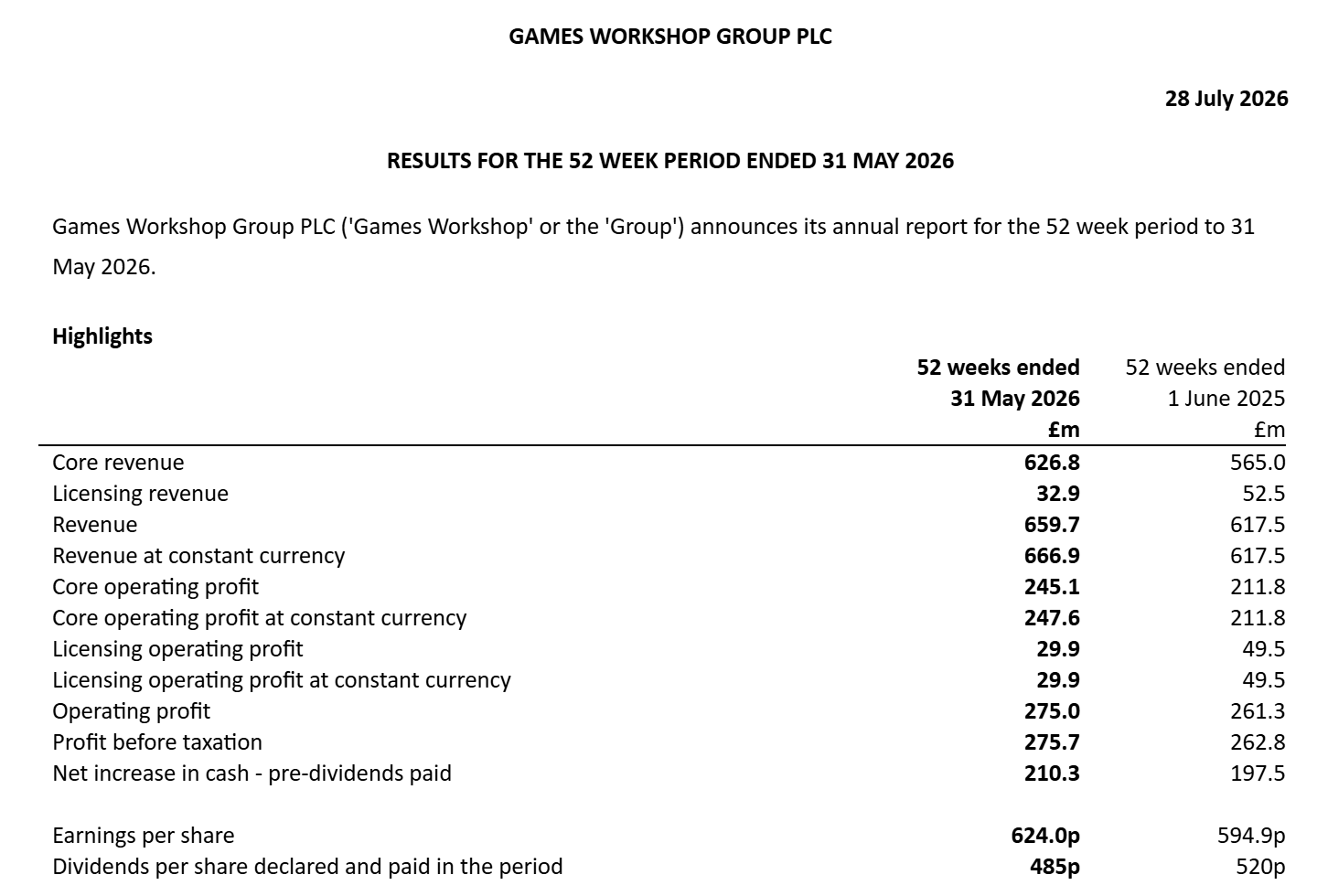
| 2026 | £659.7m | £275.7m | 485p |
Source: Games Workshop annual results announcements. The 2024 year (53 weeks) is omitted for like-for-like periods.
Games Workshop Share Price: How Warhammer Got So Big
The Games Workshop share price is usually told as a fairy tale: a Nottingham company that sells little plastic soldiers to teenagers in hoodies becomes one of the 100 biggest firms on the London Stock Exchange. The fairy tale is true. It also hides the more useful story, which is that the business and the shares have been two very different rides, and an investor who loved the first could still have lost half their money on the second.
Here are the numbers. In the year to May 2016, Games Workshop made £118.1m of revenue and £16.95m of pre-tax profit. In the year to 31 May 2026 it made £659.7m of revenue and £275.7m of pre-tax profit. That is profit up more than 16-fold in a decade. The shares, which changed hands for under £6 in late 2016, closed at 18,110p (£181.10) on 22 September 2026.
The short answer to why the Games Workshop share price is so high: the company owns a hobby with a 71% gross margin, prices that rise every year and customers who keep coming back for years, and profit has grown accordingly. The share price has still swung far harder than the profits, halving in 2022 and falling about 23% from its May 2026 peak.
This is not a tip, and nothing below is a recommendation to buy or sell the shares. It is a case study in what a moat looks like from the inside, and why owning a wonderful business at the wrong price can still hurt.
Contents
- Games Workshop share price history: the five-year ride
- How Games Workshop makes its money
- The plastic crack model: pricing power you can measure
- The Warhammer economy: businesses built on someone else's hobby
- The Amazon deal and why licensing is the cherry, not the cake
- Dividends: the surplus cash policy
- What Games Workshop teaches UK investors
- Frequently Asked Questions
Games Workshop share price history: the five-year ride
Five years ago, in autumn 2021, Games Workshop shares were coming off a lockdown boom. Locked-in hobbyists had painted their way through the pandemic, online sales surged, and the year to May 2021 produced £353.2m of revenue and £150.9m of pre-tax profit. The shares peaked at roughly 12,000p in September 2021.
Then they halved. By September 2022 the price had touched 5,891p, according to interactive investor, as growth stocks fell out of favour and freight costs and currency moves squeezed earnings. Nothing was wrong with Warhammer. The market had simply decided it was no longer willing to pay pandemic prices for it.
The recovery took about two years. A run helped by a new edition of Warhammer 40,000 in 2023 and a hit video game in 2024 pushed the company's value high enough that FTSE Russell confirmed its promotion to the FTSE 100 in the December 2024 review, effective from 23 December 2024. It was the first time the company had ever made the top index. It has stayed there since, through the September 2026 reshuffle.
The shares hit a high of 23,540p in May 2026. By 22 September 2026 they were at 18,110p, roughly 23% lower, even though the full-year results in between were records.
Games Workshop revenue and pre-tax profit (£m)
Source: Games Workshop annual results announcements, years to end of May
Look at the profit line and then think about the 2022 share price. Profit before tax went up in the year to May 2022, from £150.9m to £156.5m. The shares still halved. That gap between a business that kept growing and a share price that fell off a cliff is the whole lesson of this article in one chart.
How Games Workshop makes its money
Games Workshop designs, manufactures and sells miniatures for Warhammer 40,000, Warhammer: Age of Sigmar and a cluster of smaller games, plus the paints, rulebooks and novels that go with them. It is vertically integrated: the design studio, the injection-moulding factories and the paint factory are all in or near Nottingham. It sells three ways: through its own shops (598 of them across 24 countries at the 2026 year end), through 9,100 independent retailers in 71 countries, and online.
The company describes its strategy as "to make the best fantasy miniatures in the world, to engage and inspire our customers, and to sell our products globally at a profit". That sounds like boilerplate. It is actually unusually tight, because it rules out almost everything else a growing company gets tempted into.
The trick is that a customer is not buying a toy. They are joining a hobby. A Warhammer army is never finished: there is always another unit, another faction, a new edition of the rules that changes what is worth fielding. The models arrive as grey plastic on a frame, so before you can play you have to clip, glue and paint them, which can take longer than the game itself. That time investment is what makes people stick. Someone who has spent 200 hours painting an army is not going to wander off to a rival system because it is a tenner cheaper.
The store network is built around recruitment, not just sales. Only 133 of the 598 shops are multi-staff stores; the other 465 are small low-cost units whose real job is teaching newcomers to paint and play. Games Workshop's own annual report says the business succeeds "when more people take part in the Warhammer hobby" and that its job is "simply to find them". Once found, they spend for years.
The plastic crack model: pricing power you can measure
Hobbyists call Warhammer "plastic crack", half as a joke and half not. In finance terms, that joke is a description of pricing power: the ability to raise prices without losing customers.
You can see it in the accounts. In the year to May 2026, Games Workshop's core gross margin was 71.1%. For every £100 of miniatures sold, £71.10 was left after the direct cost of making them. Core operating profit was £245.1m on core revenue of £626.8m, a 39.1% operating margin. For comparison, plenty of good retailers are delighted with an operating margin in single digits.
Prices go up every year. The 2026 results note that "the average increase in RRPs on products this year was 3% in line with normal levels". Customers grumble, loudly, online. Then they keep buying, because the alternative is abandoning the army they have already sunk years into.
This is what Warren Buffett means by a moat: something that stops competitors taking your customers or your margin. Games Workshop's moat is really three things stacked together:
- It owns the intellectual property. You cannot make official Space Marines without a licence, and the rules only work with the models.
- It owns the factory, so the 71% margin stays in Nottingham rather than going to a contract manufacturer.
- The hobby has switching costs that are emotional rather than contractual. Nobody locks you in. You lock yourself in, one painted model at a time.
Some of it flows back to staff, too. Games Workshop pays a Group Profit Share out of surplus cash, and in 2025/26 that was a cash award of £5,000 per staff member. On a shop-floor or factory wage, five grand is real money. Fair play to them.
The Warhammer economy: businesses built on someone else's hobby
The clearest sign of how big Games Workshop has become is that other people now make a living off its customers. Massive online games do this: they spawn streamers, guide-writers and YouTubers who build whole careers on the game's audience. Warhammer has grown the same kind of ecosystem, except it sits on top of a physical hobby where people need paint, brushes, tools and somewhere to buy them.
A few examples, all real and all independent of Games Workshop:
- Painting channels. Miniac, run by Scott Walter, and the Duncan Rhodes Painting Academy each have several hundred thousand YouTube subscribers, according to third-party channel trackers. Duncan Rhodes used to be the face of Games Workshop's own painting videos on Warhammer TV. He left in 2019, built a tutorial subscription business, and then launched his own paint range, Two Thin Coats.
- Rival paint makers. The Army Painter started in Denmark in 2007 as a two-person outfit selling a single "Quickshade" dip and now runs its own production facility in Skanderborg. Barcelona-based Vallejo sells acrylics to miniature painters and scale modellers worldwide. Both sell to the same hobbyists who could otherwise be buying Games Workshop's own Citadel paints.
- Independent retailers. Essex-based Wayland Games calls itself Europe's largest independent tabletop retailer and sells Games Workshop kits at a discount to the RRP. It is one of the 9,100 independent stockists Games Workshop itself counts.
- 3D printing. A whole scene of digital sculptors now sells printable miniature files through Patreon subscriptions to hobbyists with home resin printers. It is the grey edge of the ecosystem: printing your own original designs is fine, while copying Games Workshop's sculpts infringes its intellectual property.
For an investor this cuts both ways. An ecosystem this size is proof the hobby has a gravity of its own, and every painting tutorial is free marketing that recruits the next customer. But it is also a leak. The paints, brushes and printers are where competitors can undercut Games Workshop, which is why its moat really lives in the rules, the lore and the sculpts it owns, not in the pots of paint.
If you are one of the hobbyists rather than one of the shareholders, the paint-and-tools side of the bill is where shopping around pays. PaintPicker is a price-comparison site for miniature painting: it compares prices on paints across dozens of brands, brushes and airbrushes, hobby accessories such as wet palettes and lamps, miniatures for Warhammer and other systems, and 3D printers, resin and filament, across retailers in the UK and other markets. It also has free tools like a paint matcher and paint conversion charts. It earns affiliate commission when you buy through its links.
Disclosure: we have a commercial interest in PaintPicker.
The Amazon deal and why licensing is the cherry, not the cake
The headline-grabbing part of the story is licensing. On 10 December 2024, Games Workshop announced it had concluded negotiations with Amazon to adapt the Warhammer 40,000 universe into films and television series, with associated merchandising rights. Henry Cavill, a well-known Warhammer fan, is attached as executive producer and star. In the 2026 results the company added that Amazon has brought in United Artists and horror director Mike Flanagan, while warning that "these adaptations will take years to bring successfully to market".
The video games side is already real money. Warhammer 40,000: Space Marine 2, released by Focus Entertainment and Saber Interactive in September 2024, sold millions of copies and pushed Games Workshop's licensing revenue to £52.5m in the year to May 2025. A year later licensing fell back to £32.9m, because one-off hits are, by definition, one-off.
Licensing is wonderful business while it lasts. In 2025/26 it produced £29.9m of operating profit on £32.9m of revenue, a margin above 90%, because Amazon and the games studios carry the production cost. But it is lumpy, and the company itself treats it that way. Core revenue (the miniatures) was £626.8m. Licensing was 5% of the total.
That matters for anyone thinking about the share price. If the Amazon series lands well, it is a giant recruiting advert for the hobby, and the real payoff comes when viewers walk into a shop and buy a starter set. If it flops, the core business carries on. Pricing in a hit TV show before a single episode has been filmed is how investors end up paying for a story rather than a business.
Dividends: the surplus cash policy
Games Workshop has no debt and a simple rule: it keeps a cash buffer (£120m, or three months of working capital) plus money for planned investment and staff profit share, then pays out what is left. In its own words, "we return our surplus cash to our owners and try to do so in ever increasing amounts".
| Year to end May | Dividends declared per share |
|---|---|
| 2021 | 235p |
| 2022 | 235p |
| 2023 | 415p |
| 2024 | 420p |
| 2025 | 520p |
| 2026 | 485p |
The dip in 2026 is the licensing effect again. The prior year's surplus cash had been boosted by money from licensing partners, so when that fell away, so did the payout. Total dividends paid in 2025/26 came to £160.1m.
The consequence of the policy is that Games Workshop's dividend is not a smooth progressive line like a utility's. It goes up when cash comes in and down when it does not. At 18,110p, the 485p paid in the latest year is a trailing yield of about 2.7%. If you are drawn to the share for income, the board has told you plainly that the payout tracks surplus cash rather than a promise. And outside an ISA or SIPP, dividends above the £500 dividend allowance are taxable, which the dividend tax calculator will work out for you.
What Games Workshop teaches UK investors
Here is the calculation that reframes the whole five years. In September 2021, the share price was about 9,650p at month end and the latest earnings per share were 372.7p. That is a price-to-earnings ratio of about 26. On 22 September 2026 the price was 18,110p against 2026 earnings per share of 624.0p. That is a P/E of about 29.
So over five years, the shares rose about 88% and earnings per share rose about 67%. Most of Games Workshop's five-year shareholder return was its earnings growth plus the dividends; the market warming to it (a multiple moving from about 26 to about 29) added only a modest top-up. If you want the "years to pay for itself" reading of P/E, you were paying about 26 years of current earnings in 2021 and about 29 years now.
Now look at the same five years from three different entry points, ignoring dividends:
| You put £1,000 in at | Price paid | Worth at 18,110p (22 Sep 2026) |
|---|---|---|
| The September 2021 peak | about 12,000p | about £1,509 |
| The September 2022 low | 5,891p | about £3,074 |
| The May 2026 high | 23,540p | about £769 |
Same company. Same Nottingham factory. Same plastic Space Marines. The outcome ranges from losing nearly a quarter to more than tripling your money, purely on when you bought. Past performance is not a guide to future returns, and these figures ignore dividends and dealing costs. At the 2022 low, the shares were priced at about 15 times the 391.3p of earnings per share the company had just reported for 2021/22. At the 2026 high, it was close to 40 times. The business barely changed character between those two dates. The mood did.
Three lessons fall out of that table.
A moat protects the business, not your entry price. Games Workshop's 71% gross margin did nothing to stop the shares halving in 2022. Pricing power shows up in the profit and loss account, never as a floor under the share price.
Chasing a stock after a huge run is paying for the run. The investor who bought at 23,540p in May 2026 was buying a share that had already risen roughly fourfold from its 2022 low, at close to 40 times the previous year's earnings, after it had made the newspapers. That is exactly the point at which the most good news is already in the price. It is the same pattern the 100-bagger research keeps finding: the winners are bought at a reasonable multiple, not at the top of the hype.
Single stocks are a bumpier ride than the index they sit in. If you hold a FTSE 100 or global tracker in a Stocks and Shares ISA, you have owned a sliver of Games Workshop since December 2024 without having to sit through a 50% drawdown with your own name on it. That is the trade-off of passive investing: you give up the chance of picking the next Games Workshop in exchange for never betting the house on one.
If you want to go further with single-stock analysis, start with how to value a stock, then write your investment thesis before you buy anything, so you know in advance what would make you sell. Individual shares can fall as well as rise, and you can get back less than you put in.
Frequently Asked Questions
Why is the Games Workshop share price so high?
Because the business has grown very fast and is unusually profitable. Pre-tax profit rose from £16.95m in the year to May 2016 to £275.7m in the year to May 2026, on a core gross margin of 71.1%. Investors have also been willing to pay a premium multiple for that growth, anywhere from about 15 times earnings at the 2022 low to close to 40 times at the May 2026 high, which is why the price swings so hard when expectations cool.
Does Games Workshop pay dividends?
Yes. It pays out its surplus cash after setting aside a £120m buffer and money for investment and staff profit share. Dividends declared and paid in the year to 31 May 2026 were 485p per share, down from 520p the year before because licensing income fell back after the Space Marine 2 video game year.
Why are Games Workshop shares falling?
The shares were about 23% below their May 2026 high of 23,540p by late September 2026, even after record full-year results. The 2026 results showed licensing income dropping from £52.5m to £32.9m and the dividend dipping, and at close to 40 times earnings at the peak the shares had little room for anything short of perfection. Share prices move on expectations, not just results.
When did Games Workshop join the FTSE 100?
Games Workshop was promoted to the FTSE 100 in FTSE Russell's December 2024 quarterly review, with the change taking effect from the start of trading on 23 December 2024. It was the first time the company had been in the index, and it remained a member after the September 2026 review.
What is the Games Workshop Amazon deal?
On 10 December 2024 Games Workshop agreed terms with Amazon to adapt Warhammer 40,000 into films and television series, with merchandising rights. Henry Cavill is attached as executive producer and star, and the 2026 results said United Artists and Mike Flanagan have joined. The company has said the adaptations will take years to reach the screen.
This article is general information and analysis, not personal financial advice or a recommendation to buy, sell or hold Games Workshop shares or any other investment. Capital at risk: the value of shares can fall as well as rise and you may get back less than you put in. Past performance is not a guide to future returns. Tax rules, including the dividend allowance, can change. Share prices quoted are closing prices on the dates stated.
Further Reading:
Common Stocks and Uncommon Profits - Philip Fisher - Fisher's checklist for spotting a business with lasting pricing power and loyal customers reads like a description of Games Workshop, decades before Warhammer existed. (Affiliate link - we may earn a small commission at no extra cost to you.)
The Psychology of Money - Morgan Housel - The best short book on why a great business can still be a painful holding, and why the entry price and your own behaviour matter as much as the company. (Affiliate link - we may earn a small commission at no extra cost to you.)
Sources
- Games Workshop - Results for the 52 week period ended 31 May 2026
- Games Workshop - Results for the 52 weeks to 31 May 2026 (FCA National Storage Mechanism)
- Games Workshop - Annual report announcement, year to 30 May 2021 (FCA National Storage Mechanism)
- Games Workshop - Annual report announcement, year to 28 May 2023 (FCA National Storage Mechanism)
- Games Workshop - Annual report announcement, 53 weeks to 2 June 2024
- Games Workshop - Annual report press announcement, year to 29 May 2016
- LSEG / FTSE Russell - FTSE UK Index Series review, December 2024
- Games Workshop investor relations
- interactive investor - Games Workshop share slump, September 2022
- Yahoo Finance - GAW.L historical share prices
- AJ Bell - Games Workshop full-year results reaction, July 2026
Prefer to watch?
We turn these money breakdowns into short videos
A few a week, plain-English UK money. If you would sooner watch than read, follow along:
Enjoying the content?
If this site has been useful, a coffee goes a long way.
Browse more articles
Browse all