


Are IPOs a Good Investment? Follow the Sellers
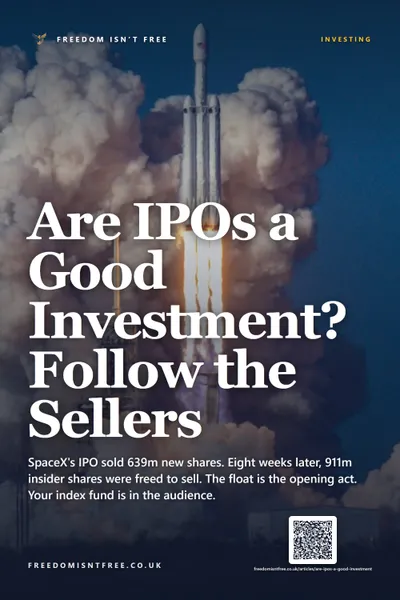
SpaceX's IPO sold 639m new shares. Eight weeks later, 911m insider shares were freed to sell. The float is the opening act. Your index fund is in the audience.
Cite this article
Freedom Isn't Free (2026) Are IPOs a Good Investment? Follow the Sellers. Available at: https://freedomisntfree.co.uk/articles/are-ipos-a-good-investment (Accessed: 8 October 2026).
Italicise the article title in your bibliography. Accessed date set to today.
TLDR
- US companies now go public at a median age of 12 years, against 5 at the height of the dotcom boom, so much of the early growth is captured by private investors before ordinary savers can buy in.
- Since 2011, 70% of US IPOs have been loss-making at listing, and the average IPO has trailed the wider market by 20.5 percentage points over its first three years, according to Jay Ritter of the University of Florida.
- SpaceX raised $86bn of genuinely new money, but its float was under 5% of the company and the first lock-up release alone freed more shares than the whole IPO sold. The exit comes after the listing, not in it.
- If you own a global tracker in a pension or ISA, you already own SpaceX: FTSE All-World added it on 22 June 2026, ten days after it listed. A potential Anthropic listing, if it happens, would likely follow the same route.
Share of US IPOs that were loss-making at listing
Percentage of US IPOs with negative trailing 12-month earnings per share. Source: Jay Ritter, University of Florida, IPO Statistics (Table 9).
Who got the money? Three big IPOs
| IPO | Shares sold by the company | Shares sold by existing holders |
|---|---|---|
| Arm (Sept 2023) | 0% | 100% (SoftBank) |
| Figma (July 2025) | 34% | 66% |
| SpaceX (June 2026) | 100% | 0% in the IPO, then 911.5m shares freed by lock-up in August |
Sources: Arm and SpaceX final prospectuses (SEC 424B4 filings); Figma IPO pricing announcement, 30 July 2025.
Are IPOs a Good Investment? Follow the Sellers
Are IPOs a good investment? The pitch says yes: a listing is your chance to get in early on the next great company. The data says the opposite. By the time a modern company floats, it is usually more than a decade old, most likely still losing money, and owned by people who have been waiting years for a liquid market to sell into. An IPO used to be how a young company raised money to grow. Today it is just as often how the people who already own it get paid.
That does not make every listing a stitch-up. SpaceX, the biggest IPO in history, raised every cent of its $86bn for the company itself. But even there, the way the shares were released, and the way index funds were lined up to buy them, shows who stands to gain most from a modern listing. And with Anthropic reported to be preparing its own listing, the question matters for anyone with a pension.
Contents
- Why companies go public later than they used to
- Are IPOs a good investment? What the data says
- Primary vs secondary shares: who gets your money
- The SpaceX IPO: new money, tiny float, staggered exit
- The Anthropic IPO: what has actually been reported
- What this means for UK investors
- Frequently Asked Questions
Why companies go public later than they used to
The best long-run record of US listings is kept by Jay Ritter, a finance professor at the University of Florida who has tracked every meaningful US IPO since 1980. His numbers show how much the timing has shifted.
| Period | Median age at IPO (all US IPOs) | Median age at IPO (tech) |
|---|---|---|
| 1999 | 5 years | 4 years |
| 2000 | 6 years | 5 years |
| 2021 | 11 years | 12 years |
| 2024 | 14 years | 13 years |
| 2025 | 12 years | 12 years |
Source: Jay Ritter, Age of companies going public, Tables 4 and 4a (data to 2025).
A dotcom-era tech company listed at four. Its 2025 equivalent listed at twelve. Those eight extra years are where a lot of the fastest growth happens, and they now happen in private, where you cannot invest.
Three things let companies wait. The first is the sheer volume of late-stage private money: PitchBook counted 945 US unicorns (private companies valued at $1bn or more) at the end of June 2026, worth a combined $5.3tn. The second is secondary sales, where existing shareholders sell their stakes privately to new investors. PitchBook estimates US venture-backed secondary deals reached about $106bn in 2025, including fund-led transactions. The third is the tender offer, where a company organises a buyer for its staff's shares so employees can cash some in without a listing. OpenAI's $6.6bn employee sale in October 2025 was a tender of exactly this kind.
Put those together and the old reason to list, needing the public's money to grow, has weakened. A private company can raise tens of billions and let its staff sell without ever filing a prospectus. When it finally does list, the founders and backers want something the private market cannot easily give them: an exit for billions of dollars of stock, at a price set by a deep public market, with index funds obliged to turn up as buyers.
Are IPOs a good investment? What the data says
Ritter's figures are not kind to the buyer who arrives on day one.
- Most listings lose money. Between 2011 and 2025, 70% of US IPOs had negative earnings in the 12 months before they listed. In the 1980s it was 19%. The only period that looks worse is 1999-2000, at 78%.
- The first day goes to whoever got an allocation. The average first-day pop across 1980-2025 is 19%. That jump goes to investors allocated shares at the offer price, usually large institutions, not to the retail investor who buys at the open.
- The years after are worse. Across 9,253 IPOs from 1980 to 2024, the average three-year return from the first closing price was 19.1%. That sounds fine until you compare it with the market over the same three years: IPOs trailed it by 20.5 percentage points. For loss-making IPOs the gap was 30.7 points.
Here is that average gap in pounds. Put £10,000 into the typical IPO at its first-day close and, on Ritter's averages, you have about £11,910 three years later. Put the same £10,000 into the whole US market on the same day and you have about £13,960. Same risk appetite, same timing, £2,050 worse off for picking the shiny new thing. (These are averages across thousands of deals, so individual IPOs vary wildly, and past performance is not a guide to the future.)
There is an obvious reason this keeps happening. The seller of an IPO chooses when to sell. Insiders know the business better than anyone, and they tend to list when conditions flatter the price. As a buyer, you are trading against the most informed person in the market at the moment of their choosing. That is the same logic behind most speculative bubbles.
Primary vs secondary shares: who gets your money
Every IPO prospectus tells you who receives your cash, and it is the most useful page few people read.
- Primary shares are new shares created by the company. Your money goes into the business to fund growth.
- Secondary shares are existing shares sold by current owners: founders, venture capital funds, early employees, a parent company. Your money goes straight to them. The company gets nothing.
Ritter does not publish an industry-wide figure for the secondary share, so the clearest evidence comes from the deals themselves:
- When Arm listed in New York in September 2023, the prospectus said plainly: "We are not selling any of the ADSs in this offering and will not receive any proceeds." All 95.5 million shares came from SoftBank, which kept about 90% of the company.
- When Figma priced in July 2025, it offered 36.9 million shares. Just 12.5 million were new. The other 24.5 million, about 66%, were sold by existing shareholders.
- When SpaceX listed in June 2026, it went the other way: 100% primary. More on that below, because it is the exception that proves the point.
The secondary portion is only half the story anyway. The bigger insider sale usually comes later, when the lock-up period ends. That is the window, often 180 days, during which pre-IPO shareholders agree not to sell. When it expires, a wave of stock that was never part of the IPO is suddenly free to hit the market.
The SpaceX IPO: new money, tiny float, staggered exit
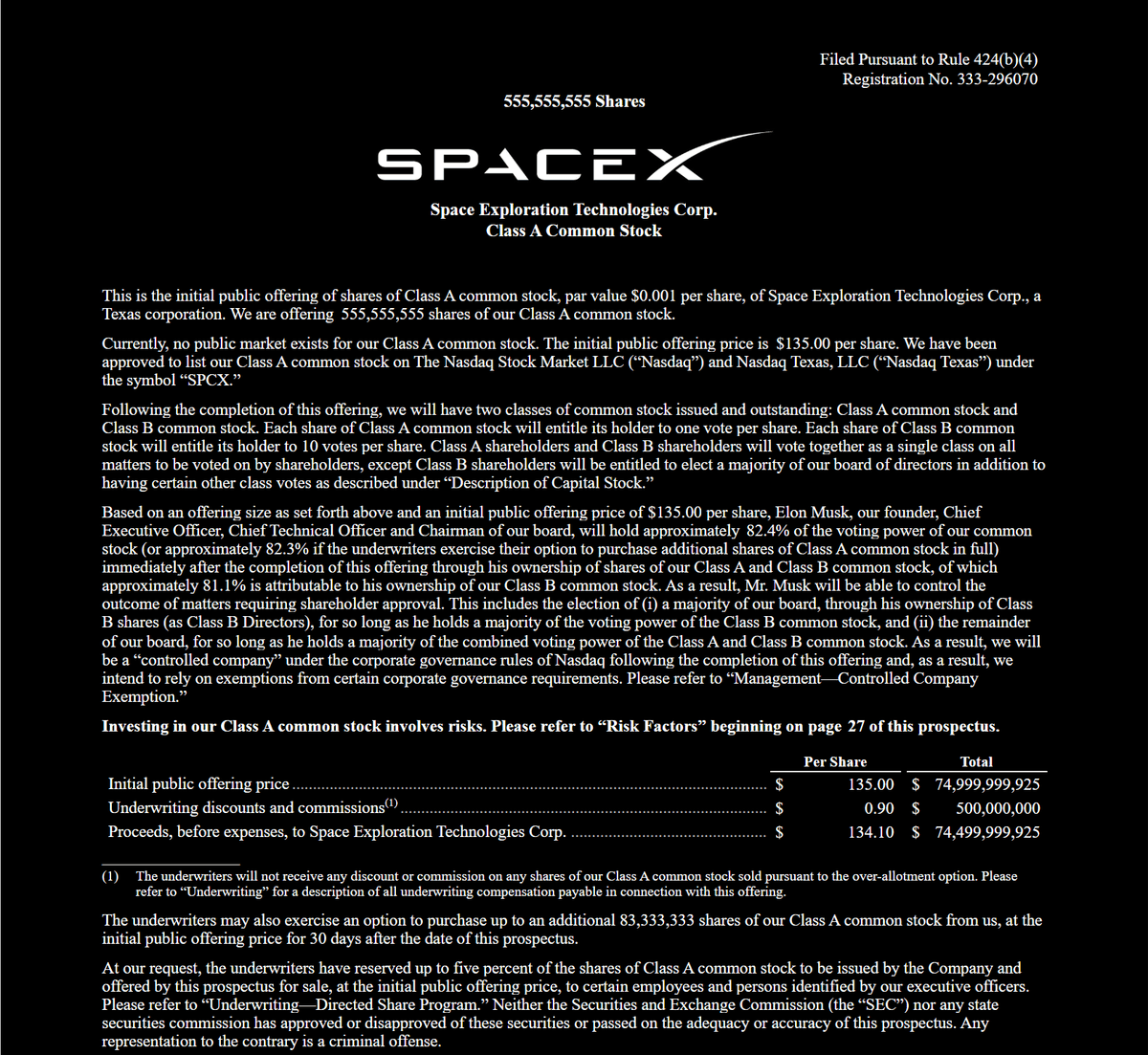
SpaceX's final prospectus, filed with the SEC on 12 June 2026, sets out the facts. It sold 555.6 million new Class A shares at $135 on Nasdaq under the ticker SPCX, and the underwriters later bought another 83.3 million under their over-allotment option, also from the company. That is 638.9 million shares and $86.25bn of gross proceeds, all going to SpaceX, with net proceeds of $85.7bn earmarked largely for AI computing capacity and launch infrastructure. At the offer price the company was worth roughly $1.77tn on our maths from the prospectus share count.
So far, so old-fashioned. Here is what makes it a modern IPO:
The float was tiny. New investors ended up owning about 4.9% of the company. Elon Musk held about 82.4% of the votes through Class B shares carrying ten votes each, making SpaceX a "controlled company" that does not need a majority of independent directors.
The early insiders had already been paid. In December 2025, according to Bloomberg Law, SpaceX's finance chief told shareholders that buyers including the company would purchase up to $2.56bn of stock from eligible holders at $421 a share, valuing SpaceX at about $800bn. After the 5-for-1 split in May 2026, that is $84.20 a share. Six months later the public paid $135, 60% more.
The lock-up was a timetable for selling. Musk is locked in for 366 days. Most other pre-IPO holders were not. The prospectus allowed up to 911.5 million shares to be released two trading days after the first earnings report, which came on 4 August 2026, followed by roughly 7% tranches through September and October, another 28% after the third-quarter results and the rest on 8 December 2026. That first release on 6 August was about 1.4 times the number of shares sold in the entire IPO. At the roughly $108 the shares closed at the day before, according to Yahoo Finance, that block was worth around $100bn.
Insider sales have started to show up in SEC filings. SpaceX president Gwynne Shotwell reported selling 342,170 shares on 22 September 2026 for about $52m, after exercising options.
The index funds were the guaranteed buyers. Nasdaq rewrote its Nasdaq-100 rules, effective 1 May 2026, to allow very large IPOs in after 15 trading days, and SpaceX joined on 7 July. FTSE Russell confirmed SpaceX for the FTSE All-World and FTSE World indices effective 22 June 2026, ten days after it started trading. S&P Dow Jones Indices was the exception: in June it kept its rules requiring 12 months of trading and a record of profits, so SpaceX is not yet in the S&P 500. (We covered the index rule changes in more depth in how the SpaceX IPO could hit your pension.)
The share price has been a ride. SpaceX closed its first day at $160.95, up 19%. It peaked at $225.64, then closed at $108.27 on 5 August, the day before the first lock-up release, according to Yahoo Finance. In early October it was trading somewhere around $168 to $172, depending on the data source. If you bought at the first close and held, you are up a few per cent. If you bought at the June peak, you are down by about a quarter.
The SpaceX deal is the strongest counter-argument to this article's thesis, and it deserves stating fairly: a company raised $86bn of real money to build real things. But it also shows the new shape of the exit. The insiders did not need to sell in the IPO. They needed the IPO to create a deep, index-backed market they could sell into over the following year and more.
The Anthropic IPO: what has actually been reported
Anthropic, the AI company that makes the Claude models, is the next name in the queue. Here is what is confirmed and what is reported, kept separate.
Confirmed by Anthropic:
- It raised $65bn in a Series H round at a $965bn post-money valuation in May 2026, up from $183bn in September 2025 and $380bn in February 2026.
- It said its revenue run-rate passed $47bn in May 2026.
- On 1 June 2026 it confidentially submitted a draft registration statement (a draft S-1) to the SEC. Anthropic said this "gives us the option to go public" once the SEC's review is complete, and that the number of shares and the price have not been set.
- It is a Delaware public benefit corporation, and a body called the Long-Term Benefit Trust holds a special class of shares that lets it elect a growing share of the board.
Reported, not confirmed:
- In December 2025 the FT reported that Anthropic had hired the law firm Wilson Sonsini to prepare for a possible listing. A spokesperson told Reuters at the time that the company "has not decided when or even if it will go public".
- In February 2026 Bloomberg reported an employee tender offer of up to $6bn at a $350bn valuation. PitchBook later reported that the tender closed below the amount investors had lined up because many staff chose to hold their shares ahead of a listing.
- Reuters and Bloomberg have reported that Morgan Stanley and Goldman Sachs are among the lead banks. On timing they disagree: Reuters reported in September a launch from mid-October, while Bloomberg reported on 1 October that a listing could come as early as mid-November, at a valuation of up to $2tn.
- Reuters, which said it had seen a draft prospectus, reported in late September that the seven co-founders would control 50.1% of the vote on key matters through a single founder share, with the Long-Term Benefit Trust electing four of seven directors.
Speculation: how much of any Anthropic offering would be new shares and how much would be sold by existing holders, how big the float would be, the lock-up terms and which index providers would fast-track it are all unknown. None of it is public, and anyone quoting numbers is guessing.
What can be said is that the same questions apply to Anthropic as to any other company. A $965bn private valuation means the early growth has already been captured privately, by venture funds, strategic investors and staff. A listing at up to $2tn, if the reports are right, would ask public buyers to pay roughly twice what private investors paid in the Series H round five months earlier. If the reported founder-share and trust arrangements go ahead, public shareholders would have limited say over the board, much as SpaceX's Class B shares limit theirs, whatever the merits of the stated public-benefit purpose. And if the listing is large enough, global index funds would buy it under the same fast-entry rules that brought in SpaceX. Read the prospectus when it is public, starting with the use of proceeds and the lock-up section.
What this means for UK investors
You already own these companies, whether you meant to or not. If your workplace pension or ISA holds a global tracker, it follows the index. FTSE All-World added SpaceX on 22 June 2026. You did not get a vote on the price, and the fund did not get one either. That is the deal with passive investing, and for most people it is still the right deal: SpaceX's investable value was about $84.9bn when FTSE Russell assessed it, a small slice of a global index worth trillions.
Buying at the IPO is now possible, but that does not make it wise. SpaceX was the first international IPO offered to UK retail investors through the new Public Offer Platform rules, with shares allocated through Hargreaves Lansdown, interactive investor and AJ Bell. AJ Bell said it received more than five times the applications of any IPO on its platform in ten years, with about half the orders placed in ISAs and a third in SIPPs. Ritter's numbers say the average buyer at the first close would have been better off with the index.
The UK is chasing the same model. The FCA's new UK Listing Rules, in force since 29 July 2024, created a single listing category and made it easier for founders to keep enhanced voting rights after listing. EY counted 23 London IPOs in 2025, raising £2.1bn, up from 18 raising £777.7m in 2024. PISCES, the new private-company trading venue, lets employees and professional investors trade private shares between listings, but ordinary retail investors are excluded. Each reform makes it easier for companies to stay private for longer or to list on founder-friendly terms. I think that is the wrong way round. The case for public markets was always that ordinary savers got to own a share of growth, and every year a company stays private is a year that growth goes to someone else.
Pension money is being steered into private markets too. Under the Mansion House Accord, 17 large UK pension providers have said they aim to put at least 10% of their default funds into private markets by 2030. That gives savers some access to pre-IPO growth, but at private-market fees, with valuations that are only marked occasionally, and in assets that are hard to sell.
The practical takeaway is plain. Treat an IPO as a sale by people who know more than you do, read who is selling and when the lock-ups end, and remember that a low-cost global index fund gets you most big listings anyway, at a fraction of the weight and without the first-day excitement. For a refresher on why fast-rising prices so often unwind, see what is speculation and our guide to surviving a market crash.
Frequently Asked Questions
Is it worth investing in IPOs?
On average, no. Jay Ritter's data on 9,253 US IPOs from 1980 to 2024 shows the average IPO trailed the overall market by 20.5 percentage points over its first three years, measured from the first-day closing price. Some IPOs do brilliantly, but you are betting on picking those few against sellers who know the company better than you do.
What are the disadvantages of buying an IPO?
You are buying from sellers who know the business best and chose the timing. Most recent US IPOs were loss-making at listing, the first-day jump usually goes to investors allocated shares at the offer price, the float is often small, and lock-up expiries can release large amounts of insider stock in the months that follow.
Do IPOs usually go up?
On the first day, usually yes: the average first-day return for US IPOs from 1980 to 2025 was 19%. But that gain mostly goes to investors who were allocated shares at the offer price. Over the following three years, the average IPO has underperformed the wider market.
Is it better to buy an IPO or wait?
The data favours waiting. A large share of insider stock is locked up for months after a listing, and the end of a lock-up can bring a wave of selling. SpaceX closed its first day at $160.95 but fell to $108.27 on the day before its first lock-up release in August 2026. Waiting also gives you a few quarters of public results to judge the business on.
What does Warren Buffett say about IPOs?
Buffett has long avoided them. In a May 2019 CNBC interview about the Uber listing, he said he did not think Berkshire Hathaway had bought a new issue in 54 years, reasoning that a single new issue, sold with high commissions and plenty of excitement, is rarely the best use of money. Berkshire did make an exception in 2020 by buying into Snowflake's IPO.
What is a lock-up period?
It is an agreement that stops pre-IPO shareholders, such as founders, employees and venture investors, from selling for a set time after the listing, often 180 days. SpaceX used a staggered version: Musk is locked in for 366 days, while up to 911.5 million other shares became free to sell two trading days after its first earnings report.
Can UK investors buy shares in a US IPO?
Usually only once the shares start trading, through a platform that offers US stocks. SpaceX was an exception: UK retail investors could apply for shares at the offer price through the new Public Offer Platform regime, via platforms including Hargreaves Lansdown, interactive investor and AJ Bell. If you hold a global index fund, you will usually end up owning very large IPOs anyway once the index adds them.
This article is general information and education, not personal financial advice or a recommendation to buy, sell or hold any share, including SpaceX or a future Anthropic listing. Capital at risk: the value of investments can fall as well as rise and you may get back less than you put in. Past performance is not a guide to future returns. Reported details about companies that have not yet published a prospectus may change. Tax rules can change.
Further Reading:
Devil Take the Hindmost - Edward Chancellor - Four centuries of new issues sold to an excited public, from the South Sea Company to the dotcom flotations. The cast changes; the seller-knows-best pattern does not. (Affiliate link - we may earn a small commission at no extra cost to you.)
The Little Book of Common Sense Investing - John Bogle - Bogle's case for owning the whole market instead of chasing the hot new name is the best antidote to IPO fever. (Affiliate link - we may earn a small commission at no extra cost to you.)
Sources
- Jay Ritter - IPO Statistics (University of Florida)
- Jay Ritter - Age of companies going public
- Jay Ritter - Long-run returns on IPOs
- SpaceX final prospectus (424B4), SEC EDGAR, 12 June 2026
- SpaceX quarterly report (10-Q), SEC EDGAR, 4 August 2026
- Arm Holdings final prospectus (424B4), SEC EDGAR, September 2023
- Figma - IPO pricing announcement, 30 July 2025
- FTSE Russell - IPO fast entry FAQ (SpaceX treatment), June 2026
- PitchBook - 2025 Annual US VC Secondary Market Watch
- Anthropic - Series H announcement, May 2026
- Anthropic - Confidential draft S-1 submission, June 2026
- Anthropic - The Long-Term Benefit Trust
- FCA - New UK Listing Rules, July 2024
- EY UK IPO Eye - Q4 2025
Prefer to watch?
We turn these money breakdowns into short videos
A few a week, plain-English UK money. If you would sooner watch than read, follow along:
Enjoying the content?
If this site has been useful, a coffee goes a long way.
Browse more articles
Browse all