






When Will Fuel Prices Go Down? Watch the Spread
Diesel is 181p a litre. 52.95p is duty, another 30p is VAT, and one slice is the bit the retailer chooses. That slice has more than doubled since 2019.
Cite this article
Freedom Isn't Free (2026) When Will Fuel Prices Go Down? Watch the Spread. Available at: https://freedomisntfree.co.uk/articles/when-will-fuel-prices-go-down-uk (Accessed: 21 September 2026).
Italicise the article title in your bibliography. Accessed date set to today.
TLDR
- Nobody can tell you when fuel prices will go down, and every page that gives you a date is guessing at the oil price.
- Just under half of a 161p litre of petrol is tax: 52.95p of duty plus 26.85p of VAT. Only the retail spread is set by the retailer.
- That spread ran at 13.9p on petrol and 14.6p on diesel in the year to September 2025, against averages of 6.5p and 8.6p from 2015 to 2019. The CMA found operating costs do not explain it.
- Fuel Finder went live in 2026 and forces every forecourt to report price changes within 30 minutes. The CMA reckons it is worth up to £4.50 a fill-up.
What you actually pay for in a litre of petrol
| Component | Pence per litre |
|---|---|
| Fuel duty (fixed by the Chancellor) | 52.95p |
| VAT at 20% (charged on top of the duty) | 26.85p |
| Wholesale fuel, biofuel and delivery | roughly 67p |
| Retail spread (the retailer decides this) | roughly 14p |
| Pump price, week commencing 17 Aug 2026 | 161.12p |
Tax is 79.80p of a 161.12p litre, just under half. The retail spread is the only line on this table any retailer chooses.
When Will Fuel Prices Go Down? Watch the Spread
Every answer you will find to when will fuel prices go down is a guess about the oil price dressed up as a forecast. Crude will ease in the autumn, the analysts say, so the pumps will follow. Sometimes that turns out to be right. It is still the wrong question, because most of what you hand over at the till was never the oil price in the first place, and the one slice that genuinely is up for grabs is the slice nobody quotes at you.
In the week commencing 17 August 2026, the average UK pump price was 161.12p a litre for petrol and 181.38p for diesel, according to the weekly road fuel prices the Department for Energy Security and Net Zero publishes every Tuesday. Five weeks earlier it was 150.53p and 164.52p. So the honest answer to the question, right now, is that they are not going down, they are going up, and anyone naming you a month is making it up. The useful question is a different one: which part of that 161p can actually fall, and what has to happen before it does.
The short version: nobody can give you a date. Just under half your pump price is fuel duty and VAT, and those only move at a Budget. The wholesale portion follows global oil markets. The one part with room to fall is the retail spread, and it has been running at double its historic level since 2019.
Contents
- Your pump price is four prices, not one
- Rockets and feathers: what the regulator actually found
- The number to watch is the retail spread
- Why diesel drivers get it worst
- What changed in 2026
- What you can actually do about it
- Frequently Asked Questions
Your pump price is four prices, not one
Break that 161.12p litre of petrol apart and it stops being a price and starts being a stack.
Fuel duty is 52.95p, set by the Chancellor, frozen since the March 2022 cut and identical on petrol and diesel. VAT is 20%, and because it is charged on the post-duty price you are paying tax on the tax: 26.85p of that litre. Together that is 79.80p, just under half of what you hand over, and none of it belongs to the forecourt.
Then comes the wholesale cost, which is the refined fuel itself plus the biofuel blended into it and the cost of getting it to the station. That tracks crude oil, sterling, and refinery margins, and it moves for reasons no British retailer controls. It is also the link in the chain that carries oil prices through into inflation and eventually your mortgage rate.
Which leaves the retail spread. This is what is left over once you subtract duty, VAT and the wholesale cost from the pump price, and it is the only line in the stack a retailer decides. On petrol it is running at roughly 14p.
So when you ask when fuel prices will go down, you are really asking one of two questions. Either "when will crude oil fall", which nobody knows, or "when will the retail spread go back to normal", which is a question with an actual paper trail. That second one is the interesting one, and it is the one almost nobody puts in front of you.
UK average pump prices, 25 May to 17 August 2026
Source: DESNZ Weekly road fuel prices, week commencing 17 August 2026
Rockets and feathers: what the regulator actually found
There is a name for the thing every driver swears is happening. Economists call it rockets and feathers: prices that shoot up like a rocket when costs rise and drift down like a feather when they fall.
For years the official line was that it was not real. The Office of Fair Trading looked at the UK fuel market in 2013 and reported that its analysis "found very limited evidence of rocket and feather pricing". Better than that, in the handful of local areas where it did find any asymmetry at all, the OFT noted the pattern was "consistent with prices that 'feather' up and 'rocket' down". The opposite of the complaint. Millions of people were told, in effect, that they were imagining it.
Then the Competition and Markets Authority looked again. Its 2023 road fuel market study concluded there was "clear evidence in the data of rocket and feather pricing for diesel in 2023", and went further on the motive: the evidence from retailers suggested this "may have been used as a strategy to increase margin in a manner that is less visible to consumers than increasing prices".
Read that twice. The regulator has put the slow drift down as a strategy, a quieter way of taking more than a price rise would have been.
One more finding from that study deserves to be better known. The CMA recorded significant drops in the price of fuel after each of its interim reports, which it said indicated "there was room for retailers to reduce prices". Being watched moved the price. Hold onto that, because it is the whole argument for what changed this year.
A word of caution on reading the chart above, though. Diesel fell 20.30p over six weeks to early July and then climbed 17.20p in five, which is close to the same speed in both directions. Petrol dropped about 1.50p a week on the way down and rose about 2.47p a week on the way back up. That looks like the pattern, and it might be. But you cannot diagnose rockets and feathers from a single episode without knowing what the wholesale price did underneath it, which is exactly why the regulator's econometrics matter more than your gut at the pump.
The number to watch is the retail spread
Here is the figure that answers the question properly. In the year to September 2025 the CMA measured the retail spread at 13.9p a litre on petrol and 14.6p on diesel. The averages for 2015 to 2019 were 6.5p and 8.6p.
More than double on petrol. Not for a month, not during a crisis. As the standing rate.
The obvious defence is costs. Wages went up, energy went up, running a forecourt got more expensive. The CMA tested it, looked at operating profit margins for large fuel retailers from 2020 to June 2025, and found they were increasing. Its conclusion in December 2025 was blunt: "Fuel margins remain at persistently high levels, and our new analysis shows operating costs do not explain this. This indicates competition in the sector is weak."
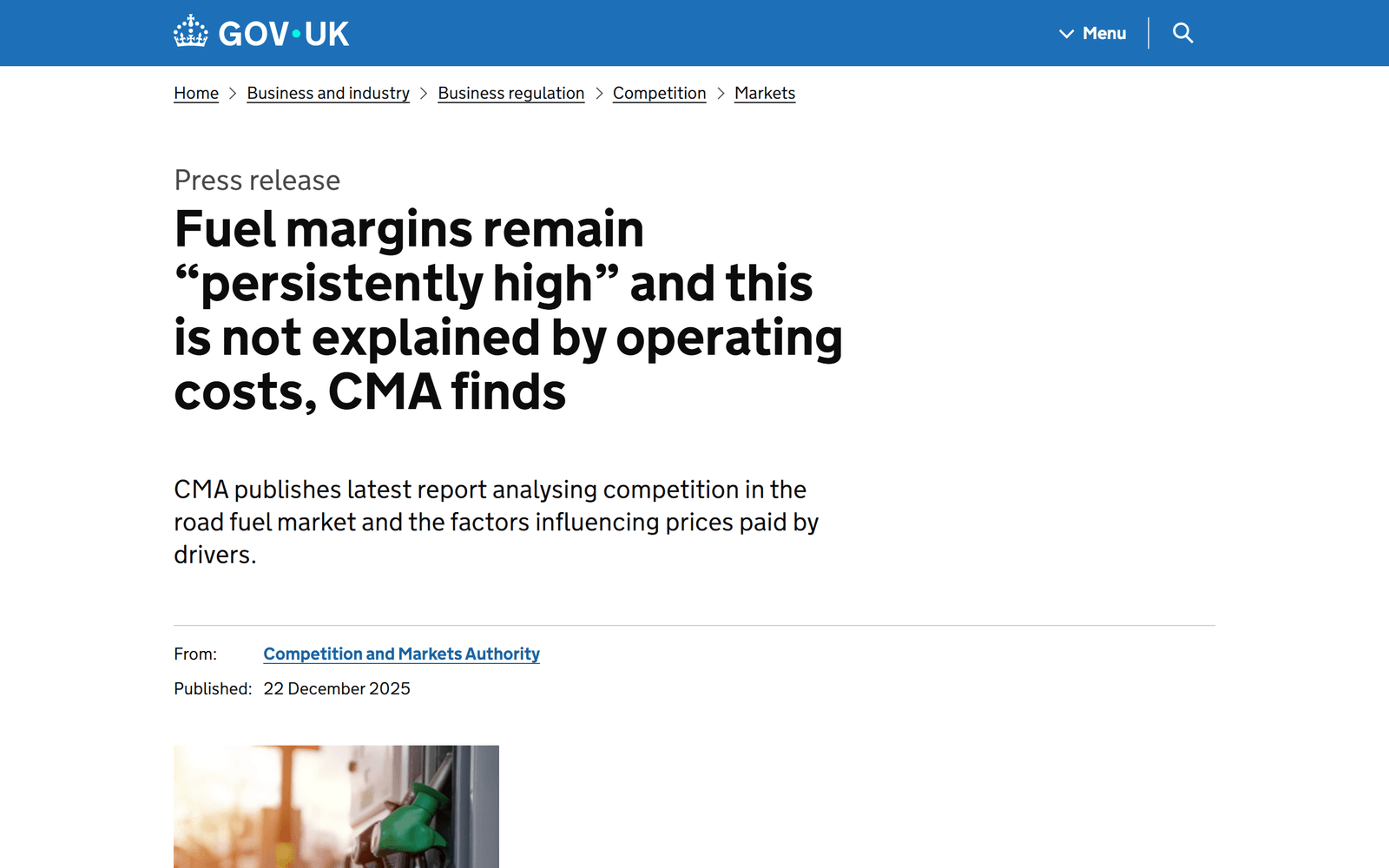
Put a price on it. The CMA found that increased retail fuel margins cost drivers over £1.6bn in 2023 alone, and that supermarket fuel margins are roughly double what they were in 2019. Add the earlier supermarket margin increases between 2019 and 2022, which the study costed at around £900 million, and the running total lands at roughly £2.5bn. That is real money, taken from a bill everybody pays and nobody can opt out of, and it sits in the same family as the loyalty penalty and every other charge that survives because comparing is harder than shrugging. Britain is unusually relaxed about this sort of thing, which is the same instinct behind why the UK will not tax wealth.
This is the same shape as every other bill where you cannot walk away. It is the argument that runs through why you cannot switch water supplier and through the poverty premium: extraction follows the absence of an exit. You do not choose the wholesale price, you certainly do not choose the duty, and until this year you could not realistically compare the one number that was actually being set for you. Weak competition is not a moral failing on the part of forecourt managers. It is what happens when nobody can see the prices.
Why diesel drivers get it worst
Diesel is 181.38p against petrol at 161.12p. That is a 20.30p gap on the same forecourt, on fuel that costs broadly similar amounts to make and carries exactly the same 52.95p of duty.
Some of that gap is real. Diesel is a globally traded product with its own supply and demand, European refining has tightened, and the wholesale price genuinely diverged from petrol. But look at the spreads again: diesel's 14.6p sits 6.0p above its 2015 to 2019 average, while petrol's 13.9p sits 7.4p above its own. Both are badly out of line, and diesel is the fuel where the CMA found clear evidence of the asymmetry. It also found retailers had pushed diesel margins harder than petrol in early 2023, leaving drivers paying 13p a litre more than if margins had held at their 2017 to 2022 average.
The people carrying that are van drivers, the trades, anyone towing, and the self-employed who cannot pass a fuel bill up the chain to anyone. Fill a 70-litre van tank and the gap against petrol is £14.21 a time. Fill it twice a week and you are over £1,400 a year worse off than the same driver in a petrol vehicle, before you have priced a single job.
What changed in 2026
For the first time, the thing the CMA said would fix this actually exists.
Fuel Finder is a statutory open-data scheme, brought in under the Motor Fuel Price (Open Data) Regulations 2025. Forecourts had to register and begin reporting from 2 February 2026, and the duty on them is strict: every price change reported within 30 minutes. The data is published as an open dataset and flows into third-party apps and sat navs, so the price is visible before you turn in rather than after you have committed. The CMA's own estimate is that it could save drivers up to £4.50 each time they fill up.
That matters more than it sounds. A feather only works in the dark. If a station can quietly hold its price 4p high for three weeks while wholesale falls, that is worth real money to them and costs each driver too little to bother chasing. Once every price change is public within half an hour, the quiet drift is no longer quiet. Remember what happened when the CMA simply published an interim report: prices dropped.
Now the part most takes on this topic leave out. The CMA looked specifically at whether retailers were exploiting the Middle East conflict, and in its May 2026 monitoring report it found that elevated wholesale prices explained most of the increase in pump prices through March and into April, with no evidence of retailers changing their pricing strategies to take advantage. Its latest report followed on 18 August 2026.
So the current spike is mostly not the forecourts, and saying so is what makes the rest of the argument stand up. The case against the fuel retailers was never that they caused this rise. It is that the baseline they charge from has sat at double the historic level for six years and their own regulator cannot find a cost that explains it. The rocket here is wholesale. The feather is the bit to watch, and we will only know how this one ends on the way down.
What you can actually do about it
Not much of this is in your hands, and pretending otherwise is how most fuel advice wastes your time. Three things genuinely are.
Use the price data now that it exists. Fuel Finder feeds apps and sat navs with near-live forecourt prices. On the CMA's numbers that is up to £4.50 a fill-up for the price of checking before you turn in. It is the single biggest lever you have and it did not exist eighteen months ago.
Know where the expensive fuel is. The CMA's monitoring consistently finds supermarket prices materially below non-supermarket retailers on average, and motorway services the most expensive of the lot. Filling up on a motorway is the fuel equivalent of buying a phone charger at an airport.
Treat the tank as a budget line, not a surprise. Duty is frozen at 52.95p, VAT is 20%, and neither is moving because you had a bad month. If your commute costs £180 in an average month, it needs a line in the budget at £200, because five weeks of what we have just watched adds about 7% to the cost of a litre.
What will not help is waiting for a good week. The whole point of a feather is that there is no obvious day it lands on.
Frequently Asked Questions
Are UK fuel prices coming down?
Not at the moment. Petrol averaged 161.12p a litre and diesel 181.38p in the week commencing 17 August 2026, up from 150.53p and 164.52p five weeks earlier. Prices did fall through June and early July, bottoming out around 149.80p for petrol on 6 July, before climbing back. DESNZ publishes the average every Tuesday, which is the fastest official read you can get.
Will fuel prices go down soon?
Nobody can tell you that, and any page that gives you a date is guessing at the crude oil price. What can be said is which part is capable of falling. Just under half your pump price is duty and VAT, which only change at a Budget. The wholesale portion moves with global markets. The retail spread is the part that has been elevated since 2019 and could come down without anything happening in an oil market at all.
Why is fuel so expensive in the UK?
Three reasons stacked on top of each other. Fuel duty at 52.95p a litre, VAT at 20% charged on top of that duty, and a retail spread the CMA measured at 13.9p on petrol in the year to September 2025 against a 6.5p average for 2015 to 2019. Tax is the biggest single component. The spread is the component that moved.
When will diesel prices go down in the UK?
Diesel carries the same 52.95p duty as petrol, so the 20.30p gap between them is wholesale cost plus retail spread. Diesel's spread was 14.6p in the year to September 2025 against an 8.6p average for 2015 to 2019, and diesel is the fuel where the CMA found clear evidence of rocket and feather pricing in 2023. Watch the spread rather than the pump price, because that is the part with room to fall.
Who has the cheapest petrol in the UK?
It varies street by street, which is the entire reason Fuel Finder was created. As a rule the CMA's monitoring finds supermarket forecourts materially cheaper than non-supermarket retailers on average, and motorway service stations the most expensive. For the actual answer near you, check a Fuel Finder-fed app before you set off rather than after.
Are fuel retailers taking advantage of the Middle East conflict?
Not from this rise, no. Its May 2026 monitoring report found elevated wholesale prices explained most of the pump price increase through March and April, and said it had not seen evidence of retailers changing pricing strategies to take advantage. Its separate and continuing finding is that margins across the market have been persistently high since 2019 and are not explained by operating costs.
This article is general information about fuel prices and consumer costs, not personalised financial advice. Pump prices move weekly and the figures here are the published averages for the week commencing 17 August 2026, with sources listed above. Fuel duty and VAT rates are set by the government and can change at any Budget. Nothing here is a forecast of what prices will do next.
Sources
- DESNZ - Weekly road fuel prices
- CMA - Road fuel annual monitoring report, December 2025
- CMA - Drivers still paying too much for road fuel, July 2024
- House of Commons Library - Petrol and diesel prices (SN04712)
- GOV.UK - Fuel Finder
- The Motor Fuel Price (Open Data) Regulations 2025
- CMA - Enhanced road fuel monitoring report, August 2026
Prefer to watch?
We turn these money breakdowns into short videos
A few a week, plain-English UK money. If you would sooner watch than read, follow along:
Enjoying the content?
If this site has been useful, a coffee goes a long way.
Browse more articles
Browse all