
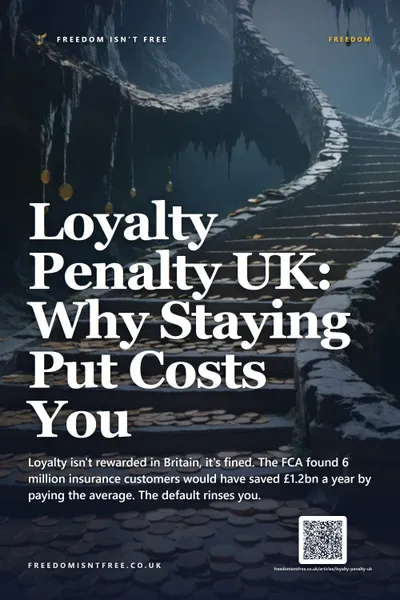

Loyalty Penalty UK: Why Staying Put Costs You
Loyalty isn't rewarded in Britain, it's fined. The FCA found 6 million insurance customers would have saved £1.2bn a year by paying the average. The default rinses you.
Cite this article
Freedom Isn't Free (2026) Loyalty Penalty UK: Why Staying Put Costs You. Available at: https://freedomisntfree.co.uk/articles/loyalty-penalty-uk (Accessed: 21 September 2026).
Italicise the article title in your bibliography. Accessed date set to today.
TLDR
- The loyalty penalty is the gap between what new customers pay and what loyal ones pay for the exact same product. The FCA found 6 million home and motor insurance customers would have saved £1.2bn in a single year by paying the average price for their risk.
- It runs across insurance, savings, mortgages, broadband and mobile. The common thread is a default - auto-renew, let the fix roll to SVR, leave cash in a legacy account - engineered to extract money from people who do nothing.
- Regulators have closed some of it: the FCA banned insurance price walking from 1 January 2022, and Ofcom banned inflation-linked mid-contract telecoms rises in new contracts from 17 January 2025.
- The counter-move is to treat switching as routine maintenance, not disloyalty. Diarise renewal dates, shop around before you accept, and never let a deal lapse to the default rate.
| Home & motor insurance | FCA: 6m customers, £1.2bn/yr overpaid (2018) |
| Easy-access savings | Only 28% of rate rises passed on (Jan 22-May 23) |
| Broadband & mobile | Out-of-contract bills, was CPI + 3.9% mid-term |
| Mortgages | SVR reversion, well above a new fix |
Where the UK loyalty penalty hides (verified figures)
Loyalty Penalty UK: Why Staying Put Costs You
The loyalty penalty is the quiet fact that, in modern Britain, staying with the same provider is not rewarded. It is fined. Across insurance, savings, mortgages and broadband, the loyal customer who renews without a fuss reliably pays more than the new customer who walks in off the street for exactly the same product. The market treats your loyalty as a behaviour to price, and it prices it against you.
This is no accident, and no oversight that a competitive market is slowly fixing. The default is built this way on purpose. Auto-renew is on by default. The fixed mortgage rolls to the standard rate by default. The bonus on your savings account drops off by default. Each of those defaults is a small machine for extracting money from people who do nothing, and "people who do nothing" is most of us, most of the time. So the counter-move is not about guilt or willpower. It is to treat switching as routine maintenance, like changing a smoke-alarm battery, rather than a grand act of disloyalty to a brand that was never loyal to you.
Contents
- What is the loyalty penalty?
- Insurance: the £1.2bn the FCA had to ban
- Savings: the rate cliff your bank is betting on
- Mortgages, broadband and mobile: the reversion trap
- The counter-move: switching as routine maintenance
What is the loyalty penalty?
The loyalty penalty is the price gap between what a company charges a new customer and what it charges an existing one for an identical product or service. It has a specific, measured size. When the Financial Conduct Authority studied home and motor insurance, it found that in 2018, 6 million loyal policyholders would have saved £1.2 billion had they simply paid the average price for their actual risk rather than the inflated renewal price.
The mechanism the FCA named is price walking. Many firms nudged prices up a little each year at renewal, so the longer you stayed, the more you paid, with the steepest prices reserved for the customers least likely to leave. The regulator was blunt about the design: the system meant "consumers have to shop around and switch every year to avoid paying higher prices for being loyal." Read that twice. The official finding is that you were being charged a fee for trust.
Insurance is only one front. The term itself was popularised by Citizens Advice, which fired a 2018 super-complaint at the Competition and Markets Authority covering five essential markets: mobile, broadband, home insurance, mortgages and savings. Its headline number was that UK consumers were losing roughly £4.1 billion a year to the loyalty penalty, an average of about £877 per household, with 8 in 10 people overpaying in at least one market. Worse, the penalty falls hardest on the people least able to absorb it, because older customers and those with poor health or low confidence are the least likely to switch. The penalty is regressive by design.
This pattern is the thing the brand "Rip-Off Britain" was invented to describe. It is not one rogue company. It is a structural feature of several regulated markets at once, which is why it took regulators, not competition, to dent it.
Insurance: the £1.2bn the FCA had to ban
Insurance was the worst offender, and the most clearly fixed. From 1 January 2022, the FCA's pricing rules came into force: when you renew a home or motor policy, the price you are offered must be no higher than the price the same firm would offer an equivalent new customer through the same channel. Price walking, as a business model, was banned. The FCA estimated the package of measures would save consumers £4.2 billion over ten years.
That is a genuine win, and it is worth being honest that the rules work. But two traps survive the reform. First, the rule stops your insurer charging you more than a new customer at that insurer. It does nothing to stop the whole market having moved cheaper elsewhere. Your renewal can be "fair" by the FCA's test and still be a poor deal against the open market. Second, auto-renewal is still on by default, so the only thing standing between you and a lazy renewal is whether you open the email. The reform took the worst of the sting out. It did not abolish the need to shop around.
So treat the renewal quote as an opening bid, never a conclusion. Run a comparison site, then ring your own insurer with the cheaper number and ask them to match it. The whole exercise is twenty minutes for a saving that is often three figures.
Savings: the rate cliff your bank is betting you won't notice
The savings version of the penalty is sneakier because nothing visibly goes wrong. Your balance does not fall. The rate just quietly fails to keep up.
When the Bank of England base rate climbed through 2022 and 2023, the big banks were in no hurry to pass it on to loyal savers. The FCA found that nine of the largest providers passed on, on average, just 28% of the base rate rise to their easy-access accounts between January 2022 and May 2023, against 51% for fixed-term and notice accounts. The loyal saver sitting in a long-standing easy-access account was, in effect, lending the bank money cheaply and getting a thank-you note instead of a competitive rate.
The other half of the trick is the bonus rate. A headline "table-topping" easy-access account often carries an introductory bonus that expires after twelve months, after which the rate collapses toward something close to zero. The account wins the comparison table on the day you open it, then quietly underpays you for every day after. If you opened a market-leading account a year ago and have not checked it since, assume you are now being underpaid until proven otherwise. This matters most for the cash you cannot afford to gamble, like your emergency fund, and our guide to the best savings account UK 2026 walks through which account types dodge the cliff.
Mortgages, broadband and mobile: the reversion trap
The most expensive loyalty penalty most households will ever pay is the mortgage one, and it has the same shape as all the others: a default that triggers when you stop paying attention. When a fixed deal ends, the lender does not move you to its best rate. It moves you to the Standard Variable Rate, the reversion rate, which sits well above what a new fix would cost. Doing nothing is the single most expensive option on the menu, and the lender is banking on your inertia to choose it for you. We cover the timing and the maths in Remortgaging UK: why lenders bank on your inertia.
Broadband and mobile run the same playbook. For years the standard move was to lock you into a contract, raise the price every March by inflation plus a few points, and then leave you on an inflated out-of-contract rate once the minimum term ended. Ofcom found that, as of April 2024, around six in ten broadband and mobile customers were on contracts with inflation-linked rises, typically the published rate plus 3.9%. The regulator has since acted: from 17 January 2025, providers can no longer write inflation-linked or percentage-based price rises into new contracts, and any rise must be stated up front in pounds and pence. Useful, but it still leaves the out-of-contract penalty fully intact. The day your minimum term ends, you become the customer the provider quietly overcharges, and the only fix is to call up and either haggle or leave.
The counter-move: treat switching as routine maintenance
The mistake is to think of this as a discipline problem you can will your way out of. You will not remember to check fourteen renewal dates a year through sheer attentiveness, and the providers know it. The fix is a system, not a resolution.
- Diarise every renewal and end date. Insurance renewal, mortgage fix expiry, savings bonus drop-off, broadband and mobile minimum-term end. Put a reminder a month before each one, because the calendar defeats the default in a way your memory never will.
- Treat every renewal quote as an opening bid. Get a market-wide comparison before you accept anything, then ring your existing provider with the cheaper number and ask them to match it.
- Never let a deal lapse to the reversion rate. The SVR, the post-bonus savings rate and the out-of-contract broadband price all punish inaction, so line up the next deal before the current one ends.
- Use the switch incentives. Banks pay current account switching bonuses precisely because they know most people never move. Take the cash and rotate.
None of this requires you to become a full-time bargain hunter. It requires roughly one focused hour, a few times a year, pointed at the handful of bills that actually matter. The pennies will look after themselves. The loyalty penalty hides in the pounds, and the pounds only move when you do.
If you want the bigger picture of why these extraction mechanisms are tolerated in the first place, why the UK won't tax wealth sets out the political economy behind it. The loyalty penalty is one of the smaller, more fixable corners of a system that mostly runs the other way.
The Psychology of Money - Morgan Housel - A sharp read on why we leave money on the table through inertia and inattention, which is exactly what the loyalty penalty preys on. (Affiliate link - we may earn a small commission at no extra cost to you.)
Frequently Asked Questions
What is the loyalty penalty in the UK?
The loyalty penalty is the higher price that existing, loyal customers pay compared with new customers for the same product. It shows up in home and motor insurance, savings accounts, mortgages, broadband and mobile. The FCA found that in 2018, 6 million loyal insurance customers would have saved a combined £1.2 billion by paying the average price for their risk instead of the inflated renewal price.
Is the insurance loyalty penalty illegal now?
Price walking in home and motor insurance is effectively banned. Since 1 January 2022, FCA rules require that your renewal price is no higher than the price the same insurer would offer an equivalent new customer through the same channel. It does not force your insurer to match cheaper rivals, though, so you should still compare the wider market at every renewal rather than auto-renewing.
How much can switching save me?
It depends on the bill. An insurance comparison can save three figures in twenty minutes. Moving off a mortgage Standard Variable Rate onto a competitive fix can save hundreds of pounds a month on a typical balance. Moving stale easy-access savings to a competitive rate, or out of an expired bonus account, recovers the interest your bank stopped paying. The single biggest wins are usually the mortgage and the savings rate.
Why do companies charge loyal customers more?
Because they can, and because most people do not switch. Firms know that customers who have stayed for years are the least likely to leave, so the renewal or reversion price is set to extract more from exactly those people. The default settings - auto-renewal, SVR reversion, expiring bonus rates - are designed so that doing nothing is the expensive choice and inertia does the firm's work for it.
How do I avoid the loyalty penalty?
Build a system rather than relying on memory. Diarise every renewal, fix expiry and bonus drop-off date, set a reminder a month before, treat every renewal quote as an opening bid to be beaten, and never let a deal roll onto the default rate. One focused hour a few times a year, aimed at the bills that matter, neutralises most of it.
This article is general information, not personal financial advice. Rates, regulations and provider terms change, and the figures here are accurate as of June 2026 with their sources listed above. Compare your own circumstances before switching any product.
Sources
Prefer to watch?
We turn these money breakdowns into short videos
A few a week, plain-English UK money. If you would sooner watch than read, follow along:
Enjoying the content?
If this site has been useful, a coffee goes a long way.
Browse more articles
Browse all