





UK Current Account Switching Bonuses 2026: Live Tracker
UK banks paid out £4bn in switching bonuses since 2013. Most people have collected £0. The maths says you can earn £400 to £600 a year if you actually do it.
Cite this article
Freedom Isn't Free (2026) UK Current Account Switching Bonuses 2026: Live Tracker. Available at: https://freedomisntfree.co.uk/articles/current-account-switching-bonuses-uk-2026 (Accessed: 10 October 2026).
Italicise the article title in your bibliography. Accessed date set to today.
TLDR
- UK banks have paid out over £4 billion in current account switching bonuses since the Current Account Switch Service launched in 2013. The bonuses are real cash, taxable as savings income, and most UK adults have never claimed a single one.
- Headline bonuses in June 2026 run from £100 to £200 per switch, with most banks attaching qualifying conditions (two direct debits, a minimum deposit, app login, salary credit). Meet them and the cash lands in two to four weeks.
- You can switch more than once a year. Most banks block repeat customers who have held an account in the last few years, but the rotation across the major banks means £400 to £600 a year of bonus income is genuinely available to a disciplined switcher.
- Not every account is worth chasing. Packaged accounts charging £15 a month for travel insurance and breakdown cover usually cost more in fees than the bonus delivers. Read the ongoing terms, not just the headline.
Indicative UK current account switching bonuses, June 2026
Headline bonuses are quoted at the published rate as of June 2026. Each bank attaches its own qualifying conditions (direct debits, deposit minimums, app logins). Offers change frequently - check the bank page before applying.
UK Current Account Switching Bonuses 2026: Live Tracker
The Current Account Switch Service has moved around 12 million UK accounts and paid out roughly £4 billion in cheeky switching bonuses since launching in 2013, and most British adults have collected exactly £0 of it. Not because the bonuses are fake or the process is broken. Because banks rely on the inertia of customers who opened an account at 18 and never moved it. UK current account switching bonuses are one of the simplest pieces of free cash in personal finance, and this article is the honest, regularly-refreshed league table that the bank-owned guides will not give you.
Contents
- Why banks pay you £200 to switch
- Live tracker: UK switching bonuses, June 2026
- How the Current Account Switch Service actually works
- The qualifying conditions banks hide in the small print
- How often can you switch and stack bonuses?
- When you should NOT switch
- What about packaged accounts?
- Frequently asked questions
Why Banks Pay You £200 to Switch
A switching bonus looks like generosity. It is not. The customer acquisition cost in UK retail banking sits somewhere between £150 and £400 depending on the channel, and a switched current account is the most valuable banking relationship a bank can win. Once your salary is paid in, your direct debits are set up, and you have got used to the app, the average customer stays for around 17 years. The £200 the bank pays you up front is a fraction of what that 17-year relationship is worth in card interchange fees, overdraft charges, mortgage and savings cross-sell, and data they can use to target other products.
Phrased the way the bank's marketing team sees it: a switching bonus is the cheapest customer acquisition channel they have. Phrased the way a switcher should see it: it is one of the few situations in UK personal finance where you can legitimately collect the asymmetry. Take the £200, meet the qualifying conditions, leave when it suits you. The bank still wins on average. The disciplined switcher wins more. This is exactly why the best UK current account is rarely a single pick: the switcher's edge comes from running a stack, rotating the high-street account purely for bonuses while keeping a separate everyday account untouched.
This dynamic also explains why packaged accounts (the £15-a-month ones bundling travel insurance and mobile cover) rarely come with switching bonuses. A customer willing to pay £15 a month is already a profitable account from day one - the bank does not need to pay £200 up front to win someone who is paying it £180 a year for the privilege.
Live Tracker: UK Switching Bonuses, June 2026
Here is the live league table as of June 2026, ordered by gross cash to the switcher. Each bonus is subject to the bank's own qualifying conditions, covered in the next section. All are paid by direct credit to the new account, usually within 28 days of switch completion.
| Bank | Account | Headline bonus | Key conditions |
|---|---|---|---|
| NatWest | Reward | £200 | Switch with two direct debits, log into mobile app, deposit £1,250 |
| Nationwide | FlexDirect | £200 | Switch with two direct debits, transfer in two payments, deposit £1,000+ |
| Santander | Edge / Edge Up | £180 | Switch with two direct debits, deposit £1,500 within 60 days |
| First Direct | 1st Account | £175 | Switch full service, deposit £1,000 within three months |
| Lloyds | Club Lloyds | £175 | Switch with three direct debits, deposit £2,000 |
| TSB | Spend & Save | £100 | Switch full service, complete five debit card transactions |
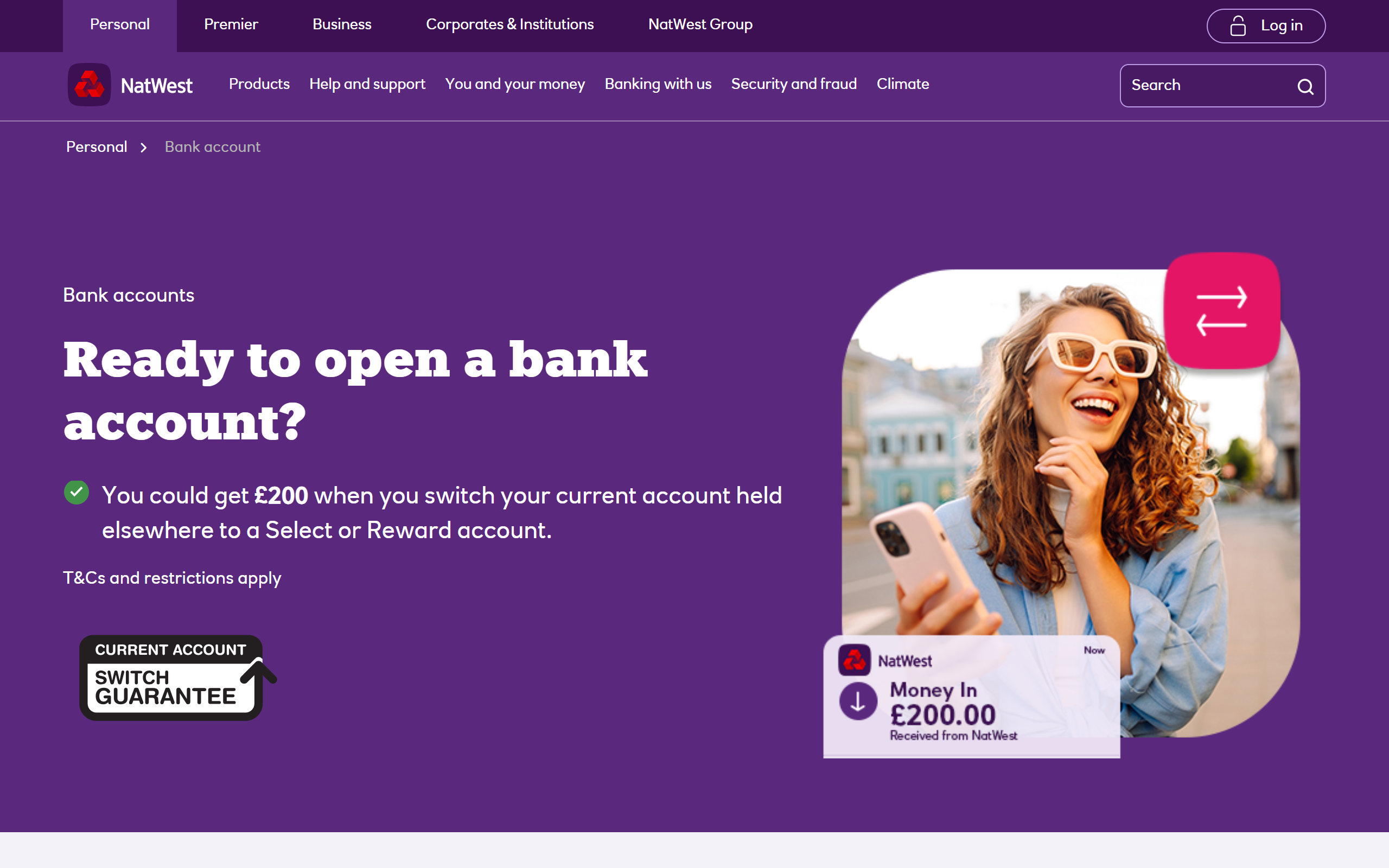
The figures above are the rate published by each bank on its consumer page at time of writing. Switching offers change almost monthly as banks rotate them in and out, and the qualifying conditions are revised more often than the headline number. Always read the live page on the bank's own site before applying. This article will be refreshed quarterly; the current refresh is June 2026.
Two practical points across the table. First, almost every bonus requires two direct debits to move across as part of the switch. Not optional. The Current Account Switch Service handles the mechanics, but if you do not have at least two direct debits running through the old account the switch does not qualify. And second, every bank now requires you to use the account in some way (app login, debit card transactions, salary credit) in the first month or two. The era of completely dormant switches collecting £200 is over.
How the Current Account Switch Service Actually Works
The Current Account Switch Service (CASS), launched in 2013, is the UK industry-wide infrastructure that moves a current account from one bank to another. It is run by Pay.UK and supported by every major UK current account provider. The headline promise is that the switch completes in seven working days, and that any incoming payments or direct debits sent to the old account are automatically redirected to the new one for 36 months.
The mechanics from the customer's side are straightforward:
- Open the new account at the receiving bank. The bank's app will offer to start a switch as part of onboarding.
- Authorise the switch. You pick a target date (must be at least seven working days ahead) and the receiving bank handles everything from there.
- On the target date, your direct debits, standing orders, and salary instruction all move across. Your old account is closed automatically.
- Any payments still addressed to the old sort code and account number for the next 36 months are silently redirected.
That last point is the bit that surprises people. You do not need to chase your employer to update the payroll record, or your gym to update the direct debit. The 36-month redirection covers it. In practice most large UK payers update their records within a few months of the first redirected payment, because Pay.UK notifies them of the new account details.
The seven-working-day window is also the trigger for the qualifying-condition clock. The bonus is paid once the switch completes and the bank has confirmed that the qualifying activity (direct debits live, app logins done, minimum deposit credited) has happened. Most banks pay within 28 days of completion.
A practical note: do not run the switch in the same week as a big bill. If a major direct debit is due in the next few days, wait until it has cleared the old account before triggering the switch. CASS handles the redirection, but the few-day uncertainty is not worth the convenience.
The Qualifying Conditions Banks Hide in the Small Print
Six conditions appear most often, and meeting all six is what gets the £200 paid. The headline bonus is what the bank uses to win the customer; the qualifying conditions are what the bank uses to decide whether to actually pay it.
Two or more active direct debits. Almost universal. The switch must transfer at least two live direct debits from the old account. Setting up brand-new direct debits at the new account a week later does not count - the conditions specifically reference direct debits moved across by the switch. If you do not have any, automate two small direct debits on the old account (a small monthly charity, a streaming service) at least a month before switching.
The minimum deposit sits anywhere from £1,000 to £2,500 paid in within a defined window (typically 30 to 60 days from switch completion), and the deposit must usually be a single transfer in, not the cumulative balance - putting in £500 across four occasions does not always trigger the condition. Some banks also want a genuine salary credit rather than a personal transfer for that minimum, identifying salary income by the BACS code attached to the payment. A direct bank transfer from your own savings account often does not count.
Stay period. Most banks now require the account to remain open and active for at least three to six months after the bonus is paid, with a clawback if you close earlier. Read the specific clawback period before treating the bonus as banked.
Then comes a token amount of in-account activity. Most banks ask for a few app logins, five contactless debit card transactions, or online banking signup. Trivial, but easy to forget if you are running the switch as a pure bonus play.
Previous customer restriction. Every bank in the table excludes customers who have held a switching-qualifying account with them in the recent past, typically within the last two to four years. This is the hard limit on how often you can claim from the same bank. It does not stop you switching between different banks.
Miss any one of these and the bank declines the bonus. The customer-service teams have no discretion - the systems pay or they do not.
How Often Can You Switch and Stack Bonuses?
The Current Account Switch Service has no annual limit on the number of switches a customer can make. The constraint is per-bank: each bank has its own rule about how recently a former customer can switch back and qualify for a bonus. Typical exclusion periods sit at two, three, or four years.
That means a disciplined switcher with two main banking relationships (a primary salary account and a secondary) can rotate around the six banks in the table above, and collect somewhere between £400 and £600 a year in switching bonuses without ever paying a banking fee. The maths is straightforward: switch twice a year (six-month gaps make life easier on direct debits), pick the two highest live bonuses each round, meet the qualifying conditions, and bank the £400 to £600.
For comparison, an emergency fund of £6,000 sitting in a cash savings account at 4% pays £240 a year before tax. Two switching bonuses delivers more than that, for around an hour of work a year, and the tax position is essentially the same (income from switching bonuses is treated as savings income and is usually fully covered by the personal savings allowance for most basic and higher rate taxpayers).
The catches on stacking:
- Each switch needs two live direct debits. Keeping two small ones permanently set up at the rotating account (a £5 charity gift aid, a streaming subscription) costs almost nothing and unlocks every switch.
- The credit check from the new account opening is a soft search at most banks and a hard search at a few. Five or six hard searches a year will start to show on your credit file. If you are about to apply for a mortgage, pause the switch rotation for six months either side.
- The stay-period clawbacks mean you need to keep the account open for at least three to six months after the bonus is paid. Plan the rotation around that constraint.
The natural ceiling is the previous-customer rule. Once you have switched into and out of all six banks in the live table, you have to wait for the exclusion period to expire on the first one before you can rotate back. In practice this is rarely a hard limit because new banks (Chase, Monzo, Starling, Virgin Money) periodically enter the switching market with their own bonuses.
When You Should NOT Switch
Three cases where the bonus is not worth the faff.
You are mid-mortgage application. Multiple hard credit searches in the six months before a mortgage application can affect the lender's affordability scoring. The £200 is not worth a worse mortgage rate. Pause switching from the day you start gathering documents through to completion.
You rely on overdraft or have erratic income. Switching a current account with a live overdraft balance is technically possible but adds friction. Some banks decline to take on customers with significant existing overdraft debt, and the qualifying conditions usually require a clean salary credit, which is harder with self-employed or gig-economy income.
Joint accounts and non-standard structures are the third pause point. Joint accounts can be switched but both parties have to consent and complete identity checks. Business accounts are not eligible for personal switching bonuses at all. And if you bank with Monzo or Starling and rely heavily on their specific app features (instant notifications, pots, budgeting tools), the small bonus from a high-street switch may not justify giving those up.
For everyone else, switching is one of the highest hourly-rate activities in UK personal finance.
What About Packaged Accounts?
A packaged current account charges a monthly fee (typically £10 to £18) in exchange for bundled benefits - travel insurance, mobile phone cover, breakdown cover, an interest rate boost on savings, sometimes airport lounge access. Examples include the Nationwide FlexPlus, the Halifax Ultimate Reward, the Co-op Bank Everyday Extra, and the Lloyds Club Lloyds Plus.
Packaged accounts rarely come with switching bonuses because the monthly fee already funds the customer acquisition cost. The question is whether the bundled benefits are worth the fee.
For some readers, yes. The Nationwide FlexPlus at £18 a month bundles unlimited family worldwide travel insurance up to age 70, mobile cover, and breakdown cover. A family that would otherwise buy all three separately is genuinely better off. The same is true of the Halifax Ultimate Reward.
For most readers, no. The packaged account is sold to a customer who would not buy any of those products separately, charges £180-£216 a year for them, and counts on the customer not cancelling. The fair test: would you buy the bundled travel insurance, phone cover, and breakdown cover as standalone products? If no, the packaged account is overpriced.
If you do want a packaged account, the typical right move is to switch into a fee-free account with a bonus, collect the £200, and then upgrade to the packaged version after the qualifying period. Most banks let you switch product type within the same account number.
Frequently Asked Questions
What is the best current account switching bonus in the UK right now?
As of June 2026, NatWest Reward and Nationwide FlexDirect both lead at £200, followed by Santander Edge at £180. First Direct and Lloyds Club both run at £175. Switching offers change frequently - usually monthly - so check the live page on each bank's site before applying. This article is refreshed quarterly.
Can I switch my current account more than once a year?
Yes. The Current Account Switch Service has no annual limit. Each bank applies its own previous-customer exclusion (typically two to four years) so the practical limit is rotating around different banks. A disciplined switcher can collect £400 to £600 a year by switching twice across the six major banks.
Do I have to pay tax on a UK current account switching bonus?
A switching bonus is treated as savings income by HMRC and counts towards your personal savings allowance (£1,000 for basic rate, £500 for higher rate, £0 for additional rate taxpayers). For most UK adults whose total annual savings income stays below the allowance, the bonus is effectively tax-free. If you exceed the allowance you pay income tax at your marginal rate on the excess.
How long does a current account switch take?
The Current Account Switch Service guarantees completion within seven working days from the target switch date you choose. The receiving bank handles the mechanics. Any payments still addressed to the old account are automatically redirected for 36 months afterwards. Bonuses are usually paid within 28 days of switch completion, provided the qualifying conditions have been met.
What is the catch with current account switching bonuses?
Three. First, the qualifying conditions (two direct debits transferred, a minimum deposit, app activity) must be met within a defined window - the bank pays nothing if you miss any condition. Second, most banks require you to keep the account open for at least three to six months or claw back the bonus. Third, each new account opening may involve a credit search, which can affect mortgage applications if multiple switches happen in the six months before applying.
Can I switch a joint account?
Yes, but both account holders have to consent and sign the switch authorisation. The receiving bank will require both parties to complete identity checks. Some bonuses are paid per account rather than per holder, so the two of you split £200 rather than each receiving £200.
What if my old bank tries to keep me from switching?
The Current Account Switch Service is regulated by Pay.UK and overseen by the FCA. Banks cannot block or delay a switch beyond the seven-working-day window. If the receiving bank confirms the switch has been actioned and your old bank refuses to release direct debits or close the account, escalate through the Financial Ombudsman Service. In practice, blocked switches are rare - the system is mature and works as designed.
Read Next
- Best Savings Account UK 2026 - where to park the cash once you have the switching bonus, broken down by easy-access, fixed, and ISA.
- Automate Finances UK - the direct-debit-and-standing-order architecture that keeps two-direct-debit switching cheap and easy to repeat.
- Emergency Fund UK - the savings tier that sits underneath every banking decision. The switching bonus is a useful top-up; it is not a substitute.
- UK Personal Finance Flowchart - where banking sits in the 10-step money plan, before investing and after the emergency fund.
Further Reading:
Atomic Habits - James Clear - the practical case for treating routine money admin as a small, repeatable system rather than a project. Two switches a year is the FIRE-style optimisation that compounds when you stop treating it as a one-off and start running it as a quarterly checklist. (Affiliate link - we may earn a small commission at no extra cost to you.)
Disclosure: This article is general consumer information, not financial advice. Current account switching bonuses are commercial offers run by the named UK banks; each offer is subject to the bank's own terms and qualifying conditions, which change frequently. Always verify the live offer on the bank's own consumer page before applying. The headline bonus figures quoted above are correct at the time of the June 2026 refresh and will be updated quarterly. Bank account switching may involve a credit search and can affect your credit file. Where this article discusses savings income tax treatment, the position depends on your personal tax circumstances and may change at future UK Budgets. Freedom Isn't Free is not FCA-authorised.
Prefer to watch?
We turn these money breakdowns into short videos
A few a week, plain-English UK money. If you would sooner watch than read, follow along:
Enjoying the content?
If this site has been useful, a coffee goes a long way.
Browse more articles
Browse all