
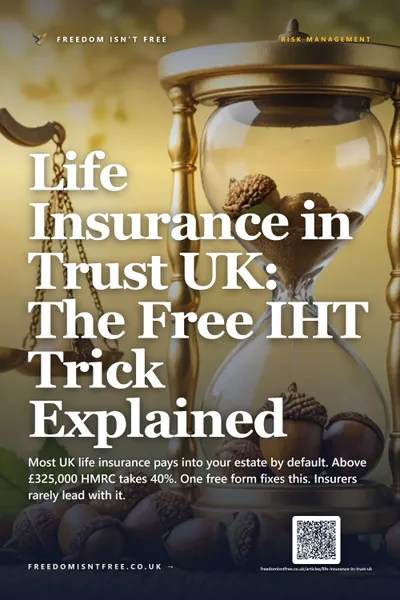

Life Insurance in Trust UK: The Free IHT Trick Explained
Most UK life insurance pays into your estate by default. Above £325,000 HMRC takes 40%. One free form fixes this. Insurers rarely lead with it.
Cite this article
Freedom Isn't Free (2026) Life Insurance in Trust UK: The Free IHT Trick Explained. Available at: https://freedomisntfree.co.uk/articles/life-insurance-in-trust-uk (Accessed: 10 October 2026).
Italicise the article title in your bibliography. Accessed date set to today.
TLDR
- Putting a UK life insurance policy in trust takes the payout outside your estate for inheritance tax. Above the £325,000 nil-rate band, that saves the family 40% on the excess.
- It also bypasses probate. The payout reaches your beneficiaries in two to four weeks, not the six to twelve months a standard policy can take while the estate is administered.
- Every major UK insurer (Aviva, Legal & General, Royal London, Vitality, AIG, HSBC) provides the trust deed free at point of purchase or any time after. It is one form. There is no tax cost and no advice fee.
- The narrow set of cases where you should pause first: blended families with stepchildren, vulnerable beneficiaries, or expected family disputes. Those want proper estate-planning advice, not a standard insurer trust form.
What a £300,000 life insurance payout actually delivers
| Setup | Lands in estate? | IHT bill on the payout | Family receives | Time to pay out |
|---|---|---|---|---|
| No trust, estate above threshold | Yes | £120,000 (40%) | £180,000 | 6 to 12 months (probate) |
| No trust, estate below threshold | Yes | £0 | £300,000 | 6 to 12 months (probate) |
| Written in trust | No | £0 | £300,000 | 2 to 4 weeks (no probate) |
Writing the policy in trust takes the payout outside the estate for IHT and bypasses probate. One form, free, set up at the insurer.
Life Insurance in Trust UK: The Free IHT Trick Explained
The phrase life insurance in trust appears in the small print of almost every UK policy sold today, and yet the average buyer leaves the option untouched. The reason is structural. The insurers benefit from selling you the policy, not from optimising the tax outcome of the payout. So the quote forms lead with "from £5 a month" and the trust paperwork lives three menus deep on the support page.
This is the article that puts the trick at the top. Written in trust, a £300,000 UK life insurance payout reaches your family in full and in weeks. Left in the default state, the same payout can lose 40% to HMRC and take a year to arrive. The form takes ten minutes and costs nothing. Most policyholders should fill it in.
Contents
- What "life insurance in trust" actually means
- The IHT trick: a worked £300,000 example
- Three other reasons to use a trust
- When you should NOT put your life insurance in trust
- Types of trust UK insurers offer
- How to set up a trust (and how to do it after the fact)
- Cohabiting couples: the case where this matters most
- Frequently asked questions
What "Life Insurance in Trust" Actually Means
A standard UK life insurance policy is an asset you own. When you die, the policy pays out and the payout lands in your estate, alongside your house, your savings, and everything else. The executor handles it, HMRC works out whether inheritance tax is due on the total, and the money eventually reaches your beneficiaries through probate.
Writing the policy in trust changes that ownership structure. You sign a trust deed that legally separates the policy from you. The policy is now held by trustees (people you nominate, usually a spouse or close family member) for the benefit of named beneficiaries (also people you nominate). On your death, the insurer pays the trustees directly. The estate never touches the money. The executor never has to administer it. Probate never sees it.
That structural shift produces three concrete consequences. The payout is outside the estate for inheritance tax. The payout reaches the beneficiaries without waiting for probate. And the choice of beneficiary is locked in at the point of signing, which can be either a feature or a bug depending on the family.
The trust is not a separate financial product. It is a legal wrapper around the policy you already have, set up using a single form provided free by every major UK insurer.
The IHT Trick: A Worked £300,000 Example
The 2026/27 inheritance tax thresholds per HMRC are unchanged from 2009:
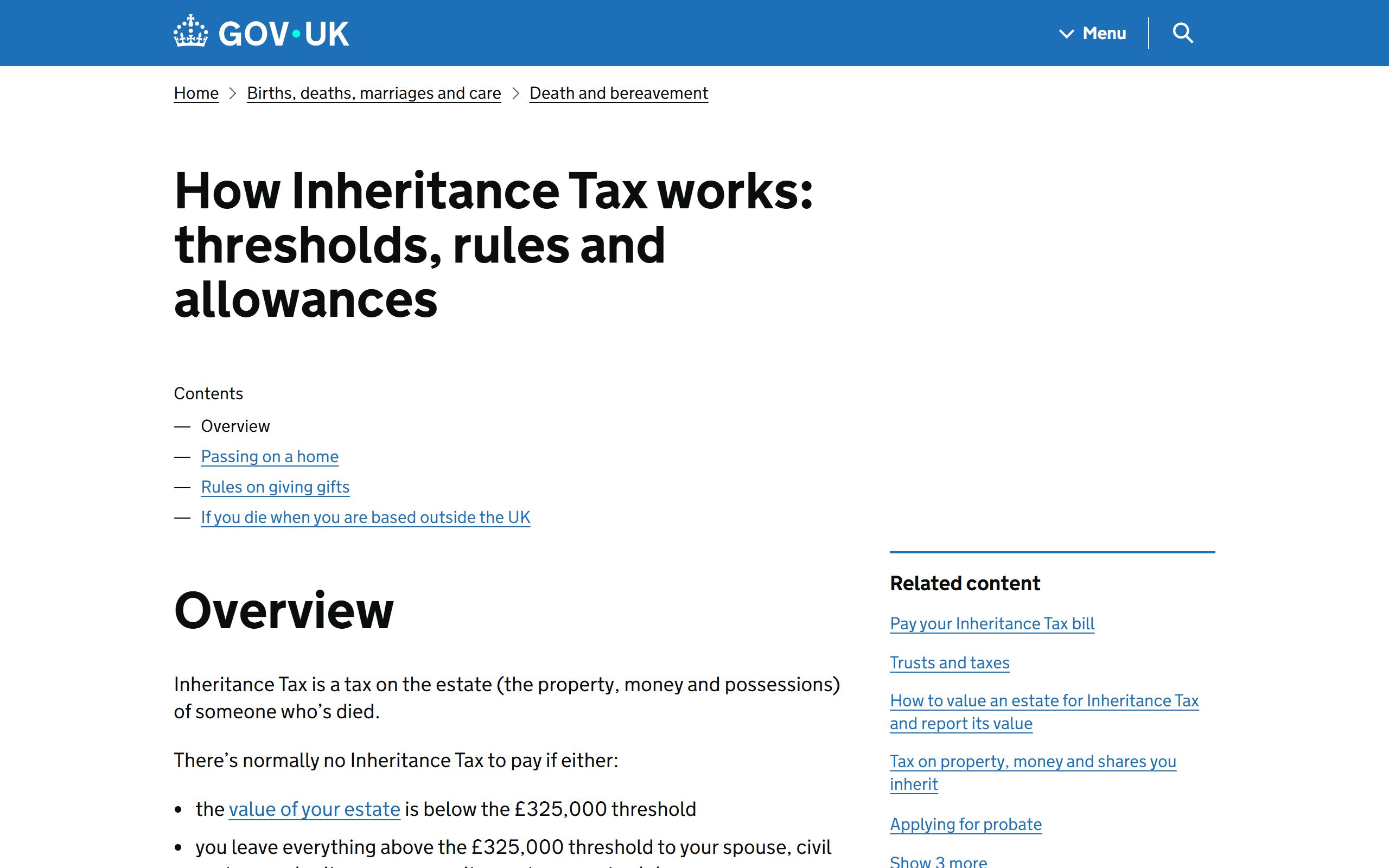
- Nil-rate band: £325,000 per person.
- Residence nil-rate band: up to a further £175,000 if you leave your main home to direct descendants, taking the effective threshold to £500,000 per person.
- Combined for a married couple or civil partners: up to £1,000,000 if both thresholds are fully used.
- Rate above the threshold: 40%.
Now consider a homeowner with a £400,000 house, £75,000 in savings, and a £300,000 life insurance policy paying out on death. The estate without the trust is £775,000. The residence nil-rate band brings the effective threshold to £500,000. The taxable excess is £275,000. The IHT bill is £110,000 (40% of £275,000). Of the £300,000 the insurer paid for, the family receives £190,000 once HMRC has taken its cut.
Write the same policy in trust on day one. The £300,000 payout now lands directly with the trustees, bypassing the estate entirely. The estate shrinks to £475,000, comfortably below the £500,000 threshold. The IHT bill drops to zero. The family receives the full £300,000.
That is a £110,000 swing on the cost of a single form. The insurer charges nothing for it. There is no advice fee, no stamp duty, no annual reporting requirement to HMRC. It is the single highest-return ten minutes most UK families with property will ever spend.
The maths only kicks in if your estate would otherwise push above the threshold. For a family with a modest estate the IHT trick saves nothing because no IHT would have been due anyway. The next section is what makes the trust worth filing even in that case.
Three Other Reasons to Use a Trust
The IHT angle is the headline, but it is not the only reason to write a policy in trust. Three more apply even when your estate sits comfortably below the nil-rate band.
Speed of payout. A policy that lands in the estate has to wait for the grant of probate before the insurer will release the money. UK probate currently runs six to twelve months on average and can stretch longer for complex estates. A policy written in trust pays out to the trustees within two to four weeks of the death certificate being received, because no probate is required. That speed matters when there is a mortgage to service, school fees due, or funeral costs in the meantime.
Control over the beneficiary. A policy that lands in the estate is distributed according to your will, or to the intestacy rules if you have not made one. Both can be challenged. A trust deed locks in the beneficiary by name and is far harder to contest. Useful where you want to ensure a specific person receives the money regardless of any later family dispute.
Avoiding the cohabiting-partner trap. If you live with a partner you are not married or civil-partnered to, intestacy law in England and Wales does not recognise them as a beneficiary at all. Your blood relatives inherit, not the person you live with. A trust naming the partner as beneficiary fixes this directly, regardless of whether you ever get round to writing a will. This is the single most common reason younger UK buyers should write the policy in trust, and the section below expands it.
These three reasons together mean a trust is usually worth filing even for buyers whose estates are nowhere near the IHT threshold.
When You Should NOT Put Your Life Insurance in Trust
The honest counterweight. A trust is the right move for most policyholders, but it locks in decisions that can become inconvenient later. Four cases warrant pause.
Blended families with stepchildren. If you have children from a previous relationship and intend to provide for both them and a new partner, a standard insurer trust deed is too blunt. You want a properly drafted discretionary trust with a letter of wishes, not the free three-page template. Spend the money on a STEP-qualified estate planner.
Vulnerable beneficiaries. A child with disabilities, a beneficiary on means-tested benefits, or someone who would struggle to manage a lump sum all need a trust structured around them. A bare trust paying out directly can disqualify a disabled adult child from benefits. A vulnerable beneficiary trust or a disabled person's trust is the correct vehicle. Again, this needs proper advice.
Expected family disputes. If you anticipate a contested estate (sibling rivalries, an estranged child, a recent divorce), the standard trust does not give you the precision you need. Get specialist advice before signing.
You actively want the policy in the estate. Rare, but it happens. If your estate is comfortably below the IHT threshold and your beneficiary is the residuary heir of your will anyway, having the payout flow through the estate keeps the administration simple and the audit trail clear. The trustees become an extra layer of paperwork for no tax benefit. Not wrong, just unnecessary.
In every other scenario, the standard insurer trust form does the job for free.
Types of Trust UK Insurers Offer
UK insurers typically offer three off-the-shelf trust types at the point of purchase. The differences look subtle on paper but matter for who can change what after the trust is set up.
Absolute trust (also called bare trust). The beneficiary is fixed at the point of signing and cannot be changed. The simplest and most common option. Used by buyers who know exactly who they want to receive the money and do not expect that to change. If your beneficiary dies before you, the payout passes to their estate, which may not be what you want.
Discretionary trust. The trustees decide which of a class of potential beneficiaries (named on the trust deed) receives what, and when. More flexible because it accommodates life changes - new children, a divorce, a beneficiary's financial circumstances changing - but requires you to trust the trustees' judgement. Often paired with a non-binding letter of wishes that records how you would like them to exercise the discretion.
Flexible (interest in possession) trust. A halfway house. There is a named default beneficiary who receives the income or payout, but the trustees can shift the benefit to other beneficiaries within a defined class if circumstances change. Less common than it used to be following the 2006 finance act changes, but still offered by some insurers.
For most buyers, the absolute trust is the right call: clarity, simplicity, no ongoing trustee judgement required. Discretionary becomes worth the extra complexity when the family is blended, the children are young, or the future shape of the household is genuinely uncertain.
How to Set Up a Trust (And How to Do It After the Fact)
Every major UK insurer makes the trust forms available online. Aviva, Legal & General, Royal London, AIG, Vitality, LV=, HSBC and Zurich all publish the deeds as downloadable PDFs in their support sections. The process is the same across providers:
- Decide on the trust type (absolute is the default; discretionary if the family situation warrants it).
- Nominate two or more trustees. Usually a spouse plus one other (an adult sibling, parent, or friend). The trustees should be people you trust to handle the payout when you cannot.
- Nominate the beneficiaries by full legal name and date of birth.
- Sign the deed in the presence of an independent witness.
- Return the original to the insurer. The insurer logs the trust against the policy. You keep a copy.
It takes ten minutes if you do it at the time of purchase, when the insurer prompts for it during onboarding. It takes thirty if you do it later, because you have to download the form yourself.
Setting up a trust on an existing policy. This is the part most buyers miss. The trust does not have to be in place at the time the policy starts. You can put any existing policy in trust at any time, as long as you are still the legal owner and the trust is signed before your death. The mechanism is identical: download the deed, complete it, send it to the insurer. For a standard term policy (no surrender value), the gift is treated as having nominal market value and the seven-year IHT clock is rarely an issue in practice. For a whole-of-life policy with a built-up surrender value, the transfer into trust is a chargeable lifetime transfer for IHT purposes and the seven-year clock does apply to the value transferred. Either way, the policy proceeds payable on death are outside the estate once the trust is logged.
That last point bears underlining. If you bought a UK life insurance policy five years ago, did not write it in trust at the time, and have a sizeable estate, you can fix it this afternoon. The form is free. The benefit is exactly the same as if you had done it on day one.
Cohabiting Couples: The Case Where This Matters Most
England and Wales do not recognise the concept of "common-law marriage", regardless of how long a couple has lived together. If you die without a will and you are not married or in a civil partnership, your cohabiting partner inherits nothing under intestacy. Your parents inherit, then your siblings, then more distant relatives. Your partner has to apply to the court under the Inheritance (Provision for Family and Dependants) Act 1975 to claim any provision, and the outcome is uncertain.
A life insurance policy in trust naming your partner as beneficiary bypasses all of this. The insurer pays the partner directly within weeks, regardless of intestacy law. There is no probate, no court application, no dispute with relatives over the estate. The trust is the cleanest, fastest way to make sure the person you actually live with is the person who actually receives the money.
That is why younger UK buyers, who often have not got around to writing a will yet, should treat the trust form as non-optional if they are buying life insurance at all. The whole point of the policy is to protect the partner, and the default arrangement does the opposite.
Scotland's intestacy rules are slightly more generous to cohabitants (the Family Law (Scotland) Act 2006 allows a discretionary court claim), but the trust is still the cleaner solution.
Frequently Asked Questions
Is it worth putting life insurance in a trust?
For most UK policyholders, yes. The three reasons are speed of payout, certainty over who receives the money, and (for estates above the £325,000 nil-rate band) a 40% inheritance tax saving on the excess. The form is free and provided by the insurer. The only cases where it is not worth doing are blended families, vulnerable beneficiaries, or expected disputes - all of which want specialist estate-planning advice instead.
What happens when you put life insurance in a trust?
The policy is legally separated from you. Trustees you nominate hold it for beneficiaries you name. When you die, the insurer pays the trustees directly within two to four weeks, bypassing probate entirely. The payout never enters your estate, so it is not counted for inheritance tax. The trustees then distribute the money to the beneficiaries according to the trust deed.
Can I put my life insurance in a trust fund in the UK?
Yes. Every major UK insurer (Aviva, Legal & General, Royal London, Vitality, AIG, HSBC, Zurich, LV=) provides the trust deed free of charge, either at the point of purchase or later on. Setting it up on an existing policy works the same way as setting it up on a new one. There is no tax cost, no advice fee, and no annual reporting requirement.
Does life insurance cover Parkinson's?
Standard term and whole-of-life insurance pays out on death, not on diagnosis of any specific condition. A Parkinson's diagnosis on its own does not trigger a payout. What does pay out on diagnosis is critical illness cover (which lists specified conditions, and Parkinson's is usually included if diagnosed before age 60) or income protection (which pays if the condition prevents you from working). Both are separate products covered in Income Protection vs Critical Illness UK.
What does Martin Lewis say about life insurance in trust?
The MoneySavingExpert guides have publicly recommended writing UK life insurance policies in trust where appropriate, on the grounds that it is free, fast, and keeps the payout out of the estate for inheritance tax purposes. The site has consistently flagged the trust form as a high-impact step most buyers miss, and notes that the major insurers all provide the deed without charge. As always with current Martin Lewis positions, check the live MoneySavingExpert guide for the latest wording.
Can I change the beneficiary after writing the policy in trust?
Depends on the trust type. With an absolute trust the beneficiary is fixed and cannot be changed (this is the simplest option and works for most buyers). With a discretionary trust the trustees can vary which of a class of potential beneficiaries receives what, which gives flexibility but requires trust in the trustees. With a flexible trust there is a named default beneficiary but the trustees can redirect the benefit within a defined class. Pick the right structure at the point of signing.
How long does it take to set up a trust on a life insurance policy?
Around ten minutes at the point of buying the policy, when the insurer prompts for the trust during onboarding. Around thirty minutes after the fact, because you have to download the deed yourself, complete it, get an independent witness, and post the original back to the insurer. Once the insurer logs the trust the policy is treated as if it had been in trust from the start for inheritance tax purposes.
Read Next
- Life Insurance UK 2026: When You Actually Need It - the pillar article. The structural decision the trust question follows from: do you need cover at all, and how much.
- Term vs Whole-Life Insurance UK - which structure fits which job, the breakeven trap on whole-of-life, and where lifetime cover genuinely pays for an estate-planning case.
- Aviva Life Insurance Review 2026 - the honest editorial review of one of the largest UK insurers, including the trust setup options at point of purchase.
- Inheritance Tax UK Guide - nil-rate band, residence nil-rate band, gifting rules, and the legitimate planning moves alongside the trust trick.
- Income Protection vs Critical Illness UK - the two protection products UK working-age adults actually need to think about beyond a death benefit.
- Insurance for FIRE - which protection policies still earn their place once you have built real savings, and which you can let lapse.
Further Reading:
Die With Zero - Bill Perkins - Perkins's argument flips the whole logic of "leaving something behind". If the goal is to die with as close to zero as possible, the trust question becomes one of timing and certainty rather than maximising the headline payout. A useful frame before deciding how much cover and how aggressively to plan the estate around it. (Affiliate link - we may earn a small commission at no extra cost to you.)
Disclosure: This article is general consumer information, not financial or legal advice. Life insurance and trust law in the UK are regulated areas; for advice specific to your circumstances - particularly for blended families, vulnerable beneficiaries, or estates with complex structures - consult an FCA-authorised protection broker, a STEP-qualified estate planner, or a solicitor. Inheritance tax rules, allowances and thresholds change at each UK Budget and Autumn Statement; the 2026/27 figures cited above are current at time of publication. Intestacy and trust law differ between England & Wales, Scotland, and Northern Ireland. Freedom Isn't Free is not FCA-authorised.
Prefer to watch?
We turn these money breakdowns into short videos
A few a week, plain-English UK money. If you would sooner watch than read, follow along:
Enjoying the content?
If this site has been useful, a coffee goes a long way.
Browse more articles
Browse all