
Self-Employed Benefits UK: Your Real Safety Net
Go self-employed and you quietly lose sick pay, an employer pension and redundancy. The state net that replaces it is thinner than you think, with a catch in Universal Credit nobody warns you about.
Cite this article
Freedom Isn't Free (2026) Self-Employed Benefits UK: Your Real Safety Net. Available at: https://freedomisntfree.co.uk/articles/self-employed-safety-net-uk (Accessed: 21 September 2026).
Italicise the article title in your bibliography. Accessed date set to today.
TLDR
- The self-employed get no Statutory Sick Pay, no employer pension, no holiday pay and no redundancy. The state safety net that replaces it is means-tested and thin.
- Universal Credit has a catch for the self-employed: after a 12-month start-up period the minimum income floor assumes you earn at least the minimum wage, even in a month you earned nothing.
- New Style ESA is the closest thing to sick pay, and your small Class 2 National Insurance payments are what unlock it.
- Because the state net is thin, the self-employed have to build their own: an emergency fund first, then a pension, and insurance only for the catastrophes that would truly ruin you.
Employee vs self-employed: the safety net gap
| Protection | Employee | Self-employed |
|---|---|---|
| Sick pay | SSP from day 4 | None - New Style ESA only |
| Pension | Auto-enrolment + employer 3% | None - you fund it yourself |
| Paid holiday | 5.6 weeks a year | Every day off is unpaid |
| Redundancy | Statutory pay + notice | None |
| Income falls | Notice, often redundancy | Universal Credit (means-tested) |
Self-Employed Benefits UK: Your Real Safety Net
Self-employed benefits in the UK are not a smaller version of what an employee gets. They are a different, thinner thing entirely. The day you go self-employed you quietly give up Statutory Sick Pay, an employer pension, paid holiday and redundancy rights, and in exchange you get a means-tested state safety net that most people never read the small print on until they need it.
That trade is the part nobody explains. This is what you can actually claim when you work for yourself, the catch in Universal Credit that limits it, and the private safety net you have to build because the state one will not catch you on its own.
What you can claim from the state when self-employed
The honest headline: less than you think, and most of it is means-tested.
Universal Credit is the main one. It is a top-up for low-income households, and being self-employed does not exclude you. If your income drops, Universal Credit can help with living costs and rent. But it looks at your whole household, including a partner's earnings and your savings, so a sole trader with a working partner or a decent cash buffer may get nothing.
New Style Employment and Support Allowance (ESA) is the closest thing the self-employed have to sick pay. It is for people who cannot work because of illness or disability, and unlike Universal Credit it is not means-tested on savings or a partner's income. It is based instead on your National Insurance record, which is where your Class 2 contributions quietly earn their keep.
Maternity Allowance replaces the maternity pay an employee would get. A self-employed mother who has paid enough Class 2 National Insurance can claim £194.32 a week (or 90% of average weekly earnings if lower) for up to 39 weeks. There is more detail in our Maternity Allowance guide.
What you will not find on the list is Statutory Sick Pay. SSP is only for employees, so a sole trader who is ill falls straight through to ESA or Universal Credit. The gap is covered in full in why there is no self-employed sick pay.
The minimum income floor: the catch in Universal Credit
Here is the detail the top search results skim over, and it matters more than any of the headline amounts.
When you first go self-employed, Universal Credit usually gives you a 12-month start-up period. During it, your actual earnings are used to work out your payment, so a slow first year is supported.
After that start-up period ends, the minimum income floor kicks in. Universal Credit stops looking at what you actually earned and instead assumes you earn at least the National Minimum Wage for your expected hours, often around 35 hours a week. If you have a terrible month and earn nothing, Universal Credit can still calculate your payment as though you earned roughly full-time minimum wage, and pay you accordingly. The shortfall is yours to absorb.
That is the structural truth of self-employed benefits in the UK: the system is built on the assumption that self-employment is a stepping stone to a minimum-wage-equivalent income, not a permanent state of lumpy earnings. It is a safety net with a hole in the middle for exactly the people whose income swings most.
What no one pays for you
Strip out the means-tested top-ups and look at what an employer quietly provides that you now have to replace yourself:
- A pension. No auto-enrolment, no employer match. The 3% an employer would have paid in is gone unless you replace it. Our self-employed pension guide covers the SIPP route.
- No Statutory Sick Pay, no occupational sick pay, not even full pay for the first day you cannot work.
- Every day off is unpaid. The 5.6 weeks of statutory holiday an employee gets is real money you no longer receive.
- Redundancy. No statutory pay, no notice period, no protection if your biggest client walks.
None of this is a reason not to be self-employed. The freedom, the upside and the control are real. But the maths has to be done honestly: a self-employed day rate that merely matches an employed salary is a pay cut once you price in the benefits you have lost.
How to build your own safety net, in order
Because the state net is thin and means-tested, the self-employed have to build a private one. The order matters more than the products.
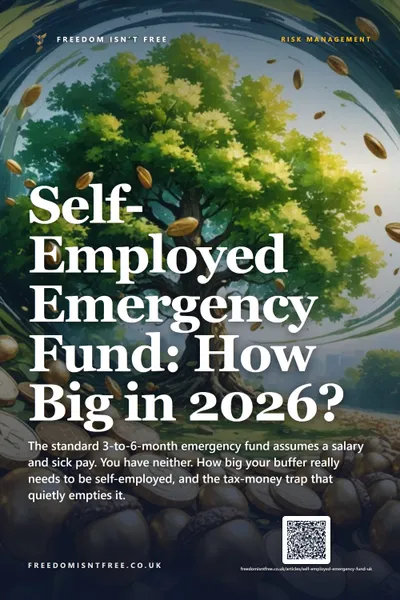
First, an emergency fund. This is the single most important thing a self-employed person can hold, and it does double duty: it covers the lumpy-income months and it covers the sick days the state will not. Aim higher than the standard employee advice, because your income is less predictable and your sick pay is zero. Our self-employed emergency fund guide covers how big.
Second, a pension. Once the buffer is solid, replace the employer pension you lost. A SIPP or personal pension with the tax relief claimed properly is the closest you get to an employer match doing the work for you.
Third, insurance, but only for catastrophe. This is where I part company with a lot of self-employed advice, which pushes income protection as a near-essential. I am sceptical of it.
That is a personal view, not a blanket rule. If you have dependents and no buffer, income protection for the self-employed is worth understanding before you decide. But build the emergency fund first. It is the protection that pays out instantly, on every kind of problem, with no claim to argue.
Frequently Asked Questions
What benefits can I claim if I am self-employed?
The main ones are Universal Credit (a means-tested top-up for low-income households), New Style Employment and Support Allowance if you cannot work through illness, and Maternity Allowance if you are having a baby. Universal Credit considers your whole household and savings, so a sole trader with a working partner or a cash buffer may not qualify. None of them replaces a salary; they are a floor, not a wage.
What can I claim if I am self-employed and off sick?
There is no Statutory Sick Pay for the self-employed. The fallback is New Style ESA, which depends on your National Insurance record rather than your savings, so your Class 2 contributions are what make you eligible. You may also get Universal Credit on top if your household income is low enough. In practice, for a short illness, your own emergency fund will reach you faster than either.
Who is eligible for the 500 pound one-off payment?
The £500 one-off payment many people still search for was a Covid-era support payment for working households on tax credits, paid in 2021. It is no longer available, and the Self-Employment Income Support Scheme (SEISS) that supported the self-employed during the pandemic has also closed. There is no current equivalent standing payment.
What are the new HMRC rules for the self-employed?
The biggest change coming is Making Tax Digital for Income Tax, which from April 2026 requires sole traders and landlords with qualifying income over £50,000 to keep digital records and file quarterly updates. The threshold drops to £30,000 in April 2027 and £20,000 in April 2028. See our Making Tax Digital guide for whether and when it applies to you.
Is being self-employed worth it without the benefits?
It can be, but only if you price the lost benefits in. An employer effectively pays for your pension, sick pay, holiday and redundancy on top of your salary. A self-employed income that only matches an employed salary is therefore a real-terms pay cut. The freedom can be worth that, but go in with the maths done, a bigger emergency fund, and a pension you fund yourself.
Sources
Prefer to watch?
We turn these money breakdowns into short videos
A few a week, plain-English UK money. If you would sooner watch than read, follow along:
Enjoying the content?
If this site has been useful, a coffee goes a long way.
Browse more articles
Browse all