


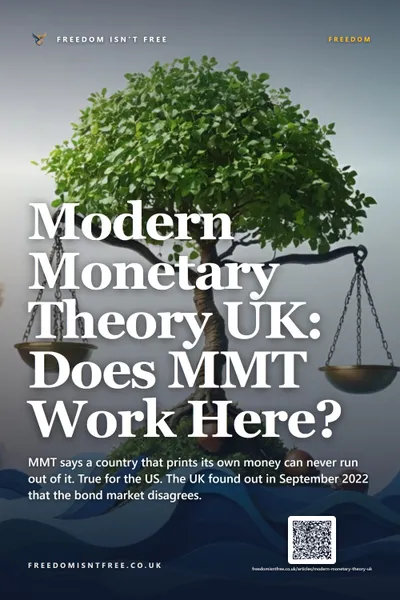


Modern Monetary Theory UK: Does MMT Work Here?
MMT says a country that prints its own money can never run out of it. True for the US. The UK found out in September 2022 that the bond market disagrees.
Cite this article
Freedom Isn't Free (2026) Modern Monetary Theory UK: Does MMT Work Here?. Available at: https://freedomisntfree.co.uk/articles/modern-monetary-theory-uk (Accessed: 21 September 2026).
Italicise the article title in your bibliography. Accessed date set to today.
TLDR
- Modern monetary theory says a government that issues its own currency cannot be forced into bankruptcy in that currency. The real limit on spending is inflation and the supply of workers, materials and energy, not running out of money.
- MMT reframes tax: it does not "fund" spending so much as destroy money and free up real resources. The job guarantee is its flagship policy, using public employment as a buffer stock.
- The catch for the UK is that sterling is not the world reserve currency and Britain imports heavily, so a falling pound imports inflation fast. The bond market disciplines the UK in a way MMT downplays.
- September 2022 is the worked example: the mini-budget sent gilt yields spiking, the pound to a record low, and the Bank of England into an emergency intervention to stop pension funds collapsing. That is the constraint, live.
MMT claim vs UK reality
| MMT claim | The UK catch |
|---|---|
| A currency issuer cannot go bankrupt in its own currency | True, and broadly accepted. Britain borrows in sterling it controls. |
| The only real limit is inflation and real resources | True, but the limit arrives faster for an import-heavy economy via the exchange rate. |
| The bond market is a price-taker the state can overrule | September 2022: gilt yields spiked, the pound hit a record low, the Bank had to intervene. |
| Tax manages inflation, it does not fund spending | Useful framing, but most economists reject the stronger version for a non-reserve currency. |
Modern Monetary Theory UK: Does MMT Work Here?
Modern monetary theory gets framed two ways: as the economics that finally proves the state can pay for everything, or as a crank theory that ends in Weimar wheelbarrows. Both are caricatures. The serious version sits in between, and the question almost nobody answers properly is the only one that matters for a British reader. Does MMT actually apply here, in a mid-sized open economy that does not print the world's reserve currency?
That last part is the whole game. Most popular MMT writing is American, and the United States plays by rules the UK does not. So this piece steelmans what MMT genuinely claims, then gives the real UK limits, with one concrete date attached: September 2022, when Britain ran a small live experiment in testing the bond market's patience and lost.
What MMT actually claims
Start with the core claim, because it is narrower and harder to dismiss than the slogans suggest. A government that issues its own free-floating currency cannot be forced to default on debt denominated in that currency. It can always create the pounds to make a sterling payment. The UK can no more "run out of pounds" than a scorekeeper can run out of points.
That part is an accounting fact, and mainstream economists broadly accept it. Britain is not Greece, which borrowed in euros it could not print. The UK borrows in sterling it controls. Bankruptcy in the household sense, where the bailiffs arrive because the cheque bounced, is not the binding risk for a currency issuer.
From there MMT makes its contested move. If solvency is not the limit, the real constraint on government spending is inflation, which is to say real resources. You can only buy what exists to be bought. The economy has so many workers, so much steel, so much electricity and warehouse space. Spend beyond what they can supply and you get inflation, not insolvency. "Can we afford it" becomes "are the workers and materials available, and if not, who gets crowded out". That is a genuinely different question from "is there money in the pot".
Where MMT comes from
Modern monetary theory is newer as a label than as a set of ideas. Its roots run back to chartalism, the theory in Georg Friedrich Knapp's 1905 book "The State Theory of Money" that money is a creature of law rather than a commodity. The state decides what settles a tax debt, and that is what gives the currency its value. Alfred Mitchell-Innes added the credit view of money in 1914, and Abba Lerner's "functional finance" in the 1940s argued a government should judge its budget by its effect on inflation and jobs, not by whether it balances. Hyman Minsky on financial instability and Wynne Godley's sectoral-balances accounting supply the rest of the plumbing.
The modern movement was built mostly in the 1990s and 2000s. The financier Warren Mosler is usually credited with reviving the chartalist case, the Australian economist Bill Mitchell coined the phrase "modern monetary theory", and L. Randall Wray wrote it up as a textbook in "Modern Money Theory: A Primer" (2015). Most of the academic work clustered around the University of Missouri-Kansas City and the Levy Economics Institute at Bard College. MMT reached a mass audience in 2020 through Stephanie Kelton's bestseller "The Deficit Myth"; Kelton advised Bernie Sanders, which is part of why the theory now reads as a project of the American left. Pavlina Tcherneva is the economist most associated with its job-guarantee proposal.
Tax and the job guarantee
The second reframe is the one that makes people splutter. In the MMT model, a currency-issuing government does not need your tax to fund its spending. It spends first by creating money, and taxes afterwards to delete some of it. Tax destroys money rather than recycling it.
So what is tax for. Two things, in this telling. It creates demand for the currency, because you need pounds to settle your HMRC bill, which is what gives the paper its value. And it frees up real resources by reducing private spending power, so the state can use those workers and materials without bidding prices to the moon. Tax is a tool for managing inflation and distribution, not a piggy bank. You can see why this lands politically: it reframes "we cannot afford it" as a choice about who gets taxed and who absorbs the inflation, not a law of arithmetic. It is the same argument we make about why the UK won't tax wealth and about the case for a wealth tax that Gary Stevenson keeps pressing: the money exists, the political will to reach it does not.
The flagship MMT policy follows from the resource view: a job guarantee. The state offers a fixed-wage public job to anyone who wants one. In a downturn the scheme swells and props up demand; in a boom workers leave it for higher private wages and it shrinks. MMT calls this a buffer stock of labour, an automatic stabiliser that anchors the wage floor instead of letting unemployment do the disciplining. Agree or not, it is a coherent policy, not a free-lunch fantasy.
Does it apply to the UK?
This is where the American framing quietly stops working. The strong MMT claims are most defensible for the country whose currency the rest of the world is desperate to hold. The United States issues the global reserve currency. Oil is priced in dollars, central banks stockpile dollars, and when there is a panic the world buys dollars. That demand gives Washington enormous slack to run deficits without the currency cracking.
Sterling has no such privilege. The pound is respected but mid-tier, and the world can take it or leave it. Britain also runs a large, persistent current account deficit: we import a huge share of what we consume, including most of our energy, much of our food and a long list of manufactured goods. That import dependence is the hinge American MMT writers gloss over.
The mechanism is simple. If a UK government spends in a way that spooks holders of sterling, the pound falls. A weaker pound makes every import more expensive in sterling terms. Petrol, gas, food and raw materials all cost more, and that feeds straight into domestic prices. So the inflation constraint MMT acknowledges arrives faster for Britain than for the US, because it comes through the exchange rate, not just domestic capacity. The UK can hit the inflation ceiling while there is still slack in the labour market, simply because the currency moved. MMT's reply, that the central bank and tax can mop up the inflation, is real but slow, and markets do not wait for the policy lags.
The 2022 lesson in bond-market discipline
Then there is the bond market, which MMT tends to wave away as a price-taker the state can always overrule. September 2022 is the cleanest UK rebuttal on record, so it is worth walking through.
On 23 September 2022, Kwasi Kwarteng delivered the mini-budget: large unfunded tax cuts, no costings from the Office for Budget Responsibility. The market response was brutal and fast. Gilt yields spiked, with five-year borrowing costs posting one of their largest single-day jumps on record. Sterling fell to an all-time low against the dollar of around $1.03 on 26 September. This was not an MMT experiment in intent, but it functioned as one in effect: a government testing whether it could spend without the bond market's blessing.
It could not. The gilt sell-off detonated a hidden problem in pension funds running liability-driven investment, or LDI, strategies. As gilt prices collapsed, these leveraged funds faced collateral calls, sold gilts to meet them, drove prices down further, and triggered more calls. A doom loop. Evidence later examined by Parliament found some funds were hours from being wound up. The Bank of England stepped in on 28 September with emergency purchases of long-dated gilts, eventually offering up to £10 billion a day, and ran the operation until 14 October purely to stop a financial-stability crisis. (For how the Bank's main lever works in normal times, see the base rate explained.) The policy was then dismantled: the 45p top-rate reversal came on 3 October, Kwarteng was sacked on 14 October, and Jeremy Hunt reversed most of the package on 17 October.
The point for MMT is precise. The UK never came close to "running out of pounds". The constraint that actually bit was the price of borrowing and the exchange rate, exactly the channels MMT treats as secondary. And the inflation context made it worse. CPI peaked at 11.1% in October 2022, a 41-year high, so this was not a quiet moment with idle resources begging to be used. The cost-of-living crisis was the real-resource ceiling MMT warns about, arriving in full force.
Where MMT still earns its keep
None of that makes MMT useless, and this is the part the deficit hawks get wrong. MMT's lasting contribution is to kill the lazy line that "the government has run out of money, so we cannot afford it". A currency issuer does not run out of its own money. When a politician says the country cannot afford decent social care, or to insulate homes, or to keep nurses' pay level with inflation, or a universal basic income, what they usually mean is that they are not willing to raise the tax or tolerate the inflation that doing it would require. That is a political choice about who bears the cost, dressed up as an iron law of the household budget. Stripping off that disguise is genuinely useful in the austerity debate.
But the fair verdict is that MMT is heterodox, and most mainstream economists reject its stronger claims for good reasons, especially for a country like the UK. Inflation is a hard constraint, not a footnote, and 2022 proved the bond market can impose its own discipline long before the printing press theoretically runs dry. The useful half of MMT is the framing of the real constraint. The dangerous half is treating it as far away when, for an import-heavy non-reserve economy, it is closer than it looks.
Frequently Asked Questions
What is modern monetary theory in simple terms?
It is the idea that a government which issues its own currency, like the UK with sterling, can never be forced to go bankrupt in that currency because it can always create more. The real limit on spending is not money but inflation: you can only buy the workers, materials and energy that actually exist. Spend beyond that and you get rising prices, not a bounced cheque.
What is the difference between MMT and Keynesian economics?
Both back government spending to support demand in a downturn, so they overlap in practice. The split is over framing. Mainstream Keynesians still see tax and borrowing as funding the state and worry about debt sustainability and bond markets. MMT says the currency issuer spends first and taxes afterwards, so the only true ceiling is inflation. Keynesians treat the deficit as a constraint to manage; MMT treats it as a residual that mostly takes care of itself.
Is MMT debunked?
Not exactly, but its strong claims are not accepted by the mainstream. The narrow point, that a currency issuer cannot be forced to default in its own currency, is just accounting and is widely agreed. The contested claim is that this gives governments far more spending room than they think. Critics, and the September 2022 UK episode, argue the inflation and bond-market constraints bite much sooner than MMT implies, especially for a non-reserve economy.
Why do economists say MMT is wrong?
The main objections are that MMT underrates how fast inflation can run out of control, that it assumes the central bank and politicians can fine-tune tax to cool an overheating economy in real time, which is politically unrealistic, and that it downplays the bond market and the exchange rate. For an import-heavy country like the UK, a falling pound imports inflation quickly, so the "just manage the inflation" answer is harder than it sounds.
Disclosure: This article is general economic commentary and education, not financial or investment advice. It describes a contested, heterodox school of macroeconomic thought and the mainstream objections to it; it is not an endorsement of any policy or party. Figures for the September 2022 episode and the October 2022 inflation peak are drawn from the Bank of England, the Office for National Statistics, and the House of Commons Library, and are accurate as of those published sources. Capital is at risk when investing, and nothing here is a recommendation to buy, sell, or hold any asset.
Sources
Prefer to watch?
We turn these money breakdowns into short videos
A few a week, plain-English UK money. If you would sooner watch than read, follow along:
Enjoying the content?
If this site has been useful, a coffee goes a long way.
Browse more articles
Browse all