



Why the UK Won't Tax Wealth
A working professional on £110k pays 60% at the margin. A duke passing farmland through the right relief pays close to nothing. Britain taxes income, not wealth. By design.
Cite this article
Freedom Isn't Free (2026) Why the UK Won't Tax Wealth. Available at: https://freedomisntfree.co.uk/articles/why-the-uk-wont-tax-wealth (Accessed: 10 October 2026).
Italicise the article title in your bibliography. Accessed date set to today.
TLDR
- Progressive taxation was supposed to redistribute resources from the wealthiest to the poorest. It does not. Britain taxes income heavily, but the wealth that sits in mansions, farms, landed titles and family trusts mostly escapes the system.
- The current marginal rate on a working professional earning £110,000 is 60%. The effective rate on the inherited estate of a duke who passes farmland through Agricultural Property Relief is, until April 2026, zero.
- Whenever the country talks about social care, the NHS, or housing, the answer the public reaches for is "tax wealth and big businesses". When the conversation turns to pensions, the answer becomes "we have to import workers". The two answers are inconsistent.
- A real wealth tax would do two things at once. It would force asset velocity (people sitting on capital have to make it productive or lose to the tax) and it would shift the burden of progressive taxation from earned income onto inherited capital. Neither of which is a politically easy sell.
Wealth taxes around the world
| Country | Threshold | Rate |
|---|---|---|
| Norway | ~£130,000 | 1.0-1.1% |
| Spain | €700,000-€3m | 1.7-3.5% |
| Switzerland (cantonal) | Varies | 0.1-1.0% |
| France (property only) | €1.3m | 0.5-1.5% |
| United Kingdom | No annual wealth tax | 0% |
Working professionals on £100k+ pay 60% at the margin. Inherited landed estates routinely pay close to nothing.
Why the UK Won't Tax Wealth
Every time a major UK financial story breaks - the NHS, social care, council bankruptcies, the housing crisis - the comments fill with the same demand. Tax wealth. Tax big business. Make the rich pay their share. Even the Greens, the SNP and large parts of Labour have run on it. Voices like Gary Stevenson have built large audiences making the wealth-tax argument, and there is genuine cross-party appetite for a wealth tax in Britain, more than there has been in fifty years.
Then someone mentions the State Pension and the triple lock, and the answers shift completely. Suddenly the only thing anyone can suggest is that we have to keep importing working-age migrants because there is no other way to pay for it. Wealth doesn't enter the conversation.
That inconsistency is the heart of this piece. Britain does not tax wealth, in any meaningful way, on purpose. The tax code is built to extract money from earned income while leaving inherited capital largely untouched. The result is a system that calls itself progressive while protecting the wealthiest forms of wealth from the same redistributive logic it applies ruthlessly to wages.
Contents
- What progressive taxation was actually for
- Why income tax is not enough
- Where the wealth actually sits
- The Agricultural Property Relief loophole
- The pension exception that proves the rule
- What a real wealth tax could look like
- Why it won't happen quickly
- Frequently Asked Questions
What progressive taxation was actually for
Progressive taxation, from Adam Smith to Piketty, was a redistribution argument: take more from those with the most and fund public goods for the poorest. That is the principle. The execution is something else.
Britain's marginal rates climb steeply. A higher-rate taxpayer pays 40% income tax plus 2% National Insurance. The £100,000 threshold triggers the 60% tax trap as the personal allowance tapers. Higher earners face the additional rate of 45%. Most working professionals - doctors, senior engineers, fund managers, lawyers - are paying combined marginal rates of 45-62%.
A 62% marginal rate on a salaried doctor would, in the original Piketty argument, fund the redistribution. It does not. Most of the tax bill goes to running the state. And the people who hold the genuinely large stocks of UK wealth pay nothing remotely like 62% on the wealth they hold.
Why income tax is not enough
The structural problem is simple. Income is a flow. Wealth is a stock. Tax the flow and you take a slice of what flows in this year. The stock keeps growing untouched.
A working professional earning £200,000 is taxed on every pound every year. After tax they keep around £120,000. To accumulate £1 million of capital, they live on a fraction of post-tax income for a decade. Each year the cycle resets and the state takes its slice again.
A landowner sitting on £20 million of agricultural property earns no taxable income from simply owning it. The land appreciates. They live off the rental yield (or structured income from a family company), pay tax on that slice, and keep the £20 million capital base intact. Their wealth grows tax-free. When they die, the estate often passes through the tax system at near-zero rates.
The duke pays a far smaller share of their wealth in tax each year than the doctor pays of their salary. That is not progressive taxation. It is the opposite.
Where the wealth actually sits
The Office for National Statistics' Wealth and Assets Survey shows that the top 10% of UK households hold around half of all household wealth, roughly £8.4 trillion at the most recent count. Most of that is not held as cash or as taxable investment income. It is held in:
- Property - primary residences, second homes, buy-to-let portfolios, country estates
- Land - agricultural land, woodland, sporting estates, development land banks
- Private business equity - family companies passed down through generations, often using business property relief
- Pensions - taxed eventually but with massive deferral and exemptions
- Trusts - the legal instrument that has done more to shield UK family wealth from inheritance tax than anything else
- Art, antiques, classic cars, jewellery - chattels that escape capital gains tax until sold and often qualify for conditional exemptions
- Landed titles and historic estates - protected by reliefs intended to preserve the heritage and the families that hold it
None of this is taxed at the marginal rates that apply to a salaried professional. That is by design.
The Agricultural Property Relief loophole
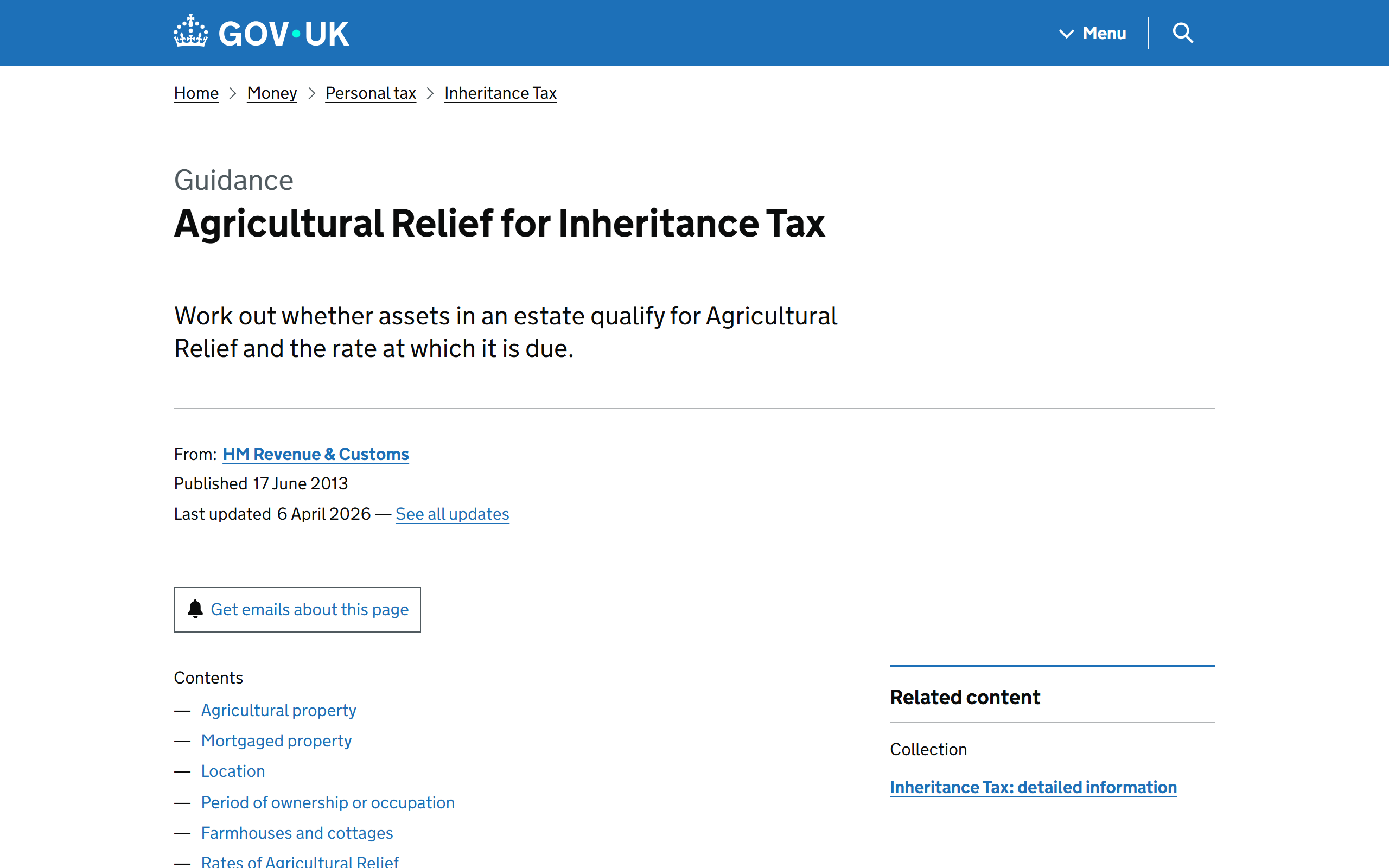
The clearest example is Agricultural Property Relief (APR), defined in Schedule 5 of the Inheritance Tax Act 1984. Until April 2026, APR allowed qualifying agricultural land to pass through inheritance tax at 100% relief - zero IHT, no upper limit. A duke holding £100 million of farmland could pass it to his heir and the Treasury collected nothing.
The same applies to Business Property Relief (BPR): 100% relief on family business shares held for at least two years. A £50 million family trading business passes tax-free.
Combine the two and a wealthy farming family or hereditary aristocrat can pass huge estates to their children paying no IHT. A working family inheriting their parents' £600,000 home in London or the South East can be hit with 40% IHT on anything above the nil-rate band.
The 2024 Autumn Budget capped APR and BPR at £1 million combined per estate, with 50% relief above that from April 2026 - the so-called "tractor tax" that produced months of NFU protests. The structure remains in place. Wealth held in farms, family businesses and landed estates still flows through inheritance with a far lighter burden than wealth held in a bank account or pension lump sum.
The Duke of Westminster's family is widely reported to have used trusts to transfer their £9 billion estate when the 6th Duke died in 2016, paying a fraction of the IHT a non-trust estate of that size would have. The trust structure is legal, well-known, and unavailable to anyone whose wealth sits in a bank account.
This is not a loophole that snuck in. It is the system as designed.
The pension exception that proves the rule
When the conversation turns to the State Pension and triple lock, the answer to fiscal pressure changes completely. The default is no longer "tax wealth, tax big business" but "we have to keep working-age immigration high to fund pensions, there is no other way".
This makes no sense unless the conversation has different rules depending on who benefits. Pensioners hold the wealth and the votes. The triple lock - State Pension rises by the highest of earnings growth, CPI inflation, or 2.5% - has compounded the State Pension well above wage growth for fifteen years. It is now the single largest line item in UK welfare spending and accelerating.
The political class that talks about taxing wealth elsewhere will not consider means-testing the State Pension, taxing pension wealth at death, or breaking the triple lock. The people who would lose are precisely the asset-owning, voting demographic that decides elections.
The result is a fiscal logic that runs in two contradictory directions. Tax the working-age earner to fund services. Import working-age migrants to fund pensions. Leave the underlying wealth held by the over-60s untouched.
For the demographics behind the triple lock argument, see our piece on why the triple lock is unsustainable.
What a real wealth tax could look like
A serious wealth tax would not be a "make the rich pay" slogan. It would be a structured annual levy on net wealth above a high threshold. Several models exist.
Norway levies around 1% on net wealth above roughly £130,000 (NOK 1.7 million), rising to 1.1% above a higher threshold. It raises real revenue and has not, despite predictions, caused mass capital flight. Norway also recycled its North Sea oil into a sovereign wealth fund - the other side of the same redistribution argument.
Spain has a wealth tax (impuesto sobre el patrimonio) plus a temporary "solidarity tax" on net wealth above €3 million, at progressive rates between 1.7% and 3.5%. France abolished its general wealth tax in 2018 but kept a property-specific version.
Switzerland has had cantonal wealth taxes since the 19th century, at rates between 0.1% and 1% on net wealth.
A UK version at 1% above £10 million of net wealth would raise serious revenue with no impact on the bottom 99% of households. At 2% above £20 million it would extract a meaningful slice from the top and force asset-rich households to either generate income from their assets or sell some to pay the bill.
A wealth tax would also create asset velocity. People sitting on capital that produces no income (empty London properties, idle land, family heirlooms) would either deploy it productively or part with it. The economy benefits when capital moves toward productive use. Idle wealth hoarded across generations is a drag on growth.
Wealth taxes are administratively complex. Valuation is hard. Assets can be moved offshore. None of this is fatal. The current system already values wealth at probate, at sale, and for capital gains. The infrastructure exists. The political will does not.
Why it won't happen quickly
The British political economy is built around protecting inherited wealth. Major land-owning families have direct representation in the House of Lords. The largest party donations come from asset-rich households and family trusts. The newspapers most-read by the over-60s are owned by billionaires and family dynasties.
A serious wealth tax would hit the people who write the rules. Every time one has been seriously discussed in Britain - the 1974 Labour proposal, the 2020 Wealth Tax Commission, the 2024 IHT changes - the press response has been ferocious and proposals have been watered down or shelved.
This is not a conspiracy. It is the visible operation of political power. People with wealth defend wealth. The cost of organising a counter-coalition is high, the benefits diffuse, the time horizon long.
But the maths is starting to bite. The triple lock alone now consumes more than £125 billion a year and rising. Council bankruptcies, NHS waiting lists, and the housing crisis all need money. The income tax base has been squeezed for fifty years, most recently through frozen tax thresholds that quietly drag more workers into higher bands every year. There is nowhere left to find revenue except where the wealth actually sits.
Whether that translates into policy in five years, twenty, or never is the political question of the next generation. The answer matters for everyone who works for a living rather than inherits one.
Frequently Asked Questions
Does the UK have a wealth tax?
Not a general one. The closest equivalents are inheritance tax (charged at death, with a long list of reliefs and exemptions), capital gains tax (charged on the disposal of assets, with the main residence and most pension assets exempt), and council tax (a stamp on property, frozen in 1991 valuations and barely progressive). None of these is an annual levy on net wealth in the way Norway, Spain or Switzerland operate.
Why don't wealthy farmers pay inheritance tax?
Until April 2026, APR and BPR allow qualifying agricultural land and family business shares to pass at death with 100% relief, regardless of value. From April 2026 the combined relief is capped at £1 million, with 50% relief above. The 50% rate produces an effective IHT of 20% on excess wealth - half what a non-farming family pays on a £600,000 inherited home.
What is the difference between income tax and a wealth tax?
Income tax is charged on what you earn in a year. Wealth tax is charged on what you own at a point in time. A worker earning £80,000 with no savings pays income tax every year and never pays wealth tax. A landowner with £20 million of property and £30,000 of declared income pays minimal income tax and (currently) no wealth tax.
Wouldn't a wealth tax cause capital flight?
Some, but the evidence from Norway, Switzerland and Spain suggests not at the scale opponents claim. The bulk of asset-rich UK wealth - land, property, family businesses, listed equities held in pensions - cannot easily be moved. A £10 million threshold would exempt almost everyone whose wealth is mobile.
What's the political case against a wealth tax?
The standard arguments: it punishes saving, is administratively complex, can cause capital flight, overlaps with existing taxes (CGT, IHT, council tax), and is hard to value illiquid assets. Each is solvable with sensible thresholds and design. The deeper argument, rarely stated, is that the people who fund and dominate British politics are precisely the people a wealth tax would hit.
Read Next:
- Gary Stevenson's Wealth Tax - the public campaign making the case.
- Frozen Tax Thresholds - fiscal drag as a stealth tax on income.
- The 60% Tax Trap - what working professionals already pay above £100,000.
- The Case for a UK Sovereign Wealth Fund - the other side of the redistribution question.
Further Reading:
Debt: The First 5,000 Years - David Graeber - The history of debt and the financial systems built to preserve inherited capital across millennia. Essential context for why the modern UK tax code looks the way it does. (Affiliate link - we may earn a small commission at no extra cost to you.)
A Short History of Financial Euphoria - John Kenneth Galbraith - A short, sharp account of how financial systems protect their winners and punish their losers across cycles of speculation. Galbraith on the social purpose of taxation is still unmatched. (Affiliate link - we may earn a small commission at no extra cost to you.)
Prefer to watch?
We turn these money breakdowns into short videos
A few a week, plain-English UK money. If you would sooner watch than read, follow along:
Enjoying the content?
If this site has been useful, a coffee goes a long way.
Browse more articles
Browse all