







How to Consolidate Your ISAs: A UK Cleanup Guide
Five ISAs across five platforms isn't diversification. It's admin debt - overlapping funds, fee bloat, and rebalancing decisions you never make. The cleanup is simpler than you think.
Cite this article
Freedom Isn't Free (2026) How to Consolidate Your ISAs: A UK Cleanup Guide. Available at: https://freedomisntfree.co.uk/articles/consolidate-isas-uk (Accessed: 10 October 2026).
Italicise the article title in your bibliography. Accessed date set to today.
TLDR
- Multiple ISAs in the same year became legal in April 2024, but having five accounts is still account bloat, not diversification
- Always use an ISA transfer initiated by the receiving provider - never withdraw and re-deposit, which costs you the allowance
- The cleanup playbook: list every account, pick one or two destination platforms, transfer in-specie where possible, then sell the overlapping holdings
- Don't consolidate workplace pensions, defined benefit schemes, or Lifetime ISAs without checking what you would lose first
Hidden US weighting from overlapping global funds
Stacking 'global' funds rarely adds diversification. It usually adds US weight.
How to Consolidate Your ISAs: A UK Cleanup Guide
If you opened a Cash ISA in 2017, a Vanguard Stocks and Shares ISA in 2020, a Trading 212 ISA in 2023, and have been picking up Premium Bonds along the way, you have collected the kind of mess most UK investors end up with. Working out how to consolidate ISAs in the UK is the most common housekeeping job we get asked about: multiple wrappers, multiple platforms, overlapping holdings, and a half-remembered plan that started with a single fund.
This guide is the cleanup playbook. We will cover what you can and cannot legally consolidate, how to transfer an ISA without losing your allowance, what to do with overlapping holdings, and when leaving things alone is the right call.
Contents
- Why simplify?
- Can you have multiple ISAs in the UK?
- How to transfer an ISA without losing the allowance
- The 5-step ISA cleanup playbook
- Overlapping holdings: S&P 500 + global tracker
- Cash sitting outside the market
- When not to consolidate
- Frequently asked questions
Why Simplify?
Three real costs come from running five accounts when one would do the job.
Mental overhead. Every account is a login, a statement, a contribution decision, and a rebalancing question. Multiply by five and the household admin becomes a chore you avoid, which means decisions get deferred and money sits in cash instead of working.
Fee bloat. Many platforms charge a flat or percentage fee per account. £4 a month on a £5,000 ISA is roughly 1% drag, before the fund TER. Spread across multiple platforms, you can pay 0.30-0.40% in fees on money that should be costing you 0.10%.
Allocation drift. Multiple wrappers with overlapping funds creates accidental concentration. A 50/50 split between an S&P 500 ETF and an MSCI World ETF sounds diversified - it isn't. MSCI World is already 70% US, so you end up at roughly 85% US instead of the 60% the world market actually weighs.
The reward for cleaning up is not just tidiness, it is fewer accidental bets and a lower fee load over a 30-year horizon.
Can You Have Multiple ISAs in the UK?
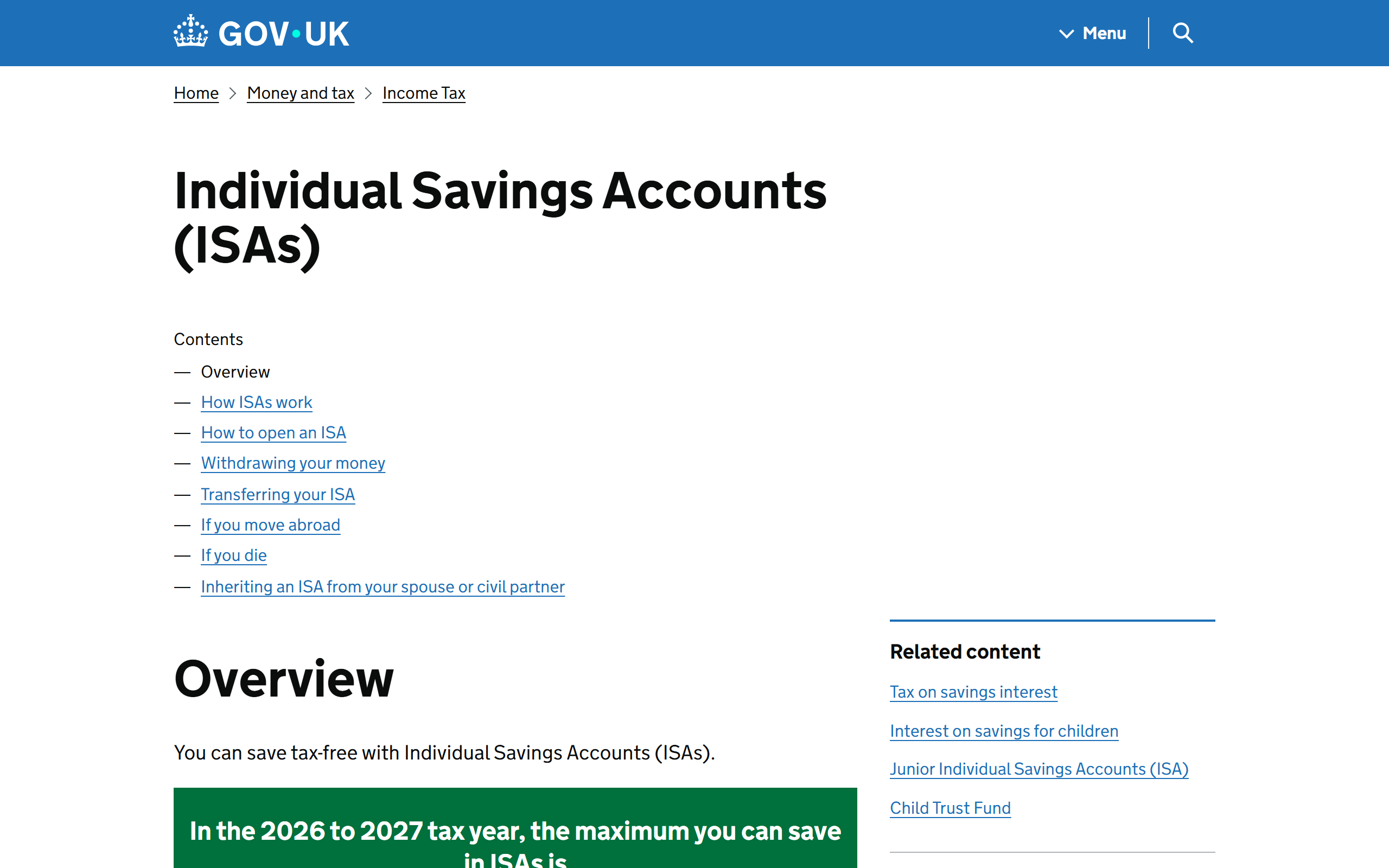
Yes. The rules changed on 6 April 2024. You can now open and contribute to multiple ISAs of the same type in a single tax year, including multiple Stocks and Shares ISAs and multiple Cash ISAs, as long as your total contribution across all of them stays within the £20,000 annual limit. The HMRC guidance on individual savings accounts sets out the eligibility, allowance, and reporting rules in full.
What you cannot do is exceed the allowance. HMRC tracks contributions across providers, so paying £15,000 into one ISA and £10,000 into another in the same year is a £5,000 over-contribution that HMRC will eventually flag and unwind.
The fact that multiple ISAs are now legal does not mean they are useful. The rule was relaxed for flexibility, not because spreading your money helps you. For most retail investors, one Cash ISA and one Stocks and Shares ISA is the right number. The rest is account proliferation dressed up as diversification.
How to Transfer an ISA Without Losing the Allowance
This is the most common mistake people make when consolidating. Never withdraw money from an ISA and re-deposit it into another ISA. That counts as a fresh contribution and eats into your £20,000 allowance.
The correct mechanism is an ISA transfer, which you initiate at the receiving platform. The new platform contacts your old platform, the holdings (or cash) move across, and your previous-year allowances stay intact. HMRC's official ISA transfer rules lay out exactly how this should be handled.
Three things to know:
- Cash ISAs can be transferred to Stocks and Shares ISAs and vice versa. No restriction on direction.
- Partial transfers of current-year money are now allowed. Before April 2024 you had to move the entire current year's contributions in one go. Today, you can split a current-year ISA across providers if you want.
- In-specie transfers preserve your holdings. Most modern UK platforms support transferring the actual fund or share rather than selling and reinvesting. Use this where possible to avoid being out of the market for the days a cash transfer takes.
Transfer time is typically 2-15 working days for cash transfers. In-specie transfers can take 4-6 weeks because the platforms have to coordinate the underlying fund movements. None of them will charge you for an incoming transfer; some platforms still charge for outgoing transfers, but most have phased that out.
The 5-Step ISA Cleanup Playbook
Follow this in order.
Step 1: List everything
Open a spreadsheet. Columns: Provider, Wrapper Type, Current Balance, Holdings, Annual Fee, This Year's Contributions. List every ISA, every GIA, every Premium Bond holding, every workplace pension. The first time you see it on one page is usually the moment the simplification problem becomes obvious.
Step 2: Pick your destination platforms
You probably need two platforms maximum. One for cash (or Premium Bonds), one for investments. The DIY platforms that win on cost for most UK investors:
- Trading 212: zero platform fees on ISA and GIA, large fund range, automated bed-and-ISA. Best for under £100k.
- Vanguard: 0.15% capped at £375/year. Limited to Vanguard funds, but their TERs are some of the lowest available. Best for pure index investors who want the path of least resistance.
- InvestEngine: zero fees on commission-free ETFs, growing platform.
- Hargreaves Lansdown / Interactive Investor: higher fees but better customer service and broader fund range. Worth it if you hold a wide mix of investment trusts and want hand-holding.
Step 3: Pick your investments
Decide what you actually want to hold. For most people, this is one global equity tracker. Nothing more is needed for the equity portion. SPDR ACWI (0.12% TER), Invesco FTSE All-World (0.15%), and Vanguard FTSE Global All Cap (0.23%) all do the same job.
If you want a bond allocation, add one global aggregate bond ETF. That is the entire portfolio.
Step 4: Initiate transfers
For each ISA you want to consolidate, log into the destination platform and open an "ISA transfer" form. You will need:
- Your existing ISA's account number and provider name
- Whether you want a cash transfer (the holding is sold and the proceeds move) or an in-specie transfer (the holdings move directly)
Submit it and walk away. Do not move money out of the old account yourself. The platforms talk to each other.
Step 5: Sell the leftovers and rebuild
Once everything is in one place, sell the holdings you no longer want (overlapping S&P 500 ETFs, themed funds you got tempted by, single stocks you have stopped following) and buy the global tracker with the proceeds.
Inside a Stocks and Shares ISA, no Capital Gains Tax applies, so you can sell freely. Outside an ISA, watch the £3,000 CGT allowance carefully and stagger sales across tax years if needed.
Overlapping Holdings: S&P 500 + Global Tracker
This is the most common accidental position. You bought an S&P 500 fund first, then bought an MSCI World or FTSE All-World tracker thinking you were diversifying. You weren't, much.
The arithmetic:
- 50% in S&P 500 + 50% in MSCI World (which is ~70% US) = ~85% US
- 100% in MSCI World = 70% US
- 100% in FTSE All-World (includes emerging markets) = 60% US
If you want a global allocation, hold one global fund. The S&P 500 sleeve is a US overweight bet that you may or may not want, but you should make it deliberately, not by accident.
Same goes for gold sleeves, themed ETFs (clean energy, AI, biotech), and country-specific funds (UK, Japan). Each is a tactical bet. Hold them only if you can articulate why they exist, what they are meant to do, and at what point you would sell them.
Cash Sitting Outside the Market
If you have a Cash ISA and Premium Bonds and an unallocated cash balance in your investment platform, you almost certainly have too much cash overall.
The clean structure:
- Emergency fund: 3-6 months of essential outgoings, in one place. Cash ISA or Premium Bonds, not both. Premium Bonds win on tax efficiency above the £1,000 / £500 personal savings allowance and offer instant access. Cash ISAs win on predictable rate.
- Investing money: anything beyond the emergency fund target, in your Stocks and Shares ISA, in the market.
If you are drip-feeding cash into your investing platform on a multi-year DCA schedule, you are market-timing under a different name. Vanguard's analysis of US data showed lump-sum investing beats DCA in roughly 67% of 12-month windows. If you cannot stomach a lump sum, compress the DCA window: six months of weekly buys, not three years of monthly.
When Not to Consolidate
Some accounts should stay where they are.
- Workplace pensions. The employer is contributing on your behalf. You cannot transfer to a new workplace pension at a different employer. You can transfer to a SIPP, but you may lose employer contributions or favourable scheme features. Only consolidate workplace pensions you have left behind, and only after checking for guaranteed annuity rates or protected tax-free cash above 25%.
- Final salary or defined benefit pensions. Transferring out is almost always a mistake. The income guarantee is worth more than the transfer value, and any transfer worth over £30,000 legally requires regulated financial advice.
- Lifetime ISAs. The 25% government bonus does not survive a transfer to a non-LISA wrapper. You can transfer between LISA providers, but do not roll a LISA into a regular Stocks and Shares ISA.
- Help to Buy ISAs. Phased out, but if you still have one and intend to use the bonus, do not transfer it.
Frequently Asked Questions
Can I have two Stocks and Shares ISAs in the same year?
Yes. Since 6 April 2024, you can open and contribute to multiple ISAs of the same type in a single tax year. The £20,000 annual allowance still applies across all of them combined. The rule change does not mean you should - one is usually enough.
Will I lose my ISA allowance if I transfer between providers?
No. An ISA transfer initiated through the new provider does not count as a withdrawal or a new contribution. Your previous-year allowances stay intact. Only withdrawing money from an ISA and depositing it manually into another loses the allowance.
How long does an ISA transfer take?
Cash transfers usually take 2-15 working days. In-specie transfers (where the holdings move across without being sold) can take 4-6 weeks because the platforms have to coordinate the underlying fund movements. Stocks and Shares ISA to Cash ISA, or vice versa, takes around 30 days.
Will I pay tax when I sell holdings to consolidate?
Inside an ISA, no. Sell and rebuy freely. In a General Investment Account, capital gains over the £3,000 annual exempt amount are taxable. Use bed-and-ISA to migrate GIA holdings into the ISA shelter and stagger any large gains across tax years.
Should I consolidate my Cash ISA into my Stocks and Shares ISA?
Only if the money is no longer earmarked for emergencies or near-term spending. Cash ISAs and S&S ISAs serve different jobs. The right answer is to size each one to its job - emergency fund or long-term investment - and avoid keeping more cash than you actually need.
Further Reading:
The Little Book of Common Sense Investing - John Bogle - The case for one global low-cost tracker held forever, written by the man who invented the index fund. The clearest answer to the "do I really need all these accounts?" question. (Affiliate link - we may earn a small commission at no extra cost to you.)
Prefer to watch?
We turn these money breakdowns into short videos
A few a week, plain-English UK money. If you would sooner watch than read, follow along:
Enjoying the content?
If this site has been useful, a coffee goes a long way.
Browse more articles
Browse all