






Maxed Your ISA? A UK Guide to General Investment Accounts
Your ISA is full and the next pound has nowhere to hide. The GIA exposes every gain to HMRC. There's one move each April that quietly drains it back inside the shelter.
Cite this article
Freedom Isn't Free (2026) Maxed Your ISA? A UK Guide to General Investment Accounts. Available at: https://freedomisntfree.co.uk/articles/general-investment-account-uk-guide (Accessed: 10 October 2026).
Italicise the article title in your bibliography. Accessed date set to today.
TLDR
- A General Investment Account (GIA) is an unwrapped brokerage account with no contribution limits but no tax shelter
- Dividends are taxed once you exceed the £500 dividend allowance, and capital gains above £3,000 are taxed at 18% or 24%
- Use a GIA only after you have maxed your ISA (£20,000) and made full use of pension contributions worth claiming
- Bed-and-ISA each April lets you shift up to £20,000 of GIA holdings into the tax shelter, gradually emptying the GIA over time
How a GIA is taxed (2026/27)
| Tax | Allowance | Basic rate | Higher rate |
|---|---|---|---|
| Dividend tax | £500 | 10.75% | 35.75% |
| Capital gains | £3,000 | 18% | 24% |
| Savings interest | £1,000 / £500 | 20% | 40% |
Allowances slashed in recent years. ISA wraps all of this away tax-free.
Maxed Your ISA? A UK Guide to General Investment Accounts
The General Investment Account UK investors hold (the GIA) is the workhorse for any money you want to put into the market once your ISA and pension are full. There is no contribution limit and no tax shelter. You can hold the same shares, funds and ETFs as in your ISA, but every dividend, every gain, and every chunk of bond interest is in HMRC's view.
For most retail investors, that should be a problem to delay rather than embrace. The £20,000 Stocks and Shares ISA allowance and the pension annual allowance cover an enormous amount of investing for the average household. Only after those are exhausted does a GIA earn its place. This guide explains what a GIA is, how it is taxed in 2026/27, when it actually makes sense, and how to use Bed-and-ISA to gradually empty it back into the tax shelter over time.
Contents
- What is a General Investment Account?
- How a GIA is taxed
- When a GIA makes sense
- ISA, SIPP, GIA: the funding order
- Bed-and-ISA: shrinking your GIA
- How to open a GIA in the UK
- Frequently asked questions
What Is a General Investment Account?
A General Investment Account is an unwrapped brokerage account. Most UK investing platforms (Trading 212, Vanguard, AJ Bell, Hargreaves Lansdown, InvestEngine, Interactive Investor) offer one alongside their ISA and SIPP. The plumbing is the same. The real difference is that there is no tax wrapper around the holdings.
Within a GIA you can buy and sell:
- Individual shares (UK and international)
- Investment trusts
- ETFs and index funds
- Active funds
- Bonds and gilts
- Most things you can hold in an ISA
What you cannot do is shelter the income or growth from tax. Every distribution, every disposal, and every interest payment is taxable depending on your other UK income. The GIA is, in effect, a numbered account at a broker. Wrappers like ISAs and SIPPs sit on top of that same plumbing and instruct HMRC to ignore what happens inside them. A GIA gives no such instruction.
There is no contribution limit, no eligibility test, and no annual allowance. You can pay in £100 a month or £100,000 in a single transfer. UK residents over 18 can open one. There is no equivalent for under-18s outside Junior ISAs and bare trusts.
How a GIA Is Taxed
Three flavours of tax can apply to a GIA in 2026/27. Each has its own allowance and rate.
Dividend tax
You get a £500 dividend allowance per tax year. Dividends inside that band are tax-free. Above it:
- 10.75% if you are a basic-rate taxpayer
- 35.75% if you are a higher-rate taxpayer
- 39.35% if you are an additional-rate taxpayer
HMRC's tax on dividends page has the current bands and worked examples.
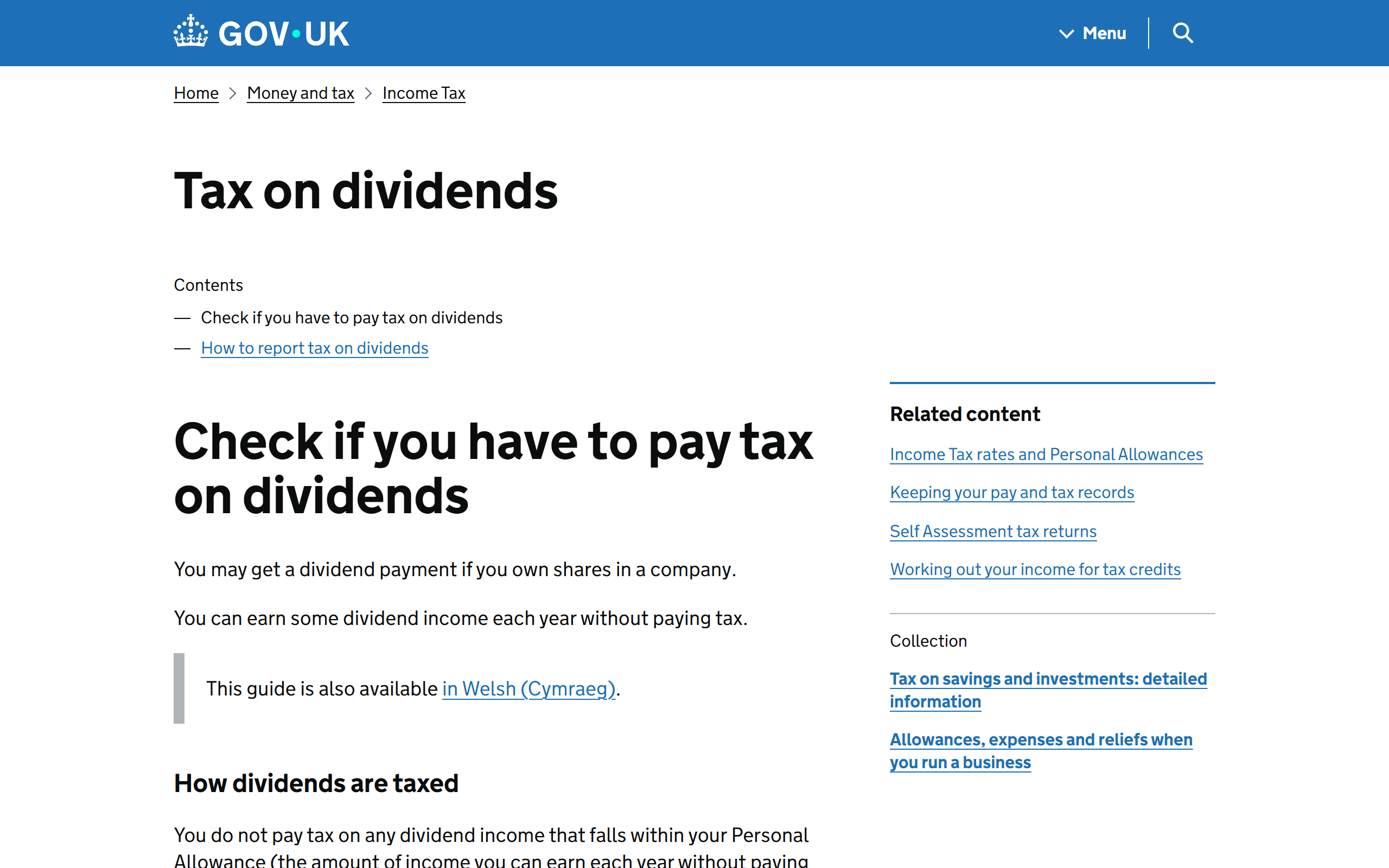
Dividends sit on top of your other taxable income for working out which band you fall into. A basic-rate earner who receives a chunky dividend can find part of it pushed into higher-rate territory.
Funds and ETFs that retain their income (accumulation share class) still distribute dividends in the eyes of HMRC, even though no cash hits your account. The reportable income is published in the fund's annual notes. This is one of the more obnoxious quirks of GIA investing: you can owe tax on income you never received.
Capital Gains Tax
When you sell a holding for more than you paid, the gain is liable for Capital Gains Tax, with the £3,000 annual exempt amount applied first. Above that:
- 18% on gains within your basic-rate band
- 24% on gains above it
The current bands are confirmed on HMRC's CGT rates page.
The £3,000 allowance has been cut from £12,300 in 2022/23 to £3,000 in 2024/25 and stays there for 2026/27. A relatively modest GIA can now generate enough annual gain to trigger a CGT event. Capital gains stack on top of your other income for working out which rate applies, the same way dividends do.
Crystallising a gain inside the allowance each year, then immediately reinvesting in a similar (but not identical) holding, is a legitimate way to use the £3,000. The "not identical" rule exists to dodge the 30-day same-share matching rules HMRC uses to stop people gaming the system.
Interest
If you hold cash inside your GIA, or you hold bonds and gilts that pay coupons, the interest counts as savings income. The personal savings allowance is £1,000 for basic-rate taxpayers, £500 for higher-rate, and £0 for additional-rate. UK gilts have a special quirk: their capital gain is fully exempt from CGT, but the coupon interest is still taxable.
Most GIA holders care most about dividends and CGT. Interest only becomes a real issue if you are running a meaningful cash position outside an ISA, in which case a Cash ISA usually beats the GIA on tax for the same yield.
When a GIA Makes Sense
There are five situations where a GIA earns its keep.
- You have already filled your £20,000 ISA. This is the obvious one. The next pound has to go somewhere.
- You have already maxed pension contributions worth claiming. For most basic-rate earners, this is the £60,000 annual allowance. For higher earners, the maths gets more complicated because of tapering, but the principle still applies: ISA and pension first, GIA second.
- You need access to the money before age 55-57. A pension locks the money up. A GIA does not, so it is sometimes the right home for medium-horizon money even if you have unused pension allowance. The trade-off is paying tax now versus paying tax (potentially less) later.
- You want to hold investments that are not allowed in an ISA. Some investment trusts, certain US-domiciled ETFs, and individual shares listed on smaller markets are GIA-only on some UK platforms.
- You are using bed-and-ISA over multiple years. If you inherited a portfolio, sold a business, or built up significant assets before discovering ISAs, a GIA is the holding pen while you migrate.
If none of those apply, you almost certainly do not need a GIA yet. Fill the ISA first.
ISA, SIPP, GIA: The Funding Order
The default funding order for a UK investor with no specific quirks looks like this:
- Workplace pension up to the employer match. Free money. Always take it before anything else.
- High-interest debt paid down. A 24% credit card APR beats any tax-advantaged equity return after fees.
- Emergency fund in a Cash ISA or savings account. Three to six months of expenses.
- Stocks and Shares ISA, up to £20,000. Tax-free growth, tax-free dividends, no CGT. The most flexible UK wrapper.
- Pension top-ups (SIPP or workplace AVC). Tax relief at your marginal rate, growth tax-free, taxed on the way out. Particularly powerful for higher-rate taxpayers and anyone in the 60% trap between £100k and £125,140.
- General Investment Account. Anything beyond the above.
Salary sacrifice into the workplace pension can sometimes leapfrog the ISA in the order, depending on whether your employer passes back their NI savings. The general principle holds: GIAs sit at the bottom because every other option offers some flavour of tax relief that the GIA cannot match.
Bed-and-ISA: Shrinking Your GIA
Bed-and-ISA is the most useful trick GIA holders have. Each April, when the new £20,000 ISA allowance opens, you sell up to that amount of GIA holdings, immediately rebuy the same (or near-identical) investments inside your ISA, and the holdings are now sheltered for life.
The mechanics:
- You crystallise any capital gain at the point of sale. If the gain falls within your £3,000 CGT allowance, no tax is due.
- Your platform usually does the sell-and-rebuy as a single transaction at one price, so you are not exposed to a market move between the two trades.
- The new ISA holdings start with a fresh acquisition price equal to the rebuy price, resetting your CGT clock.
Most platforms run this as an automated bed-and-ISA service. Trading 212, AJ Bell, Hargreaves Lansdown and Interactive Investor all support it. Some charge a small fee per holding. Vanguard requires you to do it manually.
The strategy works best when you can spread the GIA across several tax years. A £100,000 GIA can be migrated over five years using the £20,000 annual ISA allowance, harvesting up to £15,000 of CGT allowance along the way (£3,000 × 5 years). At the end of that five years, the entire portfolio is inside an ISA and immune to future tax on growth or income.
How to Open a GIA in the UK
Most UK investing platforms open a GIA either by default or as a tick-box during signup. The process takes ten minutes and needs:
- Photo ID (passport or driving licence)
- National Insurance number
- UK bank account
- A nominated debit card or bank transfer to fund the account
There is no minimum age beyond 18 and no income test. Most platforms have low or zero account fees on a GIA, and the same fund and trading charges as their ISA. Some, Trading 212 most notably, charge nothing at all to hold a GIA, while others such as HL or Interactive Investor charge a flat platform fee.
When choosing, check three things. Fund and ETF dealing fees. Platform or custody fees. The quality of the bed-and-ISA service if you plan to use one. A small monthly fee is fine on a £50,000 account but eats into a £1,000 starter pot.
Frequently Asked Questions
Is a General Investment Account the same as a brokerage account?
In substance, yes. A GIA is the UK term for an unwrapped brokerage account at an investing platform. Some platforms describe it as a "Trading Account" or "Investment Account" instead. The tax treatment is identical regardless of the label.
How much tax will I pay on £10,000 invested in a GIA?
It depends on what the £10,000 does. A typical global tracker yielding 1.5% pays roughly £150 a year in dividends, all inside the £500 dividend allowance and therefore tax-free at any income level. If the same £10,000 grew to £14,000 and you sold it, the £4,000 gain would consume your £3,000 CGT allowance and leave £1,000 taxable: £180 at the basic rate or £240 at the higher rate. Steady drip-feeding into a tracker creates very little annual tax. A trader churning positions is a different story.
Can I have a GIA and an ISA at the same time?
Yes. Almost every UK investor in this situation has both. The GIA is where money beyond the ISA goes, or where money waits before being moved into the ISA via bed-and-ISA. There is no rule that they have to be at the same provider, but having them on one platform makes bed-and-ISA painless.
Are gains in a GIA taxed if I do not sell?
No. Capital gains are only triggered on disposal. You can hold a GIA position for thirty years without paying any CGT, as long as you do not sell. Dividends, on the other hand, are taxed in the year they are paid, even if reinvested. This is why low-yield, growth-focused holdings often make the best GIA candidates.
Do I need to file a Self Assessment for my GIA?
You need to register for Self Assessment if your taxable dividends exceed £500 in a year, or if your taxable capital gains exceed £3,000 (or you sell more than £50,000 of assets, even at a loss). Below those thresholds and outside other Self Assessment triggers, HMRC does not need to know.
Further Reading:
Smarter Investing - Tim Hale - The UK index investor's blueprint, including how to think about wrappers, costs, and the long-term tax drag a GIA can introduce. (Affiliate link - we may earn a small commission at no extra cost to you.)
Prefer to watch?
We turn these money breakdowns into short videos
A few a week, plain-English UK money. If you would sooner watch than read, follow along:
Enjoying the content?
If this site has been useful, a coffee goes a long way.
Browse more articles
Browse all