Marriage Allowance UK: Claim £252 a Year From HMRC
Half a billion pounds of UK tax relief sits unclaimed every year. The form takes five minutes. HMRC will never chase you. One of you has to be under £12,570. That's it.
Cite this article
Freedom Isn't Free (2026) Marriage Allowance UK: Claim £252 a Year From HMRC. Available at: https://freedomisntfree.co.uk/articles/marriage-allowance-uk (Accessed: 10 October 2026).
Italicise the article title in your bibliography. Accessed date set to today.
TLDR
- Marriage Allowance lets you transfer £1,257 of your personal allowance to your spouse, saving them up to £252 in tax each year
- You qualify if one of you earns under £12,570 and the other is a basic-rate taxpayer
- You can backdate the claim up to four tax years, taking the lifetime saving above £1,200
- Apply free on GOV.UK in five minutes - no third-party 'reclaim' service needed
Marriage Allowance UK: Claim £252 a Year From HMRC
The Marriage Allowance UK is one of the simplest tax breaks on the books, and one of the most widely missed. HMRC's own figures suggest more than two million eligible couples never claim it. That is roughly half a billion pounds a year sitting on the table, free, waiting for a five-minute online form.
If one of you earns under £12,570 and the other is a basic-rate taxpayer, this article is for you. We will walk through exactly how the allowance works, what it pays, how to claim it without using a paid third party, and how to backdate four full tax years.
Contents
- What is the Marriage Allowance?
- Who qualifies for Marriage Allowance?
- How much can you save?
- How to apply (and avoid the rip-off middlemen)
- How to backdate up to four years
- When to cancel Marriage Allowance
- Marriage Allowance vs Married Couple's Allowance
- Frequently asked questions
What Is the Marriage Allowance?
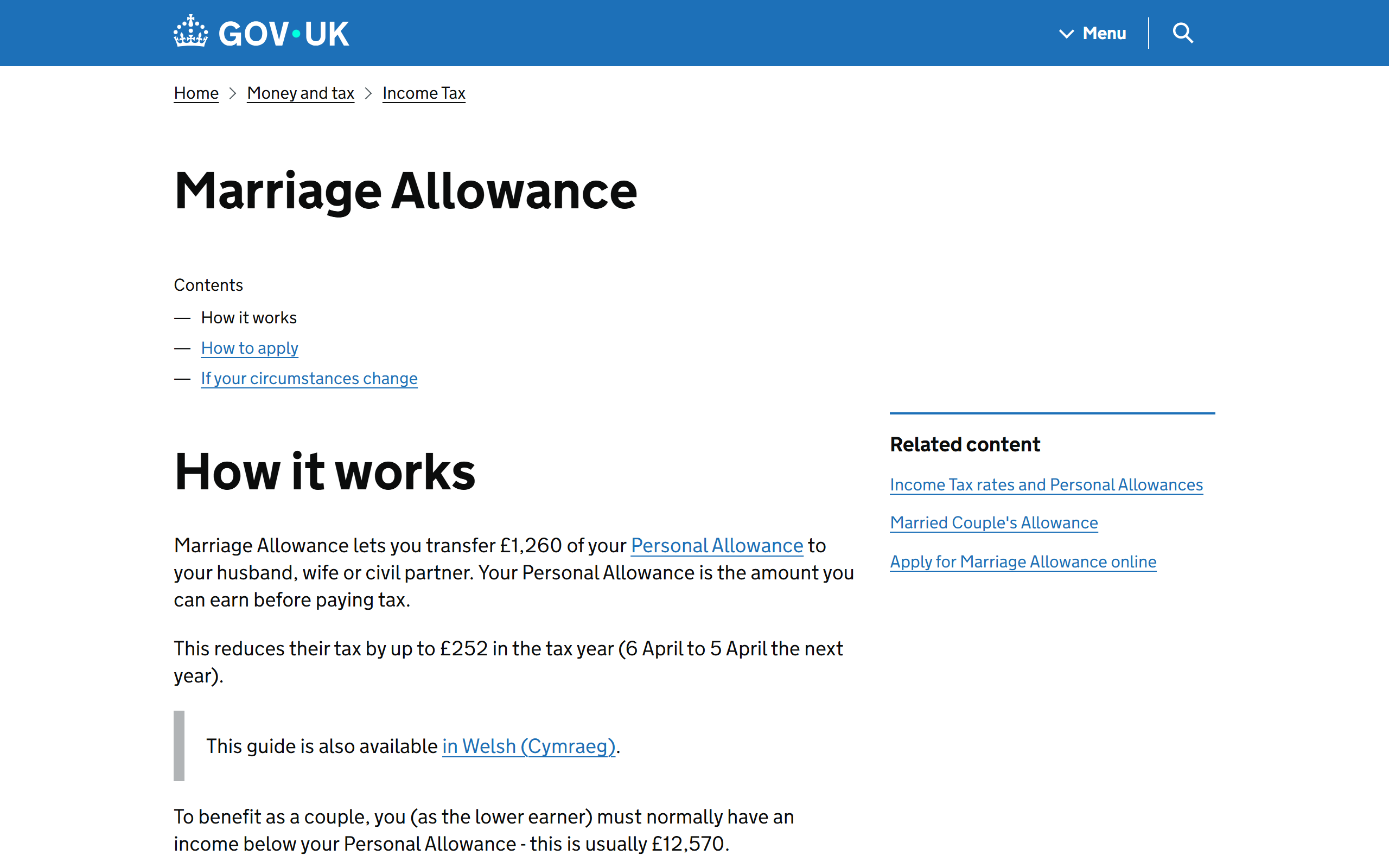
Marriage Allowance is a tax break that lets you transfer 10% of your personal allowance to your husband, wife, or civil partner. In the 2026/27 tax year that means moving £1,257 of tax-free allowance from one of you to the other.
The personal allowance is the slice of income everyone can earn each year before income tax kicks in. It has been frozen at £12,570 since April 2021 and is set to stay frozen until April 2028 - a textbook case of fiscal drag and stealth taxation. If one half of a couple is not using their full allowance because they are not earning enough to need it, the unused portion is wasted. Marriage Allowance is HMRC's mechanism for letting you reclaim part of that wasted relief by passing it across to your partner.
The receiving partner gets an enlarged personal allowance of £13,827 (£12,570 + £1,257) for the year. The giving partner has their personal allowance reduced to £11,313. Because the giver is by definition not earning enough to use their full allowance anyway, the swap is a clean win for the household.
Who Qualifies for Marriage Allowance?
You qualify if all four of the following apply:
- You are married or in a civil partnership. Cohabiting does not count, no matter how long you have lived together.
- The lower earner has annual income below the personal allowance (£12,570 for 2026/27). Income includes salary, self-employed profit, taxable pensions, and rental income, but not most ISA returns.
- The higher earner is a basic-rate taxpayer. In England, Wales and Northern Ireland that means total taxable income between £12,571 and £50,270. In Scotland the rules are slightly different: the recipient must pay the Starter, Basic, or Intermediate rate (income up to £43,662 in 2026/27).
- Both of you were born on or after 6 April 1935. If either of you was born before that date, you qualify for the older Married Couple's Allowance instead, which is more generous and uses different mechanics.
A common edge case: if the lower earner is right at the personal allowance threshold, transferring £1,257 of allowance to their partner can pull them just into income tax. The arithmetic still leaves the couple ahead overall, because the recipient saves more tax than the transferor pays, but it is worth running the numbers if both of you are close to the line.
How Much Can You Save?
In a single tax year, the maximum saving is £252 (£1,257 × 20% basic-rate tax). HMRC delivers this either through a tax code adjustment for an employed recipient, or as a reduction in the recipient's Self Assessment bill if they file a return.
Backdating multiplies the figure. You are allowed to claim for the current tax year plus the previous four, provided you were eligible across those years. The full back-claim from 2026/27 covers:
| Tax year | Saving |
|---|---|
| 2022/23 | £252 |
| 2023/24 | £252 |
| 2024/25 | £252 |
| 2025/26 | £252 |
| 2026/27 | £252 |
| Total | £1,260 |
A couple claiming for the first time in April 2026 with eligibility going back five years walks away with £1,260. The backdated portion arrives as a single cheque or BACS payment from HMRC, usually within a few weeks of approval.
Cumulative Marriage Allowance refund, backdated four years plus current
Source: HMRC Marriage Allowance rules, £252 per qualifying year
The amount transferred has been £1,257 since 2021/22 because the personal allowance has been frozen at £12,570. If the personal allowance ever rises again, the transfer figure (and therefore the saving) will rise with it.
How to Apply (And Avoid the Rip-Off Middlemen)
Applying is free. You do it directly on GOV.UK at gov.uk/apply-marriage-allowance. The process takes about five minutes if you have your details to hand. You will need:
- Your National Insurance numbers (both of you)
- Proof of identity for the lower earner: P60, recent payslip, passport, or one of a few other options listed on the form
- A Government Gateway login (you can create one on the spot if you do not have one)
The lower earner is the one who applies, because they are the one transferring their allowance. Once accepted, the change is applied automatically each tax year - you do not need to reclaim every April.
A quick warning. A small industry of third-party companies advertise themselves as "Marriage Allowance reclaim specialists" and offer to file the claim on your behalf in exchange for around 40-50% of the refund. They are not partnered with HMRC. They are not faster. They cannot get you anything you could not get yourself. The form on GOV.UK is straightforward and free. Avoid the middlemen and keep the full £1,260.
How to Backdate Up to Four Years
You can include backdating in your initial application. The GOV.UK form asks whether you want to claim for previous tax years and lets you tick the boxes for each one. HMRC then checks your records, confirms eligibility for each year, and issues the refund.
Eligibility is judged year by year. If one of you was earning above the basic-rate threshold three years ago, that single year is excluded but the others remain valid. The same applies if you were not married for the whole tax year - HMRC pro-rates based on the months you were a couple.
If you have already applied without backdating, you can still claim earlier years separately. Phone the HMRC income tax helpline on 0300 200 3300 or write to them with the details. A rebate covering several historic years can run into a few hundred pounds without much effort.
When to Cancel Marriage Allowance
The transfer carries on year after year until you actively stop it. You should cancel if:
- You divorce or your civil partnership is dissolved (HMRC will eventually catch up, but cancelling promptly avoids tax-code mess)
- The lower earner starts earning above the personal allowance, making the transfer wasteful
- The higher earner moves into the higher-rate band, which voids eligibility
Cancelling is also done on GOV.UK or by phone. If you both die or the marriage ends, the cancellation date matters for how much of the year HMRC counts as eligible. For a death, the surviving partner can choose to keep the transfer in place for the rest of the tax year if it benefits them.
Marriage Allowance vs Married Couple's Allowance
These are two different schemes and they do not overlap.
- Marriage Allowance is for couples where both partners were born on or after 6 April 1935. Worth up to £252 a year.
- Married Couple's Allowance is for couples where at least one partner was born before 6 April 1935. Worth between £427 and £1,108 in 2026/27, with the actual figure dependent on the higher earner's income.
If both schemes might apply to you, you take the older one. HMRC will not let you double-dip. The Married Couple's Allowance calculation is more involved because it tapers at higher incomes, so older couples should run their figures (or call HMRC) before assuming the headline number applies.
Frequently Asked Questions
How long does Marriage Allowance take to pay out?
The first tax-code change for the current year is usually applied within four to eight weeks. Backdated rebates take longer, often two to three months, because HMRC has to check eligibility for each historic year. Payment goes via cheque or BACS to the recipient.
Do I need to claim Marriage Allowance every year?
No. Once your application is accepted, the transfer rolls forward automatically each tax year until either of you cancels it or HMRC ends it because eligibility changes (for example, your incomes shift).
Can I claim Marriage Allowance if my spouse is self-employed?
Yes. The rules apply to total taxable income, not where it comes from. A self-employed partner with annual profit under £12,570 is eligible to transfer their allowance, and the receiving spouse can be employed, self-employed, or a mix.
Will Marriage Allowance affect my benefits or Universal Credit?
Marriage Allowance does not change either partner's gross income, only their tax position, so it is treated as neutral by most means-tested benefits including Universal Credit. It can in some edge cases change the partner's Adjusted Net Income, which matters for the High Income Child Benefit Charge and the £100k personal allowance taper. If you are anywhere near those thresholds, salary sacrifice into a pension is usually the bigger lever. Run the numbers if you are near that threshold.
Can same-sex couples claim Marriage Allowance?
Yes. The allowance has always applied equally to civil partners and to same-sex married couples. The same eligibility rules and backdating windows apply.
Further Reading:
I Will Teach You To Be Rich - Ramit Sethi - The clearest playbook for the kind of fifteen-minute household finance moves Marriage Allowance is, and the dozens of other small wins most people leave on the table. (Affiliate link - we may earn a small commission at no extra cost to you.)
Prefer to watch?
We turn these money breakdowns into short videos
A few a week, plain-English UK money. If you would sooner watch than read, follow along:
Enjoying the content?
If this site has been useful, a coffee goes a long way.
Browse more articles
Browse all