








Dividend Tax UK: Complete 2026/27 Guide
The dividend allowance was £2,000 in 2018. It's £500 today. A 75% cut almost nobody noticed because the news cycle moved on. The fix takes one phone call.
Cite this article
Freedom Isn't Free (2026) Dividend Tax UK: Complete 2026/27 Guide. Available at: https://freedomisntfree.co.uk/articles/dividend-tax-uk-guide (Accessed: 10 October 2026).
Italicise the article title in your bibliography. Accessed date set to today.
TLDR
- The dividend allowance for 2026/27 is just £500, down from £2,000 a few years ago.
- Above the allowance, dividends are taxed at 10.75% (basic), 35.75% (higher), and 39.35% (additional rate) after the November 2025 Budget rises.
- Dividends inside an ISA, SIPP, or JISA are fully tax-free and never touch your allowance.
- Sheltering shares, splitting holdings with a spouse, and Bed-and-ISA are the three biggest legal levers.
- Limited company directors should reassess the old low-salary-high-dividend playbook; the maths has shifted.
Dividend Tax UK: Complete 2026/27 Guide
If you hold shares, funds, or a slice of a limited company outside a tax wrapper, dividend tax UK rules now bite far harder than they did a few years ago. The annual dividend allowance has been cut from £2,000 to £1,000 to £500, while rates have crept up. The result is that ordinary investors and small company directors are quietly paying more tax on the same income.
This guide walks through how dividend tax works in 2026/27, the rates and allowances, a clear worked example, and the practical strategies that can keep more of your money where it belongs: with you.
Contents
- What Is the Dividend Tax in the UK?
- The Dividend Allowance for 2026/27
- Dividend Tax Rates Explained
- How Dividend Tax Is Calculated (Worked Example)
- Dividends Inside an ISA or SIPP
- Strategies to Reduce Dividend Tax
- Director and Limited Company Considerations
- How to Report Dividend Tax to HMRC
- Frequently Asked Questions
What Is the Dividend Tax in the UK?
A dividend is a slice of a company's after-tax profits paid out to shareholders. If you own shares in a FTSE 100 firm, a US-listed ETF that distributes income, or your own limited company, anything paid out as a dividend (rather than as salary or capital gain) sits in its own tax category.
HMRC treats dividends differently to earned income. They have their own rates, their own allowance, and their own quirks. They are added on top of your other income to work out which tax band the dividends fall into, but the rate applied is the dividend rate, not the income tax rate.
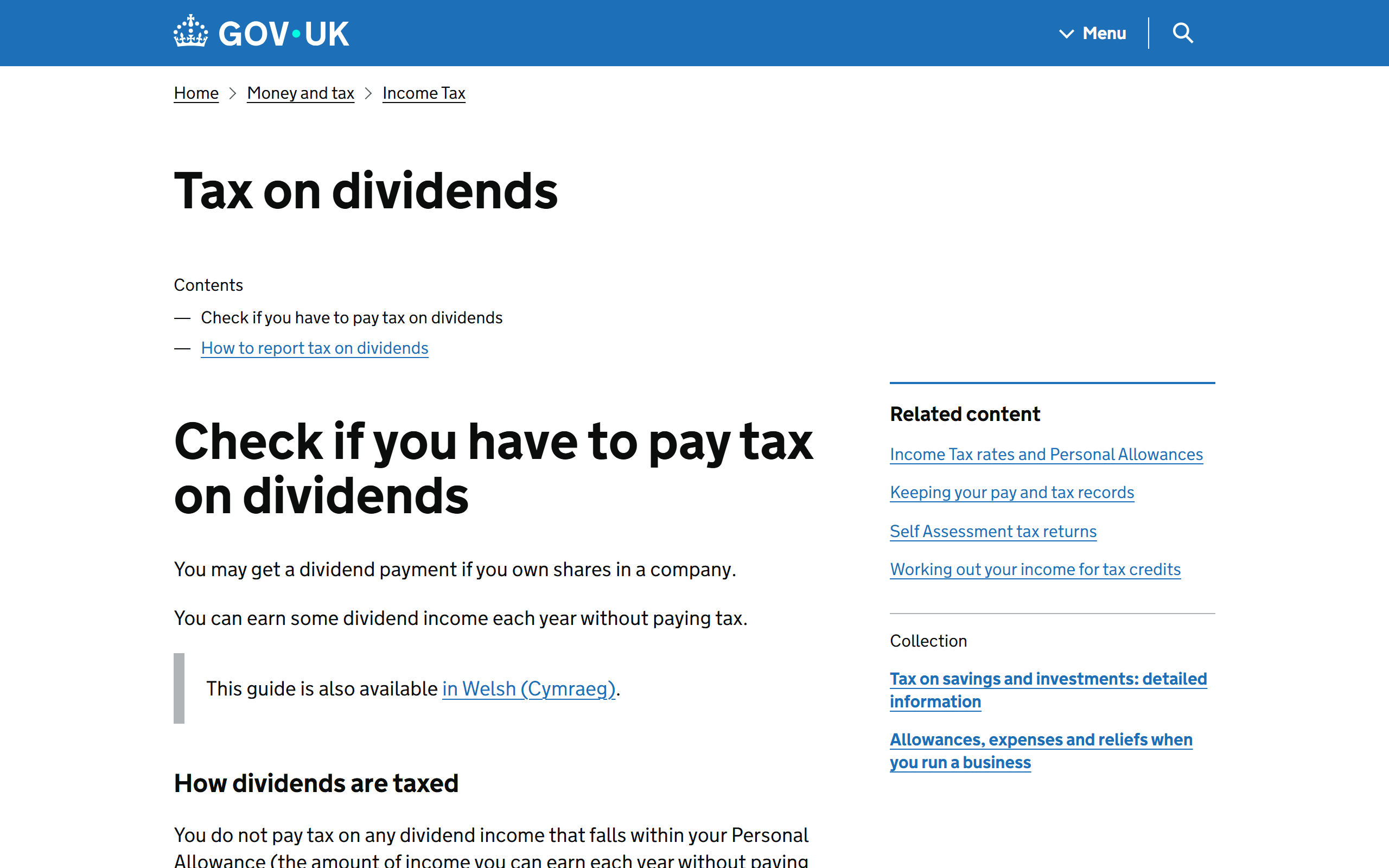
The headline rules live on the gov.uk Tax on dividends page, and the technical detail is buried in HMRC's Savings and Investment Manual.
The Dividend Allowance for 2026/27
For the 2026/27 tax year, the dividend allowance is £500. This is sometimes called the dividend nil-rate band, because the first £500 of dividends is taxed at 0% regardless of which income tax band you sit in.
It is worth pausing on how aggressively this has been cut:
- 2022/23: £2,000
- 2023/24: £1,000
- 2024/25 onwards: £500
That is a 75% reduction in three years. The allowance does not reset if you have multiple sources of dividends; it covers your total dividend income across all holdings. And if you have any dividends inside ISAs or pensions, those do not consume the allowance because they are outside the tax system entirely.
UK dividend allowance, 2017/18 to 2026/27
Source: HMRC dividend tax history
A common myth: the allowance is not a "tax-free bonus" stacked on top of your personal allowance. It just sets the first £500 of dividend income at a 0% rate. It still counts as income for the purposes of working out which band your other dividends fall into.
Dividend Tax Rates Explained
Above the £500 allowance, dividends are taxed at the following rates in 2026/27:
- Basic rate band: 10.75% (where total income is up to £50,270)
- Higher rate band: 35.75% (where total income is between £50,270 and £125,140)
- Additional rate band: 39.35% (where total income is above £125,140)
The basic and higher dividend rates each rose by 2 percentage points at the November 2025 Budget, taking effect from April 2026. The additional rate was left alone.
UK dividend tax rate by total income, 2026/27
Marginal rate on dividend income, after the £500 dividend allowance is used
Source: HMRC dividend tax rates 2026/27
The bands themselves are the standard income tax bands. Your dividends sit on top of your other income in the income "stack". So if your salary uses up most of the basic rate band, even a modest dividend can spill into the higher rate.
Note: these rates are lower than the equivalent income tax rates (20%, 40%, 45%) because dividends are paid from already-taxed corporate profits. The historical theory was that you should not be hit twice. In practice, with corporation tax at 25% for most profits, the effective combined tax burden on dividend income for a higher-rate taxpayer is comfortably above 50%.
How Dividend Tax Is Calculated (Worked Example)
Let's run a realistic case.
You earn a £40,000 salary and receive £5,000 in dividends from a general investment account in 2026/27.
Step 1: Stack the income. Total income = £40,000 salary + £5,000 dividends = £45,000.
Step 2: Apply the personal allowance and tax the salary. The personal allowance covers the first £12,570. The remaining £27,430 of salary is taxed at 20%, which is your employer's payroll problem, not ours here.
Step 3: Apply the dividend allowance. The first £500 of dividends is taxed at 0%.
Step 4: Tax the remaining dividends. Your total income of £45,000 still sits inside the basic rate band (which ends at £50,270). So the remaining £4,500 of dividends is taxed at 10.75%.
£4,500 x 10.75% = £483.75
That is your dividend tax bill. Not catastrophic, but a few years ago £2,000 of that would have been allowance-protected. Today, only £500 is.
If your salary had been £55,000, the maths flips: £4,500 of dividends at 35.75% is £1,608.75. The exact same dividend income produces more than three times the tax bill, simply because of where you sit in the income stack.
Dividends Inside an ISA or SIPP
This is the single most useful fact in this guide: dividends inside an ISA, SIPP, or Junior ISA are completely tax-free. They do not eat your dividend allowance. They do not get reported on your tax return. HMRC does not see them.
The 2026/27 ISA allowance is £20,000 per adult per tax year. If you can shelter your income-producing investments inside that wrapper, your dividend tax bill simply disappears. This is why the Stocks and Shares ISA UK guide is so central to UK investing strategy.
The same applies inside a Self-Invested Personal Pension (SIPP). Dividends inside a SIPP grow tax-free, although withdrawals later are taxed as income at your marginal rate (after the 25% tax-free lump sum).
A subtle point on accumulation funds: if you hold an accumulation ETF or fund inside an ISA, the reinvested dividends are tax-free. Outside an ISA, those reinvested dividends are still taxable as "notional" or "deemed" dividends, even though no cash hits your account. Many investors forget this and get a nasty surprise from their broker's annual tax certificate.
Strategies to Reduce Dividend Tax
The legal toolkit is reasonably sharp if you use it.
Use your ISA every year. Anything you hold in a general investment account that pays dividends should be a candidate for sheltering. A "Bed-and-ISA" is when you sell holdings in a taxable account and immediately repurchase them inside an ISA, moving them into the wrapper. Watch for capital gains on the sale leg, and check fees, but for a long-term investor it is one of the highest-impact moves available.
Use your pension. A "Bed-and-SIPP" works the same way and adds tax relief on the contribution. If you are a higher-rate taxpayer, pension contributions are an even more powerful shelter than ISAs in some scenarios.
Split holdings with a spouse or civil partner. Transfers between spouses are exempt from CGT and can move dividend-paying assets to whichever partner has the lower marginal rate. If your partner is a non-earner or basic-rate taxpayer, dividends in their name are taxed at 10.75% rather than 35.75% or 39.35%. This is fully legal and explicitly permitted by HMRC.
Tilt towards low-yield, high-growth holdings outside ISAs. If you have to hold investments in a taxable account, holding global equity index funds with a low dividend yield and reaping returns through capital gains is more tax-efficient than holding a 5% yielder. The capital gains allowance for 2026/27 is also small (£3,000), but capital gains rates can still beat dividend rates depending on your bracket. The full picture is in our Capital Gains Tax UK guide.
Run the new tax year checklist every April. Allowances reset, ISAs refill, and Bed-and-ISA opportunities are easiest to action at the start of a tax year rather than scrambling in March.
Be aware of stealth taxes. Frozen thresholds, allowance cuts, and fiscal drag mean dividend tax has quietly become a bigger deal than the headline rates suggest.
For the bigger picture on whether to even pursue dividend-paying investments, see What Is Dividend Investing? and Are Dividends Irrelevant?.
Director and Limited Company Considerations
For limited company contractors and small business owners, the old "low salary, high dividend" approach has lost a lot of its shine. The maths has shifted in three ways:
- The dividend allowance has been cut to £500.
- Corporation tax has risen to 25% for most profits over £50,000 (with a 19% small profits rate up to £50,000 and marginal relief between).
- Dividend tax rates were bumped up by 1.25 percentage points in 2022, never reversed, then raised another 2 points on the basic and higher rates at the November 2025 Budget.
A typical owner-director taking £12,570 as salary and the rest as dividends still tends to come out ahead of going pure-PAYE, but the gap is much narrower than it was. For some, particularly those running family businesses with two shareholding spouses, the strategy still works well because each shareholder gets their own dividend allowance and basic rate band.
If you are a director, redo the calculation each tax year. What was optimal in 2021 is often suboptimal in 2026.
How to Report Dividend Tax to HMRC
The reporting rules are:
- Dividends under £500: covered by the allowance, no need to report.
- Dividends between £500 and £10,000: contact HMRC. They can usually adjust your tax code via PAYE so the tax comes out of your salary, or you can register for Self Assessment.
- Dividends over £10,000: you must file a Self Assessment return.
If you already file a tax return for any other reason (self-employment, rental income, high-income child benefit charge), declare your dividends on it regardless of amount.
For dividends from foreign companies, withholding tax is often deducted at source by the originating country (typically 15% for US shares with a W-8BEN on file). You can usually claim this back as foreign tax credit relief on your Self Assessment, up to the amount of UK tax due. ISAs and SIPPs do not get you out of foreign withholding tax, only the UK tax.
Frequently Asked Questions
What is the dividend allowance 2026/27?
The dividend allowance for the 2026/27 UK tax year is £500. This is the amount of dividend income you can receive before any dividend tax applies. It has been cut from £2,000 in 2022/23, then £1,000 in 2023/24, to its current level.
Are dividends in an ISA tax-free?
Yes. Dividends paid by investments held inside a Stocks and Shares ISA, SIPP, or Junior ISA are completely tax-free. They do not count towards your dividend allowance, do not need to be reported on a tax return, and are not visible to HMRC for income tax purposes.
How much tax do I pay on £5,000 in dividends?
It depends on your other income. The first £500 is tax-free. If your total income (salary plus dividends) keeps you in the basic rate band, the remaining £4,500 is taxed at 10.75%, giving a bill of £483.75. A higher-rate taxpayer pays 35.75% on the same £4,500, which is £1,608.75.
Do I have to fill in a tax return for dividends?
You must file Self Assessment if your dividends exceed £10,000 in a tax year. For dividends between £500 and £10,000, contact HMRC. They will usually collect the tax through a PAYE coding adjustment without a full return. Anything below £500 is covered by the allowance and needs no action.
Can I transfer shares to my spouse to reduce dividend tax?
Yes. Transfers of shares between spouses or civil partners living together are exempt from capital gains tax. Once the shares are in your partner's name, the dividends are taxed at their rate. If they are a basic-rate taxpayer or non-earner, this can drop your effective rate significantly. HMRC accepts this is a legitimate planning move.
Further Reading:
Smarter Investing - Tim Hale - The clearest UK-focused argument for low-cost, tax-efficient index investing, with detailed coverage of how wrappers and tax drag interact with long-term returns. (Affiliate link - we may earn a small commission at no extra cost to you.)
Prefer to watch?
We turn these money breakdowns into short videos
A few a week, plain-English UK money. If you would sooner watch than read, follow along:
Enjoying the content?
If this site has been useful, a coffee goes a long way.
Browse more articles
Browse all