





Stocks and Shares ISA UK: The Complete 2026/27 Guide
£20,000 a year, tax-free for life, on every gain and every dividend. The Stocks and Shares ISA is the most generous wrapper a UK investor will ever access. Most don't fill it.
Cite this article
Freedom Isn't Free (2026) Stocks and Shares ISA UK: The Complete 2026/27 Guide. Available at: https://freedomisntfree.co.uk/articles/stocks-and-shares-isa-uk (Accessed: 10 October 2026).
Italicise the article title in your bibliography. Accessed date set to today.
TLDR
- You can shelter up to £20,000 a year inside a Stocks and Shares ISA in 2026/27, with zero tax on gains, dividends or interest.
- Since April 2024 you can pay into more than one Stocks and Shares ISA in the same tax year, but the £20k cap still applies across all of them.
- Pick a low-cost platform, hold globally diversified funds, and never withdraw money to move it. Always use the formal ISA transfer process.
- A Stocks and Shares ISA is the single best wrapper most UK investors will ever own. Use it before you do anything fancy.
What you can hold inside a Stocks and Shares ISA, 2026/27
| Allowed | Not allowed |
|---|---|
| UK and overseas shares | Direct property |
| ETFs, OEICs, unit trusts | Cryptocurrency wallets |
| Investment trusts | Unlisted private shares |
| Corporate and government bonds | Physical commodities |
| Cash (while deciding) | P2P loans (different ISA type) |
£20,000 annual allowance. Zero capital gains, dividend, or interest tax on anything inside.
Stocks and Shares ISA UK: The Complete 2026/27 Guide
If you take one thing away from this site, let it be this: open a Stocks and Shares ISA, fund it consistently, and hold globally diversified funds inside it. That is the unglamorous core of almost every successful UK investing journey, and it is the single most powerful tax shelter most people will ever have access to.
The Stocks and Shares ISA exists because the government wants you to invest. Whether it still wants you to invest enough is a separate argument, but the wrapper is here, the £20,000 allowance survived another Budget, and you should be using it.
This is the canonical guide. Bookmark it.
Contents
- What is a Stocks and Shares ISA?
- How much can you put in a Stocks and Shares ISA in 2026/27?
- Stocks and Shares ISA vs Cash ISA: which is better?
- What can you hold inside a Stocks and Shares ISA?
- How to open a Stocks and Shares ISA
- Costs and fees to watch out for
- Common mistakes to avoid
- Frequently Asked Questions
What Is a Stocks and Shares ISA?
A Stocks and Shares ISA is a tax-free wrapper around an investment account. You put money in, you buy investments, and HMRC ignores everything that happens inside. No capital gains tax when you sell. No dividend tax. No income tax on interest from bonds or cash held in the account. Nothing to declare on a self-assessment return.
It sits alongside the other types of ISA (Cash ISA, Lifetime ISA, Innovative Finance ISA), and you can mix and match between them up to your annual allowance. The key difference from a Cash ISA is that your money is invested rather than earning interest, so it can rise and fall in value, and over long periods it has historically grown far faster than cash.
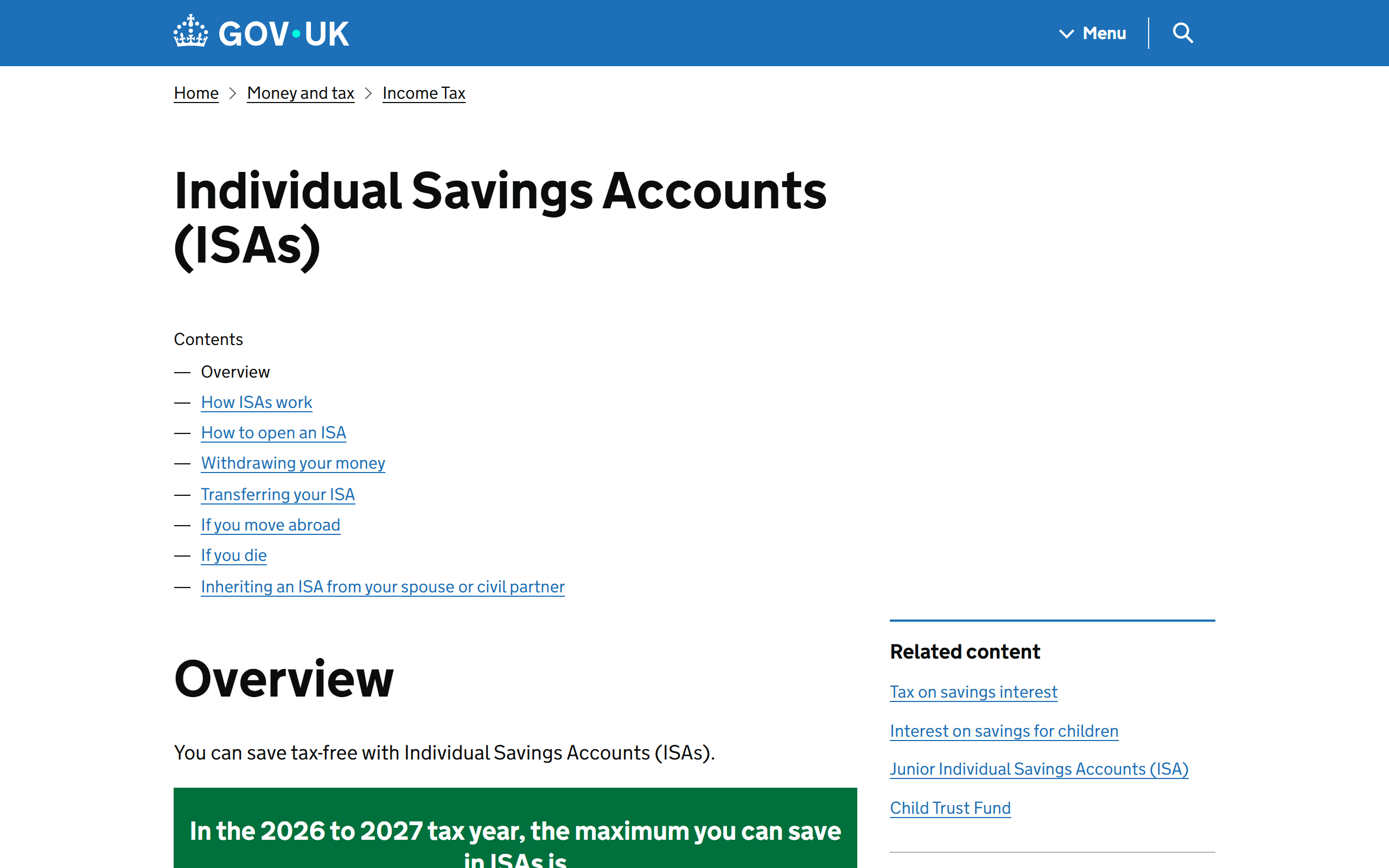
To open one you must be 18 or over and a UK resident for tax purposes.
How Much Can You Put in a Stocks and Shares ISA in 2026/27?
The total ISA allowance for the 2026/27 tax year is £20,000. That figure has been frozen since 2017/18, which means in real terms the allowance has been quietly shrinking for almost a decade. We've written about this kind of stealth tax in more detail here.
A few rules to keep straight:
- The £20,000 cap is the total across every type of ISA you hold (except the Junior ISA, which has a separate £9,000 limit for under-18s).
- You can pay into multiple Stocks and Shares ISAs in the same tax year. This rule changed in April 2024. Before that you could only fund one of each type per year.
- The Lifetime ISA is the exception. You can still only contribute to one LISA per tax year, and the £4,000 LISA limit counts towards your overall £20,000. If you are saving for a first home or retirement and want the 25% bonus on investments rather than cash, our Stocks and Shares Lifetime ISA comparison lines up the providers that offer one.
- Use it or lose it. Allowances do not roll over. April 5th comes around fast.
If you can max it out every year and let it compound at a long-run real return of around 5%, the compound interest calculator tells you what that becomes after 25 years. The number is rude.
Stocks and Shares ISA vs Cash ISA: Which Is Better?
This is the wrong question, but everyone asks it, so here is the honest answer.
For money you might need in the next five years, a Cash ISA is the right home. You want certainty, not a stock market that could drop 30% the week before you need to put down a house deposit.
For everything beyond that horizon, a Stocks and Shares ISA wins, and it usually isn't close. Cash struggles to keep pace with inflation. A globally diversified equity portfolio has averaged something like 5% to 7% real returns over multi-decade periods. The longer your horizon, the more lopsided the comparison becomes.
The compromise most sensible UK investors land on:
- An emergency fund of 3 to 6 months of expenses in cash (Cash ISA or premium account).
- Medium-term savings (house deposit, wedding, sabbatical) in a Cash ISA or short-dated bonds.
- Everything else, including pension-supplementing money for early retirement, in a Stocks and Shares ISA.
If you're trying to work out whether to prioritise an ISA or a pension, that's a different and more interesting question. We've covered it in our ISA vs pension UK comparison.
What Can You Hold Inside a Stocks and Shares ISA?
The "Stocks and Shares" name is misleading. You can hold a wide range of assets, including:
- Individual UK and overseas shares
- Investment trusts
- ETFs (exchange-traded funds)
- OEICs and unit trusts (the standard "tracker funds" most people own)
- Corporate and government bonds
- Cash, while you decide what to buy
What you cannot hold inside the ISA wrapper:
- Direct property
- Crypto (you can hold a regulated crypto ETP on some platforms, but not a wallet)
- Unlisted private company shares (outside the dedicated Innovative Finance ISA route)
For most people the right answer is one cheap, broadly diversified index fund. A global equity tracker like an all-world ETF gives you 3,000-plus companies across 50-odd countries in a single line item. That's it. That is the strategy. The rest is decoration. Adding a second fund (a bond sleeve, a UK home bias, an emerging markets tilt) is fine eventually, but only when you can articulate the actual investment thesis behind it - and even then, keep the deviation under 10% of the portfolio while you find out whether your thesis was right.
How to Open a Stocks and Shares ISA
The process is genuinely simple. You'll need:
- Your National Insurance number
- A debit card or bank details for funding
- Around 10 minutes
The choice of provider matters more than the application. Look for:
- Low platform fees. Percentage fees on large pots become eye-watering. A flat-fee broker is better once your balance gets serious.
- Cheap dealing. Fund dealing should be free or close to it. Share dealing varies wildly.
- The funds and ETFs you want. Not every platform offers every fund.
- A clean app and website. You'll be using this for decades.
- FSCS protection. Up to £85,000 per institution under the FSCS scheme, which covers fraud and provider failure rather than investment losses.
We've gone deep on platform comparison in our Trading 212 review, but the broader point is to optimise for total cost over your investing lifetime, not the welcome bonus on the homepage.
Costs and Fees to Watch Out For
Fees are the only thing in investing you can predict, and they compound against you the same way returns compound for you. A 0.5% drag a year doesn't sound like much. Over 30 years it can quietly eat 15% of your final pot.
The four costs to scrutinise:
- Platform fee. Either a flat monthly fee or a percentage of assets. Above £50,000 or so, percentage fees usually get expensive.
- Fund OCF (ongoing charge figure). What the fund itself charges. Cheap global trackers come in at 0.10% to 0.25%. Active funds can be 0.75% or more, often without justifying the cost.
- Dealing charges. Per-trade costs for shares and ETFs. Free fund dealing is now standard.
- FX fees. Buying US-listed ETFs through a UK platform usually triggers a currency conversion charge of 0.25% to 1.5% per trade. This one is sneaky.
Add it all up. If your total cost of ownership is much over 0.4% a year for a passive portfolio, you're paying too much.
Common Mistakes to Avoid
A short list of the errors I see investors make over and over again with Stocks and Shares ISAs.
Withdrawing to switch providers. Never do this. If you take money out of an ISA and then deposit it somewhere else, you've used up that chunk of your allowance for the year. Use the formal ISA transfer process, which the new provider initiates on your behalf. Your old platform sends the money or assets across without it ever leaving the wrapper.
Forgetting flexible ISAs exist. A flexible ISA lets you withdraw money and put it back in the same tax year without losing the allowance. Not all providers offer this, but if yours does, it is genuinely useful for cash-flow flexibility.
Holding too much cash inside the wrapper. Cash inside a Stocks and Shares ISA usually earns a poor rate. If you've got more than a small operational buffer sitting there, you're wasting the wrapper.
Ignoring the Bed and ISA strategy. If you hold investments outside an ISA in a general investment account, you can sell them and rebuy the same holdings inside your ISA. (See our capital gains tax UK guide for the CGT mechanics.) This crystallises any capital gain (potentially tax-free if you're under the CGT allowance) and gets the future growth into the shelter. Most platforms offer Bed and ISA as a single transaction.
Trying to time the market. The investors with the worst long-run returns are the ones who jump in and out. Set up a monthly direct debit, automate the buying, and stop checking your phone.
Forgetting why you're investing. An ISA is a tool, not the goal. If you're investing for early retirement, run the numbers in a FI number calculator and think about whether your ISA contributions will bridge the gap to your pension at age 57+.
Frequently Asked Questions
Can I have multiple Stocks and Shares ISAs?
Yes. Since April 2024 you can pay into more than one Stocks and Shares ISA in the same tax year, alongside multiple Cash ISAs. The total contributions across all of them still cannot exceed your £20,000 annual allowance. The Lifetime ISA is the only ISA type still restricted to one per tax year.
How much can I put in a Stocks and Shares ISA in 2026/27?
Up to £20,000 in the 2026/27 tax year, which runs from 6 April 2026 to 5 April 2027. This is the combined cap across every ISA you hold. Any unused allowance does not carry over into the next year, so it really is use-it-or-lose-it.
Do I pay any tax on a Stocks and Shares ISA?
No UK tax. Capital gains, dividends and interest earned inside the wrapper are all free of income tax and capital gains tax. You don't need to declare ISA holdings on a self-assessment return. Note that some overseas dividends may have foreign withholding tax deducted at source, which the ISA cannot recover.
What happens to my Stocks and Shares ISA if I die?
Your ISA can pass to a surviving spouse or civil partner via an Additional Permitted Subscription, which gives them an extra one-off allowance equal to the value of your ISA on the date of death. This is in addition to their normal £20,000 allowance. The wrapper itself ends, but the tax benefit effectively transfers.
Can I transfer a Cash ISA into a Stocks and Shares ISA?
Yes. You can transfer existing ISA balances from previous years between any ISA types without affecting your current year's allowance. Always do this via the new provider's official transfer form. Never withdraw the cash and re-deposit it, or you'll burn through your allowance for nothing.
Is my money safe in a Stocks and Shares ISA?
Your investments can rise and fall in value, and that risk is on you. Separately, the platform itself is covered by the FSCS up to £85,000 per institution if the provider fails or commits fraud. FSCS does not protect you from market losses. Diversification, low costs and a long horizon do.
The Stocks and Shares ISA is the most useful tax shelter the UK has ever offered ordinary savers. Open one. Fund it. Hold the boring funds. Then go and live your life.
Read Next
- ISA vs Pension UK: Which Should You Prioritise?
- Lifetime ISA UK Guide
- Junior ISA UK Guide
- How to Start Investing in Index Funds (UK)
- Popular UCITS ETFs for UK Investors
Further Reading:
Smarter Investing - Tim Hale - The definitive UK-focused case for low-cost, globally diversified index investing - exactly the kind of strategy a Stocks and Shares ISA was built to hold. (Affiliate link - we may earn a small commission at no extra cost to you.)
The Little Book of Common Sense Investing - John Bogle - Bogle's short, sharp argument for buying the whole market and holding forever, which is the natural fit for an ISA you intend to keep for decades. (Affiliate link - we may earn a small commission at no extra cost to you.)
Sources
- GOV.UK - How ISAs work, the £20,000 allowance and paying into more than one of the same type
- FSCS - investment compensation limit of £85,000 per firm
- GOV.UK - Junior ISA £9,000 annual savings limit
- GOV.UK - inheriting an ISA from your spouse or civil partner (Additional Permitted Subscription)
- GOV.UK - Lifetime ISA £4,000 limit and 25% government bonus
Prefer to watch?
We turn these money breakdowns into short videos
A few a week, plain-English UK money. If you would sooner watch than read, follow along:
Enjoying the content?
If this site has been useful, a coffee goes a long way.
Browse more articles
Browse all