



ISA vs Pension: Which Is Better for UK Investors?
Most UK savers pick one and call it a day. The right answer is both, in a specific order, with a return to the first one near the end. Get the sequence wrong and HMRC quietly wins.
Cite this article
Freedom Isn't Free (2026) ISA vs Pension: Which Is Better for UK Investors?. Available at: https://freedomisntfree.co.uk/articles/isa-vs-pension-uk (Accessed: 10 October 2026).
Italicise the article title in your bibliography. Accessed date set to today.
TLDR
- Pensions give upfront tax relief and employer matching but lock your money away until 57
- ISAs offer total flexibility with tax-free growth and withdrawals at any time
- Most people should use both - pension first up to employer match, then ISA, then more pension
- Your tax bracket, access needs, and retirement timeline determine the right split
ISA vs Pension: Which Is Better for UK Investors?
The ISA vs pension debate is one of the first real decisions you face once you start investing seriously in the UK. Both are tax-sheltered wrappers. Both let your money grow free of capital gains tax and dividend tax. But the rules around getting money in and getting money out are completely different, and that changes everything.
The short answer is that most people should use both. The longer answer is that the order you fill them, and the split between them, depends on your income, your tax bracket, when you need the money, and whether your employer matches pension contributions. Get this right and you could save tens of thousands in tax over your lifetime. Get it wrong and you either lock money away needlessly or miss out on free tax relief.
Contents
- How pensions work
- How ISAs work
- ISA vs pension: direct comparison
- When to prioritise your pension
- When to prioritise your ISA
- How your age changes the answer
- The optimal strategy for most people
- Frequently Asked Questions
How pensions work
A pension is a long-term savings wrapper with one defining feature: the government gives you tax relief when you put money in, but restricts when you can take it out. If you want a deeper look at the mechanics, our UK pensions explained guide covers the full picture.
Tax relief
When you contribute to a pension, you get tax relief at your marginal rate. For a basic rate taxpayer (20%), every £80 you contribute becomes £100 in your pension because HMRC adds the other £20. For a higher rate taxpayer (40%), you contribute £60 and get £100 - you pay in £80, the pension provider claims £20 from HMRC, and you claim back a further £20 through your tax return. At the additional rate (45%), the effective cost of putting £100 into your pension is just £55.
If your employer offers salary sacrifice, the deal gets even better. Your gross salary is reduced before income tax and National Insurance are calculated, so you save NI at 8% on top of income tax relief. On a £50,000 salary with 5% pension contributions through salary sacrifice, that NI saving alone is worth around £200 a year. Our SIPP vs workplace pension article breaks this down further.
Employer matching
If your employer matches your contributions, that is free money. Full stop. Under auto-enrolment, your employer must contribute at least 3% of qualifying earnings, but many will match up to 5%, 6%, or even more. An employer match of 5% on a £40,000 salary puts £2,000 a year into your pension that you would otherwise not receive. No ISA can replicate that.
Contribution limits
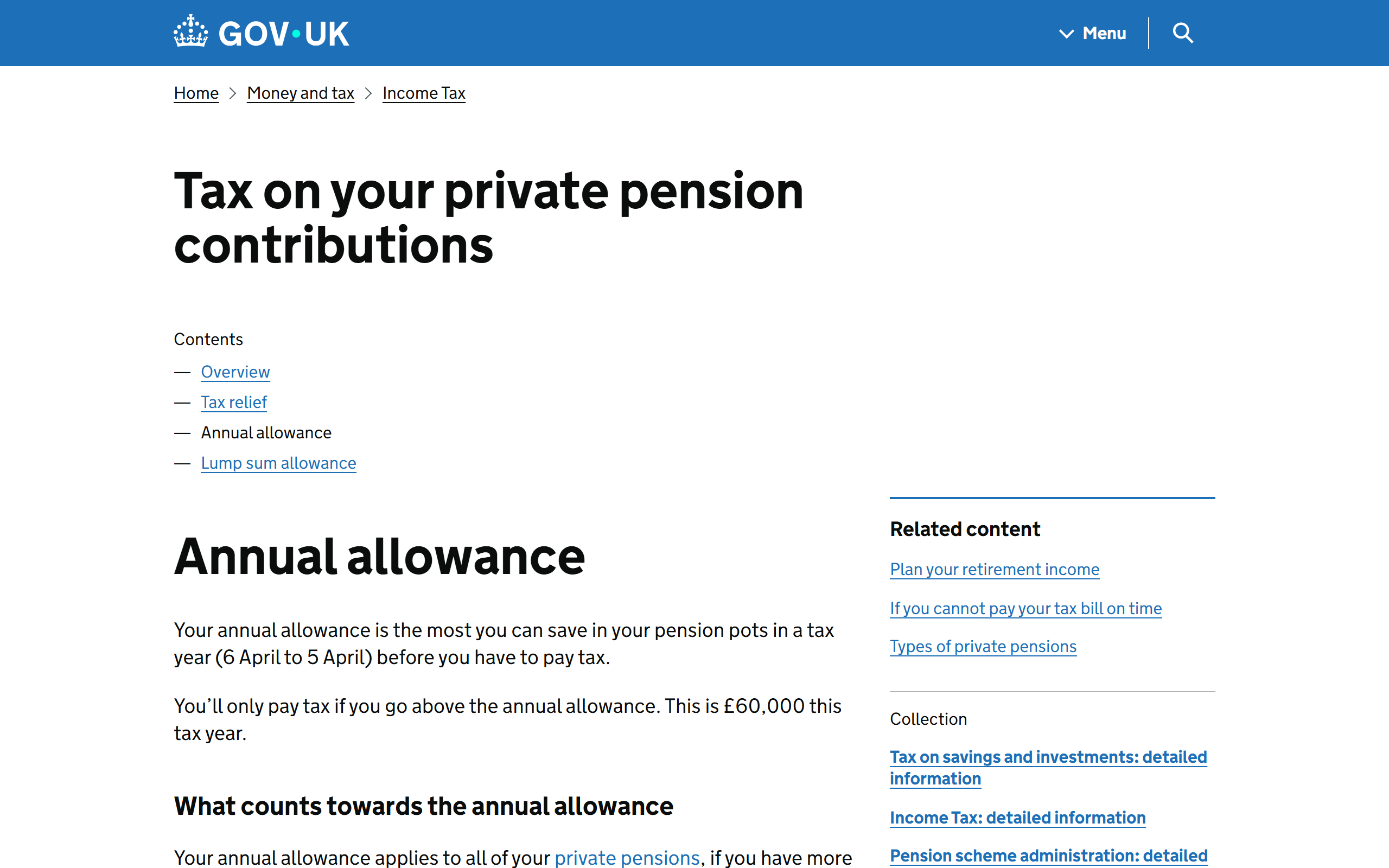
The pension annual allowance is £60,000 per year in 2026/27, or 100% of your earnings if lower. You can also carry forward unused allowance from the previous three tax years if you were a member of a pension scheme during those years. For high earners above £260,000 of adjusted income, the annual allowance tapers down to a minimum of £10,000.
Access restrictions
Here is the trade-off. Your pension money is locked away until you reach the minimum pension age, which is currently 55 and rises to 57 from 6 April 2028. When you do access it, you can take 25% as a tax-free lump sum (up to £268,275 under the lump sum allowance). The remaining 75% is taxed as income at your marginal rate.
This is a genuine restriction. If you are 30 and might need the money at 45, a pension is the wrong wrapper for that portion of your savings.
How ISAs work
An Individual Savings Account (ISA) is simpler. You put money in from your net pay - no upfront tax relief - but everything inside the wrapper grows completely tax-free, and you can withdraw it whenever you want with no tax to pay.
The ISA allowance
You can contribute up to £20,000 per tax year across all your ISA types (Cash ISA, Stocks and Shares ISA, Innovative Finance ISA, and Lifetime ISA). This allowance does not carry forward. If you do not use it by 5 April, it is gone.
For investors building long-term wealth, the Stocks and Shares ISA is the one that matters most. You can hold funds, ETFs, investment trusts, and individual shares inside it. All dividends, interest, and capital gains are completely free of tax. When you sell, there is no capital gains tax. When you withdraw, there is no income tax. That is it. No forms, no tax returns, no complications.
Flexibility
This is the ISA's biggest advantage. You can withdraw money at any time, for any reason, without penalty or tax. Some ISAs (known as flexible ISAs) even let you replace withdrawn money within the same tax year without it counting against your annual allowance. If you are building an emergency fund, saving for a house deposit in five years, or creating a bridge to cover early retirement before your pension kicks in, the ISA gives you that freedom.
No means testing
ISA wealth is invisible to the benefits system. It does not count when assessing eligibility for Universal Credit or other means-tested benefits. Pension income, by contrast, is treated as taxable income. This matters more than most people think, particularly if you are planning for semi-retirement or a phased step-down from work.
ISA vs pension: direct comparison
| Feature | Pension (SIPP/Workplace) | Stocks and Shares ISA |
|---|---|---|
| Annual allowance | £60,000 | £20,000 |
| Tax relief on contributions | 20%, 40%, or 45% | None |
| Employer matching | Yes | No |
| NI savings (salary sacrifice) | Yes | No |
| Tax on growth | None | None |
| Tax on withdrawals | 75% taxed as income | None |
| 25% tax-free lump sum | Yes | N/A (all withdrawals tax-free) |
| Access age | 57 (from 2028) | Any time |
| Inheritance tax | Usually outside your estate | Inside your estate |
| Means testing | Pension income counts | ISA wealth does not |
| Annual allowance carry-forward | Yes (3 years) | No |
The pension wins on the way in: bigger allowance, tax relief, employer matching, and NI savings. The ISA wins on the way out: total flexibility, zero tax on withdrawals, and no age restrictions.
When to prioritise your pension
You are a higher or additional rate taxpayer. The tax relief at 40% or 45% is extremely powerful. If you put £10,000 into a pension as a 40% taxpayer, it only costs you £6,000 after tax relief. To get the same £10,000 into an ISA, you need to earn roughly £16,700 before tax and NI (assuming you are in England). The pension is nearly three times more efficient.
Your employer matches contributions. If your employer matches your contributions and you are not taking the full match, you are turning down free money. This should always be your first priority before any ISA contributions. Every pound your employer matches is a 100% instant return.
You earn between £100,000 and £125,140. In this income band, you lose your personal allowance at a rate of £1 for every £2 earned above £100,000. This creates an effective marginal tax rate of 60%. Pension contributions that bring your adjusted net income below £100,000 are worth 60p in tax relief for every pound contributed. That is an extraordinary deal.
You are not planning to access the money before 57. If you are confident this money is for retirement - genuinely retirement, not "I might want it earlier" - the pension's restrictions are a feature, not a bug. They stop you raiding your own savings.
When to prioritise your ISA
You need access before 57. If there is any chance you will need this money before the pension access age, it should go in an ISA. This includes emergency funds, a house deposit, a career break fund, or a bridge fund for early retirement. The penalty for accessing pension money early is that you simply cannot do it.
You are a basic rate taxpayer with no employer match. At 20% tax relief with no employer contribution on top, the pension advantage narrows significantly. A basic rate taxpayer putting money into a pension gets 20% relief going in but will likely pay 20% tax on 75% of it coming out. After the 25% tax-free lump sum, the net benefit is modest. The ISA's zero-tax withdrawal and full flexibility can be worth more.
You are building a FIRE bridge. If you are pursuing financial independence and plan to retire before the pension access age, you need accessible money to cover the gap years. A Stocks and Shares ISA is the obvious vehicle for this. You draw down the ISA from your retirement date until 57, then switch to your pension. This is the standard FIRE bridge strategy.
You are close to the lifetime limit on pension tax-free cash. The lump sum allowance caps your tax-free pension withdrawals at £268,275. If you are approaching this, additional pension contributions lose some of their advantage.
How your age changes the answer
Both wrappers grow at the same rate inside the tax shelter, but the cost of locking money up is not equally distributed across your career. A 25-year-old putting £10,000 into a pension does not see that money again for 32 years. A 55-year-old putting in the same £10,000 sees it back in 2. The tax relief is identical. The optionality cost is wildly different.
Why £1 today is worth more than £1 in 30 years
A pound in your pocket today is worth more than a pound locked away for decades, even before inflation enters the picture. A pound today can:
- Knock down a credit card balance and save 20% in interest forever
- Become part of a house deposit that produces leveraged property gains
- Cover an emergency without forcing a stock-market sale at the wrong time
- Fund a career change, a course, or a small business
- Pay for a year off so you do not burn out
None of those uses are available with pension money. You hand HMRC £80 and you get back £100 in pension tax relief, which is a great deal on paper, but you do not see any of it again until you reach the minimum pension age. For someone with high-interest debt, no emergency fund, or a deposit they need in five years, the tax relief is irrelevant - the money cannot do the job they actually need it to do.
The lock-in cost shrinks as you get older
The lock-in cost of a pension contribution is roughly proportional to the years between contributing and accessing. At 25, you are giving up 32 years of optionality on every pound. At 45, it is 12 years. At 55, it is 2.
This has a clean implication: the older you are, the bigger the pension share of your savings should be. A 55-year-old higher-rate taxpayer maxing their pension allowance is making one of the best deals in UK personal finance, because the tax relief still applies in full but the lock-in window has almost closed. A 25-year-old doing the same is overweighting tax efficiency relative to flexibility, and may regret it when they need a deposit at 32 or want to start a business at 38.
The employer match still wins at every age
This does not mean young investors should ignore pensions entirely. The employer match alone usually justifies contributing up to the match, no matter your age. Our pension match calculator shows the long-term cost of skipping it - even a small percentage match compounds into tens of thousands of pounds over a career. The match is a guaranteed 100% instant return on your contribution. You do not get that anywhere else in personal finance.
The age-based rebalancing applies to what you do with savings beyond the match, not the match itself.
A rough age-based heuristic
After capturing the full employer match, the split between additional pension contributions and ISA contributions might look something like:
- Under 35: Heavy ISA bias. You may need the money for a deposit, a career change, or simply to handle a higher cost of living. The LISA can be useful if you are saving for a first home and are under 40.
- 35 to 50: Roughly balanced. A house is hopefully sorted, and the pension's tax relief becomes more compelling now that the lock-in window is shorter.
- 50 to 57: Heavy pension bias. The lock-in cost has almost disappeared. Use carry-forward to mop up any unused pension allowance from the previous three tax years if you can.
- 57 plus: All pension. There is no lock-in left. The tax relief plus the 25% tax-free lump sum makes pension contributions uniquely powerful at this age.
The exact mix depends on your tax bracket and circumstances, but the underlying point is that the same £1, contributed to the same pension, has a different optionality cost depending on when you contribute it. The standard "use both" advice is true at every age. The mix changes with the calendar.
The optimal strategy for most people
Here is the priority order that works for the majority of UK investors:
Step 1: Pension up to the employer match. If your employer matches 5%, contribute 5%. If they match 8%, contribute 8%. This is a guaranteed instant return and it comes before everything else. Run your numbers through the pension match calculator to see how much you would lose by leaving any of the match on the table.
Step 2: Fill your ISA. Once you have captured the full employer match, direct your next £20,000 of annual savings into a Stocks and Shares ISA. This gives you flexible, tax-free wealth that you can access at any age. If you are in your 20s or 30s, building ISA wealth early creates options. You might use it for a house deposit, a career change, or a FIRE bridge. You might never touch it and let it compound. Either way, you have the choice.
Step 3: Top up your pension. If you still have money to invest after filling your ISA, go back to your pension. The tax relief is valuable even for basic rate taxpayers, and the forced illiquidity keeps the money safe from lifestyle inflation. Higher rate taxpayers should be aggressive here because the 40% relief is hard to beat.
Step 4: Use any remaining capacity. If you have somehow filled a £20,000 ISA and a £60,000 pension allowance, you are in an excellent position. Overspill goes into a general investment account (GIA), where you will pay capital gains tax on gains above £3,000 and dividend tax on dividends above £500, but that is still better than leaving money in cash.
The numbers in practice
Take someone earning £50,000 with an employer matching 5% of salary:
- Step 1: Contribute 5% (£2,500) to the workplace pension. Employer adds £2,500. Total: £5,000 into the pension.
- Step 2: Put £500/month into a Stocks and Shares ISA. That is £6,000 per year, sheltered from all tax with full access.
- Step 3: If there is more to save, increase pension contributions above the matched amount.
After 20 years at a 7% annualised return, that £6,000/year ISA alone grows to roughly £260,000 - all tax-free, all accessible. You can run the numbers yourself with our compound interest calculator. The pension pot (including employer match and tax relief) will be larger still, but locked until 57.
The ISA gives you freedom before retirement. The pension gives you security during it. You need both.
Frequently Asked Questions
Can I have both an ISA and a pension at the same time?
Yes. There is no restriction on holding both. In fact, using both is the recommended strategy for almost every UK investor. The £20,000 ISA allowance and the £60,000 pension annual allowance are completely separate. You can contribute to both in the same tax year. For an overview of all the allowances available to you, see our new tax year checklist.
Is it better to overpay my mortgage or invest in an ISA?
It depends on your mortgage rate versus your expected investment return. If your mortgage rate is 5% and you expect investments to return 7% over the long term, investing has a higher expected return - but the mortgage overpayment is risk-free. We cover this in detail in our invest vs pay off mortgage guide. A common middle ground is to split extra money between the two.
What happens to my ISA and pension when I die?
ISA assets form part of your estate and are subject to inheritance tax (IHT) if your estate exceeds the nil-rate band. You can transfer ISA holdings to a spouse tax-free through an Additional Permitted Subscription (APS). Pensions are generally outside your estate for IHT purposes, which makes them a powerful tool for passing on wealth. If you die before 75, your beneficiaries can draw down the entire pension tax-free. After 75, they pay income tax at their marginal rate on withdrawals.
Should I use a Lifetime ISA instead of a pension?
The Lifetime ISA (LISA) gives a 25% government bonus on contributions up to £4,000 per year, which is equivalent to basic rate pension tax relief. But it has significant downsides: you must be under 40 to open one, you can only withdraw penalty-free for a first home or after age 60, and the 25% withdrawal penalty for other purposes means you lose more than the bonus you received. For most people, a pension (with its higher allowance, employer matching, and NI savings) is the better choice. The LISA can work as a supplement, not a replacement.
How do I open a Stocks and Shares ISA or SIPP?
Both are available through UK investment platforms like Vanguard, AJ Bell, Interactive Investor, and Trading 212. Opening an account takes about 10 minutes. You will need your National Insurance number and a form of ID. For a Stocks and Shares ISA, you transfer money in and invest it yourself - there is no tax claim to file. For a SIPP, the provider claims basic rate tax relief automatically. Higher rate taxpayers need to claim the extra relief through their self-assessment tax return. If you are not sure where to start, our beginner's guide to investing walks through the process step by step.
Further Reading:
Smarter Investing - Tim Hale - The best UK-specific guide to building a low-cost, diversified portfolio inside your ISA and pension. (Affiliate link - we may earn a small commission at no extra cost to you.)
I Will Teach You To Be Rich - Ramit Sethi - A practical system for automating your savings across multiple accounts so your ISA and pension fill themselves each month. (Affiliate link - we may earn a small commission at no extra cost to you.)
Prefer to watch?
We turn these money breakdowns into short videos
A few a week, plain-English UK money. If you would sooner watch than read, follow along:
Enjoying the content?
If this site has been useful, a coffee goes a long way.
Browse more articles
Browse all