
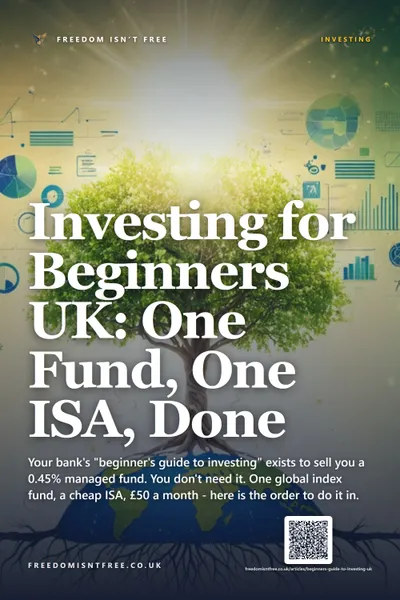
Investing for Beginners UK: One Fund, One ISA, Done
Your bank's "beginner's guide to investing" exists to sell you a 0.45% managed fund. You don't need it. One global index fund, a cheap ISA, £50 a month - here is the order to do it in.
Cite this article
Freedom Isn't Free (2026) Investing for Beginners UK: One Fund, One ISA, Done. Available at: https://freedomisntfree.co.uk/articles/beginners-guide-to-investing-uk (Accessed: 10 October 2026).
Italicise the article title in your bibliography. Accessed date set to today.
TLDR
- You do not need to pick stocks or time the market. A single global index fund (such as VWRP or HMWO) gives you instant diversification across thousands of companies.
- Invest in the right order: take your full workplace pension match first (it is free money), then a Stocks and Shares ISA, then a Lifetime ISA if you are under 40.
- Start with as little as £25 to £50 a month. The habit of investing regularly matters far more than the amount you begin with.
- Ignore social media hype, ignore the daily market noise, and ignore your bank's "managed" funds. Boring, low-cost, consistent investing wins.
UK global index ETFs for beginners
| ETF | Ticker | Index | OCF |
|---|---|---|---|
| Vanguard FTSE All-World | VWRP | FTSE All-World | 0.22% |
| HSBC FTSE All-World | HMWO | FTSE All-World | 0.13% |
| iShares MSCI ACWI | SSAC | MSCI ACWI | 0.20% |
| Invesco FTSE All-World | FWRG | FTSE All-World | 0.15% |
Any of these four is a sensible single-fund starting portfolio. Don't agonise.
Investing for Beginners UK: One Fund, One ISA, Done
You have some money sitting in a savings account earning a few percent. You keep hearing people talk about stocks, ETFs, ISAs. Part of you thinks you should be doing something with your money, but the whole thing feels like a members-only club where everyone else already knows the rules.
Here is the good news: investing for beginners in the UK is not complicated. The financial industry wants you to think it is, because complexity justifies fees. But the evidence is clear - most people are better off buying a single, cheap, diversified fund and leaving it alone for years. That is genuinely it.
This guide walks you through the mindset, the right order to use your UK accounts, and the mechanics of getting started. If you would rather work through it as a structured path with short lessons and calculators, our free investing course covers the same ground step by step.
Contents
- Why bother investing at all?
- Ignore the noise
- Build your investment thesis
- The right order to invest your money in the UK
- Why index ETFs are the sensible starting point
- Start small and stay consistent
- Is £50 a month enough? A worked example
- Why your bank's beginner guide won't tell you this
- What to expect in your first year
- Train your risk tolerance before the stakes are high
- Frequently asked questions
Why bother investing at all?
Cash in a savings account feels safe. And for short-term goals - an emergency fund, a holiday next year - it is the right place. But over longer time horizons, cash quietly loses purchasing power. Inflation eats it.
Over the past century, global stock markets have returned roughly 7-10% per year on average (before inflation). That is not a guarantee, and there have been horrific years mixed in. But the long-term trend, measured over decades, has been upward. Every single time people said "this time is different," the market eventually recovered and went higher.
If you have money you will not need for five or more years, leaving it all in cash is the riskier choice. Not because your balance will go down, but because its buying power will.
Use our compound interest calculator to see how even modest amounts grow over 10, 20, 30 years. The numbers are surprising.
Ignore the noise
Before we talk about what to buy, we need to talk about what to ignore. Because the biggest threat to your investing success is your own behaviour, not the fund you pick.
Ignore FOMO. Your colleague doubled their money on some AI stock. Your mate is into crypto. Someone on Reddit turned two grand into fifty. These stories are real, but they are survivorship bias. For every person who got lucky, hundreds lost money doing the same thing. You never hear from them.
Ignore the news cycle. Markets dropped 3% today. A war started. Interest rates moved. The temptation is to react, to do something. But doing something is almost always the wrong move. The investors who perform worst are the ones who trade the most. The ones who perform best are often the ones who forgot they had an account.
Ignore predictions. Nobody - not fund managers, not economists, not that confident bloke on YouTube - consistently predicts where markets are heading. The data on this is overwhelming. Most professional stock pickers fail to beat a simple index fund over any meaningful period.
Your job as an investor is to be boring. Spectacularly, relentlessly boring.
Build your investment thesis
Here is something most beginners skip, and it costs them when things get rough: write down why you are investing.
This is your investment thesis. It does not need to be clever. It just needs to be yours. Something like:
"I believe the global economy will continue to grow over the next 20-30 years. Companies will keep innovating, people will keep buying things, and I want to own a tiny slice of that growth. I am investing for retirement / a house deposit / financial independence, and I do not need this money for at least 10 years."
That is it. Nothing fancy.
But here is why it matters: at some point, markets will fall. Not 2-3%. More like 20-40%. It happened in 2008, 2020, and 2022. It will happen again. When it does, every instinct in your body will scream at you to sell. The headlines will be apocalyptic. People around you will be panicking.
This is the moment your thesis saves you. You go back and read it. Has anything actually changed? Is the global economy permanently broken? Have humans stopped innovating? If your thesis still holds - and it almost certainly will - then a market drop is not a reason to sell. It is a sale. Everything you were going to buy anyway is now cheaper.
The people who panic-sold in March 2020 locked in losses. The people who held, or better yet kept buying, saw their portfolios fully recover within months and hit new highs.
Conviction comes from clarity. Write your thesis down. Put it somewhere you will find it when you are scared.
The right order to invest your money in the UK
Most beginner guides skip the single most valuable thing a UK investor can be told: the order matters more than the fund. Put the same £100 in the wrong account and you can leave hundreds of pounds of free money and tax relief on the table every year. Here is the order that works for almost everyone, top to bottom. Do not move down a step until you have done the one above it.
1. Clear expensive debt and build an emergency fund first. Paying off a credit card charging 20%-plus is a guaranteed 20% return no investment can match. Then keep three to six months of essential spending in an easy-access savings account. Investing comes after this, not before.
2. Take your full workplace pension match. If you are employed, you are almost certainly already an investor through workplace pension auto-enrolment. The legal minimum is 8% of your qualifying earnings (the band between £6,240 and £50,270): 5% from you, 3% from your employer. That employer 3% is free money, and some employers match more if you put in more. Contributing enough to capture the full match is the highest-return move on this list. Turning it down is turning down a pay rise.
3. Fill a Stocks and Shares ISA. Once the match is captured, a Stocks and Shares ISA is the beginner's workhorse. You can pay in up to £20,000 each tax year, and every penny of growth, dividends and interest inside it is free of UK tax, with no lock-in. This is where your global index fund lives.
4. Use a Lifetime ISA if you are under 40. Saving for a first home (up to £450,000) or for retirement? A Lifetime ISA lets under-40s pay in up to £4,000 a year and the government adds a 25% bonus, up to £1,000 a year of free money, until you turn 50. The catch: withdraw it for anything other than a first home or age 60 and you pay a 25% penalty that claws back more than the bonus. Right tool, narrow job, and not always the right one over a SIPP.
5. Top up your pension, then a general account. If you still have money to invest after the ISA is full, more pension contributions buy you tax relief at your marginal rate, and a SIPP gives you control over how it is invested. Only once pensions and ISAs are full does a taxable general investment account make sense.
For most beginners, steps 1 to 3 are the whole game for years. The fund you choose for step 3 is the same boring global tracker we cover next.
Why index ETFs are the sensible starting point
An ETF (exchange-traded fund) is a basket of investments you can buy as a single unit on the stock exchange. An index ETF tracks a specific index - like the FTSE 100 or the S&P 500 - by holding all (or most) of the companies in that index.
A global index ETF goes one step further and holds thousands of companies across the entire world. One purchase, instant diversification across the US, Europe, Japan, emerging markets, everywhere.
Three things make this the right starting point for most beginners:
Diversification without effort. Instead of picking individual stocks and hoping you chose well, you own a slice of the entire global economy. If one company or country struggles, others pick up the slack.
Rock-bottom costs. The best global ETFs charge around 0.10-0.25% per year. That is pennies per hundred pounds invested. Compare that to the 1-2% many active fund managers charge while usually performing worse.
Simplicity. One fund. That is your entire portfolio. You do not need to rebalance, research earnings reports, or worry about sector allocation. The index does that for you.
Some well-known global index ETFs available to UK investors:
| ETF | Index tracked | Ongoing charge |
|---|---|---|
| Vanguard FTSE All-World (VWRP) | FTSE All-World | 0.22% |
| HSBC FTSE All-World (HMWO) | FTSE All-World | 0.13% |
| iShares MSCI ACWI (SSAC) | MSCI ACWI | 0.20% |
| Invesco FTSE All-World (FWRG) | FTSE All-World | 0.15% |
Any of these will do the job. Do not agonise over which one. The differences between them are tiny. Pick one, buy it regularly, and move on with your life. If you want to dig deeper into what makes a good index fund, we have a detailed guide on choosing one.
Start small and stay consistent
The single most common reason people do not start investing is they think they need a lot of money. You do not. Most platforms let you invest from as little as one pound.
The actual mechanics are straightforward:
1. Open a Stocks and Shares ISA. Following the order above, this is your workhorse: a tax-free wrapper where any gains, dividends or interest are completely free from UK tax. You can pay up to £20,000 into ISAs each tax year. Our tax year checklist covers the full set of allowances.
2. Pick a low-cost platform. Trading 212, InvestEngine, and Vanguard are all solid choices for beginners. Look for zero or low platform fees and commission-free ETF dealing.
3. Set up a regular investment. Even 25 or 50 pounds a month. Automate it so it leaves your account on payday, the same way rent or bills do. You will not miss it.
4. Buy the same global ETF every month. This is called pound-cost averaging. Some months you will buy when prices are high, some months when they are low. Over time, it averages out. The beauty is you never have to think about timing.
5. Do not invest money you cannot afford to lose. Build an emergency fund first - three to six months of expenses in an easy-access savings account. Only invest money you genuinely will not need for five or more years.
The amount does not matter nearly as much as the habit. Someone investing 50 pounds a month for 20 years will almost certainly end up with more than someone who waits three years to save up a "proper" lump sum.
Is £50 a month enough? A worked example
"Is £200 a month enough to invest?" is one of the most common things UK beginners type into Google, and the answer is that there is no minimum that is "enough" or "too little". What matters is how long the money compounds. Time does the heavy lifting, not the size of the monthly amount.
Here is what a regular monthly investment into a global tracker could grow into over 30 years. These figures assume a 7% average annual return, which is roughly the long-run global equity average before inflation. They are illustrative arithmetic, not a forecast or a promise. Real returns are bumpy, are reduced by inflation and fees, and are never guaranteed.
| Monthly investment | Paid in over 30 years | Illustrative value at 7% |
|---|---|---|
| £25 | £9,000 | ~£30,000 |
| £50 | £18,000 | ~£61,000 |
| £100 | £36,000 | ~£122,000 |
| £200 | £72,000 | ~£244,000 |
Two things jump out. First, in every row the final figure is far larger than the amount paid in, because decades of compounding do most of the work. Second, £200 a month is not a magic threshold; it simply compounds to more than £50 a month does. Someone who starts with £25 a month today and increases it as their pay rises will comfortably beat someone who waits five years for the "right" amount.
So the answer to "is it enough?" is: yes, whatever you can sustain is enough to start. Begin with a figure you will not be tempted to cancel the first time money is tight. You can always raise it later. Plug your own numbers into our compound interest calculator to see how the curve changes with time and contribution.
Why your bank's beginner guide won't tell you this
Open the "beginner's guide to investing" on almost any bank or fund-supermarket website and you notice the same thing: it is strangely vague. Lots of "it depends on your circumstances", very little "here is what to actually do".
That vagueness is not an accident. A bank's "beginner's guide to investing" is really a customer-acquisition funnel. The free "learn to invest" hub exists to open you a platform account; the friendly explainer exists to nudge you into a "managed" fund charging 0.45% to 1% a year for something a global index tracker does for around 0.15%. Telling you the honest version, that one cheap fund in a cheap ISA, left alone for decades, beats almost everything they sell, would be telling you to walk past their entire product range.
The boring approach in this guide does not have a marketing department, which is exactly why nobody with a marketing department teaches it. That does not make it wrong. It makes it free. For the evidence that low-cost passive investing genuinely wins, see why passive investing beats active funds.
What to expect in your first year
Let's be straight about what the early days look like, because nobody talks about this bit.
Your portfolio will be small, and the movements will feel meaningless. You put in 50 pounds and it goes up 38p. Or down 1.20. It feels like nothing is happening. This is normal. Compounding is a slow burn. It barely registers in year one, becomes noticeable around year five, and gets genuinely exciting around year ten.
You will see red days. Some weeks your balance will be lower than what you put in. You will feel a knot in your stomach. This is also normal. Zoom out. Look at a chart of any global index over 20 years. Every single dip that felt like the end of the world is now an invisible blip.
You will be tempted to tinker. To switch funds, to add some individual stocks, to "optimise" your portfolio. Resist this. The best thing you can do in your first few years is build the muscle of doing nothing. Check your portfolio once a month at most. Ideally less.
You will hear about people making more money than you. Someone will have a higher return because they were concentrated in US tech, or caught a rally in some niche sector. That is fine. They also took on more risk than you. Your goal is not to beat everyone else. Your goal is to steadily build wealth in a way you can stick with for decades.
The investors who win are the most patient, rarely the cleverest.
Train your risk tolerance before the stakes are high
This is the real reason to start small, and it has nothing to do with compound interest.
Everyone thinks they are fine with risk until they watch their own money go down. You can read a hundred articles about how markets always recover. You can nod along to charts showing long-term growth. But none of that prepares you for the feeling of opening your app and seeing a number that is less than what you put in.
Starting with 50 or 100 pounds a month does more than dip your toe in: it is a training ground. When the market drops 10% and your 600-pound portfolio loses 60 quid, it stings a bit but it is not life-changing. That is the point. You get to experience the emotional side of investing - the anxiety, the urge to sell, the temptation to check every hour - while the actual financial consequences are tiny.
You also get space to make mistakes cheaply. Maybe you panic-sell during your first dip and then watch the price recover a week later. That lesson costs you 15 pounds instead of 15,000. Maybe you chase a hot stock tip and it goes nowhere. Better to learn that with beer money than your house deposit.
By the time your portfolio grows to a size where market swings actually matter - five figures, six figures - you will have already lived through several drops. You will know what your gut does when markets tank, and you will know from experience that doing nothing was the right call every single time.
This emotional training is worth more than any book or calculator. You cannot shortcut it. You have to feel it. So start small, let the market knock you around a bit, and build that muscle before there is real money on the line.
Frequently asked questions
What is the best investment for beginners in the UK?
For most beginners, a single low-cost global index fund held inside a Stocks and Shares ISA. It spreads your money across thousands of companies worldwide in one purchase, charges around 0.15% a year, and needs no ongoing management. It is not exciting, but it quietly beats the large majority of professionally managed funds over time.
How should I start investing as a beginner?
In order: clear expensive debt and build an emergency fund, capture your full workplace pension match, then open a Stocks and Shares ISA, buy one global index fund, and set up an automatic monthly payment on payday. That is the entire process. Everything else is optimisation.
Where should I invest first as a beginner?
Your workplace pension, if you have one, because the employer match is free money no other account offers. After that, a Stocks and Shares ISA is the natural home for your first fund: tax-free, flexible, and with a generous £20,000 annual allowance. Only look at a general (taxable) account once your ISA is full.
How much money do I need to start investing in the UK?
As little as one pound on most platforms. There is no meaningful minimum. The idea that you need thousands to start is a myth. Set up a small regular investment and increase it as your income grows.
Is £200 a month enough to invest?
Yes, and so is £50 or even £25. There is no threshold that counts as "enough"; what matters is starting and keeping it going. At a 7% illustrative long-run return, £200 a month could grow to roughly £244,000 over 30 years, but the habit matters far more than the exact figure. Pick an amount you can sustain when money is tight, then raise it as your income grows.
How do I turn £1,000 into £10,000 in the UK?
Not quickly, and not safely. Anything promising to ten-times your money fast is speculation or an outright scam, and the people selling those stories are not the ones who lost money trying. Real investing is slow: a 7% annual return roughly doubles your money every decade or so. The reliable way to reach £10,000 is to keep adding regularly and let compounding do the work over years, not to gamble on a shortcut.
Should I invest a lump sum or spread it out over time?
If the idea of putting a large amount in at once makes you anxious, spread it out. Pound-cost averaging (investing a fixed amount regularly) slightly reduces your expected return compared to lump-sum investing, but it is psychologically much easier. And an approach you actually stick with beats a theoretically optimal one you abandon.
What if the market crashes right after I start?
It might. Markets fall roughly 10% or more about once a year on average, and 20% or more every few years. If your thesis still holds and you do not need the money soon, a crash is an opportunity to buy more at lower prices. The worst thing you can do is sell at the bottom.
Are index ETFs really better than picking individual stocks?
For the vast majority of people, yes. Over 15-year periods, around 90% of professional fund managers fail to beat their benchmark index. If the professionals cannot do it consistently, the odds of a beginner doing it are slim. An index fund gives you the market return minus a tiny fee, which puts you ahead of most active investors.
Should I use an ISA or a pension (SIPP)?
Both, ideally. An ISA gives you flexible, tax-free access to your money at any time. A SIPP locks your money away until age 57 (from April 2028) but gives you tax relief on contributions - the government effectively tops up your investment by 20-45% depending on your tax bracket. For money you will not need until retirement, a SIPP is hard to beat. For everything else, use an ISA.
Read next
- The Free Investing Course: Start Here - the same ground as a guided, step-by-step path
- Step by Step Investing UK
- How to Start Investing in Index Funds UK
- Your First Portfolio UK: One Global Fund, Trickle In
- Investing Small Amounts Monthly UK
- How to Choose a Low-Cost Index Fund
Further Reading:
Two books that pair well with this guide are below, and if you want to go deeper, our recommended investing books for UK beginners ranks the full shelf.
The Little Book of Common Sense Investing - John Bogle - The founder of Vanguard makes the case for index investing in plain English. If you read one investing book, make it this one. (Affiliate link - we may earn a small commission at no extra cost to you.)
The Psychology of Money - Morgan Housel - Less about spreadsheets, more about behaviour. Explains why your relationship with money matters more than your knowledge of markets. (Affiliate link - we may earn a small commission at no extra cost to you.)
This article is educational and not financial advice. Investing puts your capital at risk: the value of investments can go down as well as up, and past performance is not a guide to future returns. Tax rules, allowances and account limits can change and depend on your circumstances. Any funds or platforms named are examples to illustrate the point, not recommendations.
Prefer to watch?
We turn these money breakdowns into short videos
A few a week, plain-English UK money. If you would sooner watch than read, follow along:
Enjoying the content?
If this site has been useful, a coffee goes a long way.
Browse more articles
Browse all