
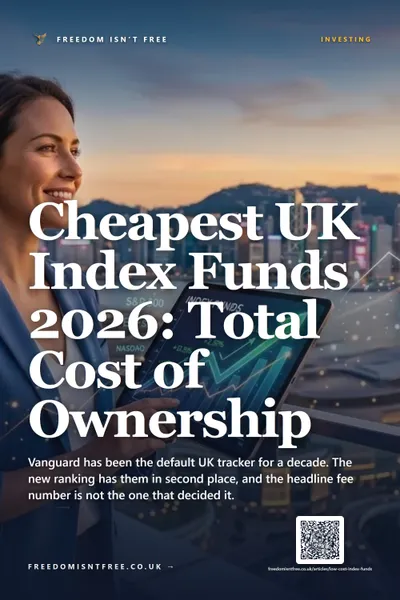



Cheapest UK Index Funds 2026: Total Cost of Ownership
Vanguard has been the default UK tracker for a decade. The new ranking has them in second place, and the headline fee number is not the one that decided it.
Cite this article
Freedom Isn't Free (2026) Cheapest UK Index Funds 2026: Total Cost of Ownership. Available at: https://freedomisntfree.co.uk/articles/low-cost-index-funds (Accessed: 21 September 2026).
Italicise the article title in your bibliography. Accessed date set to today.
TLDR
- Understanding different cost terms like AMC, OCF, and TCO is important when comparing index funds.
- Vanguard's cost advantage has diminished, with new competitors like Amundi offering lower total costs.
- Total Cost of Ownership (TCO) is the most accurate measure of a fund's cost, including both disclosed fees and undisclosed transaction costs.
- When choosing a low-cost index fund, consider the overall TCO rather than just the Ongoing Charges Figure (OCF).
Cheapest UK Index Funds 2026: Total Cost of Ownership
Contents
- AMC, OCF, TER: What the Acronyms Mean
- What Monevator's Research Found
- Why the Vanguard Default No Longer Holds
- Wrappers Matter as Much as Fees
- A Practical Starting Point
- Author's Take
- Frequently Asked Questions
Choosing an index fund sounds simple. Find the cheapest one that tracks the index you want. Done.
In practice, the definition of "cheapest" is less obvious than most guides suggest - and getting it wrong can cost you thousands of pounds over a 20-year investment horizon. The difference between a fund charging 0.07% and one charging 0.20% looks trivial. On a £100,000 portfolio compounding at 7% per year for 20 years, it is roughly £30,000.
The good news is that the UK investor community has done the hard work here. Monevator's regularly-updated low-cost index tracker guide is the most thorough comparison of its kind for UK investors, and the findings are more interesting than the headline numbers suggest.
AMC, OCF, TER: What the Acronyms Actually Mean
Before comparing costs, you need to understand what is being measured. The fund industry has a habit of using multiple overlapping terms that are easy to confuse. (If you want a broader walkthrough of the numbers on a fund's factsheet, see How to Read an ETF Factsheet.)
AMC - Annual Management Charge This is the base fee charged by the fund manager for running the fund. It is the number most prominently advertised, and it is almost always the least useful figure for comparison. The AMC excludes a range of other costs that are also deducted from your returns.
OCF - Ongoing Charges Figure (also called TER, Total Expense Ratio) This is a better number. The OCF includes the AMC plus other costs such as administration fees, legal fees, and audit costs. In most EU and UK regulated fund documentation, you will find the OCF prominently disclosed. It is the industry standard for fee comparison, and it is materially more accurate than the AMC.
TCO - Total Cost of Ownership This is the number that actually matters, and it is the one that most fund comparisons ignore entirely.
The OCF captures the costs charged explicitly to the fund. It does not capture the transaction costs the fund incurs when buying and selling securities to track the index - portfolio turnover costs, bid-offer spreads on the underlying holdings, and the market impact of large trades. These costs are real and they reduce returns, but they are not disclosed in the OCF.
Monevator's tracker guide adds an estimate of these transaction costs to the OCF to arrive at a TCO figure. For a fund with high portfolio turnover or that holds illiquid securities, the gap between OCF and TCO can be significant.
What Monevator's Research Found
The headline finding from Monevator's tracker comparison is that Vanguard's cost advantage has largely disappeared. For years, Vanguard was the default recommendation for UK passive investors - their funds were meaningfully cheaper than the alternatives. That is no longer true across the board. A new wave of competitors, particularly Amundi, now offers lower TCOs in several important categories.
Here is a summary of the cheapest options by asset class as of Monevator's most recent update:
Global All-World Equity
The most important category for most investors - a single fund that tracks the entire global stock market.
| Fund | Ticker | TCO |
|---|---|---|
| Amundi Prime All Country World ETF | PACW | 0.07% |
| SPDR MSCI ACWI ETF | ACWI | 0.12% |
The Amundi PACW at 0.07% TCO is the cheapest global all-world fund available to UK investors. For most people building a simple one-fund portfolio, this is the starting point.
US Large Cap
US equities dominate global indices (typically 60-65% of MSCI All World), so a dedicated US fund can make sense as a core holding.
| Fund | Ticker | TCO |
|---|---|---|
| SPDR S&P 500 ETF | SPXL | 0.03% |
| Amundi MSCI USA ETF | MSCU | 0.03% |
| UBS Core S&P 500 ETF | S5UA | 0.03% |
Three funds tied at 0.03% TCO. At this level, the cost is essentially negligible and other factors - your broker's dealing costs, the bid-offer spread, whether you prefer accumulation or income units - become the deciding factors.
UK Equity
| Fund | Ticker | TCO |
|---|---|---|
| iShares UK Equity Index Fund D | GB00B7C44X99 | 0.05% |
For UK-listed equity exposure, the iShares fund is the cheapest option on a TCO basis.
Emerging Markets
Emerging markets funds tend to have higher transaction costs because the underlying securities are less liquid.
| Fund | Ticker | TCO |
|---|---|---|
| Amundi MSCI Emerging Markets ETF | LEMA | 0.14% |
Even at 0.14%, this is meaningfully cheaper than many emerging markets funds that advertise low OCFs but carry higher transaction costs.
A 0.1% gap against a 1% fund sounds trivial. Run it across a few decades of compounding and the cheaper fund pulls clearly ahead, which is the whole reason these tables matter:
Why the Vanguard Default No Longer Holds
For UK investors who started investing in the 2010s, the default recommendation was usually some variation of: "Buy Vanguard, they're the cheapest." This was broadly true at the time. Vanguard brought index investing to the UK retail market at a price point that was genuinely disruptive.
That has changed. Amundi in particular has aggressively priced its ETF range below Vanguard equivalents. On TCO, the Amundi PACW global all-world ETF is cheaper than the comparable Vanguard offering. The SPDR S&P 500 ETF undercuts Vanguard's S&P 500 tracker on total cost.
This is not a criticism of Vanguard - their funds are still excellent, well-managed, and perfectly respectable choices. But the days of defaulting to Vanguard purely on cost grounds are over. Check the TCO before you buy.
Wrappers Matter as Much as Fees
The most important cost decision you can make is not which fund to buy - it is which account to hold it in.
ISA - Individual Savings Account All returns inside an ISA are free of UK income tax and capital gains tax. For a fund paying dividends, this matters immediately: dividend income outside an ISA is taxed above the annual dividend allowance. For a fund you intend to hold for decades and eventually sell, the CGT shelter matters enormously. If you are choosing a platform to hold your ISA, Trading 212 is a solid starting point for UK investors.
SIPP - Self-Invested Personal Pension Contributions to a SIPP receive tax relief at your marginal income tax rate. A basic rate taxpayer investing £800 has £1,000 working for them immediately - a 25% uplift before investment returns. The tradeoff is that you cannot access the money until age 57 (from April 2028). For retirement assets, this is almost always the right wrapper.
The hierarchy for most UK investors:
- Fill your ISA allowance (£20,000 per tax year) with your core index fund holdings
- Contribute to your employer's pension to at least capture any employer match
- Consider a SIPP for additional pension savings if you have used your ISA allowance
Inside these wrappers, the fund choice matters. Outside them, tax drag can dwarf the difference between a 0.07% and a 0.20% fund.
A Practical Starting Point
If you are a UK investor who wants to keep things simple, here is a straightforward framework:
One-fund global portfolio: Amundi Prime All Country World ETF (PACW) inside a Stocks and Shares ISA. 0.07% TCO. Tracks 2,800+ companies across 23 developed and 24 emerging markets. One purchase, annual top-ups, done.
Two-fund portfolio with home bias: PACW for global exposure, iShares UK Equity Index Fund D for a tilt towards UK equities (which are currently trading at a significant valuation discount to the US). Still simple. Still cheap. For more on how a value or regional tilt fits into a long-term strategy, see Value, Growth, and Dividend Investing - Three Approaches Compared.
Three-fund with emerging markets: Add the Amundi MSCI Emerging Markets ETF (LEMA) for dedicated EM exposure if you want more control over regional weights than PACW provides.
In all three cases, the total portfolio cost is well below 0.15% TCO. The compounding impact of that over 30 years is substantial.
A direct word for anyone reading this and feeling paralysed: start with the one-fund version. Do not graduate to two or three until you can articulate, in a sentence, the actual investment thesis behind the second holding. "I want a UK home bias because the UK's CAPE is at a 30-year low" is a thesis. "I want a UK home bias because that feels patriotic" is not. And whatever the second holding is, keep it under 10% of the portfolio while you are testing it. Slow, steady, and diversified wins this race. Diversifying away from one global tracker before you have a real reason is just adding moving parts that complicate decisions and dilute returns.
Bookmark Monevator's Tracker List
Fund costs change. New entrants arrive. Vanguard may reprice. Amundi may not. The specific tickers cited in this article reflect Monevator's research at a point in time.
Monevator's low-cost index tracker guide is updated regularly and remains the most reliable UK-specific resource for comparing TCO across fund categories. If you are making a significant investment decision, check the current version rather than relying on any snapshot - including this one.
Further Reading:
The Little Book of Common Sense Investing - John Bogle - The definitive case for low-cost index investing, straight from the man who invented the index fund. Everything in this article traces its intellectual lineage back to Bogle's work. (Affiliate link - we may earn a small commission at no extra cost to you.)
Smarter Investing - Tim Hale - The definitive UK guide to evidence-based investing. Covers fund selection, factor tilts, and portfolio construction using ISAs and SIPPs in far more depth than any article can. (Affiliate link - we may earn a small commission at no extra cost to you.)
Frequently Asked Questions
What is the difference between OCF and TER?
OCF (Ongoing Charges Figure) and TER (Total Expense Ratio) are largely interchangeable terms - both capture the annual cost charged directly by the fund, including the management fee plus admin, legal, and audit costs. OCF is the standard UK disclosure term. Neither captures transaction costs the fund incurs when buying and selling securities, which is why Total Cost of Ownership (TCO) is the more complete measure for comparison.
Is Vanguard still the cheapest index fund provider in the UK?
No longer across the board. Amundi has aggressively priced its ETF range below comparable Vanguard offerings. On a TCO basis, the Amundi PACW global all-world ETF (0.07%) is cheaper than the equivalent Vanguard fund. The SPDR S&P 500 ETF ties with others at 0.03% TCO. Vanguard funds remain excellent, but defaulting to them purely on cost grounds is no longer justified - check current TCOs via Monevator's tracker guide before buying.
What does TCO (Total Cost of Ownership) mean for index funds?
TCO adds an estimate of transaction costs - the dealing costs the fund incurs when buying and selling securities to track the index - to the published OCF. These transaction costs are real and reduce returns but are not disclosed in the OCF. For funds with high portfolio turnover or illiquid underlying holdings, the gap between OCF and TCO can be significant. Monevator's tracker guide calculates TCO for major UK index funds.
Should I use an ISA or a SIPP for my index funds?
Both, ideally. The hierarchy for most UK investors is: ISA first (£20,000 annual allowance, fully flexible withdrawals), then employer pension to capture any match, then SIPP for additional pension savings. ISAs are better for funds you may need before retirement age. SIPPs provide upfront tax relief at your marginal rate but lock the money until age 57 (from April 2028). For long-term retirement assets, the SIPP tax relief advantage is usually decisive.
How much does a 0.1% difference in fund fees matter over 20 years?
On a £100,000 portfolio compounding at 7% per year over 20 years, a 0.1% annual fee difference compounds to roughly £15,000 in lost returns. A 0.2% difference is around £30,000. The maths is straightforward: every basis point of fee is a basis point of return you do not receive, compounded annually for the life of the investment. Over multi-decade horizons, small differences in TER or TCO become significant.
Read next
Prefer to watch?
We turn these money breakdowns into short videos
A few a week, plain-English UK money. If you would sooner watch than read, follow along:
Enjoying the content?
If this site has been useful, a coffee goes a long way.
Browse more articles
Browse all