

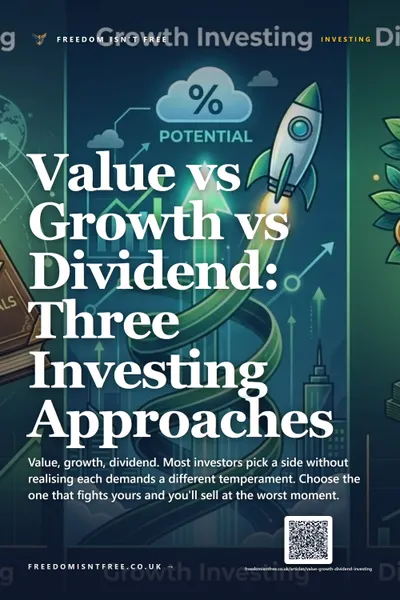
Value vs Growth vs Dividend: Three Investing Approaches
Value, growth, dividend. Most investors pick a side without realising each demands a different temperament. Choose the one that fights yours and you'll sell at the worst moment.
Cite this article
Freedom Isn't Free (2026) Value vs Growth vs Dividend: Three Investing Approaches. Available at: https://freedomisntfree.co.uk/articles/value-growth-dividend-investing (Accessed: 21 September 2026).
Italicise the article title in your bibliography. Accessed date set to today.
TLDR
- Value investing involves buying assets below their intrinsic value, relying on market irrationality to recover prices over time.
- Growth investing focuses on companies with high revenue and earnings growth, often at the expense of current profitability.
- Dividend investing targets companies that pay regular dividends, providing a steady income stream for investors.
Value vs Growth vs Dividend: Three Investing Approaches Compared
There is more than one way to invest in equities for the long term. Most investors eventually encounter three broad approaches: value investing, growth investing, and dividend investing. Each has a different logic, a different history, and attracts a different type of investor.
Understanding how they differ - and what each requires from you psychologically as well as financially - helps you build a portfolio you can actually stick to.
Value Investing: Buying Below Intrinsic Worth
The Idea
Value investing is the practice of buying assets that are trading below their intrinsic value - their worth based on underlying fundamentals like earnings, book value, and cash flows.
The core insight is that markets are sometimes irrational. Fear, short-termism, and herd behaviour can push good companies to prices that do not reflect their actual economic worth. Patient investors who buy at these moments and wait for the price to recover can earn above-average returns.
Where It Comes From
Value investing was formalised by Benjamin Graham in The Intelligent Investor, first published in 1949. Graham developed the concept of the "margin of safety" - buying at a meaningful discount to estimated intrinsic value so that even if your analysis is partially wrong, you still protect your capital.
Graham's most famous student, Warren Buffett, built Berkshire Hathaway into one of the most successful investment vehicles in history using principles derived from Graham's work - though Buffett evolved the approach to include a preference for high-quality businesses at fair prices, rather than mediocre businesses at very cheap prices.
What It Looks Like in Practice
Value investors look for:
- Low price-to-earnings (P/E) ratios relative to the market or sector
- Low price-to-book ratios
- Companies trading below the liquidation value of their assets
- Businesses temporarily out of favour due to short-term problems that do not affect long-term value
For ordinary investors, value exposure is most easily achieved through factor ETFs - funds that select stocks based on valuation metrics rather than market capitalisation.
The Challenges
Value investing requires patience, conviction, and the willingness to hold positions that are underperforming while the market chases something more exciting. There have been extended periods - most notably the 2010s - where growth stocks dramatically outperformed value, and many value investors lost confidence.
It also requires genuine analytical effort to assess intrinsic value accurately. Passive exposure through a value ETF removes some of this burden but also removes the potential for significant outperformance.
Growth Investing: Paying for Future Earnings
The Idea
Growth investing focuses on companies that are growing their revenues, earnings, or market share faster than the broader economy - often at the expense of current profitability. These companies typically reinvest most of their earnings back into the business rather than paying dividends.
The premise is that a company growing at 25% per year is worth paying a premium for, because the compounding of that growth will produce exceptional returns over time.
The Math Behind It
If you invest in a company with no current earnings but a credible path to significant future profits, the intrinsic value lies in discounted future cash flows - the present value of everything the business will earn in future years.
This makes growth investing highly sensitive to assumptions about the future. A modest change in expected growth rate or the discount rate applied to future earnings can dramatically change the calculated value of a growth company.
What It Looks Like in Practice
Growth investors look for:
- Revenue growth of 15-30%+ per year
- Expanding market share in a large addressable market
- Competitive advantages that suggest current margins can be maintained or improved at scale
- Management with a track record of effective capital allocation
The technology sector has dominated growth investing for the past two decades. Companies like Apple, Microsoft, and Nvidia have delivered extraordinary returns - and now constitute a large proportion of global index funds.
The Challenges
Growth investing requires you to pay for an uncertain future. When growth stocks are popular, valuations become stretched - investors pay high multiples for earnings that may or may not materialise.
When interest rates rise, growth stocks typically fall hardest. The reason is mathematical: future earnings become less valuable when discounted at a higher rate. A growth company whose value depends largely on profits 10 years from now is much more sensitive to rate changes than a company paying dividends today.
Growth investing also tends to amplify panic during downturns. If you bought a stock at 40 times earnings because you believed in its growth story, a 30% price drop is much harder to hold through than a 30% drop in a company you bought at 10 times earnings with a solid dividend yield.
Dividend Investing: Income Over Capital Gains
The Idea
Dividend investing focuses on companies or funds that pay regular cash distributions to shareholders - a portion of their profits returned directly to investors.
The appeal is both financial and psychological. Financially, dividends provide a tangible, income-based return that does not depend on selling your shares. Psychologically, dividends provide a concrete reminder that your portfolio represents real businesses generating real profits - which makes it easier to hold through periods of price volatility.
What It Looks Like in Practice
Dividend investors look for:
- Companies with consistent, growing dividend histories
- Dividend yields that are sustainable relative to earnings (dividend cover ratio)
- Businesses in sectors with stable cash flows - financials, utilities, consumer staples, energy
- Low payout ratios that leave room for growth
For most ordinary investors, a global dividend ETF is the most practical way to access dividend investing. These funds hold hundreds of dividend-paying companies across global markets, providing broad diversification while maintaining the focus on income-generating businesses.
A commonly cited example is Vanguard's FTSE All-World High Dividend Yield ETF (VHYL), which provides global dividend exposure at a low ongoing cost. This is not a recommendation to buy any specific fund - your circumstances will determine what is appropriate for you. For the UK-specific tax comparison between a dividend and a growth strategy (which matters in a General Investment Account but vanishes inside an ISA or SIPP), see dividend vs growth investing in the UK.
The Challenges
Dividend investing is not a free lunch. A company that pays out most of its profits as dividends is retaining less capital for reinvestment - which may limit its growth rate. Over very long periods, high-dividend strategies have not always outperformed total-return strategies.
Dividends can also be cut. A high dividend yield can be a sign of a financially stressed company whose share price has fallen because the business is in trouble. Assessing whether a dividend is sustainable requires the same rigour as any other form of analysis.
Which Approach Is Right for You?
There is no objectively correct answer. The right approach depends on your goals, your time horizon, and your temperament.
| Value | Growth | Dividend | |
|---|---|---|---|
| Primary appeal | Buying cheap | Capturing future growth | Income and clarity of value |
| Time horizon | Long (5-10+ years) | Long (5-10+ years) | Long (10+ years) |
| Volatility tolerance | High | High | Moderate |
| Requires analysis? | Yes (or a factor ETF) | Yes (or a growth ETF) | Less - ETFs handle it |
| Psychological challenge | Holding when others are selling | Holding when multiples compress | Watching price fall while collecting income |
| Best suited to | Analytical, patient investors | Conviction investors with long horizon | Income-focused or behavioural investors |
Many investors blend approaches. A core global tracker (capturing growth and market beta) combined with a dividend or value ETF overlay is a reasonable, evidence-based structure for a long-term portfolio.
Further Reading
If you want to go deeper on these approaches, the foundational texts are worth reading:
- Value investing: Benjamin Graham's The Intelligent Investor is the classic starting point. Dense but rewarding.
- Index and cost-conscious investing: John Bogle's The Little Book of Common Sense Investing makes the case for low-cost passive exposure across all three styles.
- Investor psychology: Morgan Housel's The Psychology of Money is essential for understanding why temperament matters as much as strategy.
Frequently Asked Questions
Which investing style has the best long-term track record?
Over the very long run (decades, across multiple markets), value investing has historically produced modestly higher returns than the broad market - a phenomenon known as the "value premium." Growth investing has dominated in certain periods, most notably the 2010s in the US. Dividend investing typically produces total returns broadly in line with the market, with more of the return delivered as income rather than capital appreciation.
Can I combine all three approaches?
Yes, and many experienced investors do. A common structure is a core global tracker (capturing market returns from growth and value across all sectors) combined with a value or dividend ETF overlay. This reduces concentration in expensive US tech, adds income, and maintains full market participation. The right blend depends on your goals, tax situation, and temperament.
Is value investing dead?
It has been declared dead many times. The most recent extended period of underperformance was the 2010s, when US growth stocks - particularly large-cap technology - dramatically outperformed value stocks globally. Academic evidence for the value premium over very long periods remains intact, but it is not reliable over any 5-10 year window, and requires significant patience and conviction to implement.
Are dividend stocks safe?
Relative to the broader market, dividend-paying companies tend to have more stable revenues and earnings - but dividends can and do get cut. A high dividend yield is sometimes a warning sign: the share price may have fallen because the market anticipates a cut. Dividend safety requires looking at the payout ratio (dividends as a percentage of earnings) and the company's earnings trend, not just the headline yield.
How should a beginner choose between these three approaches?
For most beginners, the practical answer is to start with a low-cost global index fund and learn the territory before making any style-based decisions. Index investing captures exposure to all three styles in proportion to market capitalisation. Once you have a few years of investing experience, you will have a much better sense of which approach matches your psychology and goals.
Related Reading:
- What Is Intrinsic Value - and Why Every Investor Should Understand It
- Why Dividend ETFs Can Be a Powerful Long-Term Strategy
- Too Much US Tech? How a Value Tilt Can Rebalance Your Portfolio
The Warren Buffett Way - Robert G. Hagstrom - The most accessible treatment of Buffett's investment philosophy, covering his evolution from pure Graham-style value investing to buying high-quality businesses at fair prices. Essential reading if the value section of this article resonated with you. (Affiliate link - we may earn a small commission at no extra cost to you.)
100 Baggers - Christopher Mayer - A study of stocks that returned 100x their purchase price, identifying the characteristics that separate exceptional long-duration growth compounders from the rest. The growth investing companion to Graham's value classic. (Affiliate link - we may earn a small commission at no extra cost to you.)
Prefer to watch?
We turn these money breakdowns into short videos
A few a week, plain-English UK money. If you would sooner watch than read, follow along:
Enjoying the content?
If this site has been useful, a coffee goes a long way.
Browse more articles
Browse all