
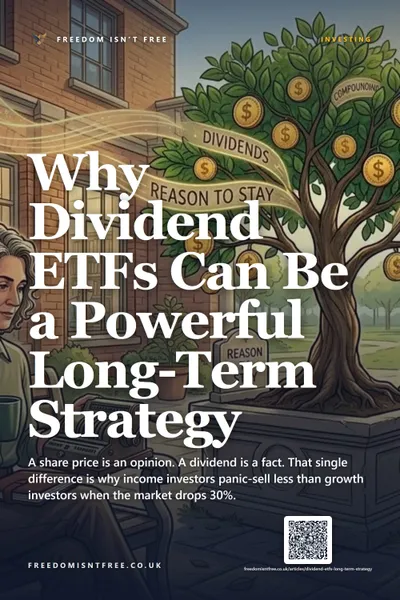

Why Dividend ETFs Can Be a Powerful Long-Term Strategy
A share price is an opinion. A dividend is a fact. That single difference is why income investors panic-sell less than growth investors when the market drops 30%.
Cite this article
Freedom Isn't Free (2026) Why Dividend ETFs Can Be a Powerful Long-Term Strategy. Available at: https://freedomisntfree.co.uk/articles/dividend-etfs-long-term-strategy (Accessed: 21 September 2026).
Italicise the article title in your bibliography. Accessed date set to today.
TLDR
- A dividend ETF pays you real cash from real company profits - an anchor that makes a 30% drawdown survivable rather than terrifying.
- The main global options in 2026: VHYL at 0.29% a year (2,328 holdings), Fidelity Global Quality Income at 0.40%, SPDR Dividend Aristocrats at 0.45%.
- When the price of an income fund falls, the yield on new purchases rises. That maths is why income investors panic-sell less.
- Go global, keep charges under 0.30% where you can, and write down your drawdown plan before you buy.
Dividend ETF selection checklist
| Criterion | Why it matters | Sensible target |
|---|---|---|
| Global exposure | Single-country funds concentrate risk | MSCI World or FTSE All-World index |
| Ongoing charge (OCF) | Fees compound over decades | Below 0.30% |
| Distribution policy | Acc reinvests, Inc pays cash | Match to your life stage |
| Top 10 concentration | High weight signals stock-specific risk | Read the factsheet |
| Drawdown plan | You must hold through a 30% drop | Write it down before you buy |
Apply the checklist before you click buy, not after the first dip.
Why Dividend ETFs Can Be a Powerful Long-Term Strategy
There are two broad approaches to long-term investing. The first is to buy a total market index fund and trust that, over decades, global economic growth will lift your portfolio. The second is to focus on assets that pay you while you wait - dividend-paying companies and the ETFs that track them.
Both approaches work. But dividend investing offers something the pure total-return approach does not: a tangible, income-based connection to the underlying value of what you own.
That connection matters more than most people realise - not just financially, but behaviourally.
Real Companies, Real Cash
When you own a dividend-paying ETF, something concrete happens every quarter. Companies in the fund earn profits. A portion of those profits is distributed to shareholders. The money arrives in your account.
Nothing about that sequence depends on a screen refreshing in your favour. Dividends are the product of real economic activity - of businesses selling goods and services, managing costs, and generating returns for their owners.
That tangibility changes how you relate to your investments. A share price is an opinion. A dividend is a fact.
When you understand that your ETF holds hundreds of profitable companies that collectively pay out billions in dividends each year, a short-term price drop looks different. The price may have fallen. But the underlying businesses are still earning. The dividends are still being paid. The investment case has not changed.
The Anchor of Intrinsic Value
The most dangerous moment in investing is when prices fall and you do not know why you bought in the first place.
If you bought because the price was rising, a falling price gives you no logical reason to hold on. Worse, it gives you no logical floor. You do not know when to stop worrying, because you never had a value-based reason to own the asset in the first place.
Dividend investors have an anchor.
Run the actual numbers. Say you hold £10,000 of a fund yielding 3.5% - it pays you £350 a year. The market falls 20% and your holding is marked at £8,000. The companies inside the fund are still earning and still distributing, so the income is still £350. But every new £1,000 you invest now buys the same income stream at a 20% discount: £350 / £8,000 = 4.4% on fresh money, up from 3.5%. The drop has made the thing you are buying better, not worse. The correct emotional response is interest.
This is the psychological power of understanding intrinsic value. When you know what you own and why it is worth owning, volatility becomes signal rather than noise.
The Difference Between Investing and Speculation
This distinction matters, and it is one that many people gloss over.
Investing means buying an asset because you believe it will generate returns based on its underlying economic activity - its earnings, cash flows, dividends, or productive capacity.
Speculation means buying an asset primarily because you expect its price to rise, without a clear view of the underlying value that would justify a higher price.
Both can produce profits. But they respond to price drops very differently.
An investor who owns dividend ETFs because they represent profitable global companies has a framework for thinking through a downturn. Does the fall reflect a genuine deterioration in the companies' earnings? Or is it short-term sentiment? The answers shape the response.
A speculator who owns the same ETF because it was going up last year has no such framework. When the price falls, there is nothing to reason from. The only question is whether the price will recover - and that is a question nobody can answer.
If you find yourself panicking during a market correction and you cannot explain why your holdings have value independent of their recent price performance, that is a sign you may be speculating rather than investing. There is no shame in recognising this. But it is worth addressing, because speculation without self-awareness is how investors get badly hurt.
Practical Tips for Building a Dividend ETF Portfolio
If you want to build a dividend-focused portfolio you can hold through volatility, here are the principles that matter:
1. Go global
Single-country dividend ETFs concentrate your risk unnecessarily. A global dividend ETF spreads your exposure across the US, Europe, Asia, and emerging markets - reducing the impact of any one economy underperforming.
Look for ETFs tracking indices like the MSCI World High Dividend Yield Index or the FTSE All-World High Dividend Yield Index.
2. Keep costs low
Even a 0.5% annual fee will meaningfully compound over decades. Look for funds with ongoing charges below 0.3% if possible. Here is what the three most popular global options actually cost and hold (figures from justETF, July 2026):
| Fund | OCF | Holdings | Trailing yield |
|---|---|---|---|
| Vanguard FTSE All-World High Dividend Yield (VHYL) | 0.29% | 2,328 | 2.5% |
| Fidelity Global Quality Income (FGQI) | 0.40% | 242 | 1.8% |
| SPDR S&P Global Dividend Aristocrats (GBDV) | 0.45% | 93 | 3.8% |
The table tells you something the marketing does not: yield and diversification pull in opposite directions. The Aristocrats fund pays the most but holds just 93 companies; VHYL holds 25 times as many stocks and charges the least, but its screen is broader, so the yield is lower. Pick your trade-off deliberately rather than sorting by yield and clicking the top row.
3. Reinvest dividends (at the accumulation stage)
If you are not yet living off your investments, use accumulation share classes or automatically reinvest dividends. This compounds your returns and smooths out the psychological temptation to spend the income.
Wherever possible, hold the fund inside a Stocks and Shares ISA. Outside a wrapper, distributions above the £500 allowance are taxed at 10.75% to 39.35% for 2026/27 - the dividend tax guide covers the bands - and an income-focused fund generates exactly the kind of income that hits that allowance fastest.
4. Understand what is inside the fund
Spend 20 minutes reading the fund factsheet - it is less faff than it sounds. What are the top 10 holdings? What sectors dominate? How has the dividend yield moved over time? You do not need to know every company, but you should have a broad sense of what you own.
5. Have a plan for drawdowns
Before you invest, write down what you will do if the fund falls 30%. If your plan is to hold and keep buying, write that down. If you genuinely cannot stomach a 30% drop without selling, you may need to reconsider your allocation - not because dividend ETFs are bad, but because any strategy you cannot stick to is no strategy at all.
Staying Invested Is the Strategy
The biggest advantage of dividend investing is not the yield. It is the mindset it creates.
Investors who understand why their assets have value are far more likely to stay invested through downturns - and staying invested is, statistically, the most important variable in long-term outcomes.
The global stock market has gone up over every extended period in modern history. The investors who captured those returns were not the cleverest. They were the ones who did not sell when things got scary.
Two caveats before you rebuild your portfolio around income. Dividend strategies have lagged growth on raw total return for most of the last fifteen years - the dividend vs growth comparison puts numbers on that gap. And the feeling of safety a dividend gives you is partly an illusion, for reasons worth understanding: why dividend investing feels safer but isn't. Neither kills the case. Both should inform how much of your portfolio you commit to it.
Dividend ETFs give you the intellectual framework to be one of those investors who holds. That framework, more than the income itself, is the strategy.
Frequently Asked Questions
What is a dividend ETF?
A dividend ETF is a fund that holds a basket of dividend-paying companies and distributes their combined income to investors at regular intervals - typically quarterly. Rather than selecting stocks yourself, you gain diversified exposure to hundreds of dividend-paying businesses across global markets. Popular examples include Vanguard's FTSE All-World High Dividend Yield ETF (VHYL) and the iShares MSCI World Quality Dividend ETF.
Are dividend ETFs better than growth ETFs?
Neither is objectively better - they serve different purposes. Dividend ETFs provide regular income and a tangible connection to underlying business value, which makes them easier to hold through downturns. Growth ETFs typically reinvest all earnings, aiming for higher long-term capital appreciation. Over very long periods, total return strategies (growth-focused) have sometimes outperformed pure dividend strategies. The right choice depends on your goals, time horizon, and psychological make-up.
Do dividend ETFs perform well in a falling market?
Better than speculation-driven holdings, typically. When markets fall, dividend ETF investors have a rational anchor - the underlying companies are still earning and distributing income, even if the price has dropped. This framework makes it easier to hold or buy more during downturns rather than selling in panic. That said, dividends can be cut in severe recessions, and no ETF is immune to market falls.
Should I choose accumulation or income units for a dividend ETF?
If you are still building your portfolio and do not need the income, accumulation units automatically reinvest dividends, compounding your returns without you having to act. Income units distribute cash to your account. During the accumulation phase, acc units are generally more efficient. When you reach the withdrawal phase and need the income to live on, income units make more practical sense.
How do I find a cheap global dividend ETF for UK investors?
Look for ETFs tracking indices like the FTSE All-World High Dividend Yield Index or MSCI World High Dividend Yield Index. Compare ongoing charges figures (OCF) - anything under 0.3% is reasonable for a global dividend ETF. Vanguard, iShares, and HSBC all offer options in this range. Hold inside a Stocks and Shares ISA to shelter dividend income from UK income tax, which matters increasingly as the dividend allowance has fallen to just £500.
Further Reading:
The Ultimate Dividend Playbook - Josh Peters - Specifically about dividend investing as a long-term strategy. Peters, a former Morningstar analyst, covers how to identify reliable dividend payers and build a portfolio that grows income over time. (Affiliate link - we may earn a small commission at no extra cost to you.)
Get Rich with Dividends - Marc Lichtenfeld - A practical guide to dividend growth investing, covering how to find companies that will reliably raise their dividends year after year and compound your income. (Affiliate link - we may earn a small commission at no extra cost to you.)
Related Reading:
Sources
Prefer to watch?
We turn these money breakdowns into short videos
A few a week, plain-English UK money. If you would sooner watch than read, follow along:
Enjoying the content?
If this site has been useful, a coffee goes a long way.
Browse more articles
Browse all