

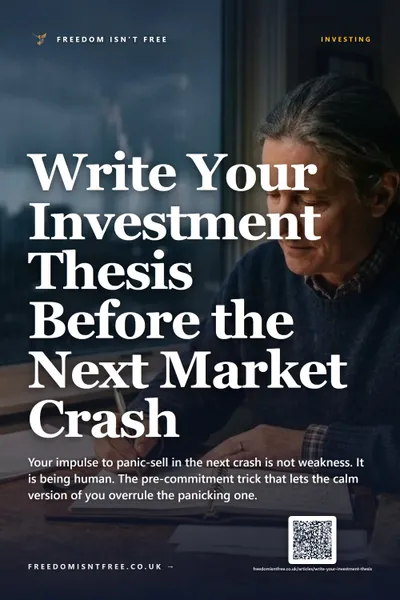



Write Your Investment Thesis Before the Next Market Crash
Your impulse to panic-sell in the next crash is not weakness. It is being human. The pre-commitment trick that lets the calm version of you overrule the panicking one.
Cite this article
Freedom Isn't Free (2026) Write Your Investment Thesis Before the Next Market Crash. Available at: https://freedomisntfree.co.uk/articles/write-your-investment-thesis (Accessed: 21 September 2026).
Italicise the article title in your bibliography. Accessed date set to today.
TLDR
- Create a written investment thesis when you are calm to guide your decisions during market chaos.
- An investment thesis explains why your strategy makes sense, not what the market will do.
- A thesis is a flexible framework that reflects your values, goals, and honest self-assessment.
- Write down your response to market downturns to avoid emotional selling.
- Your thesis should include specific details about your investments, time horizon, and actions during price drops.
The four questions your thesis must answer
| Question | Why it matters |
|---|---|
| What do I own and why? | Anchors you to a logic, not a price chart |
| What is my time horizon? | Decides how much volatility you can tolerate |
| What will I do when prices fall? | Pre-commits the calm version of you |
| What would make me change strategy? | Filters real signals from scary headlines |
Keep it under two pages. If you cannot read it in five minutes during a panic, you will not read it.
Write Your Investment Thesis Before the Next Market Crash
Most investing mistakes are not made from ignorance. They are made in the dark, under pressure, when prices are moving fast and the news is alarming and your gut is screaming at you to do something.
The solution is pre-commitment, not more willpower.
A written investment thesis is a document you create when you are calm, rational, and thinking clearly - and then refer back to when you are none of those things. It answers the question: why do I own what I own, and what am I going to do when things go wrong?
If you do not have one, write one now. Here is how.
What a Thesis Is - and What It Is Not
An investment thesis is not a prediction. You are not forecasting what the market will do next year. You are articulating why your strategy makes sense regardless of what the market does next year.
It is a framework for thinking rather than a rigid rulebook - one that reflects your values, your goals, your knowledge, and your honest assessment of your own behaviour.
It should be short enough to read in five minutes when you are panicking. Long enough to actually answer the important questions.
Example Thesis Statements
The best way to understand what a thesis looks like is to see real examples. Here are two that reflect very different but equally valid approaches.
Thesis 1: The Dividend Investor
"I invest primarily in global dividend-paying stocks and ETFs. I do this because dividends represent real company profits distributed to shareholders - they give me confidence that my portfolio has intrinsic value beyond its current price. When the price of my holdings falls, I remind myself that the underlying companies are still earning and paying dividends. A price drop is a sale, not a disaster. My response to a significant market decline is to buy more, not to sell."
This thesis anchors the investor to a specific logic. When prices fall, they have a pre-written argument for why holding - or buying more - makes sense. The emotional pressure to sell is countered by a framework they created when they were thinking clearly.
Thesis 2: The Hands-Off Index Investor
"I invest a fixed amount each month into a global index tracker. I have set this up as an automatic direct debit and I do not actively manage it. I do this because I do not have the expertise or the time to make good individual stock decisions, and I know that if I watch the markets closely I will panic and make bad decisions. My strategy depends on me not interfering. If I feel the urge to change my allocation or pause contributions during a downturn, that feeling is exactly what my thesis warns me about. I do not act on it."
This thesis is remarkable for its self-awareness. The investor has essentially written a pre-mortem - they have identified the specific mistake they are likely to make and told their future self not to make it. The thesis is a safeguard against the investor's own psychology.
Building Your Own Thesis
Your thesis should answer the following questions. You do not need to write an essay - a paragraph per question is enough.
1. What do you invest in, and why?
Be specific. Not "shares" but "a global equity index fund" or "dividend ETFs tracking MSCI World" or "a mix of a UK tracker and a global dividend fund." Then explain why. What is it about this approach that makes sense to you?
2. What is your time horizon?
Are you investing for retirement in 30 years? For financial independence in 10? For a house deposit in 5? Your time horizon determines how much short-term volatility you can rationally tolerate.
3. What will you do when prices fall?
Write this down before it happens. Will you hold? Buy more? Rebalance? The answer should follow logically from your strategy. If you invest in a global index fund on the grounds that global equities have always recovered over long periods, your answer should be "I will hold and keep contributing."
4. What would have to be true for you to change your strategy?
This is the most important question. What would be a legitimate reason to alter your approach - not a scary news headline, but a genuine change in your circumstances or a fundamental flaw in your logic?
For most long-term investors, the legitimate triggers are things like: your time horizon shortens dramatically, you need the money sooner than planned, or you discover your strategy was based on a factual error. Market volatility is never on the list.
Warning Signs That You May Be Speculating
A good investment thesis requires you to be honest about what kind of investor you actually are. If any of the following are true, your thesis needs to confront them directly - because they are signs that your portfolio may contain speculative positions rather than genuine investments.
You cannot explain what your holdings do or earn. If you own a stock or fund and you could not describe, in plain English, how it generates returns - what the underlying businesses do, how they make money, why they pay dividends or grow earnings - then you do not have an investment case. You have a bet on the price.
You bought because of hype or fear of missing out. If the primary reason you bought something was because everyone was talking about it, or because the price had been rising and you did not want to miss out, that is speculation. There is no underlying logic to fall back on when the price reverses.
A price drop makes you anxious with no rational response. Investors can say: "The price fell, but the dividends are still being paid and the business is still profitable - I am comfortable holding." Speculators can only say: "I hope the price comes back." If you have no rational argument for why your holdings are worth holding after a fall, you are speculating.
You have no plan for a 40% drop. If a 40% decline in your portfolio would cause you to sell in a panic, either your portfolio is not suited to your risk tolerance, or you have never genuinely thought through the implications of what you own. A written thesis forces you to confront this before it happens.
The Commitment Device
The reason to write your thesis down - not just think it, but actually write it - is that written commitments work differently than mental intentions.
When your portfolio is down 25% and you are reading alarming headlines, the version of you making decisions is a stressed, loss-averse version who wants relief from discomfort - not the calm, long-term-thinking version who designed your strategy.
Your written thesis is a message from your past self to your future self. It says: I thought about this carefully. I anticipated that you would feel this way. Here is what we decided to do.
That is not guaranteed to stop you from making a mistake. But it gives you pause. It creates a gap between the impulse and the action. And in investing, that gap is often all you need.
A Note on Self-Knowledge
The best investment strategies are not the ones that look best on a backtest. They are the ones you can actually stick to.
A strategy that generates 9% average annual returns but causes you to sell in every major drawdown will underperform a strategy that generates 7% but that you hold through every storm.
Your thesis should reflect who you are, not who you wish you were. If you know you will panic when you watch the market too closely, build a strategy that removes the watching. If you know you need to feel connected to the value of your investments to stay calm, build a portfolio that gives you that connection.
The goal is to be an investor who stays invested - because that, more than anything else, determines your long-term outcome. Perfect is not the bar.
Frequently Asked Questions
What should an investment thesis include?
Your thesis should cover four things: what you invest in and why, your time horizon, what you will do when prices fall, and what would constitute a legitimate reason to change your strategy. Keep it short enough to read in five minutes when you are stressed. The purpose is not to document a perfect plan - it is to provide a pre-written argument from your calm self to your panicked future self.
How long should an investment thesis be?
One to two pages is ideal. The constraint is deliberate - it forces you to be specific about the things that actually matter and cut the rest. A thesis that takes 30 minutes to read will not be read when you need it most. A single side of A4 that you have actually read three times is worth more than a 20-page document you consulted once.
When should I review my investment thesis?
Review it when your circumstances change significantly - your time horizon shortens, you come into or lose a large sum, or you have a fundamental change in financial goals. Do not review it in response to market conditions. A falling market is not a legitimate trigger for a strategy review. If you find yourself wanting to update your thesis because the market is down 20%, that is the scenario your original thesis was written to prevent.
Is an investment thesis different from an investment plan?
Slightly. A plan covers mechanics: how much to invest, which accounts, how often to rebalance. A thesis covers logic: why the strategy makes sense in the first place and what to do when things go wrong emotionally. Both are useful. The thesis is the document you read when you are scared. The plan is the document you follow when you are calm.
Can I have an investment thesis if I only use index funds?
Yes - and it may be the most important one to write. Index fund investors do not need a stock-picking thesis, but they do need to articulate why passive investing makes sense, why they will not switch to active funds after a bad year, and what they will do if the market falls 40%. The thesis for an index investor is essentially a commitment not to override the strategy when it feels uncomfortable.
Related Reading:
- The Iran Crisis Won't Wreck Your Portfolio - But Panic Might
- Why Dividend ETFs Can Be a Powerful Long-Term Strategy
- An Introduction to Financial Independence, Retire Early (FIRE)
Further Reading:
The Psychology of Money - Morgan Housel - Perhaps the most readable book ever written about the relationship between money and human behaviour. Essential context for understanding why a written thesis matters. (Affiliate link - we may earn a small commission at no extra cost to you.)
The Behavior Gap - Carl Richards - Simple sketches that explain the gap between investment returns and actual investor returns caused by emotional decision-making. Exactly the gap a written thesis is designed to close. (Affiliate link - we may earn a small commission at no extra cost to you.)
Leuchtturm1917 A5 Hardcover Notebook - The premium notebook of choice for serious journaling. Write your investment thesis in it and keep it with your investing documents - your calm self leaving instructions for your future panicked self. (Affiliate link - we may earn a small commission at no extra cost to you.)
Common Stocks and Uncommon Profits - Philip Fisher - The classic on how to think deeply about what you own and why - the intellectual ancestor of "know your thesis." Warren Buffett cited it as one of his core influences. (Affiliate link - we may earn a small commission at no extra cost to you.)
Prefer to watch?
We turn these money breakdowns into short videos
A few a week, plain-English UK money. If you would sooner watch than read, follow along:
Enjoying the content?
If this site has been useful, a coffee goes a long way.
Browse more articles
Browse all