

The Iran Crisis Won't Wreck Your Portfolio - But Panic Might
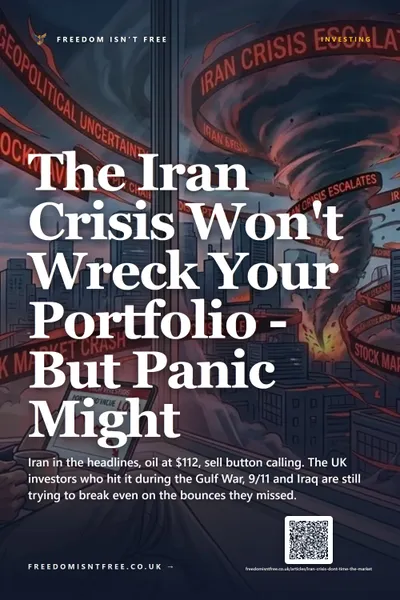
Iran in the headlines, oil at $112, sell button calling. The UK investors who hit it during the Gulf War, 9/11 and Iraq are still trying to break even on the bounces they missed.
Cite this article
Freedom Isn't Free (2026) The Iran Crisis Won't Wreck Your Portfolio - But Panic Might. Available at: https://freedomisntfree.co.uk/articles/iran-crisis-dont-time-the-market (Accessed: 21 September 2026).
Italicise the article title in your bibliography. Accessed date set to today.
TLDR
- Markets have historically survived and recovered from major crises like the Gulf War, 9/11, and the Iraq War.
- Timing the market rarely works because sharp sell-offs and recoveries often occur together, making it difficult to pick the bottom.
- Automating your investments through consistent, scheduled contributions helps exploit market volatility without needing to react emotionally.
- If you feel intense panic about selling your investments, consider whether you truly understand the underlying value of the assets you hold.
Major geopolitical shocks and recovery
| Crisis | Year | Initial market hit | Recovery |
|---|---|---|---|
| Gulf War | 1990-91 | Sharp fall | Within months |
| 9/11 attacks | 2001 | -12% in a week | Within 2 months |
| Iraq War | 2003 | Already priced in | Stocks rallied at start |
| Russia-Ukraine war | 2022 | Global sell-off | Recovered within months |
Every shock felt different. None permanently derailed a diversified investor.
The Iran Crisis Won't Wreck Your Portfolio - But Panic Might
Every few months a headline arrives that feels different. Not routine volatility, but something that makes you wonder whether this time the rules have changed. Tensions in the Middle East. Oil prices spiking. Markets selling off. The urge to do something - to sell, to wait, to protect what you have built - can feel overwhelming.
The Iran crisis is one of those moments. And if you are sitting at your screen wondering whether to reduce your exposure, move to cash, or pause your monthly contributions, this article is for you.
The short answer is: do not change anything. Here is why.
Markets Have Survived Far Worse
History is littered with events that felt like civilisation-ending crises at the time and turned out to be temporary shocks in a long upward trend.
- The Gulf War (1990-91): Markets fell sharply on Iraq's invasion of Kuwait, then recovered within months once the conflict ended.
- 9/11 (2001): The S&P 500 fell roughly 12% in the week following the attacks. Within two months it had fully recovered.
- The 2003 Iraq War: Markets had already priced in much of the uncertainty. Once the war started, stocks rallied.
- The Arab Spring (2010-12): Oil prices surged. Global equities wobbled. Then continued upward.
- Russia-Ukraine (2022): A genuine, prolonged war in Europe. Global indices sold off, then recovered over the following months.
None of these events permanently derailed a diversified, long-term investor. In most cases, the investors who came out ahead were the ones who did nothing - or better still, kept buying.
Why Market Timing Destroys Returns
The idea behind timing the market is simple: sell before the crash, buy back at the bottom. In practice, it almost never works.
The problem is symmetry. Markets do not give you clean signals. The best days and the worst days often cluster together. If you are out of the market during a sharp sell-off, you are very likely also out during the sharp recovery that follows.
Research consistently shows that missing just a handful of the best trading days in a decade can cut your total return in half. The data behind time in the market is overwhelming. The investor who stayed fully invested through every crisis typically outperforms the one who made clever moves at the wrong moments.
Timing the market requires you to be right twice - when to sell, and when to buy back in. Most professionals cannot do it consistently. There is no reason to believe you can either, and no shame in acknowledging that.
The Case for Automating Your Investments
The best thing most investors can do is remove the decision entirely.
Set up a monthly direct debit into a global index fund or dividend ETF. Pick an amount you can sustain without thinking about it. Then let it run - through crises, elections, oil price spikes, and everything else.
This approach - sometimes called pound-cost averaging - means you automatically buy more units when prices are low and fewer when prices are high. You do not need to know when the bottom is. The strategy exploits volatility for you, rather than exposing you to it.
More importantly, it removes your emotions from the equation. You do not have to decide anything. The money moves on a schedule you set years ago. A crisis becomes irrelevant, not because it is not real, but because your strategy does not require you to respond to it.
A Warning: Panic May Be Telling You Something
Here is the part most investing articles skip.
If you are feeling genuine, stomach-churning panic right now - not mild concern, but a compulsion to sell everything - it is worth asking yourself an honest question: do you actually understand why the assets you hold have value?
Not the price. The value.
- If you hold a global equity fund, can you explain that it represents ownership of thousands of real businesses with real earnings?
- If you hold a dividend ETF, do you understand that those dividends are paid from actual company profits?
- If you hold individual stocks, can you articulate why each one is worth owning regardless of what the price does this week?
If the answer is no - if you are holding assets primarily because the price was going up and you expected it to keep going up - then you may not be investing. You may be speculating.
Speculation is not always wrong. But it carries a different risk profile. Speculators own positions they cannot rationally defend when prices fall. When those positions drop, there is no logical floor - no underlying value to anchor to. That is why the panic feels different. That is why the urge to sell is so strong.
The solution is not to sell in a panic. It is to use this moment to interrogate your portfolio. Do you understand what you own? Do you own it for reasons that still make sense if the price falls another 20%?
What to Actually Do Right Now
Nothing. Or more precisely:
- Do not sell unless your personal circumstances have changed, not the news headlines.
- Keep your direct debit running. If you have automated your investments, do not touch the automation.
- If you have spare cash and a long time horizon, a market dip is a buying opportunity, not a reason to retreat.
- If the panic is severe, treat it as a signal to review your portfolio - not to change it in a hurry, but to understand it better. What do you own? Why? Would you be comfortable buying more at today's price?
Geopolitical events resolve. Sometimes quickly, sometimes slowly. But the global economy keeps generating output, companies keep earning profits, and long-term investors who stayed the course keep building wealth.
The Iran crisis will pass. Whether your portfolio grows through it depends almost entirely on whether you interfere.
Related Reading:
- Why Dividend ETFs Can Be a Powerful Long-Term Strategy
- Write Your Investment Thesis Before the Next Market Crash
- Are Dividends Irrelevant?
Frequently Asked Questions
Should I sell my investments during a geopolitical crisis?
Almost certainly not, if your investment strategy is sound and your personal circumstances have not changed. Markets have historically recovered from every geopolitical shock - wars, terrorist attacks, pandemics, and oil crises included. Selling during a crisis locks in losses and requires you to make two correct decisions: when to sell and when to buy back in. Most investors get both wrong.
How does market timing hurt long-term returns?
Research consistently shows that missing just 10 of the best trading days in a 20-year period can cut total returns roughly in half. Because the best recovery days often cluster immediately after the worst selling days, investors who exit during crashes frequently miss the sharpest rebounds. The investor who stays fully invested through every crisis captures all of them; the market timer has to be right twice.
What is pound-cost averaging and how does it help during a crisis?
Pound-cost averaging means investing a fixed sum at regular intervals - a monthly direct debit, for example - regardless of market conditions. When prices fall during a crisis, the same monthly amount buys more units. When prices recover, you hold those extra units at a profit. The strategy turns volatility from a risk into an advantage. More importantly, it removes the decision entirely: the money moves on a schedule, not in response to news.
What should I do if I am feeling genuine panic about my portfolio?
First, do not sell anything. Second, use the feeling as a diagnostic: can you explain why your holdings have value independent of their current price? If yes, your strategy is sound and the panic is noise. If no, you may be speculating rather than investing - and the right response is to understand your portfolio better, not to liquidate it. Writing a personal investment policy statement while calm gives your future self something to read in exactly this situation.
Is the Iran crisis different from previous geopolitical crises?
Every crisis feels different at the time. The specific details are always unique - different countries, different events, different scale. But the market mechanism is consistent: fear drives prices below fundamental value, creating opportunities for long-term investors. The Gulf War, 9/11, the 2003 Iraq War, and the Russia-Ukraine conflict all felt potentially civilisation-altering in the moment. All proved to be temporary shocks in a longer upward trend for diversified investors.
Further Reading:
The Psychology of Money - Morgan Housel - Explains why smart people make terrible financial decisions under stress, and what you can do about it. (Affiliate link - we may earn a small commission at no extra cost to you.)
The Behavior Gap - Carl Richards - Simple sketches that illustrate why investors consistently earn less than the funds they invest in - and how staying the course closes that gap. (Affiliate link - we may earn a small commission at no extra cost to you.)
A Wealth of Common Sense - Ben Carlson - An entire book dedicated to keeping calm through market noise, explaining why simple long-term strategies outperform clever ones during exactly the kind of crisis this article describes. (Affiliate link - we may earn a small commission at no extra cost to you.)
Thinking, Fast and Slow - Daniel Kahneman - The foundational text on why our instinctive reactions to fear and loss are systematically wrong - the academic basis for everything this article argues about staying the course. (Affiliate link - we may earn a small commission at no extra cost to you.)
Prefer to watch?
We turn these money breakdowns into short videos
A few a week, plain-English UK money. If you would sooner watch than read, follow along:
Enjoying the content?
If this site has been useful, a coffee goes a long way.
Browse more articles
Browse all