




Dogs of the Dow: Rules, Returns and the FTSE 100 Version
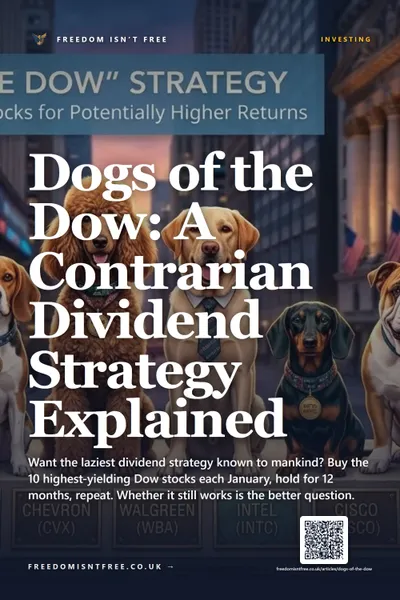
Want the laziest dividend strategy known to mankind? Buy the 10 highest-yielding Dow stocks each January, hold for 12 months, repeat. Whether it still works is the better question.
Cite this article
Freedom Isn't Free (2026) Dogs of the Dow: Rules, Returns and the FTSE 100 Version. Available at: https://freedomisntfree.co.uk/articles/dogs-of-the-dow (Accessed: 21 September 2026).
Italicise the article title in your bibliography. Accessed date set to today.
TLDR
- The Dogs of the Dow: buy the 10 highest-yielding Dow Jones stocks each January, hold for exactly 12 months, then repeat the screen.
- The 2026 Dogs yield between 2.51% (Johnson & Johnson) and 6.78% (Verizon) - half the list yields less than 3%.
- The record is mixed: strong outperformance from the 1970s to the mid-1990s, a bad tech-boom stretch, and a losing 2010s against the S&P 500.
- The same rules work on the FTSE 100, where yields run higher - but the UK Dogs cluster in energy, financials and tobacco.
The Dogs of the Dow rules in one table
| Step | Rule |
|---|---|
| 1. Universe | Take the 30 stocks in the Dow Jones Industrial Average |
| 2. Filter | Rank by trailing dividend yield, pick the top 10 |
| 3. Sizing | Equal weight, 10% in each position |
| 4. Hold | Exactly 12 months, no in-year tinkering |
| 5. Rebalance | Repeat the screen, sell anything that drops out |
| 6. Wrapper | ISA shelters the heavy dividend income from UK tax |
Mechanical, transparent, and cheap to run. The discipline is in not deviating.
Dogs of the Dow: Rules, Returns and the FTSE 100 Version
There is a particular kind of investing satisfaction in buying something that everyone else has temporarily gone off. The Dogs of the Dow is built entirely on that idea.
It is one of the simplest systematic strategies in existence: once a year, identify the 10 stocks in the Dow Jones Industrial Average with the highest dividend yield, buy an equal amount of each, hold for exactly 12 months, and rebalance. No earnings calls. No macroeconomic forecasting. No gut feelings.
It sounds almost too simple to work. Whether it does - consistently, and net of costs - is a more interesting question than most people realise.
Where It Came From
The strategy was popularised by Michael O'Higgins in his 1991 book Beating the Dow. O'Higgins argued that the 30 companies in the Dow Jones Industrial Average are by definition blue-chip businesses - large, established, and unlikely to disappear. When one of them offers an unusually high dividend yield relative to its peers, it typically means one of two things: either the share price has fallen, or the company has maintained its dividend while others have grown theirs. Either way, the logic goes, you are buying quality at a temporary discount.
The strategy was not entirely new - versions of it had been discussed in academic and practitioner circles for decades - but O'Higgins gave it a name, a clear ruleset, and a compelling historical backtest. For investors who prefer a purely passive approach, our review of low-cost index funds covers the alternative. The book sold well enough to make "Dogs of the Dow" a permanent fixture in the retail investing lexicon.
The Logic Behind the Strategy
Dividend yield is calculated as annual dividend divided by share price. If a stock's yield is high relative to the rest of the index, it usually means the price has fallen while the dividend has held steady.
For a company like Coca-Cola, Johnson & Johnson, or Verizon - the kind of businesses that populate the Dow - a depressed share price often reflects temporary headwinds: a bad quarter, a regulatory concern, a shift in sentiment. The company is still generating cash, still paying shareholders, still fundamentally intact. The market has just turned cold on it for now.
By systematically buying these out-of-favour names, the Dogs strategy is a form of value investing without requiring you to analyse balance sheets. The dividend yield acts as a mechanical filter that identifies the most beaten-up blue chips in the index.
The thesis has two components working together:
- Mean reversion - unloved blue chips tend to recover as temporary headwinds fade
- Dividend income - while you wait for the recovery, you are being paid to hold
Historical Performance
Backtests of the Dogs strategy against the Dow Jones and the S&P 500 show a mixed picture depending on the time period examined.
From the 1970s through to the mid-1990s, the strategy outperformed convincingly - which is partly why O'Higgins' book resonated so strongly. In the late 1990s tech boom, it lagged badly, as the Dow's industrial heavyweights were left behind by growth stocks. Through the 2000s and early 2010s, it recovered relative performance. In the 2010s, it generally underperformed a simple S&P 500 tracker.
The summary: the Dogs strategy has beaten the market in some periods and underperformed in others. Like most factor strategies, it tends to work over long cycles but can go through extended stretches of underperformance that test investor discipline.
The 2026 Dogs of the Dow
Here is the actual list. These are the 10 highest-yielding Dow constituents as of 31 December 2025, per the official Dogs of the Dow screen:
| 2026 Dog | Ticker | Yield at selection |
|---|---|---|
| Verizon | VZ | 6.78% |
| Chevron | CVX | 4.49% |
| Merck | MRK | 3.23% |
| Amgen | AMGN | 3.08% |
| Procter & Gamble | PG | 2.95% |
| Coca-Cola | KO | 2.92% |
| UnitedHealth | UNH | 2.68% |
| Home Depot | HD | 2.67% |
| Nike | NKE | 2.57% |
| Johnson & Johnson | JNJ | 2.51% |
Two things jump out of that table. First, the "high yield" bar on today's Dow is remarkably low: half the 2026 Dogs yield under 3%, and the bottom four pay less than a bog standard UK easy-access savings account. Only Verizon looks like a classic Dog. A yield screen can only surface what the index gives it, and a Dow trading at elevated valuations gives it thin pickings - which is worth knowing before you assume the 2026 vintage carries the same value signal as the 1991 one.
Second, the list is a live demonstration of the strategy's contrarian core. UnitedHealth and Nike are on it because their share prices fell hard, not because their boards turned generous. Buying them in January means betting on mean reversion at precisely the moment the news flow says otherwise. That is the whole strategy in miniature.
The UK Equivalent: Dogs of the FTSE 100
The same logic applies to the FTSE 100. At the start of each year, screen the index for the 10 highest-yielding constituents and buy an equal position in each.
The FTSE 100 is particularly interesting for this strategy because it contains a large number of mature, dividend-paying businesses - miners, energy companies, banks, consumer staples - that are structurally prone to yield spikes when sentiment turns. The UK market has also historically traded at a valuation discount to the US, which some argue makes mean reversion plays more reliably available.
UK investors should note that the FTSE 100 Dogs tend to cluster heavily in a few sectors - energy, financials, and telecoms in particular. This means the portfolio can be more concentrated sectorally than the ticker count suggests.
The Limitations and Criticisms
The strategy is simple but not without real flaws. Weigh these before committing capital.
Concentration risk. Ten stocks is not a diversified portfolio. If one position suffers a dividend cut or a serious operational problem, the impact on your returns is significant. In a year where two or three Dogs blow up, you will feel it.
Dividend traps. A high yield is not always a sign of a temporarily depressed price. Sometimes it signals a dividend that the market believes is about to be cut. When that cut comes, the share price usually falls further and the yield disappears. Distinguishing between a value opportunity and a dividend trap is harder than it looks.
Backtests also flatter the strategy through survivorship bias. The Dow Jones is periodically rebalanced, removing companies that have declined and replacing them with stronger ones - so the universe you are screening has already been curated. Real-world results from earlier eras would have included companies that were later dropped from the index, some of which never recovered.
Tax and wrapper. Dividend income outside an ISA or SIPP is subject to UK dividend tax above the £500 allowance, and the November 2025 Budget pushed the rates up: from April 2026 you pay 10.75% at basic rate and 35.75% at higher rate on dividends above the allowance. Running a deliberately high-yield strategy in a taxable account hands a slice of your edge straight to HMRC every year. Inside an ISA or SIPP, this problem disappears entirely.
Then there are the running costs, which deserve actual numbers rather than a hand-wave. Say you run a £10,000 FTSE 100 Dogs portfolio and four names change at the annual rebalance - a typical year. That is 4 sells and 4 buys. On a broker charging £5.95 a trade, dealing costs come to 8 x £5.95 = £47.60. Add 0.5% stamp duty on the £4,000 of UK share purchases, another £20. Total: £67.60, or 0.68% of the portfolio - versus £13 a year (0.13%) for a cheap global tracker doing nothing. A zero-commission platform cuts the dealing fees but the stamp duty stays. On a £100,000 portfolio the percentages shrink; on £2,000, the same £20-70 of friction becomes a serious headwind.
Practical Implementation for UK Investors
If you want to run this strategy, here is a sensible framework:
1. Use an ISA. Shelter the dividend income and any capital gains from tax. Running a high-yield strategy in a general investment account is an unnecessary drag.
2. Screen at the start of January. Use a free screener (Stockopedia, ShareScope, or even a broker's built-in tools) to rank the FTSE 100 or Dow Jones constituents by trailing dividend yield. Take the top 10.
3. Invest equally. Divide your capital into 10 equal positions. The strategy has no opinion on which Dog will perform best - equal weighting is part of the discipline.
4. Rebalance once a year. On the same date the following year, repeat the screen. Sell any positions that have dropped out of the top 10, buy whatever has entered. Hold the ones that remain.
5. Count the costs. If your broker charges per trade, a full turnover year (10 sells, 10 buys) adds up fast, and stamp duty applies to every UK purchase either way. Factor this into your return expectations, especially on smaller portfolios - the worked example above puts the drag at around 0.7% a year on a £10,000 pot.
The Verdict
The Dogs of the Dow is a legitimate, systematic, evidence-based strategy with a coherent rationale. It is not a get-rich-quick scheme. It is not a guaranteed market-beater. It is a disciplined approach to owning cheap blue-chip dividend payers that has beaten the market in some long stretches and lagged in others.
For investors who want something more active than a passive index tracker but simpler than stock-picking, it occupies an interesting middle ground. The rules are clear. The emotional discipline required is high - you are buying the most unloved names in an index, often at moments when the news around them is bad.
If you can stick to the rules, keep costs low, and house the portfolio inside an ISA, the Dogs strategy is a perfectly rational addition to a broader investing approach. It is not a replacement for a core index fund position. Think of it as a deliberate value tilt with a dividend income component - systematic, transparent, and cheap to run. Use our compound interest calculator to model how reinvested dividends compound over a 20-year holding period.
Further Reading:
The Intelligent Investor - Benjamin Graham - The philosophical foundation of value investing that underpins the Dogs strategy. Graham's concept of buying good businesses at temporarily depressed prices is exactly what the Dogs approach mechanises. (Affiliate link - we may earn a small commission at no extra cost to you.)
The Little Book of Common Sense Investing - John Bogle - The definitive case for low-cost index funds, which makes it the ideal counterpoint to the Dogs strategy - read both before deciding which approach fits you. (Affiliate link - we may earn a small commission at no extra cost to you.)
Dividends Still Don't Lie - Kelley Wright - Uses dividend yield as a value signal to identify when blue-chip stocks are historically cheap or expensive - the same contrarian logic that underpins the Dogs of the Dow strategy. (Affiliate link - we may earn a small commission at no extra cost to you.)
The Little Book That Beats the Market - Joel Greenblatt - Greenblatt's "magic formula" is another systematic, rules-based contrarian strategy. Worth reading alongside the Dogs approach to understand what mechanical value investing can and cannot deliver. (Affiliate link - we may earn a small commission at no extra cost to you.)
Frequently Asked Questions
What are the Dogs of the Dow?
The Dogs of the Dow is a mechanical investing strategy: at the start of each year, buy the 10 highest-yielding stocks in the Dow Jones Industrial Average in equal amounts, hold for 12 months, and rebalance. Popularised by Michael O'Higgins in his 1991 book Beating the Dow, the strategy uses dividend yield as a proxy for temporarily out-of-favour blue chips. The 2026 Dogs range from Verizon (6.78% yield at selection) down to Johnson & Johnson (2.51%).
Has the Dogs of the Dow strategy beaten the market?
The historical record is mixed. From the 1970s through the mid-1990s, the strategy outperformed convincingly. Through the 2010s, it generally underperformed a simple S&P 500 tracker as growth stocks dominated. Like most factor strategies, it works over some long cycles and lags in others. No strategy beats the market in every period, and the Dogs is no exception.
What is the UK equivalent of the Dogs of the Dow?
The Dogs of the FTSE 100: screen the FTSE 100 at the start of January for the 10 highest-yielding constituents and buy an equal position in each. The FTSE 100 is particularly suited to this approach because it contains many mature, dividend-paying businesses in sectors like energy, financials, and consumer staples that are prone to yield spikes when sentiment turns. UK investors should note the sectoral concentration this creates.
What is a dividend trap and how do I avoid it?
A dividend trap is a stock with a high yield that signals financial distress rather than a buying opportunity. When a share price falls because the market expects a dividend cut, the yield looks attractive - but when the cut comes, the price usually falls further and the income disappears. To avoid traps, check the dividend cover ratio (earnings divided by dividend per share) and the trend in earnings. A yield of 8%+ is often a warning sign rather than an invitation.
Should I run the Dogs strategy inside an ISA?
Yes. High-yield strategies generate significant dividend income, which is taxed above the £500 annual dividend allowance outside a tax-efficient wrapper - at 10.75%, 35.75% or 39.35% for 2026/27 depending on your income tax band. Running this strategy in a general investment account creates unnecessary tax drag. Inside a Stocks and Shares ISA, dividends and capital gains are entirely free of UK tax, which meaningfully improves the strategy's net return.
Read next
Sources
Prefer to watch?
We turn these money breakdowns into short videos
A few a week, plain-English UK money. If you would sooner watch than read, follow along:
Enjoying the content?
If this site has been useful, a coffee goes a long way.
Browse more articles
Browse all