

Financial Independence, Retire Early (FIRE) Explained
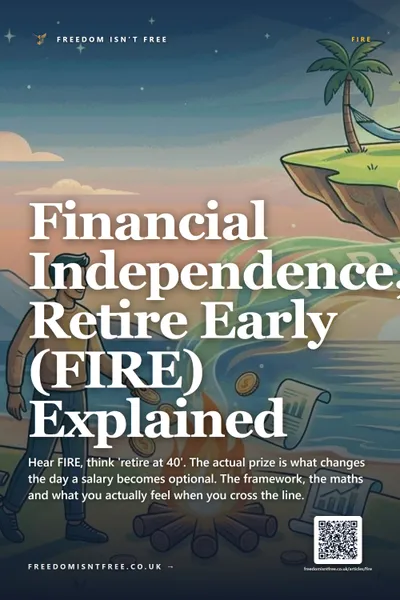
Hear FIRE, think 'retire at 40'. The actual prize is what changes the day a salary becomes optional. The framework, the maths and what you actually feel when you cross the line.
Cite this article
Freedom Isn't Free (2026) Financial Independence, Retire Early (FIRE) Explained. Available at: https://freedomisntfree.co.uk/articles/fire (Accessed: 21 September 2026).
Italicise the article title in your bibliography. Accessed date set to today.
TLDR
- Financial Independence, Retire Early (FIRE) means earning enough from investments to cover living expenses without needing a job.
- FIRE focuses on freedom, flexibility, and intentional living, which can mean retiring early or simply having the security to choose how to spend time.
- The savings rate, or the percentage of income saved and invested, is a key factor in achieving FIRE.
- FIRE strategies usually involve long-term investing in broad index funds and low-cost diversified portfolios.
- The 4% rule is a guideline suggesting that you can withdraw 4% of your investment portfolio per year in retirement with a high probability of long-term sustainability.
Financial Independence, Retire Early (FIRE) Explained
Financial Independence, Retire Early (commonly known as FIRE) is a personal finance philosophy focused on building enough wealth so that you are no longer dependent on employment income. Once financially independent, work becomes optional rather than necessary.
FIRE is about freedom, flexibility, and intentional living. For some people, that means retiring decades early. For others, it simply means having the security to choose how they spend their time.
What Does Financial Independence Mean?
Financial independence (FI) occurs when your investments generate enough income to cover your living expenses without needing to work.
This income typically comes from:
- Investment portfolios (stocks, index funds, ETFs)
- Dividends
- Rental properties
- Other passive or semi-passive income streams
Once your assets can sustainably fund your lifestyle, you have reached financial independence.
The "Retire Early" Part
The second half of FIRE, retiring early, is not mandatory. Many people who pursue FIRE choose to:
- Retire in their 40s or 50s
- Transition to part-time work
- Start passion projects
- Travel
- Spend more time with family
- Build businesses without financial pressure
Early retirement is simply one possible outcome of financial independence.
The Core Principle: The Savings Rate
FIRE heavily emphasises the savings rate, which is the percentage of income you save and invest.
For example:
- If you save 10% of your income, financial independence will take a long time.
- If you save 50%, progress accelerates dramatically.
- At very high savings rates (70%+), timelines shorten significantly.
The savings rate matters more than income alone because it determines how quickly you accumulate investable capital. Plotted at a 7% real return, the years-to-FI curve bends sharply once your savings rate climbs out of the single digits.
Years to financial independence by savings rate
Source: Mr Money Mustache - The Shockingly Simple Math Behind Early Retirement
The Role of Investing
Most FIRE strategies rely on long-term investing, typically in:
- Broad index funds
- Low-cost diversified portfolios
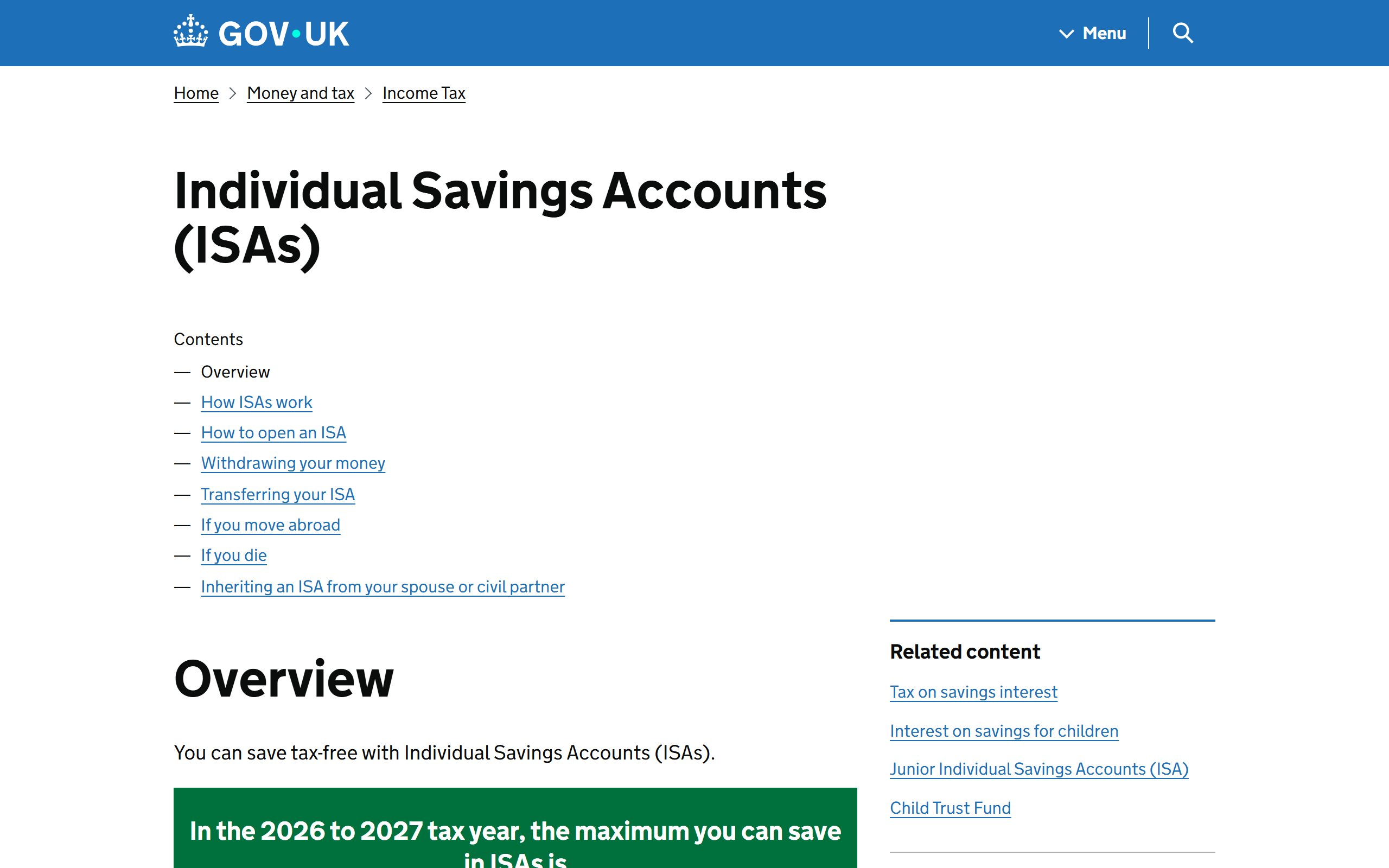
- Tax-efficient accounts (such as ISAs and pensions in the UK)
The goal is not to speculate or trade frequently, but to benefit from:
- Market growth
- Compounding returns
- Long-term economic expansion
FIRE is generally aligned with a buy-and-hold, low-cost investment philosophy.
The 4% Rule
A commonly referenced guideline in FIRE discussions is the 4% rule.
This rule suggests that you can withdraw approximately 4% of your investment portfolio per year in retirement, adjusted for inflation, with a historically high probability of long-term sustainability.
For example:
- If you need £30,000 per year to live:
- You would aim for roughly £750,000 invested.
While the 4% rule is not a guarantee, it is a useful planning framework.
Different Types of FIRE
FIRE is not one single strategy. Common variations include:
Lean FIRE
A minimalist lifestyle with lower annual expenses.
Fat FIRE
A higher-spending retirement requiring a larger portfolio.
Coast FIRE
You accumulate enough invested capital early that, even without further contributions, compound growth will likely reach your retirement target by traditional retirement age.
Barista FIRE
You reach partial financial independence and supplement income with part-time or flexible work.
Why People Pursue FIRE
Motivations vary, but common reasons include:
- Greater autonomy over time
- Reduced financial stress
- Ability to pursue creative work
- Freedom to travel
- Early exit from high-pressure careers
- Increased resilience against job loss
For many, FIRE is less about stopping work and more about gaining choice.
Key Components of a FIRE Plan
A typical FIRE strategy involves:
- Tracking expenses carefully
- Increasing income where possible
- Maintaining a high savings rate
- Investing consistently
- Minimising unnecessary fees and taxes
- Building a diversified portfolio
- Planning for healthcare and long-term risks
Common Misconceptions
FIRE is not about extreme deprivation.
It is about aligning spending with values.
FIRE is not only for high earners.
While higher income helps, controlling expenses is equally important.
FIRE is not purely about retiring at 30.
It is about financial flexibility at any age.
Is FIRE Realistic?
Yes, but it requires:
- Discipline
- Long-term thinking
- Emotional resilience during market volatility
- A commitment to consistent investing
It is not a get-rich-quick strategy. It is a gradual wealth-building approach.
The Bigger Picture
Financial Independence, Retire Early is about designing your life intentionally.
Whether your goal is early retirement, reduced working hours, career flexibility, or simply financial security, FIRE provides a framework for building long-term wealth and autonomy.
FIRE is not about quitting work. It is about having the option not to need it.
Frequently Asked Questions
What does FIRE stand for?
FIRE stands for Financial Independence, Retire Early. It is a personal finance philosophy centred on building enough invested capital that your portfolio generates sufficient returns to cover living expenses indefinitely, making paid employment optional. The "Retire Early" element is not mandatory - many FIRE practitioners continue to work in some capacity, but on their own terms.
How much money do you need to achieve FIRE?
The standard benchmark is 25 times your annual expenses (the Rule of 25), derived from the 4% withdrawal rate. If you spend £30,000 a year, your FIRE number is approximately £750,000. If you spend £20,000, it is £500,000. UK investors with a longer retirement horizon often target 30 times expenses (a 3.3% withdrawal rate) for additional safety. The State Pension, available from age 67, meaningfully reduces the required portfolio for early retirees.
What savings rate do you need for FIRE?
The higher the better, but even a 20-30% savings rate produces meaningful long-term progress. The relationship is not linear: a 50% savings rate roughly halves the time to FIRE compared to 25%, because you are both saving more and needing less (your living costs are lower). Extreme early retirement (before 40) typically requires savings rates of 50-70%. Most FIRE practitioners aim for 30-50% as a sustainable range.
What is the 4% rule in FIRE?
The 4% rule, derived from the 1998 Trinity Study examining US market data from 1926 to 1995, suggests that a 50-75% equity portfolio can sustain inflation-adjusted withdrawals of 4% of the initial value per year for 30 years in approximately 95% of historical scenarios. It is the most widely cited benchmark for FIRE planning. Early retirees with 40-50 year horizons often use 3-3.5% for additional safety.
Is FIRE only for high earners?
No. While higher income provides more capital to invest, the critical variable is savings rate - the percentage of income saved and invested. Someone on £35,000 saving 40% of take-home pay will build wealth faster than someone on £80,000 saving 10%. That said, median UK earnings make FIRE genuinely challenging without significant income growth. Investing in skills and career advancement is often the highest-return lever early in the journey.
Read next
Further Reading:
Quit Like a Millionaire - Kristy Shen - A modern FIRE guide that uses mathematical "Yield Shields" to protect portfolios, written from a journey out of poverty to early retirement. One of the most practical FIRE books available. (Affiliate link - we may earn a small commission at no extra cost to you.)
Playing with FIRE - Scott Rieckens - A memoir-style introduction to the FIRE movement following one couple's journey from high-spending to financially independent. The most readable entry point for those new to financial independence. (Affiliate link - we may earn a small commission at no extra cost to you.)
Financial Freedom - Grant Sabatier - A practical, number-driven guide to accelerating the FIRE timeline, covering income growth alongside savings rate optimisation. (Affiliate link - we may earn a small commission at no extra cost to you.)
Prefer to watch?
We turn these money breakdowns into short videos
A few a week, plain-English UK money. If you would sooner watch than read, follow along:
Enjoying the content?
If this site has been useful, a coffee goes a long way.
Browse more articles
Browse all