







UK Overdraft Charges Explained: 40% APR Is Standard
Your high-street overdraft is more expensive than your credit card. A 2020 reform meant to make it cheaper made it worse for nearly everyone. The reason is in the fine print.
Cite this article
Freedom Isn't Free (2026) UK Overdraft Charges Explained: 40% APR Is Standard. Available at: https://freedomisntfree.co.uk/articles/uk-overdraft-charges (Accessed: 10 October 2026).
Italicise the article title in your bibliography. Accessed date set to today.
TLDR
- Since the 2020 FCA reform, UK arranged overdrafts are charged at a single APR around 40%, which is higher than most credit cards.
- Most current accounts now charge the same rate whether you are £10 or £1,000 into your overdraft - the simplification meant prices went up for moderate users.
- Treat an overdraft as a debt to clear, not a buffer to live in. Pay it off using the snowball or avalanche method alongside any card debt.
- Switching to a fee-free overdraft account or one with an interest-free buffer is the single fastest way to stop the bleeding.
Cost of carrying a £1,000 balance for a year
Post-2020 FCA reform put UK overdrafts above almost every other consumer credit rate.
UK Overdraft Charges Explained: 40% APR Is Standard
In 2020, the FCA forced UK banks to overhaul how they price overdrafts. The old system - a tangle of daily fees, monthly fees, and tiered interest rates that nobody could compare - was replaced with a single APR. Cleaner. Simpler. Easier to compare. The headline rate that emerged from the reform: around 40% APR for most major banks.
That is higher than the average credit card APR. Higher than most personal loans. Higher than basically every form of consumer credit available in the UK. The bank's reasoning is that overdrafts are short-term and uncollateralised, so the rate has to be high. The result is that an overdraft is one of the most expensive ways to borrow money you can casually fall into without realising.
Contents
- What Changed in 2020
- How 40% APR Actually Costs You
- Arranged vs Unarranged Overdrafts
- How to Clear an Overdraft Fast
- Bank Accounts With Better Overdraft Terms
- Frequently Asked Questions
What Changed in 2020
Before 2020, UK overdraft pricing was a maze. Some banks charged a flat daily fee (£1 to £6 per day), others charged interest, others charged unarranged-overdraft penalty fees of £20-£35 a pop. The same overdraft could cost £30 a month at one bank and £200 a month at another, and customers had no realistic way to compare.
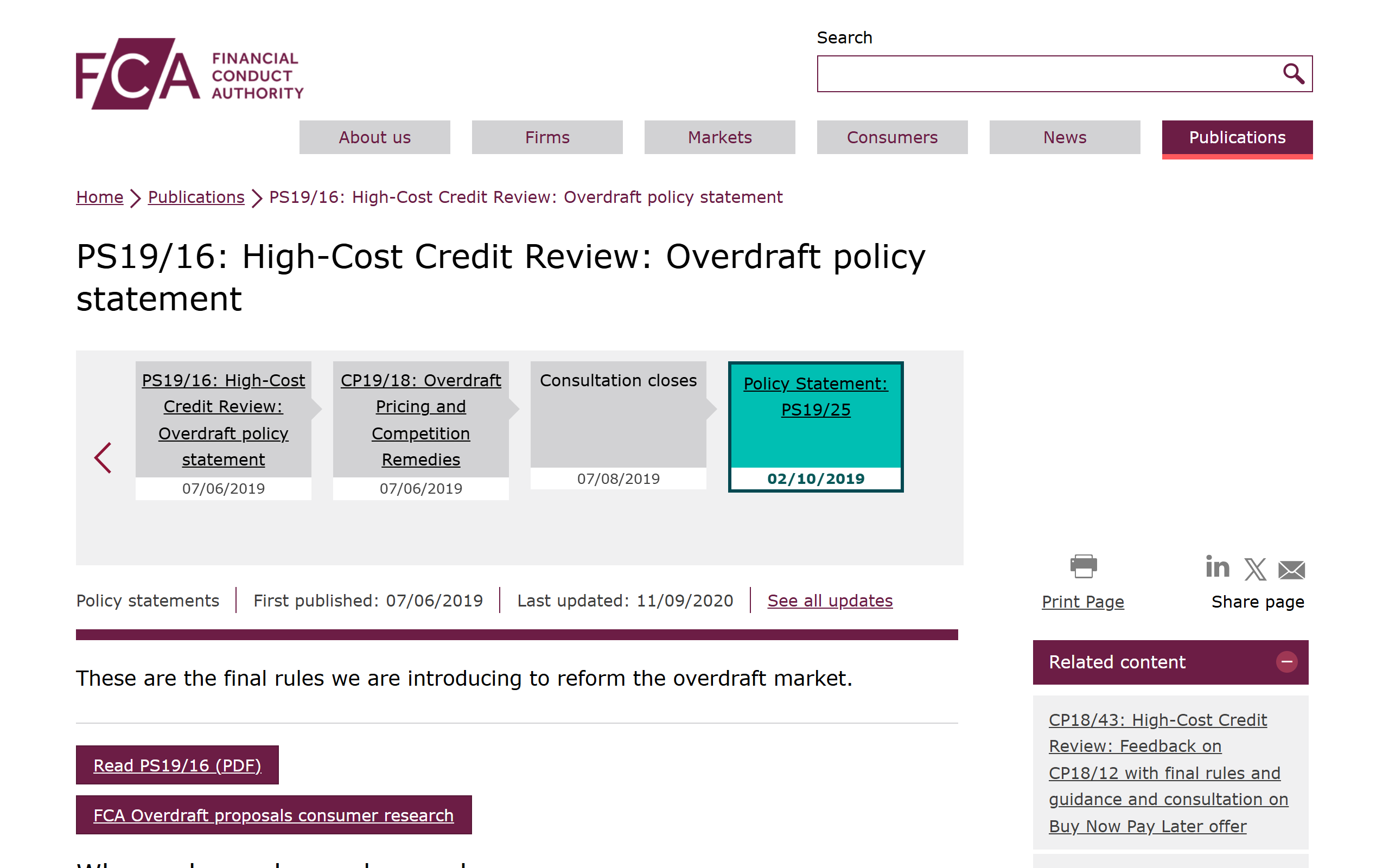
The FCA's 2020 overdrafts reform (PS19/16) required all UK banks to:
- Use a single APR for all overdraft borrowing
- Charge the same rate whether the overdraft is arranged or unarranged
- Eliminate fixed daily and monthly fees
- Send alerts before customers go into overdraft
The intent was good. The outcome was mixed. The simplification meant that customers who used to pay a small daily fee for occasional overdraft use now pay a percentage rate on every penny of their balance. For people who consistently sat in their overdraft, the effective price often went up rather than down.
The major banks all settled around the same rate within months: HSBC, NatWest, Lloyds, Barclays, Santander, and most challenger banks now charge between 35% and 45% APR. A few specialist accounts go higher (some sub-prime accounts approach 50% APR) and a few specifically advertise lower rates as a competitive feature.
How 40% APR Actually Costs You
A 40% APR on overdraft borrowing is not the simple equivalent of paying 40p on every pound you borrow per year. The interest accrues daily and compounds. Here is what it looks like in practice for someone who lives £500 into their overdraft for a full year:
- Headline figure: 40% APR
- Daily interest charge: roughly 55p per day on a £500 balance
- Annual cost: approximately £200 in interest
That is £200 a year for the privilege of being £500 short. Stretch it to £1,000 in overdraft and the annual cost is around £400. For comparison, a 24% APR credit card with the same £1,000 balance would cost about £240 a year - and that is if you only paid the minimum.
Now consider the typical UK overdraft user. The FCA's 2023 review showed that the average daily overdraft balance for users who go into overdraft regularly is around £400-£700, and they are in overdraft for 22+ days of every month. So they are paying interest at 40% APR for most of every month, on most of their overdraft limit, year-round.
That works out to around £150-£250 a year for someone in a typical pattern. Not catastrophic in isolation, but a steady drag on net income that persists indefinitely. Cleared just once, the same amount could be redirected to your ISA forever.
Arranged vs Unarranged Overdrafts
Pre-2020, going into an unarranged overdraft (without your bank's permission) triggered penalty fees of £20-£35 per day plus higher interest rates. Some users were running up £100+ in fees in a single week from a £20 overshoot.
Post-2020, the rules require banks to charge the same rate whether the overdraft is arranged or unarranged. So an unarranged overdraft now costs the same in interest as an arranged one. This is a real improvement for people who occasionally go a few pounds over without warning.
But the picture is not entirely rosy. Banks now reserve the right to decline payments that would push you into an unarranged overdraft. So a direct debit might bounce, costing you £5-£10 from the originator (often utility companies or insurers) and potentially damaging your relationship with them. The hidden cost has shifted from bank penalty fees to declined-payment fees and reputation hits with billers.
The practical takeaway: arrange the overdraft if you think you might use one, set up alerts at £100 above zero so you have warning, and treat any overdraft borrowing as a high-priority debt to clear rather than a free buffer.
How to Clear an Overdraft Fast
The mechanics of clearing an overdraft are slightly different from clearing a card or loan. You cannot just throw a lump sum at it, because most current accounts do not have a "minimum payment" - you simply have to get your account back into the black.
1. Treat it as a debt with a target date
Pick a date by which you want to be out of the overdraft permanently. For a £500 overdraft, six months is realistic for most people. For £1,500, give yourself nine to twelve months.
Calculate the monthly clearance amount: £500 over 6 months means you need to add £85 a month to your account beyond your normal spending. £1,500 over 12 months is £125 a month.
2. Build a starter savings cushion first
This sounds counterintuitive but matters. If you go from -£500 to £0 with no buffer, the next unexpected £80 expense puts you straight back into the overdraft and you start over.
Aim for a minimum of £200-£300 in a separate savings account before committing fully to overdraft clearance. This pads your account against shocks while you work the overdraft down.
3. Use the snowball or avalanche method if you have other debts
If you have credit card debt as well as an overdraft, run them through the debt payoff calculator and decide which to attack first. At 40% APR, an arranged overdraft is usually higher than a credit card, so the avalanche method puts the overdraft first. Our debt payoff calculator guide walks through the choice.
4. Cut your overdraft limit as you progress
Most banks let you reduce your overdraft limit through their app in 30 seconds. Drop it from £1,000 to £500 once you are out of the £500-£1,000 range. The lower limit acts as a guardrail against drifting back into deep overdraft territory.
5. Set up balance alerts
Configure low-balance alerts at £100 above zero (so you have warning before going into overdraft) and a "back to zero" alert for the day you clear it. The "you cleared it" notification is genuinely satisfying and worth setting up.
For a wider plan around what comes after clearing the overdraft, our UK personal finance flowchart shows where overdraft clearance fits relative to building an emergency fund and starting to invest.
Bank Accounts With Better Overdraft Terms
If you genuinely need an overdraft, some UK accounts offer much better terms than the standard 40%.
Fee-free overdraft buffers. Some accounts include a £15-£100 interest-free buffer before any charges kick in. First Direct, Starling, and a few others have offered these. Useful for occasional overshoots, useless if you sit in overdraft consistently.
0% overdraft accounts. A small number of accounts have offered 0% overdrafts as a competitive feature. The catch is usually that they require a minimum monthly deposit (e.g. £1,500 of salary in) and have other restrictions. Worth shopping around; check Money Saving Expert for the current best deals.
Switch incentives. UK banks regularly run switch bonuses of £125-£200 for moving your current account. If you are stuck in overdraft, switching to an account with a switch bonus and a fee-free buffer can put you in the black overnight, plus give you 12 months at a lower rate to clear any remaining debt.
The Current Account Switch Service makes the move easy. It transfers your direct debits, standing orders, and incoming payments to the new account in 7 working days, and forwards any payments sent to the old account for at least 36 months.
Frequently Asked Questions
Why are UK overdraft rates so much higher than credit card rates?
Banks argue that overdrafts are short-term, unsecured, and only used by a fraction of customers, so the rate has to cover the cost of providing the facility to everyone. The FCA disputed this and forced the 2020 reform; rates went up rather than down, suggesting banks were genuinely losing money on the old structure for the customers who used it most heavily. The current 40% APR is the market-clearing rate after the reform.
Does going into overdraft hurt my credit score?
Using an arranged overdraft does not directly hurt your credit score, though it appears on your credit report and lenders can see how often you use it. An unarranged overdraft, missed payment, or returned direct debit can damage your score. The bigger long-term issue is utilisation: lenders looking at your file want to see that you have credit available and are not consistently maxing it out.
Can I negotiate a lower overdraft rate?
Banks rarely negotiate overdraft rates with individual customers. The published rate is what you get. The exception is hardship cases, where banks may temporarily reduce or pause interest charges if you contact them about genuine financial difficulty. This is for emergencies, not as a routine money-saving tactic.
Is it worth taking out a personal loan to clear an overdraft?
Possibly. A personal loan at 9-12% APR is much cheaper than a 40% overdraft, so consolidating an overdraft of £1,500+ into a loan can save serious money. The risks are: (1) you have to qualify for a sub-15% rate; (2) you have to actually clear the overdraft and not slowly run it back up; (3) loan fees and any early-repayment charges should be factored in. Run the comparison through the debt payoff calculator.
What about a 0% balance transfer card?
A 0% balance transfer card normally cannot transfer an overdraft directly. Some "money transfer" cards (a less common variant) let you transfer cash to your current account at 0% interest for a fixed period in exchange for a 3-5% transfer fee. These work for clearing overdrafts but are harder to find. Check the small print before applying.
Prefer to watch?
We turn these money breakdowns into short videos
A few a week, plain-English UK money. If you would sooner watch than read, follow along:
Enjoying the content?
If this site has been useful, a coffee goes a long way.
Browse more articles
Browse all