

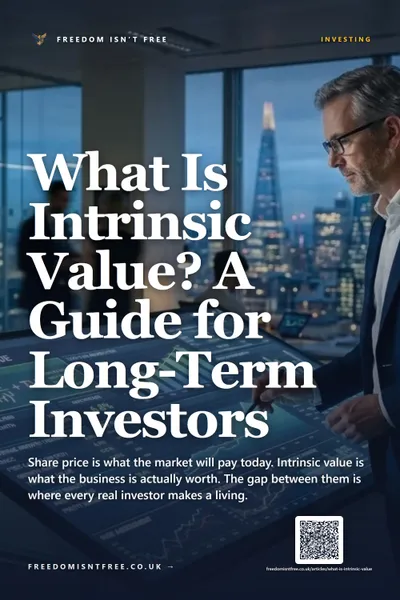


What Is Intrinsic Value? A Guide for Long-Term Investors
Share price is what the market will pay today. Intrinsic value is what the business is actually worth. The gap between them is where every real investor makes a living.
Cite this article
Freedom Isn't Free (2026) What Is Intrinsic Value? A Guide for Long-Term Investors. Available at: https://freedomisntfree.co.uk/articles/what-is-intrinsic-value (Accessed: 21 September 2026).
Italicise the article title in your bibliography. Accessed date set to today.
TLDR
- Intrinsic value is the true worth of an asset based on its fundamental economic factors, not its current market price.
- Understanding intrinsic value helps investors make rational decisions during market fluctuations.
- The margin of safety concept suggests buying assets when they are priced below their intrinsic value to protect against estimation errors and market volatility.
- Dividends can be a clear indicator of a company's intrinsic value as they reflect its earnings and cash flows.
Intrinsic value vs market price
| Asset type | Source of intrinsic value | What the market price reflects |
|---|---|---|
| Shares | Future earnings and dividends | Sentiment, news, flows |
| Bonds | Coupon payments and principal | Interest rate expectations |
| Rental property | Net rental income | Local supply and demand |
| Global index fund | World corporate earnings | Aggregate of all the above |
Margin of safety: pay 70-80p for an asset you estimate is worth £1.
What Is Intrinsic Value? A Guide for Long-Term Investors
There is a question every investor should be able to answer about every asset they own: what is this actually worth?
Not what the market says it is worth today. Not what you paid for it. Not what you hope it will be worth next year. What is it intrinsically worth - based on the cash it generates, the assets it holds, the economic activity it represents?
That question is the foundation of the concept of intrinsic value, and understanding it is one of the most important things you can do as an investor.
Intrinsic Value in Economics
The concept of intrinsic value originates in economics, not finance. Classical economists like Adam Smith and David Ricardo distinguished between the "use value" of a good (what it is actually useful for) and its "exchange value" (what someone will pay for it). Water has high use value but low exchange value. Diamonds have high exchange value but limited use value. This is the classic "diamond-water paradox" that introductory economics courses still teach.
In modern economics, intrinsic value refers to the fundamental worth of something based on its utility, productive capacity, or the income it generates - independent of what the market currently prices it at. A factory has intrinsic value because it produces goods. A piece of farmland has intrinsic value because it grows crops. A government bond has intrinsic value because it promises future cash payments.
This economic concept translates directly into investing. When investors talk about intrinsic value, they are applying the same idea: what is this asset actually worth based on what it does, not what the crowd currently thinks?
The Core Idea for Investors
Intrinsic value is the value an asset has based on its underlying fundamentals, independent of its current market price.
The market price of an asset fluctuates constantly - driven by sentiment, news, fear, greed, interest rates, and a thousand other factors. Intrinsic value changes much more slowly. It is driven by the actual economics of the underlying asset.
For a share in a company, intrinsic value is derived from:
- The earnings the company generates
- The dividends it pays to shareholders
- The assets it owns (property, equipment, intellectual property)
- The cash flows it is expected to produce in future years
For a bond, intrinsic value is the present value of the future interest payments and the return of principal.
For a rental property, intrinsic value is based on the rental income it generates relative to its costs.
The market price of any of these assets may be higher or lower than their intrinsic value at any given moment. The insight that drives value investing is simple: over time, prices tend to revert towards intrinsic value. Buying assets priced significantly below their intrinsic value gives you a margin of safety.
Why It Matters
Consider two investors who own the same share.
Investor A bought because the price had been rising. They did not analyse the company. They expected the momentum to continue.
Investor B bought because they studied the company's earnings, concluded the shares were trading at a discount to what the business was actually worth, and expected the price to eventually reflect that value.
Now the price falls 25%.
Investor A is rattled. They have no framework for deciding whether to hold or sell. The price has gone down - that is all they know. The temptation to sell is strong.
Investor B looks at the same situation differently. Has anything changed about the company's earnings or prospects? If not, the shares are now an even bigger discount to intrinsic value. The rational response is not panic - it may be to buy more.
Understanding intrinsic value does not guarantee you are right about any specific investment. But it gives you a rational framework for thinking about price movements that is completely absent from price-momentum investing.
The Margin of Safety
Benjamin Graham - the father of value investing and the teacher who shaped Warren Buffett's thinking - introduced the concept of the "margin of safety" in his book The Intelligent Investor.
The idea is straightforward: if you estimate an asset's intrinsic value at £100, do not pay £100 for it. Pay £70 or £80. That discount is your margin of safety.
It protects you in two ways:
- Against estimation errors. Your estimate of intrinsic value might be wrong. A margin of safety means you can be somewhat wrong and still not lose money.
- Against market volatility. Even if you are right about the long-term value, prices can fall further before recovering. A lower purchase price gives you more room to absorb short-term pain.
The margin of safety is not just a technical concept. It is a philosophy of humility - an acknowledgement that you are working with imperfect information and that uncertainty should be reflected in the price you are willing to pay.
Intrinsic Value and Dividends
One of the clearest expressions of intrinsic value for ordinary investors is the dividend.
A company that pays a consistent, growing dividend is demonstrating several things at once:
- It generates real cash profits (you cannot pay dividends with accounting tricks)
- Management believes the earnings are sustainable
- There is a direct, tangible transfer of value from the business to shareholders
When you own a dividend-paying stock or ETF, the dividend is a regular, concrete reminder of the underlying value you hold. You are not simply trusting that the price will rise. You are receiving a portion of the business's profits.
This is why dividend investors often stay calmer during market downturns. The price may have fallen - but the dividends are still being paid. The intrinsic value of the business has not disappeared.
When Prices Diverge from Intrinsic Value
Markets are not always wrong, but they are frequently emotional. Prices regularly overshoot and undershoot underlying value.
In bull markets, optimism drives prices above intrinsic value. Assets trade at high multiples of earnings. The most popular investments are priced for perfection, leaving little margin of safety. This is when risk is highest, even though everything feels safe.
In bear markets, fear drives prices below intrinsic value. Good businesses trade at discounts to what they are rationally worth. Investors who understand this, and have the conviction to act on it, buy during these periods. This is when risk is lowest, even though everything feels dangerous.
Morgan Housel captures the psychology behind this beautifully in The Psychology of Money - why the same asset feels completely different to hold when the price is rising versus falling, even if the underlying value is unchanged.
Intrinsic Value vs Speculation
If you own an asset you cannot value - if you have no framework for what it is worth independent of its price - you are almost certainly speculating.
Speculation is not automatically bad. It is simply a different activity. But it carries a different risk profile. Speculators are entirely dependent on other buyers being willing to pay more in future. There is no floor, because there is no rational basis for any particular price.
When speculative assets fall in price, there is no intrinsic value to anchor to. The only question is whether sentiment will turn. Investors in this position often panic and sell, locking in losses that a genuine investor - one who understood the underlying value and bought at a discount - would never have experienced.
How to Think About Intrinsic Value Practically
You do not need to be a financial analyst to think about intrinsic value. Here are some practical starting points:
- For individual stocks: Look at the price-to-earnings (P/E) ratio, dividend yield, and earnings growth history. Compare to the company's own historical ratios and to sector peers.
- For ETFs: Understand the sectors the fund holds and why those businesses generate returns. A global dividend ETF holds hundreds of profitable companies - that is its intrinsic value base.
- For index funds: The intrinsic value case rests on long-term global economic growth. The world economy has grown consistently over decades. A global index fund is a claim on a portion of that output.
The key is to have an answer when someone asks: why do you think this is worth holding? If your answer involves future price appreciation rather than underlying economic activity, examine it carefully.
Frequently Asked Questions
What does intrinsic value mean in economics?
In economics, intrinsic value is the fundamental worth of a good, asset, or resource based on its utility or productive capacity - independent of its market price. The concept goes back to classical economists like Adam Smith, who distinguished between "use value" (what something is actually useful for) and "exchange value" (what people will trade for it). In modern economics and finance, the term is used to describe the true worth of an asset based on the income or cash flows it generates, as opposed to whatever the market happens to price it at on any given day.
What is intrinsic value in simple terms?
Intrinsic value is what an asset is actually worth based on its fundamentals - its earnings, cash flows, dividends, or underlying assets - independent of what the market is currently pricing it at. The key insight is that market price and intrinsic value are not the same thing. Price is driven by sentiment and can fluctuate wildly. Intrinsic value changes much more slowly, based on what the underlying business actually produces.
How do you calculate intrinsic value?
For individual stocks, the most common approaches are discounted cash flow (DCF) analysis, which estimates the present value of future earnings, and relative valuation using ratios like P/E (price-to-earnings) or P/B (price-to-book) compared to peers or historical norms. For most ordinary investors, the goal is not a precise figure but a rough sense of whether an asset appears cheap, fairly valued, or expensive relative to what it earns.
What is the margin of safety?
The margin of safety is the principle, popularised by Benjamin Graham, of buying an asset at a meaningful discount to your estimated intrinsic value. If you believe a company is worth £100 per share, you only buy at £70 or below. This cushion protects you in two ways: against errors in your valuation estimate, and against further price falls before recovery. It is a philosophy of humility built into the price you pay.
Is intrinsic value relevant for index fund investors?
Yes. An index fund investor's intrinsic value case rests on long-term global economic growth. The world economy has grown consistently across every decade in modern history. A global index fund is a claim on a portion of that output - which is why it has intrinsic value independent of what any given day's market price says. Understanding this is what allows index investors to hold through downturns without panic.
What is the difference between intrinsic value and book value?
Book value is an accounting concept - the value of a company's assets minus its liabilities as recorded on the balance sheet. Intrinsic value is a forward-looking concept - the present value of everything the company will earn in future. For asset-heavy businesses like banks or property companies, book value can be a reasonable proxy for intrinsic value. For businesses whose value lies in intellectual property, brand, or software, book value often significantly understates intrinsic value.
Related Reading:
- Why Dividend ETFs Can Be a Powerful Long-Term Strategy
- Value, Growth, and Dividend Investing - Three Approaches Compared
- Write Your Investment Thesis Before the Next Market Crash
Further Reading:
The Intelligent Investor - Benjamin Graham - The foundation of value investing and the original source of intrinsic value thinking. Introduces the "Mr. Market" allegory to help investors stay rational during volatility. (Affiliate link - we may earn a small commission at no extra cost to you.)
The Little Book of Valuation - Aswath Damodaran - Damodaran is the world's foremost authority on valuation, and this is his most accessible work. Covers DCF, relative valuation, and how to estimate intrinsic value for different types of businesses. (Affiliate link - we may earn a small commission at no extra cost to you.)
Warren Buffett and the Interpretation of Financial Statements - Mary Buffett & David Clark - A practical guide to reading company accounts through Buffett's lens, focused on identifying the financial characteristics that indicate durable competitive advantage and sustainable intrinsic value. (Affiliate link - we may earn a small commission at no extra cost to you.)
Prefer to watch?
We turn these money breakdowns into short videos
A few a week, plain-English UK money. If you would sooner watch than read, follow along:
Enjoying the content?
If this site has been useful, a coffee goes a long way.
Browse more articles
Browse all