





Accumulation vs Income ETFs UK: Acc or Inc?
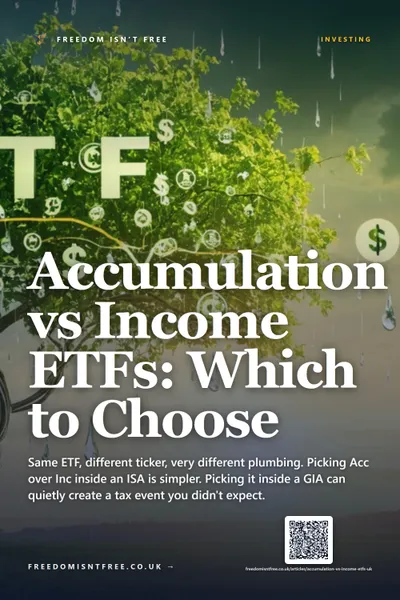
Same ETF, different ticker, very different plumbing. Picking Acc over Inc inside an ISA is simpler. Picking it inside a GIA can quietly create a tax event you didn't expect.
Cite this article
Freedom Isn't Free (2026) Accumulation vs Income ETFs UK: Acc or Inc?. Available at: https://freedomisntfree.co.uk/articles/accumulation-vs-income-etfs-uk (Accessed: 10 October 2026).
Italicise the article title in your bibliography. Accessed date set to today.
TLDR
- Accumulation ETFs reinvest dividends automatically inside the fund, compounding without you doing anything
- Income (distributing) ETFs pay dividends out as cash, giving you flexibility over how to use them
- Inside an ISA or SIPP, accumulation funds are simpler and more tax-efficient
- In a general investment account, accumulation funds still create a tax event via excess reportable income
Accumulation vs income: same fund, different plumbing
| Feature | Accumulation (Acc) | Income (Inc/Dist) |
|---|---|---|
| Example ticker | VWRP | VWRL |
| Dividend handling | Reinvested in fund | Paid out as cash |
| OCF | 0.22% | 0.22% |
| Inside ISA/SIPP | Tax-free either way | Tax-free either way |
| Inside GIA | Taxed via ERI | Taxed on receipt |
VWRP and VWRL track the same FTSE All-World index with identical holdings.
Accumulation vs Income ETFs: Which to Choose
Choosing between accumulation vs income ETFs is one of the first decisions UK investors face when buying a fund, and it trips up more people than it should. You find the ETF you want, search for it on your platform, and discover there are two versions of the same fund - one ending in "Acc" and another ending in "Dist" or "Inc". Same index. Same holdings. Different plumbing for dividends.
The difference matters, but it is not complicated once you understand the mechanics. This guide explains how each type works, the tax treatment in different account types, and which one makes sense depending on where you are in your investing life.
The short answer: an accumulation ETF reinvests dividends automatically inside the fund, while an income (distributing) ETF pays dividends out as cash. Inside a Stocks and Shares ISA or SIPP there is no tax difference, so accumulation is the simpler choice while you are building wealth. Choose income if you need regular cash flow, for example in retirement.
Contents
- How accumulation ETFs work
- How income (distributing) ETFs work
- Tax treatment: ISA and SIPP vs general investment account
- When to choose accumulation
- When to choose income
- Real UK ETF examples
- Author's Take
- Frequently Asked Questions
How Accumulation ETFs Work
An accumulation ETF (often marked "Acc" in the fund name) takes any dividends paid by the underlying companies and reinvests them automatically back into the fund. The cash never reaches your brokerage account. Instead, it is used to buy more of the assets inside the fund, which increases the net asset value (NAV) per share.
You still own the same number of shares. But each share becomes worth slightly more every time dividends are reinvested. Over decades, this compounding effect is significant.
Here is why this matters in practice:
- No cash drag. Dividends do not sit as uninvested cash in your account waiting for you to manually reinvest them. The fund handles it immediately.
- No dealing fees. Every time you manually reinvest a dividend, you may pay a transaction fee. Accumulation funds skip this entirely.
- Compound growth on autopilot. The reinvested dividends earn their own returns, which earn their own returns. This is the engine of long-term wealth building, and accumulation funds automate it completely.
The most widely held accumulation ETF among UK investors is probably Vanguard FTSE All-World UCITS ETF (ticker: VWRP). It tracks roughly 4,000 companies across developed and emerging markets, and every dividend those companies pay gets rolled back into the fund. If you want a deeper look at how funds like VWRP fit into a portfolio, our guide on popular UCITS ETFs covers the details.
How Income (Distributing) ETFs Work
An income ETF (marked "Dist" or "Inc") does the opposite. When the companies inside the fund pay dividends, the fund collects them and distributes the cash to you - typically quarterly, sometimes semi-annually or monthly.
This means dividends land in your brokerage account as actual cash. You can spend it, reinvest it in the same fund, invest it somewhere else, or let it sit.
The distributing version of that same Vanguard All-World fund is VWRL. Identical index, identical holdings, identical ongoing charge of 0.22%. The only difference is that VWRL pays dividends out while VWRP keeps them in.
Income ETFs are popular with:
- Retirees who want regular cash flow without selling shares
- Income-focused investors who want to see dividends arrive as tangible proof of their investments working
- Tactical rebalancers who prefer to direct dividend cash towards whichever asset is underweight
For more on why dividend income can be a behavioural anchor during volatile markets, see our article on why dividend ETFs can be a powerful long-term strategy.
Tax Treatment: ISA and SIPP vs General Investment Account
This is where the accumulation vs income decision actually has financial consequences, and it depends entirely on which account you hold the fund in.
Inside an ISA or SIPP
If your ETF is inside a Stocks and Shares ISA or a SIPP, there is no tax on dividends or capital gains regardless of which version you hold. Accumulation or distributing - HMRC does not care. The ISA wrapper shields everything.
In this situation, accumulation is almost always the better choice for investors who are still building wealth. It is simpler, avoids cash drag, and eliminates the need to manually reinvest. You buy and forget.
The only reason to choose distributing inside an ISA is if you actually need the income - for example, you are retired and drawing down from your ISA to cover living expenses. Even then, some investors prefer accumulation and simply sell a small number of shares when they need cash, giving them more control over timing.
For a full breakdown of how pensions and ISAs compare, see our UK pensions explained guide.
Inside a General Investment Account (GIA)
This is where things get less intuitive. Many people assume that because accumulation funds reinvest dividends internally, there is no taxable event. That is wrong.
HMRC taxes accumulation fund holders on something called excess reportable income (ERI). This is the income the fund earned and reinvested on your behalf. Even though you never saw the cash, HMRC treats it as if you received it. You owe dividend tax on that amount, just the same as if you held the distributing version and received the payout.
In practice, this means:
- Accumulation funds in a GIA are not a tax dodge. You are taxed on dividends either way.
- The excess reportable income must be declared on your self-assessment tax return if it pushes you above the dividend allowance.
- The dividend allowance is £500 per year (2026/27). Dividend income above that is taxed at 10.75% (basic rate), 35.75% (higher rate), or 39.35% (additional rate). The basic and higher rates rose by 2 percentage points on 6 April 2026, so dividends cost more to hold outside a wrapper than they did a year ago.
The one advantage accumulation funds still hold in a GIA is a slightly lower capital gains bill when you eventually sell. Because dividends were reinvested (and already taxed as income via ERI), the base cost of your shares is higher, which reduces your capital gain on disposal. But this is a marginal benefit, not a game-changer.
The bottom line: in a GIA, the tax treatment of accumulation and distributing funds is very similar. Pick whichever one suits your workflow. If you plan to reinvest dividends anyway, accumulation saves you the hassle.
When to Choose Accumulation
Accumulation is the default choice for most UK investors who are in the building phase of their financial life. If the following applies to you, go with Acc:
- You are investing inside an ISA or SIPP. No tax difference, and accumulation is operationally simpler.
- You do not need income from your investments right now. You are growing your pot, not drawing from it.
- You want maximum compounding with minimum effort. Every dividend is reinvested immediately, with no dealing fees and no cash sitting idle.
- You prefer a clean portfolio. One holding that grows in value, rather than receiving small cash payments you need to manage.
For investors who are decades from retirement and investing through a regular investing habit, accumulation is the path of least resistance.
When to Choose Income
Income is the right call when you need cash flow or want control over dividend allocation:
- You are in retirement or semi-retirement and need your portfolio to generate spending money without selling units.
- You are investing in a GIA and want dividends paid out rather than dealing with excess reportable income calculations. Some investors find it cleaner to receive the cash and know exactly what they owe HMRC.
- You want to rebalance with new money. Receiving dividends as cash lets you direct that money towards whichever fund or asset class has drifted below its target allocation.
- You are a behavioural investor. Seeing dividends arrive in your account provides a tangible sense of progress that helps you stay invested through rough patches. Never underestimate the power of this. As we discussed in our dividends relevance piece, the behavioural benefits of income are real even if the pure maths says they are irrelevant.
Real UK ETF Examples
Here are some of the most common accumulation and income pairs available to UK investors on major platforms:
Vanguard FTSE All-World UCITS ETF
| Detail | Accumulation | Distributing |
|---|---|---|
| Ticker | VWRP | VWRL |
| Ongoing charge | 0.22% | 0.22% |
| Distribution | Reinvested | Quarterly payout |
| Domicile | Ireland | Ireland |
| Index | FTSE All-World | FTSE All-World |
VWRP and VWRL are the same fund with different dividend handling. VWRL is one of the most traded ETFs on the London Stock Exchange and has been around since 2012. VWRP launched later but has grown rapidly because most new investors prefer the accumulation version. We break down this exact pairing in our VWRP vs VWRL comparison, and if you are weighing a higher-yield distributing option, our VHYL vs VWRL guide covers the income trade-off.
Invesco FTSE All-World UCITS ETF (FWRG)
Invesco entered the global tracker space with FWRG, an accumulation-only ETF tracking the FTSE All-World index at an ongoing charge of just 0.15%. That is meaningfully cheaper than Vanguard's 0.22%. FWRG uses a combination of physical replication and sampling, and it has attracted significant inflows from cost-conscious UK investors. There is no distributing version - if you want a global tracker with payouts, you would still need VWRL or a similar fund.
iShares Core MSCI World UCITS ETF
| Detail | Accumulation | Distributing |
|---|---|---|
| Ticker | SWDA | IWDL |
| Ongoing charge | 0.20% | 0.50% |
| Distribution | Reinvested | Semi-annual payout |
| Domicile | Ireland | Ireland |
| Index | MSCI World | MSCI World |
Note the significant cost difference here. The accumulation version (SWDA) is one of the cheapest MSCI World trackers available, while the distributing variant costs more than double. This is not always the case, but it is worth checking - sometimes accumulation and distributing versions of the same fund family carry different charges.
Also note that the MSCI World index only covers developed markets (no emerging markets), unlike the FTSE All-World. If you want a broader reach, VWRP or FWRG are better options.
Frequently Asked Questions
Is it better to invest in accumulating or distributing ETFs?
For most UK investors in the building phase, accumulating ETFs are better because they reinvest dividends automatically with no dealing fees and no cash drag. Inside an ISA or SIPP there is no tax difference, so accumulation wins on simplicity. Distributing ETFs are better if you need regular income, for example in retirement, or want to control where dividend cash is redeployed.
Can I switch from accumulation to income (or vice versa) without selling?
No. Accumulation and distributing ETFs are separate securities with different ticker symbols. To switch, you need to sell one and buy the other. Inside an ISA this has no tax consequences, but in a GIA the sale could trigger a capital gains event. Plan accordingly.
Do accumulation ETFs really compound better than income ETFs?
In theory, if you reinvest every dividend from an income ETF immediately and without fees, the returns should be identical. In practice, accumulation funds compound more efficiently because there is no delay, no dealing fee, and no cash sitting uninvested between distribution dates. Over 20 or 30 years, that small edge adds up.
£10,000 at 7%, 20 years: Acc vs Inc with manual reinvestment drag
How do I find the excess reportable income for my accumulation fund?
Fund providers publish ERI figures on their websites, usually in a document called the "reportable income" or "excess of reportable income" report. Your platform may also include this in your annual tax statement. HMRC expects you to report it if your total dividend income exceeds the £500 allowance.
Is there any reason to hold both accumulation and income versions?
Some investors hold accumulation inside their ISA and distributing in their GIA for simplicity - the distributing version in the GIA makes it clearer what dividend income has been received for tax purposes. Others hold accumulation everywhere and deal with ERI reporting at self-assessment time. Either approach works. Pick the one that reduces the chance of you making a mistake on your tax return.
Are accumulation funds better for the FIRE community?
For anyone pursuing financial independence, accumulation funds are a natural fit during the wealth-building phase. They maximise compounding and minimise friction. Once you reach your FI number and start drawing down, you might switch some holdings to distributing funds to create a natural income stream - or you might just sell units periodically. There is no single right answer, but accumulation during the growth years is the standard approach.
Further Reading:
The Little Book of Common Sense Investing - John Bogle - The case for low-cost index fund investing, including why minimising friction (like automatic dividend reinvestment) compounds into serious money over time. (Affiliate link - we may earn a small commission at no extra cost to you.)
Smarter Investing - Tim Hale - A clear UK-specific guide to building a portfolio with ETFs, covering accumulation vs income choices in the context of ISAs and SIPPs. (Affiliate link - we may earn a small commission at no extra cost to you.)
This article is for general information and education only. It is not financial advice and does not account for your personal circumstances. Capital is at risk: the value of investments can fall as well as rise and you may get back less than you put in. Past performance is not a guarantee of future results, and the projection above is an illustration, not a forecast. Tax rules and allowances depend on your individual situation and can change. Consider taking regulated financial advice before making investment decisions.
Prefer to watch?
We turn these money breakdowns into short videos
A few a week, plain-English UK money. If you would sooner watch than read, follow along:
Enjoying the content?
If this site has been useful, a coffee goes a long way.
Browse more articles
Browse all