







UK Pensions Explained: What You Actually Get
Your workplace pension is calculated on a slice of your salary, not all of it. The slice is smaller than most people think. That gap compounds to tens of thousands by retirement.
Cite this article
Freedom Isn't Free (2026) UK Pensions Explained: What You Actually Get. Available at: https://freedomisntfree.co.uk/articles/uk-pensions-explained (Accessed: 10 October 2026).
Italicise the article title in your bibliography. Accessed date set to today.
TLDR
- The full new State Pension pays 12,548 a year in 2026/27 and requires 35 qualifying years of National Insurance contributions. The triple lock guarantees it rises each year by the highest of inflation, average earnings growth, or 2.5%.
- Auto-enrolment means most employees contribute at least 5% of qualifying earnings to a workplace pension, with employers adding at least 3%. This is not optional for employers.
- NEST is the government-backed default pension scheme. It charges a 1.8% fee on every contribution plus a 0.3% annual management charge, which is higher than many alternatives.
- Salary sacrifice lets you contribute to your pension from your gross pay, saving both income tax and National Insurance. Your employer saves NI too, and many pass that saving into your pension.
- Qualifying earnings only count income between 6,240 and 50,270, so if you earn 30,000, your pensionable pay is just 23,760. Some employers use total earnings instead, which is more generous.
Qualifying earnings excluded by salary
Auto-enrolment ignores the first £6,240 of pay. Lower earners lose the biggest slice.
2026/27 UK pension headline numbers
| Item | 2026/27 value | Why it matters |
|---|---|---|
| Full new State Pension | £12,548/year | Needs 35 NI years |
| Lower qualifying earnings | £6,240 | Pay below this earns no AE contribution |
| Upper qualifying earnings | £50,270 | Pay above this is capped for AE |
| Auto-enrolment minimum | 8% total | 5% employee + 3% employer |
| Pension annual allowance | £60,000 | Or 100% of earnings if lower |
Source: gov.uk benefit and pension rates 2026/27.
UK Pensions Explained: What You Actually Get
Pensions are one of those topics where most people know they should pay attention but never quite get around to understanding how any of it works. The language is dense, the rules change often, and by the time someone explains the difference between qualifying earnings and total earnings you have already glazed over.
This guide covers the fundamentals. How the State Pension works, what your employer actually contributes, what NEST is and why its fees matter, and how salary sacrifice can put more money in your pension for less cost to you. No jargon without explanation, no assumptions about what you already know.
Contents
- The State Pension
- The triple lock
- Workplace pensions and auto-enrolment
- The 5% and 3% minimum contributions
- What is NEST?
- NEST fees
- Salary sacrifice
- Qualifying earnings vs total earnings
- Putting it all together
- Frequently asked questions
The State Pension
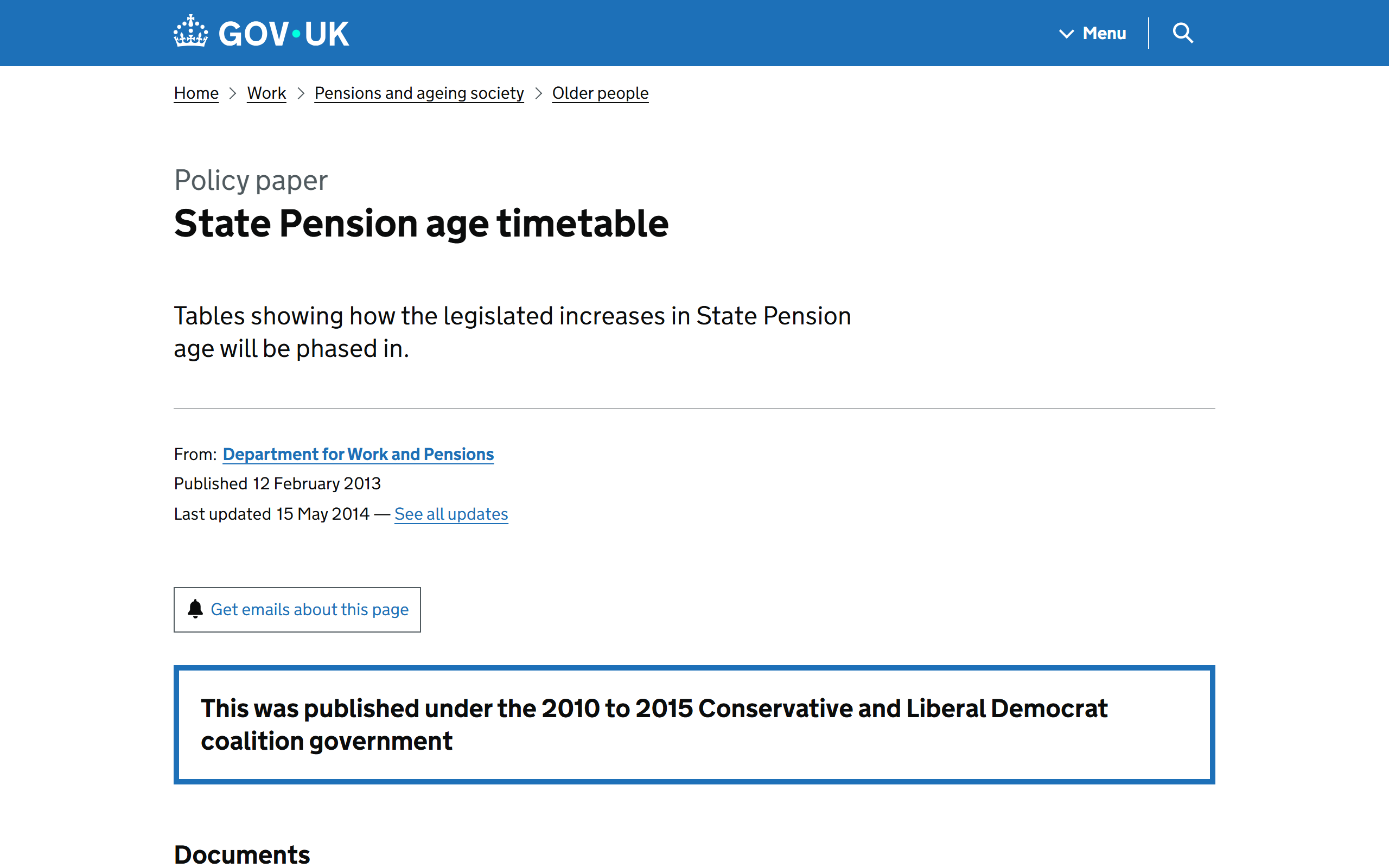
The State Pension is a regular payment from the government that you receive once you reach State Pension age. The State Pension age is currently transitioning from 66 to 67, a phased increase that started on 6 April 2026 and completes by March 2028. A further increase to 68 is legislated for 2044-2046, though the exact timeline remains under review.
The full new State Pension (for those reaching State Pension age from 6 April 2016 onwards) pays £12,548 per year in 2026/27, which is £241.30 per week or roughly £1,046 per month.
How you qualify
You build up your State Pension by accumulating qualifying years of National Insurance (NI) contributions. You need:
- 35 qualifying years for the full State Pension
- At least 10 qualifying years to get anything at all
A qualifying year means you have either:
- Earned above the Lower Earnings Limit (£6,708 in 2026/27) and paid NI through employment
- Received National Insurance credits (for example, through claiming Child Benefit, Jobseeker's Allowance, or Carer's Allowance)
- Made voluntary NI contributions (Class 3) to fill gaps in your record
You can check your State Pension forecast and NI record at gov.uk/check-state-pension. It takes five minutes and tells you exactly how many qualifying years you have, how much State Pension you are on track for, and whether you have any gaps worth filling.
Filling gaps in your NI record
If you have gaps - perhaps from years spent abroad, self-employed with low profits, or not working - you can often make voluntary contributions to fill them. The current cost is £956.80 per year for a Class 3 contribution, and each additional qualifying year adds about £359 per year to your State Pension for life.
That is a very good deal. Paying £957 to receive an extra £359 every year from retirement until you die means the contribution pays for itself in under three years. After that, it is pure gain. If you have gaps, filling them is one of the best financial moves you can make.
The triple lock
The triple lock is the mechanism that determines how much the State Pension increases each year. Under the triple lock, the State Pension rises by the highest of:
- Average earnings growth (as measured by the Annual Survey of Hours and Earnings)
- Consumer Price Index (CPI) inflation
- 2.5%
This means the State Pension should never lose purchasing power in real terms, and in years where wages outpace inflation it actually gains. In 2026/27, the triple lock delivered a 4.8% increase based on average earnings growth. The previous year saw an 8.5% rise and the year before that a 10.1% rise. Those are not typos. When wages or prices spike, the triple lock can deliver serious increases.
Why it matters
Without the triple lock, successive governments could quietly let the State Pension erode in real terms by linking it only to prices or earnings (whichever was lower). The triple lock prevents that by guaranteeing a minimum floor of 2.5% growth even in years of low inflation and flat wages.
The catch
The triple lock is a policy commitment, not a law carved in stone. It was temporarily modified during COVID when a statistical anomaly in earnings data would have triggered an artificially high increase. There is ongoing political debate about its long-term affordability as the ratio of pensioners to workers increases. Both major parties have pledged to maintain it, but fiscal pressure from an ageing population means its future form could change.
For planning purposes, it is reasonable to assume the State Pension will roughly keep pace with inflation over the long term. But building a retirement plan that depends entirely on the triple lock remaining in its current form for 30+ years is optimistic.
Workplace pensions and auto-enrolment
Since 2012, auto-enrolment has required most UK employers to automatically enrol eligible workers into a workplace pension scheme. You are eligible if you:
- Are aged 22 or over
- Are under State Pension age
- Earn at least £10,000 per year
- Work in the UK
If you meet these criteria, your employer must enrol you and start making contributions. You can opt out, but you would be turning down free money from your employer and tax relief from the government - so very few people should.
Auto-enrolment was introduced because millions of people were reaching retirement with almost no private savings. Making pension saving the default rather than an active choice changed the numbers overnight. Before auto-enrolment, around 55% of eligible employees had a workplace pension. That figure is now above 85%.
The 5% and 3% minimum contributions
Under auto-enrolment rules, the minimum total contribution is 8% of qualifying earnings, split as follows:
| Who pays | Minimum contribution |
|---|---|
| Employee | 5% (includes tax relief) |
| Employer | 3% |
| Total | 8% |
When the rules say you contribute 5%, that includes tax relief. As a basic rate (20%) taxpayer, you actually pay 4% from your take-home pay and HMRC tops it up to 5% through pension tax relief. So the real out-of-pocket cost is lower than it first appears.
What this looks like in practice
Take someone earning £30,000 a year. Their qualifying earnings (more on this below) are £23,760. The minimum contributions would be:
| Percentage | Annual amount | Monthly amount | |
|---|---|---|---|
| Employee (5%) | 5% | £1,188 | £99 |
| Employer (3%) | 3% | £713 | £59 |
| Total (8%) | 8% | £1,901 | £158 |
The employee's 5% includes tax relief. Their actual payslip deduction at the basic rate would be around £79 per month, with the remaining £20 coming from tax relief.
Many employers go further
These are minimums. Many employers offer enhanced matching - contributing more if you do too. A common structure is a 1:1 match up to 5% (you put in 5%, they put in 5%, total 10%) or even higher in sectors like tech, finance, and the public sector. Always check your scheme rules. Our pension match calculator can help you work out what your employer's match is actually worth in today's money.
What is NEST?
NEST (National Employment Savings Trust) is the government-backed pension scheme set up specifically to support auto-enrolment. It was created because when auto-enrolment launched, many existing pension providers did not want to accept small employers or low-earning workers - the admin costs were too high relative to the contributions.
NEST solved this by acting as a default scheme that any employer can use, regardless of size. Key features:
- Open to all employers - no minimum size or contribution level
- Run as a trust-based scheme - governed by an independent board with a legal duty to act in members' interests
- Accepts all workers - including part-time, low-paid, and workers with multiple jobs
- Invests in age-appropriate funds by default, gradually moving to lower-risk investments as you approach retirement
If your employer has not chosen a specific pension provider, there is a good chance you are in NEST. As of 2024, NEST has over 12 million members, making it one of the largest pension schemes in the UK.
How NEST invests your money
NEST uses a retirement date fund approach by default. When you join, you are placed in a fund that targets your expected retirement year. The fund starts with a cautious growth phase (to protect early contributions when your pot is small), moves to a higher-growth phase in your middle working years, and gradually shifts to less volatile investments as you approach retirement.
You can change your fund choice if you want, but the default option is designed to work for most people without requiring any decisions.
NEST fees
NEST's fee structure has two parts:
| Fee | Rate | What it means |
|---|---|---|
| Contribution charge | 1.8% | Taken from every contribution before it is invested |
| Annual management charge (AMC) | 0.3% | Charged on your total fund value each year |
The contribution charge is unusual
Most pension providers do not charge a fee on contributions. The 1.8% charge means that for every £100 paid into your NEST pension, only £98.20 is actually invested. Over a career, this adds up.
NEST introduced this charge to repay the government loan that funded its setup. The plan was always to remove or reduce the contribution charge once the loan was repaid. As of 2024, NEST has repaid its loan ahead of schedule, but the charge remains in place. There have been ongoing discussions about reducing it, but no confirmed date for removal.
How NEST fees compare
The 0.3% AMC is competitive - it sits within the 0.75% charge cap that applies to all auto-enrolment default funds. But the 1.8% contribution charge makes NEST more expensive than alternatives when you look at total cost.
To illustrate, suppose you contribute £200 per month for 30 years into two different schemes, both earning 5% annual growth:
| Scheme | Contribution charge | AMC | Final pot (approx) |
|---|---|---|---|
| NEST | 1.8% | 0.3% | ~£155,000 |
| Low-cost alternative | 0% | 0.15% | ~£164,000 |
That is roughly £9,000 less in your pension over 30 years, purely from fees. The difference comes almost entirely from the contribution charge eating into every payment before it has a chance to compound.
£200 a month for 30 years - NEST vs a low-cost alternative
Both compound at 5% gross. NEST takes 1.8% off every contribution and 0.3% off the balance each year.
Source: Monthly contributions of £200, 5% gross annual return, fees as stated. NEST = 1.8% contribution charge plus 0.3% AMC. Alternative = 0.15% AMC.
Should you switch away from NEST?
If your employer only offers NEST, you cannot simply choose a different workplace scheme - your employer decides the provider. But you can:
- Ask your employer whether they would consider switching to a lower-cost provider (some will, especially if employees raise it)
- Open a SIPP (Self-Invested Personal Pension) alongside your workplace pension for any additional contributions beyond the employer match. A low-cost SIPP typically charges no contribution fee and a lower AMC
- Transfer out of NEST periodically into a cheaper SIPP, though check for any restrictions first
The priority should always be capturing your employer's match first, regardless of fees. Even NEST's 1.8% contribution charge does not wipe out the value of free employer money.
Salary sacrifice
Salary sacrifice (sometimes called salary exchange) is an arrangement where you agree to reduce your gross salary, and your employer pays the equivalent amount directly into your pension. The key difference from a normal pension contribution is when the tax and NI are calculated.
How it works
With a normal pension contribution:
- Your employer pays you your full salary
- You pay income tax and National Insurance on it
- Your pension contribution is taken, and HMRC adds tax relief
With salary sacrifice:
- Your contractual salary is reduced by the amount of your pension contribution
- Your employer pays the reduced salary (so you pay less income tax and less National Insurance)
- Your employer sends the sacrificed amount directly to your pension
- Because the money never hits your payslip as salary, there is no income tax or NI to reclaim
Why this saves you money
Under normal contributions, you get income tax relief but you still pay employee National Insurance (8% in 2026/27 on earnings between the primary threshold and the upper earnings limit). With salary sacrifice, you avoid NI on the sacrificed amount entirely.
For a basic rate taxpayer sacrificing £200 per month:
| Normal contribution | Salary sacrifice | |
|---|---|---|
| Gross amount | £200 | £200 |
| Income tax saved | £40 (20%) | £40 (20%) |
| Employee NI saved | £0 | £16 (8%) |
| Cost to you | £160 | £144 |
| In your pension | £200 | £200 |
That extra £16 per month might look small, but over 30 years of contributions it compounds into thousands of pounds.
The employer NI bonus
Your employer also saves National Insurance on the sacrificed amount (currently 15% employer NI on earnings above £5,000). Many employers pass some or all of this saving into your pension as an additional contribution. If your employer passes the full saving through:
| Amount | |
|---|---|
| Your sacrifice | £200 |
| Employer NI saving (15%) | £30 |
| Total into your pension | £230 |
This is one of the few arrangements where both you and your employer save money while your pension gets more. Ask your HR or payroll team whether salary sacrifice is available and whether they pass through the employer NI saving.
Watch out for
- Salary sacrifice reduces your gross salary on paper. This can affect mortgage applications (lenders look at gross salary), statutory payments like maternity pay (calculated on actual salary), and any benefits linked to salary level.
- You cannot sacrifice below the National Minimum Wage. Your post-sacrifice salary must remain at or above the legal minimum.
- Some employers do not offer it. Salary sacrifice is not a legal requirement - it is an arrangement your employer chooses to make available.
Qualifying earnings vs total earnings
This is one of the most misunderstood parts of UK pensions, and it directly affects how much money goes into your pension each month.
Qualifying earnings
Under auto-enrolment, the default basis for pension contributions is qualifying earnings. This is not your full salary. It is the portion of your earnings that falls within a band:
- Lower threshold: £6,240 per year (2026/27)
- Upper threshold: £50,270 per year (2026/27)
Only income between these two limits counts as qualifying earnings.
Example: If you earn £30,000, your qualifying earnings are:
£30,000 - £6,240 = £23,760
Your pension contributions (and your employer's) are calculated as a percentage of £23,760, not £30,000. This means the first £6,240 of your salary generates no pension contributions at all.
Total earnings (sometimes called "total pay")
Some employers calculate pension contributions on your total gross salary from the first pound. No lower threshold, no deduction. If you earn £30,000 and your employer uses total earnings, pension contributions are calculated on the full £30,000.
The difference in practice
Here is how the two approaches compare for someone earning £30,000 with minimum 8% total contributions:
| Basis | Pensionable pay | 8% contribution | Monthly amount |
|---|---|---|---|
| Qualifying earnings | £23,760 | £1,901 | £158 |
| Total earnings | £30,000 | £2,400 | £200 |
That is an extra £499 per year going into your pension under total earnings - £42 per month more. Over a 30-year career with investment growth, that difference compounds into a meaningfully larger pension pot.
Why it matters more for lower earners
The qualifying earnings band disproportionately affects lower earners. Someone earning £15,000 has qualifying earnings of just £8,760 - meaning 42% of their salary is excluded from pension contributions. Someone earning £50,000 has qualifying earnings of £43,760 - only 12% excluded.
| Salary | Qualifying earnings | % of salary excluded |
|---|---|---|
| £15,000 | £8,760 | 42% |
| £25,000 | £18,760 | 25% |
| £35,000 | £28,760 | 18% |
| £50,000 | £43,760 | 12% |
This is one reason why auto-enrolment, while a huge improvement, still leaves lower earners with inadequate pension savings.
How to find out which basis your employer uses
Check your pension scheme documentation, your latest benefit statement, or ask your HR or payroll team. The key question is: "Are my pension contributions calculated on qualifying earnings or total earnings?" If it is qualifying earnings and your employer would consider switching to total earnings, that is effectively a pay rise delivered straight into your pension.
Putting it all together
Here is how all these pieces connect for a typical UK employee:
- The State Pension gives you a foundation of £12,548 per year (in 2026/27) from State Pension age, protected (for now) by the triple lock. It is useful but not enough to live on comfortably.
- Auto-enrolment means you are probably already in a workplace pension with at least 8% of qualifying earnings going in (5% from you, 3% from your employer).
- Your employer might offer more than the minimum. Check whether enhanced matching is available - contributing enough to capture the full employer match is almost always the right first move.
- Your scheme might be NEST, which is perfectly functional but charges a 1.8% contribution fee that eats into your returns. If you are making additional contributions beyond the employer match, a low-cost SIPP could be a better home for them.
- Salary sacrifice can reduce the cost of your pension contributions by saving you National Insurance. Ask whether your employer offers it.
- Check whether you are on qualifying earnings or total earnings. If it is qualifying earnings, understand that the first £6,240 of your salary is not generating any pension contributions.
The pension system is not perfect, but understanding how it works puts you in a much stronger position than ignoring it. The default settings - auto-enrolment minimums into NEST on qualifying earnings - are better than nothing, but they are designed as a floor, not a ceiling. Knowing where the levers are means you can pull them.
Frequently asked questions
Can I opt out of auto-enrolment?
Yes, but it is almost never a good idea. Opting out means you lose your employer's contribution (free money) and the tax relief on your own contributions. Your employer will re-enrol you every three years, but any contributions missed in the meantime are gone. The only scenario where opting out might make sense is if you have unmanageable high-interest debt that needs clearing first.
How much State Pension will I get?
Check your forecast at gov.uk/check-state-pension. You need 35 qualifying years for the full amount (£12,548/year in 2026/27). If you have fewer qualifying years, you will get a proportionally reduced amount. You need at least 10 years to get anything.
Is NEST any good?
NEST does its job. It accepts everyone, invests sensibly by default, and the 0.3% annual management charge is reasonable. The downside is the 1.8% contribution charge. If NEST is your only option through work, use it to capture the employer match. For additional voluntary contributions, consider a low-cost SIPP instead.
What is the pension annual allowance?
The annual allowance is the maximum you can contribute to pensions in a tax year while still receiving tax relief. For 2026/27 it is £60,000 (or 100% of your earnings, whichever is lower). High earners with adjusted income above £260,000 may have a tapered allowance as low as £10,000. Most people are nowhere near this limit.
When can I access my pension?
The minimum pension age is currently 55, rising to 57 on 6 April 2028. The State Pension age is separate - currently transitioning from 66 to 67 (completing March 2028). You cannot access your State Pension early, but you can access workplace and private pensions from the minimum pension age.
Should I make additional voluntary contributions?
If you have captured the full employer match, have no high-interest debt, and have an adequate emergency fund, then yes - additional pension contributions are very tax-efficient, especially for higher-rate taxpayers. The question is whether to put extra money into your workplace pension or a separate SIPP. If your workplace scheme has high fees (like NEST's contribution charge), a low-cost SIPP for the extra contributions may be better value.
What happens to my pension if I change jobs?
Your pension pot stays where it is. You do not lose it. You can leave it with your old employer's scheme, transfer it to your new employer's scheme, or consolidate it into a SIPP. Having multiple small pension pots scattered across old employers is common but messy - consolidating makes it easier to track your total retirement savings.
Further reading:
- NEST Pension UK: Fine for Some, a Tax for Others - Whether to stay or transfer out of the UK's default auto-enrolment provider
- How Much Is State Pension UK 2026/27? - The 2026/27 figures, why most don't get the full amount, and the Class 3 top-up maths
- NHS Pension Scheme Contributions 2026/27 Explained - Tier rates, the 23.7% employer match, and the McCloud remedy in plain English
- Reassure Pension: What to Do When Yours Lands Here - The closed-book consolidator and when transferring out makes sense
- Pension Match Calculator: What Is It Really Worth? - Calculate the present value of your employer's pension match
- Trading 212 SIPP: The Cheapest Pension in the UK? - A zero-fee SIPP option for additional contributions
- Sovereignty in Retirement: Beyond the State Pension - Why the State Pension alone is not enough
- Using Your Pension Lump Sum to Reduce Your Mortgage - How the 25% tax-free lump sum works
- Budgeting 101 - Get your spending under control before optimising your pension
Smarter Investing - Tim Hale - The best UK-focused guide to building a low-cost, evidence-based investment portfolio inside your pension and ISA. (Affiliate link - we may earn a small commission at no extra cost to you.)
I Will Teach You To Be Rich - Ramit Sethi - A practical system for automating your finances, including pension contributions, so the right money goes to the right place every month without willpower. (Affiliate link - we may earn a small commission at no extra cost to you.)
Prefer to watch?
We turn these money breakdowns into short videos
A few a week, plain-English UK money. If you would sooner watch than read, follow along:
Enjoying the content?
If this site has been useful, a coffee goes a long way.
Browse more articles
Browse all