



How Much Is State Pension UK 2026/27?
The 'full' UK State Pension is £241.30 a week. The average actually paid is £194. The £47 gap is 25 years of NI gaps and contracted-out years quietly compounding.
Cite this article
Freedom Isn't Free (2026) How Much Is State Pension UK 2026/27?. Available at: https://freedomisntfree.co.uk/articles/how-much-is-state-pension-uk (Accessed: 10 October 2026).
Italicise the article title in your bibliography. Accessed date set to today.
TLDR
- The full new State Pension in 2026/27 is £241.30 a week, which works out at £12,548 a year. The basic State Pension (old system) is £184.90 a week or £9,615 a year.
- Most people do not receive the full amount. Contracted-out periods, gap years, and incomplete NI records mean the average payment in 2026 sits closer to £194 a week than the headline figure.
- A single person on the full new State Pension and nothing else is roughly £3,500 a year below the Pensions and Lifetime Savings Association minimum retirement standard. The State Pension is a floor, not a plan.
- Filling missing NI years with voluntary Class 3 contributions costs £956.80 per year for 2026/27 and pays itself back in under three years for someone who lives a typical post-67 lifespan.
2026/27 State Pension at a glance
| Type | Weekly | Annual | Who Gets It |
|---|---|---|---|
| Full new State Pension | £241.30 | £12,548 | Reached SPA on/after 6 April 2016 with 35 qualifying NI years |
| Full basic State Pension | £184.90 | £9,615 | Reached SPA before 6 April 2016 with 30 qualifying NI years |
| Couple, both on full new | £482.60 | £25,096 | Both partners individually qualify in full |
| Average actually paid | ~£194 | ~£10,090 | Includes partial entitlements, contracted-out deductions |
Source: gov.uk proposed benefit and pension rates 2026/27. Average reflects DWP data on amounts actually in payment.
How Much Is State Pension UK 2026/27?
The full new State Pension in 2026/27 is £241.30 a week, which works out at £1,046 a month or £12,548 a year. The full basic State Pension, paid to those who reached State Pension age before 6 April 2016, is £184.90 a week (£9,615 a year). Most articles on this topic bury those numbers four scrolls down to keep you on the page. The answer is the answer.
The interesting question is the one the official guides do not address. The full amount is what most readers think they are entitled to. Most are not, because contracted-out years, NI gaps, and pre-2016 deductions quietly shrink the payment by amounts that compound over a 25-year retirement into the price of a small flat. So the right question is not "how much is the State Pension" but "how much will I actually get".
Contents
- The 2026/27 figures
- Why most people do not get the full amount
- How to check what you will actually receive
- The triple lock and what it means for future increases
- State Pension age - the moving target
- Voluntary Class 3 NI top-ups: is it worth it?
- Is the State Pension enough to live on?
- Frequently Asked Questions
The 2026/27 Figures
There are two State Pensions running in parallel and the one you receive depends on when you reached State Pension age.
New State Pension (reached SPA on or after 6 April 2016): full rate £241.30/week, £1,046/month, £12,548/year.
Basic State Pension (reached SPA before 6 April 2016): full rate £184.90/week, £801/month, £9,615/year, plus in many cases an additional State Pension (SERPS / S2P) built up before 2016.
For a couple where both partners qualify for the full new amount, the household figure is £482.60/week or £25,096/year. There is no longer a "married couple's" rate; each adult builds their own entitlement on their own NI record, a quiet but important shift from the pre-2016 system that gave non-working spouses a derived rate.
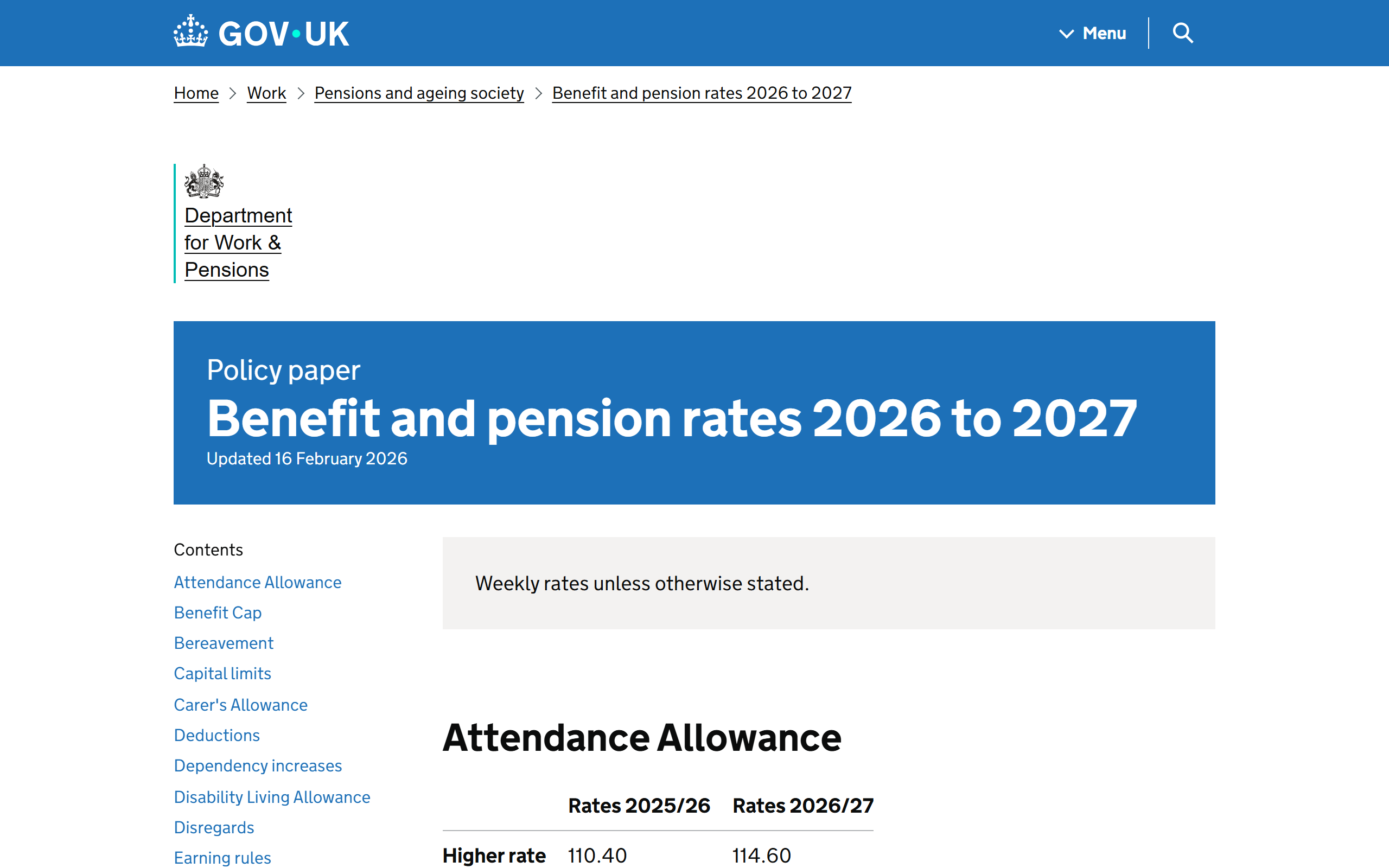
The figures are the proposed 2026/27 rates published by gov.uk, applying from the first Monday after 6 April 2026.
Why Most People Do Not Get the Full Amount
The headline £241.30 is the ceiling, not the average. DWP statistics show the average new State Pension actually in payment sits closer to £194 a week. That is a £47/week gap, or £2,440 a year, between what readers assume they will get and what is landing in the average pensioner's bank account.
Three main reasons for the shortfall.
Gap years in your NI record. You need 35 qualifying years on the new system for the full amount. Each missing year costs you 1/35th, roughly £358 a year of pension for life. Career breaks, time abroad, low-profit self-employment, and unclaimed Child Benefit credits all create gaps. A 25-year worker getting £8,963 instead of £12,548 is losing £3,585 every year of retirement.
Contracted-out years. Between 1978 and 2016, millions of workers were "contracted out" of the additional State Pension (SERPS, then S2P) in exchange for a lower NI rate, with the difference paid into a workplace pension. When the new system launched in 2016, those years were credited with a Contracted Out Pension Equivalent deduction. The practical effect: someone with 35 NI years can still receive less than £241.30 if a chunk of those years were contracted out. This catches people in their 50s and 60s who assumed 35 years was 35 years.
The 10-year floor. Below 10 qualifying years you get nothing. Not a reduced amount; nothing. People who worked briefly in the UK and then moved abroad, or spent most of their working life caring without claiming credits, are the common casualties.
The reframe: "the full State Pension" is really three different numbers wearing the same label. The legal maximum, the average actually paid, and the figure on your own forecast. The third is the only one that matters for you.
How to Check What You Will Actually Receive
Two minutes on gov.uk/check-state-pension gives you the only number that matters: your personal forecast. Log in with Government Gateway, and the page shows your current entitlement, the projected entitlement if you keep contributing until SPA, and a year-by-year NI record flagging any incomplete years.
The sibling State Pension forecast article walks through how to read the projection figures and which gaps are worth filling. The 90-second version: log in, write down the number, treat anything below the full rate as a problem to investigate, not an outcome to accept.
The Triple Lock and What It Means for Future Increases
The State Pension is uprated each April by the triple lock: the highest of CPI inflation, average earnings growth, or 2.5%. In 2026/27 the lock delivered a 4.8% rise. The two preceding years saw 8.5% and 10.1% increases when post-pandemic inflation and wage data spiked.
Compounded over a working life, this is the single most generous indexation any UK benefit receives, and the reason the policy is increasingly contested. The OBR estimates maintaining it could push State Pension spending from 5% of GDP to over 8% by the 2070s. The frozen tax thresholds running alongside it claw some of it back via fiscal drag: a pensioner whose State Pension rises 8% sees more of it cross the £12,570 Personal Allowance each year, especially with private pension income on top. We covered both in why the triple lock is unsustainable and frozen tax thresholds UK.
The honest planning assumption: do not load-bear a 30-year retirement plan on the triple lock surviving in current form. Assume it is quietly modified within the next parliament (most likely to a smoothed earnings link), discount accordingly, and treat anything better as upside.
State Pension Age - The Moving Target
The State Pension age (SPA) is when you can first claim. It depends on when you were born.
| Date of birth | State Pension age | Notes |
|---|---|---|
| Before 6 April 1960 | 66 | Already in payment for most |
| 6 April 1960 to 5 February 1961 | 66 + a few months | Phased rise during 2026 to 2028 |
| 6 February 1961 to 5 April 1977 | 67 | Phased rise completes March 2028 |
| 6 April 1977 onwards | 68 (planned) | Legislated for 2044-2046, under review |
The rise from 66 to 67 began on 6 April 2026 and completes in March 2028. The further rise to 68 is legislated for 2044-2046 but successive governments have signalled it could be brought forward to the late 2030s. If you are in your 40s now, plan for an SPA of 68.
Deferral uplifts the new State Pension by 1% for every nine weeks delayed, or roughly 5.8% a year. For healthy retirees still earning above the higher-rate threshold, deferral often beats drawing and being taxed at 40%.
Voluntary Class 3 NI Top-Ups: Is It Worth It?
If your forecast shows you below the full rate and the gap is from missing years rather than contracted-out deductions, voluntary Class 3 National Insurance contributions are usually one of the highest-return moves available in UK personal finance.
The 2026/27 cost is £956.80 to fill one missing year (Class 3 is set at £18.40 per week). Each filled year adds roughly £358 a year to your eventual State Pension. Walk the maths: £957 in now, £358 a year from State Pension age, paid for life and triple-lock uprated. Payback inside 2.7 years of drawing. ONS cohort life expectancy at 67 is roughly 85 for men and 87 for women, so a 60-year-old paying £957 today receives around £6,400 in nominal terms over 18 years. Inflation-linked and government-backed. Nothing in the regular retail savings market comes close on a like-for-like basis.
Two caveats, and they matter. First, if you are already on track to hit 35 NI years through normal employment before SPA, paying Class 3 for an earlier missing year is wasted; you cannot exceed the full rate. Always check your forecast first. Second, if you were self-employed in the missing year with profits below the threshold, you can pay Class 2 at £3.65 per week (£189.80 per year) for the same credit. Five times cheaper. The Future Pension Centre on 0800 731 0181 will confirm whether a specific year's payment moves your eventual pension before you transfer any money to HMRC. This is a general framework, not personal advice; the right answer depends on your own record and circumstances.
Is the State Pension Enough to Live On?
The Pensions and Lifetime Savings Association publishes annual Retirement Living Standards that put a number on what different lifestyles actually cost. For a single person outside London:
| Standard | Annual income | What it covers |
|---|---|---|
| Minimum | £14,400 | Food, heating, basic clothing, no car, one UK holiday |
| Moderate | £31,300 | A small car, two UK holidays, more flexibility |
| Comfortable | £43,100 | Foreign holidays, regular leisure, car replacements |
The full new State Pension at £12,548 a year sits roughly £1,850 below the PLSA minimum for a single person. A single retiree on State Pension alone cannot reach the official "minimum" lifestyle. A couple both drawing the full new amount gets £25,096 between them, which clears the joint minimum. The system functions for couples and creaks for single retirees.
The State Pension is a floor, not a plan. It prevents absolute poverty in old age and it does that job. It does not fund the retirement most readers of a personal finance blog actually want. That floor exists because successive generations of UK workers funded it through their NI contributions and successive governments chose to defend it: the triple lock, contributory entitlement, the Pension Credit safety net. Auto-enrolment was bolted on top because the policy view from 2012 onward was that the floor alone is not enough for a modern working life - and that the cost of building the rest cannot be left entirely to individual willpower. That is a deliberately worker-protective design choice and it deserves the credit it rarely gets.
For your own "enough" number, the how much to retire UK piece runs the maths and the drawdown calculator lets you stress-test it. The take-home pay calculator shows the input side; the UK pensions explained guide covers how the State Pension stacks with auto-enrolment and SIPP contributions on top.
Frequently Asked Questions
How much is the State Pension going up in April 2026?
The State Pension rose by 4.8% in April 2026, based on the average earnings growth limb of the triple lock. That took the full new State Pension from £230.25 a week to £241.30 a week (an extra £11.05 a week, or £575 a year). The basic State Pension rose by the same percentage, from £176.45 to £184.90 a week.
How much State Pension will I get if I have never worked?
Fewer than 10 qualifying NI years and you receive nothing. Between 10 and 35 years you get a pro-rata amount: each year adds 1/35th of the full rate, around £358 a year. Many people who have not held a paid job still have qualifying years through Child Benefit credits, Carer's Allowance, or Universal Credit. Check your record before assuming a zero.
How much money can you have in the bank and still get a full State Pension?
The State Pension is contributory, not means-tested. Any amount of savings is fine; you still receive your full entitlement based on your NI record. The means-tested benefit is Pension Credit, which tops up income to £238.00 a week for a single person in 2026/27 and tapers at savings above £10,000.
How much pension will I get at 66?
If you reached State Pension age before 6 April 2026, payment starts at 66. Birthdays in the transitional window (April 1960 to March 1961) have an SPA between 66 and 67. Anyone born from 6 February 1961 onwards has an SPA of 67 and cannot draw the State Pension at 66 at all. The amount, when it starts, depends on your NI record rather than your age.
Is there an increase for pensioners in 2026?
Yes. The triple lock delivered a 4.8% increase in April 2026, lifting the full new State Pension to £241.30 a week. The Personal Allowance remains frozen at £12,570 (just £22 above the new State Pension), so most pensioners with any private income now find part of their State Pension being taxed.
Read Next
- Sovereignty in the Silver Years: Beyond the State Pension Myth - why treating the State Pension as your retirement plan is the most expensive assumption you can make.
- Annuity vs Drawdown UK: Which Is Right for You? - once the State Pension is in payment, the next decision is what to do with the private pot on top.
- Safe Withdrawal Rate UK: Why the 4% Rule Falls Short - the maths that decides how long a private pension lasts alongside the State Pension floor.
This article is general information about UK State Pension rules and is not personal financial advice. Tax and benefit rules can change, and individual entitlement depends on your own NI record and circumstances. For a binding answer on your own forecast or top-up decision, speak to the Future Pension Centre (0800 731 0181) or a regulated adviser.
Sources
- GOV.UK - proposed benefit and pension rates 2026/27 (full new £241.30/week, basic £184.90/week)
- GOV.UK - voluntary National Insurance contributions rates (Class 3 set at £18.40/week)
- GOV.UK - check your State Pension forecast
- PLSA Retirement Living Standards - minimum, moderate and comfortable retirement income levels
- ONS - cohort life expectancies (life expectancy at age 67)
Prefer to watch?
We turn these money breakdowns into short videos
A few a week, plain-English UK money. If you would sooner watch than read, follow along:
Enjoying the content?
If this site has been useful, a coffee goes a long way.
Browse more articles
Browse all