
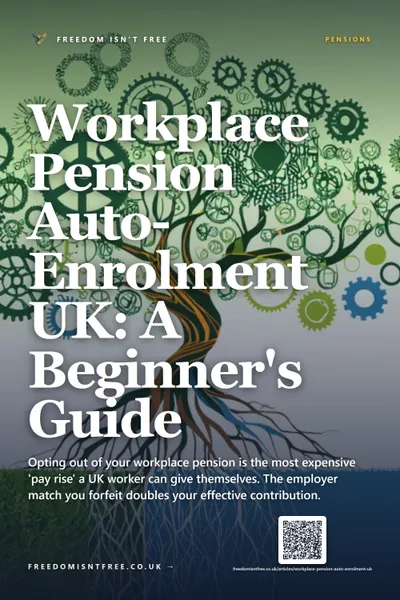



Workplace Pension Auto-Enrolment UK: A Beginner's Guide
Opting out of your workplace pension is the most expensive 'pay rise' a UK worker can give themselves. The employer match you forfeit doubles your effective contribution.
Cite this article
Freedom Isn't Free (2026) Workplace Pension Auto-Enrolment UK: A Beginner's Guide. Available at: https://freedomisntfree.co.uk/articles/workplace-pension-auto-enrolment-uk (Accessed: 10 October 2026).
Italicise the article title in your bibliography. Accessed date set to today.
TLDR
- Auto-enrolment requires UK employers to enrol workers aged 22+ earning above £10,000/year into a workplace pension
- Minimum total contribution is 8%: 5% from you (gross of tax relief), 3% from your employer
- Opting out forfeits the employer match - effectively giving up free money equal to 3-10% of salary depending on the scheme
- Above the auto-enrolment minimum, many employers offer matched contributions up to 5% or more - always max the match
Auto-enrolment 2026/27: who pays what
| Component | Rate | On a £30k salary |
|---|---|---|
| Employee contribution | 5% (4% net of tax relief) | £951/yr |
| Employer contribution | 3% | £713/yr |
| Tax relief at basic rate | 20% added back | £237/yr |
| Total going into your pot | 8% of qualifying earnings | £1,901/yr |
Qualifying earnings band: £6,240-£50,270. Opting out forfeits the 3% employer match - a guaranteed 100% return.
Workplace Pension Auto-Enrolment UK: A Beginner's Guide
For UK workers aged 22 or over earning above £10,000 a year, workplace pension auto-enrolment is the default. Your employer signs you up, money is deducted from your salary each month, and a workplace pension is built up in your name. Many people barely notice the deduction, and many opt out without realising what they are giving away.
This guide covers how auto-enrolment works in 2026/27, the contribution mechanics, how to read your payslip, and the most underused part of the system: pushing contributions above the minimum to claim the full employer match.
Contents
- What auto-enrolment is
- The 8% minimum and how it splits
- How to read your pension contribution on a payslip
- Why opting out is almost always a mistake
- Going beyond the minimum: matched contributions
- Salary sacrifice for workplace pensions
- Frequently asked questions
What Auto-Enrolment Is
Introduced in 2012 and rolled out gradually until 2018, auto-enrolment requires UK employers to put eligible workers into a qualifying workplace pension scheme automatically. The Pensions Regulator publishes the full list of employer duties under auto-enrolment.
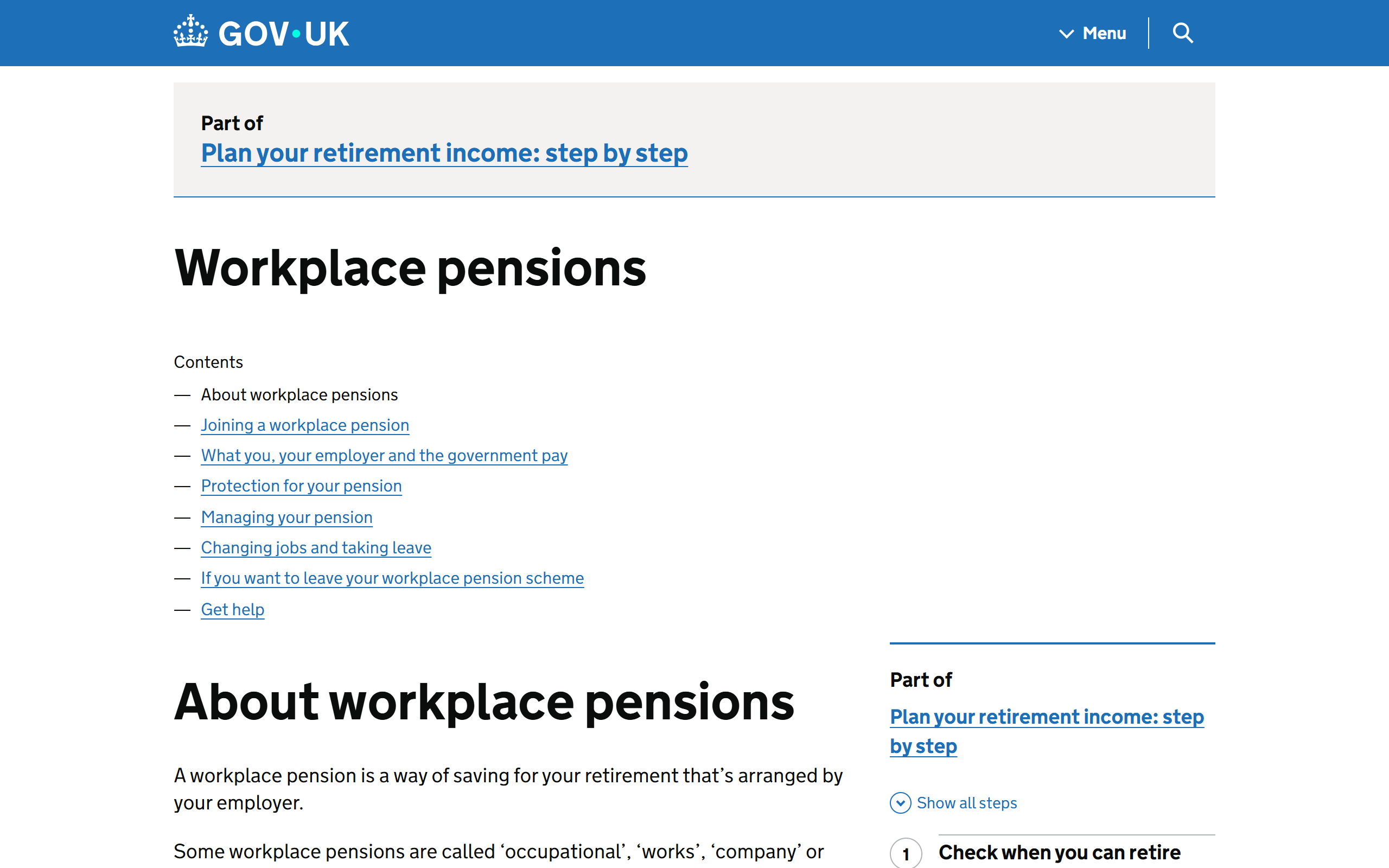
For the worker's-eye view, the official GOV.UK workplace pensions guide covers eligibility, opt-out, and how contributions appear on your payslip. You are eligible if you:
- Are aged between 22 and State Pension age
- Earn more than £10,000 per year (the "earnings trigger")
- Work in the UK
Workers below the earnings trigger or under 22 can ask to opt in voluntarily; the employer then has to enrol them. Workers above the trigger are enrolled by default and have to actively opt out if they want to.
The pension is owned by you, follows you across employers (each new job triggers a fresh enrolment with that employer's pension scheme), and can be consolidated, transferred, or grown until you draw it from age 55-57.
The 8% Minimum and How It Splits
The minimum total contribution under auto-enrolment is 8% of qualifying earnings, split:
- 5% from the employee (you) - includes basic-rate tax relief, so the actual deduction from your gross pay is 4%
- 3% from the employer
Qualifying earnings is the band of pay between £6,240 and £50,270 (2026/27 figures). Earnings above or below those thresholds are not counted unless your employer has chosen a more generous structure.
For a £30,000 earner:
- Qualifying earnings: £30,000 - £6,240 = £23,760
- Total 8% contribution: £1,901/year (£158/month)
- Your share (5%): £1,188 - £237 of which is basic-rate tax relief = £951 actual deduction
- Employer share (3%): £713
Some employers contribute on full salary, not just qualifying earnings, which is more generous. Others use banded earnings (the £6,240-£50,270 range) which is the legal minimum. Check which one your scheme uses - the difference for a £30,000 worker is £208/year of total contribution.
How to Read Your Pension Contribution on a Payslip
A typical UK payslip shows pension contributions in one of three ways:
- Net Pay arrangement (most occupational schemes): contributions are taken from gross pay before tax. Your taxable pay on the payslip is reduced by the contribution. Tax relief is automatic at your full marginal rate.
- Relief at Source (most personal pensions and some workplace schemes): contributions are taken from net pay (after tax). The pension provider claims back basic-rate tax relief from HMRC and adds it to your pot. Higher-rate taxpayers must claim the extra relief via Self Assessment.
- Salary Sacrifice: your gross salary is reduced by the contribution amount before any tax or NI is calculated. Tax and NI savings flow automatically; the contribution appears as an "employer contribution" on the payslip.
Look for "Pension" or "Pension Deduction" on the payslip. The format varies by employer. If you cannot tell which method is being used, ask your HR or payroll team - it matters because the higher-rate tax relief mechanism differs.
Why Opting Out Is Almost Always a Mistake
You can opt out of auto-enrolment within one month of being enrolled and get your contributions refunded. Beyond a month, you can stop contributing but cannot reclaim what was already deducted.
Opting out is almost always financial self-sabotage:
- You forfeit the employer match. The 3% employer contribution is essentially free money on top of your salary - opting out is a 3% pay cut.
- You forfeit tax relief. Even basic-rate workers get an immediate 20% boost on every pound contributed.
- You forfeit decades of compound growth. £1,000 contributed at 25 grows to roughly £8,000 by 65 at 5% real returns.
- The cash flow benefit of opting out (a 4% net increase in take-home pay for most workers) is dwarfed by the long-term cost.
The only scenarios where opting out makes some sense:
- You have very high-interest debt (24%+ APR credit cards) and need every spare pound to clear it. In this case, opt out only as long as the debt is being aggressively paid down.
- You are in serious immediate financial distress and your survival depends on the additional cash flow.
Even in those cases, opt back in as soon as the immediate problem is resolved. Most people who opt out "for a year" never opt back in until their next job.
Going Beyond the Minimum: Matched Contributions
Many UK employers offer matched contributions above the auto-enrolment minimum. The most common structures:
- "We match up to 5%": you contribute 5% of salary, they contribute 5% (above the 3% minimum)
- "We match 1-for-1 up to 6%": same idea, slightly higher cap
- "We contribute 10%, you contribute 5%": no match per se, but very generous total contribution
- Some sectors (financial services, oil & gas, big tech) offer 2-for-1 matches up to 5% - i.e. you contribute 5% and they contribute 10%
The employer match is the single highest-return investment available to most UK workers - typically 100-200% return on the matched portion in year one. There is essentially no other place in finance where you can earn 100% on day one.
Use the pension match calculator to see exactly what you forgo by under-contributing relative to your employer's match.
Salary Sacrifice for Workplace Pensions
If your employer offers it, salary sacrifice is the most efficient way to make pension contributions:
- Your gross salary is reduced by the contribution amount
- Income tax (20%, 40%, or 45%) is saved on the contribution
- Employee NI (8% or 2%) is also saved
- Employer NI (15%) is also saved - many employers pass this back into your pension
For a basic-rate worker at £30,000 sacrificing £200/month:
- Income tax saved: £40
- Employee NI saved: £16
- Net cost to take-home pay: £144 for £200 in pension (a 39% effective relief)
- Plus potential £30 employer NI passback: total contribution becomes £230 for £144 net
Salary sacrifice for higher-rate workers, especially those caught in the 60% tax trap, is even more powerful. For workers in the trap, salary sacrifice can deliver effective relief of 65-75%.
Frequently Asked Questions
What is the minimum contribution under UK auto-enrolment?
8% of qualifying earnings (the band £6,240-£50,270 in 2026/27). Of that, 5% comes from you (4% net of basic-rate tax relief) and 3% from your employer. Some employers contribute on full salary or use higher rates above the legal minimum.
Can I opt out of my workplace pension?
Yes, you can opt out within one month of enrolment (with a refund of contributions) or stop contributing later (without refund). Opting out forfeits the employer match and decades of compound growth, so it is almost always financially harmful unless you are in severe immediate financial distress.
What happens to my workplace pension if I change jobs?
Nothing immediately - the pot stays in the scheme run by your former employer's provider. You can leave it there, transfer it to your new employer's scheme, or transfer it to a SIPP for more control. Transferring is usually free, but check for any guaranteed annuity rates or special features before consolidating.
Do I get tax relief on my pension contributions?
Yes. The relief mechanism depends on your employer's scheme - either taken from gross pay (Net Pay), claimed by the provider (Relief at Source), or via salary sacrifice. Higher-rate and additional-rate taxpayers in Relief-at-Source schemes need to claim the extra relief through Self Assessment.
How much should I be contributing to my workplace pension?
At minimum, enough to claim the full employer match. Above that, target 15-20% of gross salary (employer + employee combined) for a comfortable retirement, more if you start late or want to retire early. The auto-enrolment 8% minimum is rarely enough on its own for full retirement income replacement.
Prefer to watch?
We turn these money breakdowns into short videos
A few a week, plain-English UK money. If you would sooner watch than read, follow along:
Enjoying the content?
If this site has been useful, a coffee goes a long way.
Browse more articles
Browse all