

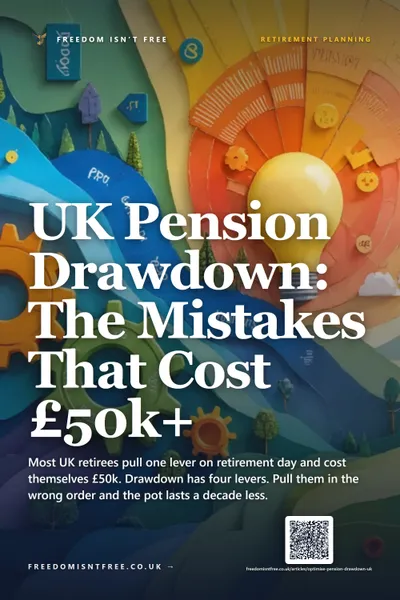



UK Pension Drawdown: The Mistakes That Cost £50k+
Most UK retirees pull one lever on retirement day and cost themselves £50k. Drawdown has four levers. Pull them in the wrong order and the pot lasts a decade less.
Cite this article
Freedom Isn't Free (2026) UK Pension Drawdown: The Mistakes That Cost £50k+. Available at: https://freedomisntfree.co.uk/articles/optimise-pension-drawdown-uk (Accessed: 10 October 2026).
Italicise the article title in your bibliography. Accessed date set to today.
TLDR
- Optimising pension drawdown is about pulling four levers together: withdrawal rate, pot sequencing, tax-free cash timing, and a cash buffer for bad markets.
- Drawing taxable pension income up to your personal allowance before the State Pension starts is one of the biggest tax savings available to UK retirees.
- Taking the full 25% tax-free lump sum on day one is usually a mistake. Phasing it across years preserves growth and tax-free flexibility.
- Triggering flexi-access drawdown carelessly can cap your future pension contributions at £10,000 a year through the Money Purchase Annual Allowance.
Pension drawdown phases for UK retirees
| Phase | Income source | Tax cost | Risk |
|---|---|---|---|
| Before State Pension | SIPP up to £12,570 | £0 income tax | Wasted personal allowance |
| After State Pension | ISA + tapered SIPP | Stay under £50,270 | Higher-rate creep |
| Sequence-risk buffer | 1-3 years of cash | Cash drag | Selling in a crash |
| MPAA trigger | Drop to £10,000 cap | Lost future relief | One-way door |
Pull all four levers, not just the withdrawal rate.
Optimise Pension Drawdown UK: A 2026 Tactical Guide
Optimising your pension drawdown in retirement is the difference between a pot that lasts 25 years and one that lasts 35. Most UK retirees focus on the headline withdrawal rate and ignore everything else, which leaves real money on the table every year. The withdrawal rate matters, but it is one lever among four, and the others compound. The drawdown calculator is a useful place to test how each lever changes the answer.
This guide covers the practical decisions you control once you actually start drawing income: which pot to draw from first, how to use the 25% tax-free cash, how to avoid the Money Purchase Annual Allowance trap, and how to build a cash buffer that protects you from bad early markets.
Contents
- The Four Levers of Pension Drawdown Optimisation
- Pick the Right Withdrawal Rate and Flex It
- Sequence Your Pots in the Right Order
- Use the 25% Tax-Free Cash Strategically
- Avoid the Money Purchase Annual Allowance Trap
- Build a Cash Buffer for Sequence Risk
- Frequently Asked Questions
The Four Levers of Pension Drawdown Optimisation
Every pound of extra income you generate in retirement comes from pulling one of four levers:
- Withdrawal rate - how much you take out each year as a percentage of your pot
- Pot sequencing - which wrapper you draw from first (SIPP, workplace pension, ISA, GIA)
- Tax-free cash - when and how you take the 25% lump sum
- Sequence-risk defence - how you avoid selling assets during a market crash
Most retirees pull lever one and ignore the rest. The compounding gain from doing all four well is enormous. A retiree drawing tax-efficiently from a £600,000 mixed portfolio can typically extend pot life by 8 to 12 years compared to one who simply takes a flat percentage from a SIPP each year.
Pick the Right Withdrawal Rate and Flex It
The 4% rule comes from American research and American markets. UK retirees who copy it tend to be too aggressive. The Barclays Equity Gilt Study shows long-run real returns from UK equities have been roughly 5% versus 7% in the US. That gap eats withdrawal rates over a 30-year horizon.
A 3% to 3.5% starting withdrawal rate is more defensible for a UK-focused or balanced global portfolio. The case for that lower number is laid out in detail in the Beyond the 4% Rule guide. On a £700,000 pot that is £21,000 to £24,500 a year before the State Pension. Once your State Pension starts, the effective withdrawal rate from the portfolio drops because the State Pension fills part of the income gap.
Flat withdrawal rates are easy to model but rarely the right answer in real life. Guardrails-based withdrawal is more flexible and almost always produces better outcomes. The basic rule:
- Set a target rate (say 3.5%)
- If your portfolio falls more than 20% from its peak, cut spending by 10%
- If it rises more than 20% above its peak, allow yourself a 10% pay rise
This adjustment costs little in good years and prevents catastrophic shortfalls in bad ones. The numbers can be tuned, but the principle holds: link spending loosely to portfolio performance and you get most of the benefit of a high static rate without the downside risk.
Sequence Your Pots in the Right Order
This is the single biggest tax optimisation available to UK retirees, and most people get it wrong. The right order depends on whether you have stopped work before State Pension age.
Phase One: Before the State Pension Starts
Between the day you stop work and the day your State Pension begins (currently age 66, rising to 67 by 2028), your taxable income is whatever you choose to make it. This is the most valuable tax window of your life, and the optimal play is usually:
- Draw taxable income from your SIPP up to the personal allowance (£12,570 in 2025-26)
- Top up with tax-free cash from your 25% lump sum or with ISA withdrawals
- Leave your ISA invested as long as you can
Drawing £12,570 a year from your SIPP through this window costs zero income tax. The same withdrawal taken after the State Pension starts can cost up to £2,514 a year in tax for a basic-rate retiree. Over a five-year gap that is £12,500 of preventable tax. The ISA-pension bridge guide covers the full mechanics of using ISAs to fill the gap when SIPP income is at its tax-efficient ceiling.
Phase Two: Once the State Pension Is Running
Once the State Pension turns on, it consumes most or all of your personal allowance on its own. The full new State Pension in 2026/27 is around £230 a week, or roughly £12,000 a year. Any further SIPP income on top is taxed at 20% or higher.
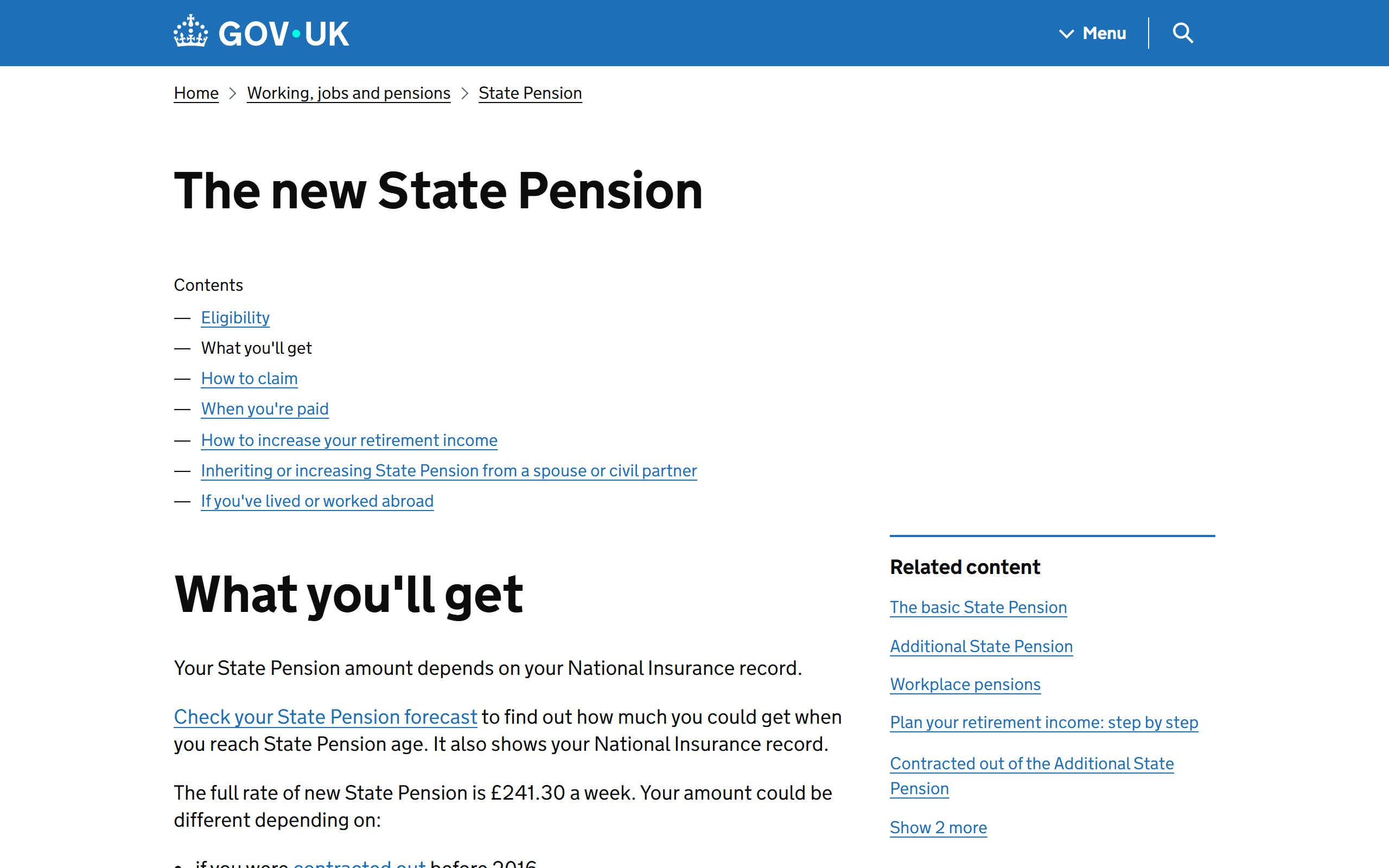
This is the point where ISA withdrawals become valuable. Every pound from an ISA is fully tax-free and does not count towards your taxable income. Mixing ISA and SIPP withdrawals lets you stay below the higher-rate threshold of £50,270 while drawing a comfortable income.
Phase Three: Inheritance Considerations
UK pensions sit outside your estate for inheritance tax until April 2027, after which the rules change. From that point onwards, unspent pensions will count towards your estate. The old "spend the ISA, leave the SIPP for your kids" logic is being inverted. Check the latest position before locking in a strategy that depends on the old rules.
Use the 25% Tax-Free Cash Strategically
The 25% tax-free lump sum is the most popular pension feature in the UK and the most often misused. Two common mistakes:
Mistake one: taking the full 25% on day one. Once removed from the pension wrapper, that money loses its tax-sheltered growth. Held in a bank account, it earns interest taxed at your marginal rate. Held in a GIA, it loses its capital gains protection. Only the ISA wrapper preserves tax-free status, and that is capped at £20,000 a year.
Mistake two: never taking it at all. Some retirees, having heard "leave it to grow", refuse to use the lump sum even when they have an obvious need. If you have a residual mortgage, expensive credit, or a large home repair, the tax-free cash is often the cheapest source of funding. The trade-off between using the lump sum to clear a mortgage versus leaving it invested is covered in the pension tax-free lump sum and mortgage guide.
The optimal pattern for most retirees is phased tax-free cash, sometimes called UFPLS (Uncrystallised Funds Pension Lump Sum). Each withdrawal from your pension comes 25% tax-free and 75% taxable. You take small chunks year by year, using the tax-free portion as part of your income mix rather than as a one-off windfall.
Phased tax-free cash has three advantages:
- The bulk of your pension stays invested and growing
- You preserve the option to use the tax-free cash for a future lump-sum need
- The annual tax-free portion combines with your ISA to keep your total taxable income low
Avoid the Money Purchase Annual Allowance Trap
The Money Purchase Annual Allowance (MPAA) is the silent destroyer of retirement-adjacent careers. The moment you take any taxable income from a defined contribution pension via flexi-access drawdown, your annual contribution allowance is permanently capped at £10,000 per year, down from £60,000.
If you plan to keep working part-time, consult, or run a side business after starting drawdown, this matters. A £40,000 salary sacrifice pension contribution becomes impossible the day after you take your first taxable drawdown payment.
There are three ways to dodge the trap:
- Take only the tax-free 25% lump sum first. The MPAA is triggered by taxable income, not by tax-free cash. You can crystallise some or all of your pot, take the 25% tax-free, and leave the taxable portion alone until you have stopped contributing.
- Use small pots withdrawal. You can withdraw up to three pension pots of £10,000 or less each as small pots without triggering the MPAA. This requires the pots to be technically separate.
- Use an annuity. Buying an annuity from your pension does not trigger the MPAA. This is rarely the right answer for other reasons but it is worth knowing.
The cleanest answer for someone planning a phased exit from work is to live off ISA savings or a part-time salary until contributions have stopped, then start pension drawdown. If you trigger the MPAA accidentally, there is no way to reverse it.
Build a Cash Buffer for Sequence Risk
Sequence-of-returns risk is the technical term for why the order of returns matters more than the average. A retiree who hits a 30% market drop in year two of retirement can run out of money even if the long-run average return matches expectations. The same retiree hitting the same drop in year twenty typically does not.
The defence is straightforward: hold one to three years of essential spending in cash or cash-equivalents at the start of retirement, so you never have to sell equities during a crash. When markets crash, you draw from cash. When they recover, you refill the cash buffer from the rebound.
A practical setup for a retiree spending £30,000 a year:
- £30,000 to £60,000 in a cash savings account or money market fund
- The rest invested in a balanced portfolio aligned with your withdrawal rate
- Top up the cash buffer in years your portfolio rises by more than 10%
You give up a little long-run return on the cash but you remove the worst-case scenario from the table. Most academic studies find this trade is worth it for retirees who actually need their pension to fund their lifestyle. For high-net-worth retirees with substantial buffers already, a smaller cash position is acceptable.
Frequently Asked Questions
What is the optimal pension drawdown strategy in the UK?
There is no single optimal strategy because the answer depends on your pot mix, your State Pension age, and whether you plan to keep contributing to a pension. For most UK retirees the best baseline is a 3 to 3.5% starting withdrawal rate, taxable SIPP income drawn up to the personal allowance before the State Pension starts, phased tax-free cash rather than a single lump sum, ISA withdrawals to top up income tax-free, and a one to three year cash buffer to ride out market drops.
Should I take my 25% tax-free pension lump sum now?
Usually no, not all at once. Taking it gradually (UFPLS or phased drawdown) keeps the bulk of your pot invested and tax-sheltered while still letting you use the tax-free portion as part of your annual income. The exception is if you have an immediate need such as paying off a mortgage at a high rate, where the tax-free cash is the cheapest source of funds.
How much can I withdraw from my pension before paying tax?
Once you have used your 25% tax-free cash for a given crystallisation, the remaining 75% is taxed as income. You can withdraw up to your personal allowance (£12,570 in 2025-26) tax-free if you have no other income. Combine this with ISA withdrawals and tax-free cash and a UK retiree can comfortably take £25,000 to £30,000 a year without paying any income tax.
What is the MPAA and how do I avoid triggering it?
The Money Purchase Annual Allowance caps your annual pension contributions at £10,000 once you start taking taxable income from a defined contribution pension. To avoid triggering it, take only the 25% tax-free lump sum first, use small pots withdrawals (up to three pots of £10,000 or less), or hold off on drawdown until you have finished contributing. Buying an annuity does not trigger the MPAA either.
How do I protect my pension from a market crash early in retirement?
Hold one to three years of essential spending in cash or money market funds at the start of retirement, and avoid selling equity holdings during downturns. Refill the cash buffer in years when your portfolio rises strongly. This guards against sequence-of-returns risk, which is the danger that bad early returns permanently shrink the base your portfolio compounds from.
Does the State Pension count towards my drawdown income?
It counts towards your taxable income but not towards your portfolio withdrawal rate. The State Pension acts as a guaranteed income floor, currently around £12,000 a year for the full new State Pension, which reduces the amount you need to draw from your invested pot. Once it starts at age 66 (rising to 67 by 2028), your effective withdrawal rate from the portfolio drops, which extends pot longevity. The mechanics of relying on the State Pension as a floor are covered in Sovereignty in the Silver Years.
Further Reading:
Die With Zero - Bill Perkins - Perkins makes the case for spending your portfolio down rather than overprotecting it. A useful counterweight when an optimised drawdown plan tells you your pot will outlive you. (Affiliate link - we may earn a small commission at no extra cost to you.)
Quit Like a Millionaire - Kristy Shen - Shen retired at 31 and explains her practical approach to safe withdrawal rates and pot sequencing, with useful comparisons to UK-style retirements. (Affiliate link - we may earn a small commission at no extra cost to you.)
Prefer to watch?
We turn these money breakdowns into short videos
A few a week, plain-English UK money. If you would sooner watch than read, follow along:
Enjoying the content?
If this site has been useful, a coffee goes a long way.
Browse more articles
Browse all