
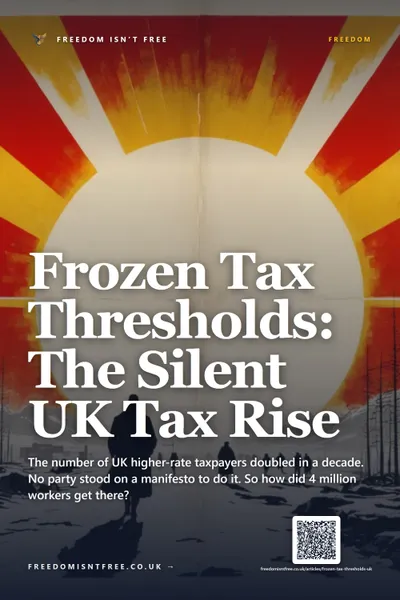

Frozen Tax Thresholds: The Silent UK Tax Rise
The number of UK higher-rate taxpayers doubled in a decade. No party stood on a manifesto to do it. So how did 4 million workers get there?
Cite this article
Freedom Isn't Free (2026) Frozen Tax Thresholds: The Silent UK Tax Rise. Available at: https://freedomisntfree.co.uk/articles/frozen-tax-thresholds-uk (Accessed: 23 August 2026).
Italicise the article title in your bibliography. Accessed date set to today.
TLDR
- Frozen tax thresholds are the most expensive tax change of the past decade. The Personal Allowance and the higher-rate threshold have been held flat since 2021/22 while wages and prices have climbed sharply.
- Fiscal drag pulls workers into higher tax bands without anyone explicitly voting to put them there. The Office for Budget Responsibility estimates the threshold freezes will raise tens of billions a year by 2028/29.
- The number of UK higher-rate taxpayers has roughly doubled in a decade, from around 4 million to over 8 million, largely without a public conversation about it.
- Whichever party is in power, frozen thresholds have become the default fiscal lever. They are a tax rise dressed as inaction, and they hit middle earners hardest.
Frozen UK tax thresholds vs CPI-uprated equivalents
| Threshold | Current (2026/27) | Frozen since | CPI-uprated |
|---|---|---|---|
| Personal Allowance | £12,570 | 2021/22 | ~£15,500 |
| Higher-rate threshold | £50,270 | 2021/22 | ~£62,000 |
| Dividend allowance | £500 | Cut from £5,000 | n/a (cut) |
| Capital gains allowance | £3,000 | Cut from £12,300 | n/a (cut) |
| IHT nil-rate band | £325,000 | 2009 | £500,000+ |
Source: gov.uk thresholds, ONS CPI series. The IHT band has been frozen for over 15 years.
Frozen Tax Thresholds: The Silent UK Tax Rise
Frozen tax thresholds have done more to raise the average British tax bill over the last five years than any new tax announced from the despatch box. The Personal Allowance, the higher-rate threshold, the additional-rate threshold, the dividend allowance, the capital gains allowance, the inheritance tax nil-rate band: the headline numbers have been held flat or cut while wages and prices have climbed sharply. The result is a country where millions of people now pay higher rates of tax than they did a few years ago, on essentially the same real income, and almost none of them voted for it.
This is the politics of fiscal drag. It is the most powerful tax tool in modern UK government, and it is invisible by design.
Contents
- What fiscal drag actually is
- The double squeeze on workers
- How frozen thresholds became Britain's favourite tax
- Who actually pays
- Why both parties love this lever
- When the triple lock meets the frozen Personal Allowance
- What you can do about frozen tax thresholds
- Frequently Asked Questions
What Fiscal Drag Actually Is
Fiscal drag is what happens when tax thresholds do not move with inflation or wage growth. In a normal year, the Personal Allowance, the higher-rate threshold and the additional-rate threshold would all rise gently to keep pace with rising prices and earnings. When they do, your tax bill stays roughly constant in real terms.
When the thresholds are frozen, they do not just stand still. They effectively shrink, because everything else around them keeps moving. A pound today is worth less than a pound was in 2021/22. A salary that has tracked inflation is bigger in cash terms than it was, even though it buys the same things. So if the threshold above which you start paying 40% income tax has not moved, but your salary has, you will cross it without feeling any richer.
The Institute for Fiscal Studies has been documenting this for years. Their analysis of frozen thresholds is a good place to see the size of the effect. The Office for Budget Responsibility's Economic and Fiscal Outlook projects that the current freezes will pull in tens of billions of pounds a year by 2028/29, several times the cost of any single recent tax cut.
This is the lever, in a sentence. Hold the numbers still, let inflation do the work, collect more tax without anyone having to argue for it.
Higher-rate tax threshold: nominal vs real value (2021-2028 freeze)
Nominal stays at £50,270. Real value falls as CPI eats it.
Source: ONS CPI, HMRC threshold history. Real-value series indexed to 2021 pounds using CPI.
The Double Squeeze on Workers
For working people, fiscal drag is an inflation amplifier as much as a tax issue.
The mechanics are simple. Prices rise. Your supermarket shop, your energy bill, your rent or mortgage are bigger this year than last. To keep your real spending power steady, you need a pay rise that beats inflation. So you ask for one, change jobs to get one, take on the extra hours that earn one - and finally drag your nominal income up by the amount the cost of living has gone up.
Now hit the second wall. The pay rise that put you back to where you were in real terms has just pushed you closer to (or over) a frozen tax threshold. The Personal Allowance, the higher-rate band, the additional-rate cliff, the Child Benefit clawback at £60,000, the Personal Allowance taper at £100,000 - none of those moved. Your nominal pay did. So your marginal tax rate quietly steps up, and the pay rise that was supposed to keep you whole gets taxed at a higher rate than the previous one was. The harder the inflation, the harder you have to chase, the more of the chase the freeze takes.
That is the worker's-eye view of fiscal drag. The pensioner's-eye view, where the State Pension itself is now closing on the Personal Allowance under the triple lock, is the same dynamic in a different demographic. Both ends of the income distribution are being walked into the same tax bands by inflation, while the bands themselves stand still.
UK marginal tax rate by income band, 2026/27
Frozen thresholds pull workers into the higher bands without anyone voting for it
Source: HMRC income tax rates 2026/27. NI primary threshold £12,570, upper earnings limit £50,270.
How Frozen Thresholds Became Britain's Favourite Tax
Threshold freezes are not new in the UK. They have been used in budgets for decades, usually in small doses. What changed in the early 2020s was the scale and the duration.
In the March 2021 Budget, Rishi Sunak announced that the Personal Allowance and the higher-rate threshold would be frozen until 2026. In November 2022, Jeremy Hunt extended the freezes by two more years and added a cut to the additional-rate threshold from £150,000 to £125,140. The Labour government that came in afterwards has not unfrozen them. As things stand the thresholds remain frozen until at least the end of the current parliament.
That is the longest sustained freeze of the major thresholds in modern British history. It coincided with a period of sharp wage growth and the highest inflation the UK had seen in forty years. The two things together made the freeze far more powerful than any chancellor would have admitted at the despatch box.
You can see the political appeal. Announcing a 1p rise in the basic rate of income tax would have led every news bulletin for a week. Freezing thresholds for several years raised more money in total and barely registered. The Resolution Foundation called it "the biggest stealth tax rise in modern British history". The number of voters who could name what was happening was tiny. The number who felt it was huge.
Who Actually Pays
Frozen thresholds do not hit everyone equally. They hit hardest where the thresholds bite, which is mostly the middle of the income distribution.
The Personal Allowance freeze drags more people into income tax at the bottom. That includes a lot of part-time workers, retirees with modest private pensions, and second earners. It is a small amount per person, but it widens the tax base substantially.
The higher-rate threshold freeze is where the big numbers are. The number of UK higher-rate taxpayers has roughly doubled over the last decade, from around 4 million to over 8 million. That is mostly fiscal drag - Britain has not produced 4 million genuine new high earners. Senior nurses, experienced teachers, mid-career engineers, NHS consultants, train drivers - the kind of jobs that historically did not put you anywhere near the higher-rate band - are now routinely there.
The additional-rate cut from £150,000 to £125,140 captured a smaller group of higher earners and pushed them into a band that, combined with the loss of the Personal Allowance over £100,000, creates the 60% tax trap. For families inside that band, marginal rates of 60-62% on every extra pound earned are not a theoretical edge case any more. They are normal.
Frozen capital gains and dividend allowances meanwhile have hit a different group: the small army of UK retail investors, BTL landlords selling properties, and family business shareholders. The dividend allowance has fallen from £5,000 in 2017/18 to £500 in 2024/25. The capital gains allowance has fallen from £12,300 to £3,000. These are not freezes, they are cuts, but they belong to the same family of changes - quiet, technical, hard to argue with at the despatch box, easy to deliver in spreadsheet form. The full picture, including the 60% trap and student loan surcharge, is in our stealth taxes UK breakdown.
Why Both Parties Love This Lever
The cleanest test of any fiscal policy is whether governments of opposing parties keep using it. Frozen thresholds pass that test cleanly.
For the centre-right, the freeze is a way to raise revenue without raising rates. Headline tax rates are politically sacred to the modern Conservative Party. Allowances and thresholds are not. So the rates can stay flat and the revenue can rise, and at the despatch box you can still claim to be the party of low tax.
For the centre-left, the freeze raises money without picking a fight. Active rate rises require votes, set-piece arguments and visible losers. A continued freeze just lets the existing policy keep doing its work. Manifestos can promise no rises in the headline rates of income tax, NI or VAT, while the threshold lever keeps pulling. Labour's 2024 manifesto did exactly that, and the freezes inherited from the previous government have been kept in place since.
The lever is also extremely tidy operationally. There is no need for new legislation. There is no need to argue about who deserves to be taxed and who does not. The mechanism is invisible. The political cost is spread across millions of people, each of whom only loses a little, and most of whom never connect the loss to a specific decision.
That is exactly the kind of thing modern democracies tend to keep using. As we wrote in why the UK won't tax wealth, the British tax system is built to keep working when the politics are unpleasant, more than to suit the politics of the moment. Frozen thresholds are one of the cleanest examples of how it does that.
The size of the silent tax rise is easiest to see when you put today's thresholds next to where they would sit if they had risen with inflation. You can run your own income through our take-home pay calculator to see exactly which bands the freeze has pulled you into this year.
| Threshold | Current (2026/27) | Frozen since | If uprated with CPI |
|---|---|---|---|
| Personal Allowance | £12,570 | 2021/22 | ~£15,500 |
| Higher-rate threshold | £50,270 | 2021/22 | ~£62,000 |
| Additional-rate threshold | £125,140 | 2023 (cut from £150,000) | ~£180,000+ |
| Dividend allowance | £500 | Cut from £5,000 (2017/18) | n/a (cut, not frozen) |
| Capital gains allowance | £3,000 | Cut from £12,300 (2022/23) | n/a (cut, not frozen) |
| IHT nil-rate band | £325,000 | 2009 | over £500,000 |
Sources: gov.uk Income Tax rates and Personal Allowances, Capital Gains Tax allowances, Inheritance Tax thresholds. CPI-uprated estimates calculated from the ONS CPI series.
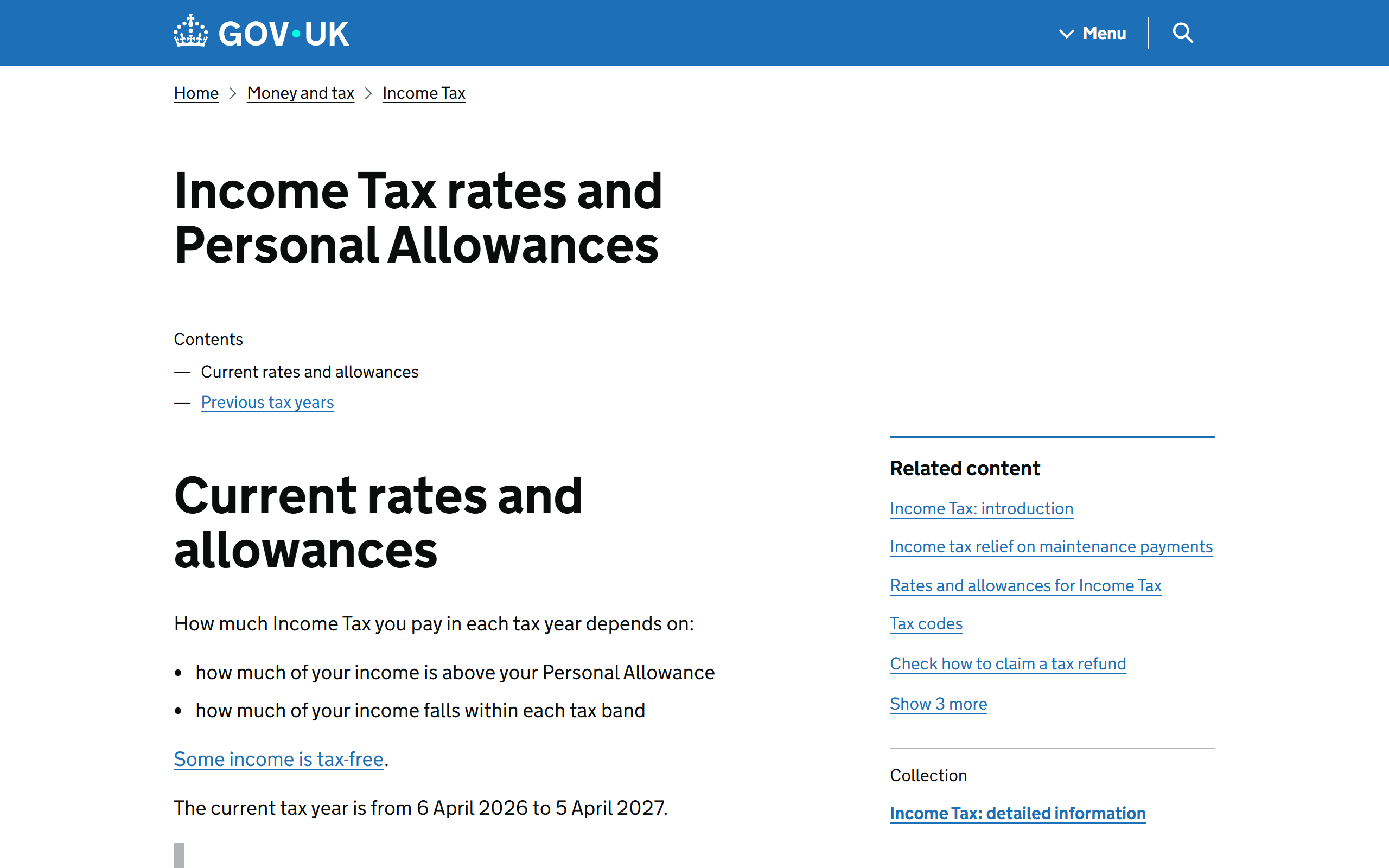
The IHT nil-rate band is the single most extreme example: held at £325,000 since 2009, it would now be well over £500,000 if it had risen with inflation, and the number of estates pulled into inheritance tax has more than doubled over the same period.
When the Triple Lock Meets the Frozen Personal Allowance
The most vivid live example of fiscal drag is what is now happening to the State Pension itself.
The full new State Pension is around £11,500 a year as of 2025/26 (£221.20 a week). The triple lock guarantees it rises annually by the highest of inflation, average earnings or 2.5%. The Personal Allowance, meanwhile, has been frozen at £12,570 since 2021/22.
If the State Pension keeps climbing at the 4-8% pace it has averaged over the last few years, it is on course to exceed the frozen Personal Allowance within the next two or three tax years. At that point, pensioners whose only income is the State Pension will, for the first time in decades, owe income tax on it. The state will be paying out a benefit and the state will be taxing it back.
This is the stealth tax in its purest form. One half of government raises the State Pension to keep up with inflation. The other half refuses to raise the Personal Allowance for the same reason. The collision is mathematical and unavoidable. No one has to stand at a despatch box and announce a tax rise on pensioners; the freeze does it on its own.
The Conservative government's "triple lock plus" pledge in the run-up to the 2024 election was an explicit attempt to head this off by tying the Personal Allowance for pensioners to the State Pension itself. The incoming Labour government dropped the policy, so the collision is back to a matter of when, not if. The first cohort of pure-State-Pension retirees being taxed on their own state benefit is now a near-term Budget problem rather than a long-run one.
What You Can Do About Frozen Tax Thresholds
You can't unfreeze them yourself. What you can do is make the system work harder for you in ways that the freezes do not capture.
Use pension contributions to claw back tax bands. Pension contributions reduce your "adjusted net income", which is the figure that determines whether you fall into the 60% trap, lose Child Benefit, or breach the higher-rate or additional-rate thresholds. For someone earning between £100,000 and £125,140, putting the excess into a pension is one of the most reliable ways to stop fiscal drag from costing you a fortune. The mechanics are explained in salary sacrifice pension UK.
Max your ISAs. Frozen dividend and capital gains allowances are far less painful inside an ISA, where dividends and gains are tax-free regardless of size. The 2026/27 ISA allowance is still £20,000 a year per adult.
Check your personal allowance band carefully. If your income is bouncing around £100,000, even a small change in pension contributions or a marriage allowance transfer can move you across the personal allowance taper and change your effective marginal rate dramatically.
Plan around inheritance early. With the IHT nil-rate band frozen and most allowances cut, more middle-class estates are caught every year. Lifetime gifts, the seven-year rule, pension nominations and trust planning are no longer just for the very wealthy.
Use pension carry-forward. If a bonus, share grant or unusually good year suddenly pushes you over the higher-rate or additional-rate threshold, the three-year carry-forward rule lets you sweep unused annual allowance from the previous three tax years into a single bumper pension contribution. It is the most underused tool for high earners caught by fiscal drag.
The frozen thresholds will keep doing what they do whether you act or not. Whether they cost you the maximum amount, or something less, depends almost entirely on what you do at the edges.
Frequently Asked Questions
What is fiscal drag?
Fiscal drag is what happens when tax thresholds (the Personal Allowance, higher-rate threshold, dividend and CGT allowances, IHT nil-rate band) are held at the same cash value rather than rising with inflation. As nominal incomes rise, more people get pulled across each threshold and pay a larger share of their income in tax, even when their real spending power has not changed.
How long are UK tax thresholds frozen for?
The current freezes on the Personal Allowance, the higher-rate threshold and the additional-rate threshold are scheduled to remain in place to the end of the current parliament. They have already been extended once and could be extended further at any future Budget.
Are frozen tax thresholds technically a tax rise?
Politically they are usually presented as not being a tax rise because the headline rates have not changed. Economically they are a tax rise. They raise more revenue from the same set of taxpayers in real terms, and the OBR scores them accordingly when modelling future tax receipts.
Will the State Pension be taxed because of frozen thresholds?
It is on course to be. If the State Pension continues to rise at recent rates under the triple lock, it will exceed the frozen £12,570 Personal Allowance within two to three tax years. The "triple lock plus" pledge that would have prevented this was scrapped after the 2024 election.
Read Next
- Stealth Taxes UK: How the System Kills Your Compounding - the wider family of stealth taxes including the 60% trap, the Child Benefit clawback, and the student loan surcharge.
- The 60% Tax Trap UK - why earnings between £100,000 and £125,140 are taxed at an effective marginal rate of 60%, and how to escape it.
- New Tax Year UK Investor Checklist - the annual moves that pull more of your money out of fiscal drag's reach.
Further Reading:
I Will Teach You To Be Rich - Ramit Sethi - Sethi's "Big Wins" framework is the right answer to fiscal drag. The big levers (salary, pension contributions, ISA allocation, fee discipline) dominate the small ones (mars bars and lattes), and frozen thresholds make that even more true. (Affiliate link - we may earn a small commission at no extra cost to you.)
Prefer to watch?
We turn these money breakdowns into short videos
A few a week, plain-English UK money. If you would sooner watch than read, follow along:
Enjoying the content?
If this site has been useful, a coffee goes a long way.
Browse more articles
Browse all