






Pension Carry-Forward & Tapered Annual Allowance UK
Your £60,000 pension allowance can collapse to £10,000 by accident. One careless drawdown move triggers it. Most high earners never spot the trap until the relief is already gone.
Cite this article
Freedom Isn't Free (2026) Pension Carry-Forward & Tapered Annual Allowance UK. Available at: https://freedomisntfree.co.uk/articles/pension-carry-forward-tapered-allowance-uk (Accessed: 10 October 2026).
Italicise the article title in your bibliography. Accessed date set to today.
TLDR
- The standard annual allowance is £60,000 of pension contributions per tax year (employer + personal combined)
- You can carry forward unused allowance from the previous three tax years - useful for irregular earners and bonus-driven contributions
- Earners with adjusted income above £260,000 face a tapered annual allowance, dropping by £1 for every £2 above the threshold, to a floor of £10,000
- Carry-forward and tapering interact - high earners need to model the rules carefully before making large contributions
Pension Carry-Forward & Tapered Annual Allowance UK
For most UK pension savers, the £60,000 annual allowance is generous enough to never become a constraint. For high earners and people making one-off large contributions, two extra rules matter: pension carry-forward lets you roll up to three years of unused allowance, and the tapered annual allowance restricts how much high earners can put in each year.
This guide covers both rules in 2026/27, how they interact, and how to model your true contribution cap before writing a five-figure cheque to your SIPP.
Contents
- The standard annual allowance
- How carry-forward works
- The tapered annual allowance
- The Money Purchase Annual Allowance trap
- Worked examples
- Common mistakes to avoid
- Frequently asked questions
The Standard Annual Allowance
The annual allowance is the cap on total pension contributions per tax year that qualify for tax relief. Anything above the cap triggers an annual allowance charge at your marginal income tax rate, which usually wipes out the tax relief on the excess.
For 2026/27 the standard annual allowance is £60,000, frozen at this level since April 2023 (raised from £40,000). Contributions counted against the allowance include:
- Personal contributions to a SIPP or stakeholder pension (gross of any tax relief)
- Workplace pension contributions made by you and your employer combined
- Salary sacrifice into a pension (counts as employer contribution)
The contribution cap is also limited by your relevant earnings - you cannot contribute more than 100% of your earnings into a pension and still get tax relief, regardless of allowance available. For a £40,000 earner the practical cap is £40,000, even though the allowance theoretically permits £60,000.
How Carry-Forward Works
If you have not used your full annual allowance in past tax years, you can roll it forward to the current tax year and contribute more than the £60,000 cap. The rules:
- You must be a member of a UK pension scheme (any qualifying scheme) in the tax year you are carrying forward from. You do not need to have actually contributed - just been a member.
- Carry-forward goes back three tax years. So in 2026/27 you can use unused allowance from 2023/24, 2024/25, and 2025/26.
- You must use the current year's allowance first, then the oldest of the carried-forward years.
- Total contributions in the current year are still capped at 100% of your relevant earnings for that tax year.
Maximum theoretical contribution in 2026/27 with full carry-forward and £60k annual allowance for each prior year:
- 2026/27: £60,000
- 2025/26: £60,000 (if unused)
- 2024/25: £60,000 (if unused)
- 2023/24: £60,000 (if unused)
- Total: £240,000
This is gated by your earnings in 2026/27. If you earned £180,000 in 2026/27, your maximum contribution that year is £180,000 (regardless of carried-forward room), and the £60,000 from earlier years that exceeds your earnings is wasted.
Carry-forward is mostly relevant for:
- One-off large contributions (e.g. selling a business, receiving an inheritance)
- Self-employed earners with lumpy income
- High earners receiving a large bonus they want to redirect
- Late-career savers playing catch-up
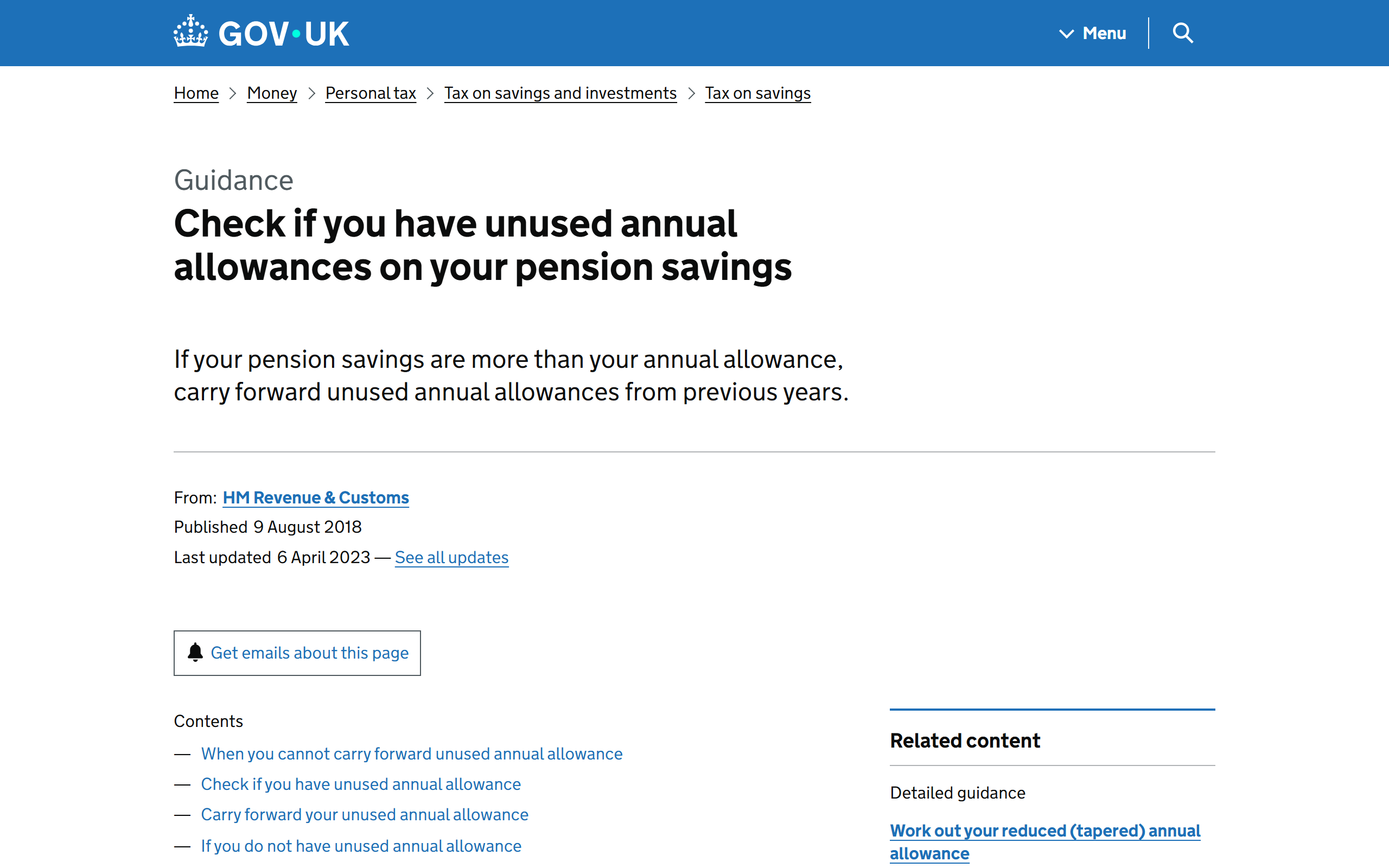
HMRC's official guidance on checking unused annual allowances walks through the year-by-year calculation.
The Tapered Annual Allowance
For high earners, the £60,000 annual allowance is reduced via a taper, set out in HMRC's guidance on the tapered annual allowance. From 2023/24:
- Tapering starts above adjusted income of £260,000
- Allowance reduces by £1 for every £2 above £260,000
- Minimum (fully tapered) allowance is £10,000 at adjusted income of £360,000+
Adjusted income for this purpose is your total taxable income plus any pension contributions made by your employer (but not your own salary sacrifice). So a worker earning £200,000 with £30,000 of employer pension contributions has adjusted income of £230,000, comfortably below the taper threshold.
Tapering is also subject to a threshold income test - if your "threshold income" (broadly your taxable income excluding pension contributions) is below £200,000, the taper does not apply regardless of adjusted income. This second test exists to prevent salary-sacrifice arrangements being penalised for high earners with modest take-home pay but very high gross compensation.
| Adjusted income | Annual allowance for that year |
|---|---|
| Up to £260,000 | £60,000 (no taper) |
| £280,000 | £50,000 |
| £300,000 | £40,000 |
| £320,000 | £30,000 |
| £340,000 | £20,000 |
| £360,000 + | £10,000 |
If your tapered allowance is £10,000 and your employer is contributing £30,000 to your pension, you face an annual allowance charge on £20,000 of "excess" contributions, generally at your marginal income tax rate. The charge can be paid out of the pension itself via the "Scheme Pays" arrangement.
The Money Purchase Annual Allowance Trap
If you have already started flexibly drawing income from a defined contribution pension (taking taxable income above the 25% tax-free cash), your annual allowance for further contributions drops to £10,000 - the Money Purchase Annual Allowance (MPAA).
This applies even if your earnings are well below the tapered threshold. The MPAA exists to stop people drawing pension income, redirecting it back into the pension, and double-counting the tax relief.
Practical implications:
- The MPAA is a one-way door. Once triggered, you cannot go back to the £60,000 allowance.
- It does not apply if you have only taken the 25% tax-free cash and not any taxable income
- Carry-forward is also lost from the moment the MPAA kicks in
- Salary sacrifice still counts towards the £10,000 MPAA cap
For anyone considering pension drawdown before fully retiring, the MPAA is the single biggest pitfall to model carefully.
Worked Examples
High earner with carry-forward room
Sarah earns £150,000 in 2026/27. Her workplace pension contributions are £15,000/year. She received a £200,000 bonus in 2026/27 and wants to put it all into a pension.
- Adjusted income: well below £260,000, no tapering
- Standard annual allowance: £60,000 in 2026/27
- Workplace contributions used in past 3 years: roughly £15,000/year
- Carry-forward room: 3 × (£60,000 - £15,000) = £135,000
- Total room in 2026/27: £60,000 + £135,000 = £195,000
- Sarah can contribute up to £195,000, capped only by her relevant earnings (£350,000 with the bonus, so no constraint)
High earner caught by the taper
Mark earns £350,000 in 2026/27. His employer pension contribution is £40,000.
- Adjusted income: £350,000 + £40,000 = £390,000
- Above the £360,000 fully-tapered threshold
- Annual allowance: £10,000 (fully tapered)
- Employer contribution alone (£40,000) blows through the allowance by £30,000
- Annual allowance charge applies on £30,000 at his 45% marginal rate = £13,500
Mark needs to either reduce employer contributions or accept the charge. Carry-forward may help if he has unused room from the previous three years.
MPAA trigger
Janet is 58, took flexi-access drawdown of £20,000 of taxable income from her SIPP last year. She now wants to put a £25,000 windfall into her pension.
- MPAA triggered: annual allowance is £10,000
- £25,000 contribution would create £15,000 of excess
- Annual allowance charge on £15,000 at her 40% rate = £6,000
- Better to put the £15,000 elsewhere (ISA, GIA)
Common Mistakes to Avoid
- Forgetting workplace contributions in the calculation. Both employer and employee contributions count.
- Triggering MPAA without realising. Many people take income from a small pension years before retirement and lock themselves into the £10,000 cap permanently.
- Using carry-forward without being a scheme member. Membership is required for the carry-forward to be available, even if no contributions were made.
- Mixing up adjusted income and threshold income. The taper requires both tests; getting one wrong can lead to mistaken contributions or unnecessary cautious contributions.
- Ignoring the relevant earnings cap. You cannot contribute more than 100% of your earnings in a tax year and claim relief.
For a worked-through model with all three rules, run your specific numbers through HMRC's pension annual allowance calculator at gov.uk before making large contributions.
Frequently Asked Questions
Can I carry forward unused pension allowance?
Yes - up to three previous tax years if you were a member of a UK pension scheme during those years. You must use the current year's allowance first, then the oldest carried-forward year. Total contributions are also capped at 100% of your relevant earnings for the current year.
What is the tapered annual allowance?
A reduction in the £60,000 annual allowance for very high earners. Above £260,000 of adjusted income, the allowance drops by £1 for every £2 of additional income, to a floor of £10,000 at £360,000+ of adjusted income. The taper is also subject to a £200,000 threshold income test.
Does the annual allowance include employer contributions?
Yes. Both employer and personal contributions (and any salary sacrifice arrangements) count towards the same allowance. A worker with £30,000 of employer contributions has £30,000 of remaining allowance for personal contributions, before any carry-forward.
What happens if I exceed the annual allowance?
You face an annual allowance charge at your marginal income tax rate on the excess. The charge can be paid from your pension via "Scheme Pays" if it exceeds £2,000 in a single scheme, or directly via Self Assessment. There is no upper limit on the charge.
What is the Money Purchase Annual Allowance?
A reduced annual allowance of £10,000 that applies once you have flexibly drawn taxable income from a defined contribution pension. It is permanent - once triggered, you cannot return to the £60,000 standard allowance. Carry-forward is also lost from that point.
Prefer to watch?
We turn these money breakdowns into short videos
A few a week, plain-English UK money. If you would sooner watch than read, follow along:
Enjoying the content?
If this site has been useful, a coffee goes a long way.
Browse more articles
Browse all