



Self Assessment Tax Return 2026/27: The Honest Guide
Self assessment isn't hard. It's a half-day job HMRC has accidentally rebranded as a month-long ordeal. Most people don't even need to file. The four who do should read this first.
Cite this article
Freedom Isn't Free (2026) Self Assessment Tax Return 2026/27: The Honest Guide. Available at: https://freedomisntfree.co.uk/articles/self-assessment-tax-return-uk (Accessed: 10 October 2026).
Italicise the article title in your bibliography. Accessed date set to today.
TLDR
- For most filers, Self Assessment is a half-day job, not a month-long ordeal. The "it is hard" narrative is HMRC accidental marketing.
- You only need to file if you cross specific triggers: side income over £1,000, rental income over £1,000, dividends or interest beyond the allowances, CGT above £3,000, or total income over £150,000.
- Four mistakes cause most HMRC enquiries: round-number estimates, missing untaxed bank interest, forgetting dividends or crypto, and claiming personal expenses as business costs.
- Pay an accountant once income passes £100,000, or when you combine self-employment with rental income and dividends. Below that, doing it yourself is the rational call.
Self Assessment deadlines for the 2025/26 tax year
| Date | What | Penalty for missing | Who it applies to |
|---|---|---|---|
| 5 Oct 2026 | Register for Self Assessment | Failure-to-notify penalty (up to 30% of tax due) | First-time filers only |
| 31 Oct 2026 | Paper return deadline | £100 fixed, then daily charges | Paper filers only |
| 30 Dec 2026 | Online filing if you want PAYE coding | No penalty, but you lose the option to collect via tax code | PAYE earners with under £3,000 of tax due |
| 31 Jan 2027 | Online return + tax payment | £100 fixed, then daily charges, then 5% of tax due | Everyone filing online |
Source: HMRC, May 2026. Penalties stack: a return filed a year late can cost £1,600 even if you owe nothing.
Self Assessment Tax Return 2026/27: The Honest Guide
If you have been putting off your Self Assessment tax return because you think it is hard, you have fallen for HMRC's accidental marketing. For roughly 80% of filers it is a half-day job, not a month-long ordeal. The complexity comes from a small number of edge cases that HMRC's own guidance treats as routine, and from the fact that the system is built to assume you already know what you are doing. Neither is the same thing as the return itself being difficult.
This guide covers the bit nobody else will say plainly: most people do not need to file at all, the four mistakes that actually trigger an HMRC enquiry, the deadline that costs you nothing but everyone misses, and the income level at which paying for an accountant stops being a luxury and starts paying for itself.
This is general information about the UK tax system, not personal tax advice. If your situation is genuinely complex - rental portfolio, foreign income, six-figure earnings, business losses - speak to a qualified accountant before filing.
A note on the dates. The return you are filing right now covers the 2025/26 tax year (6 April 2025 to 5 April 2026), due online by 31 January 2027. The 2026/27 tax year (6 April 2026 to 5 April 2027) is the live tax year you are operating under: the allowances and thresholds quoted below are the 2026/27 figures unless flagged otherwise, because those are the numbers that will govern next year's return and your day-to-day planning. Where a figure is specific to the 2025/26 return you are about to file, it is called out explicitly.
Contents
- Do you actually need to file?
- The deadlines that matter
- What you need before you start
- Online vs paper in 2026
- Deductions most people miss
- The four mistakes that trigger an HMRC enquiry
- Payment on account explained
- When to pay an accountant
- Frequently asked questions
Do You Actually Need to File?
Most UK adults do not need to file a Self Assessment tax return. PAYE handles the entire thing for the standard employed worker with no side income, no rental property, and no large investment account. HMRC's own check tool backs this up.
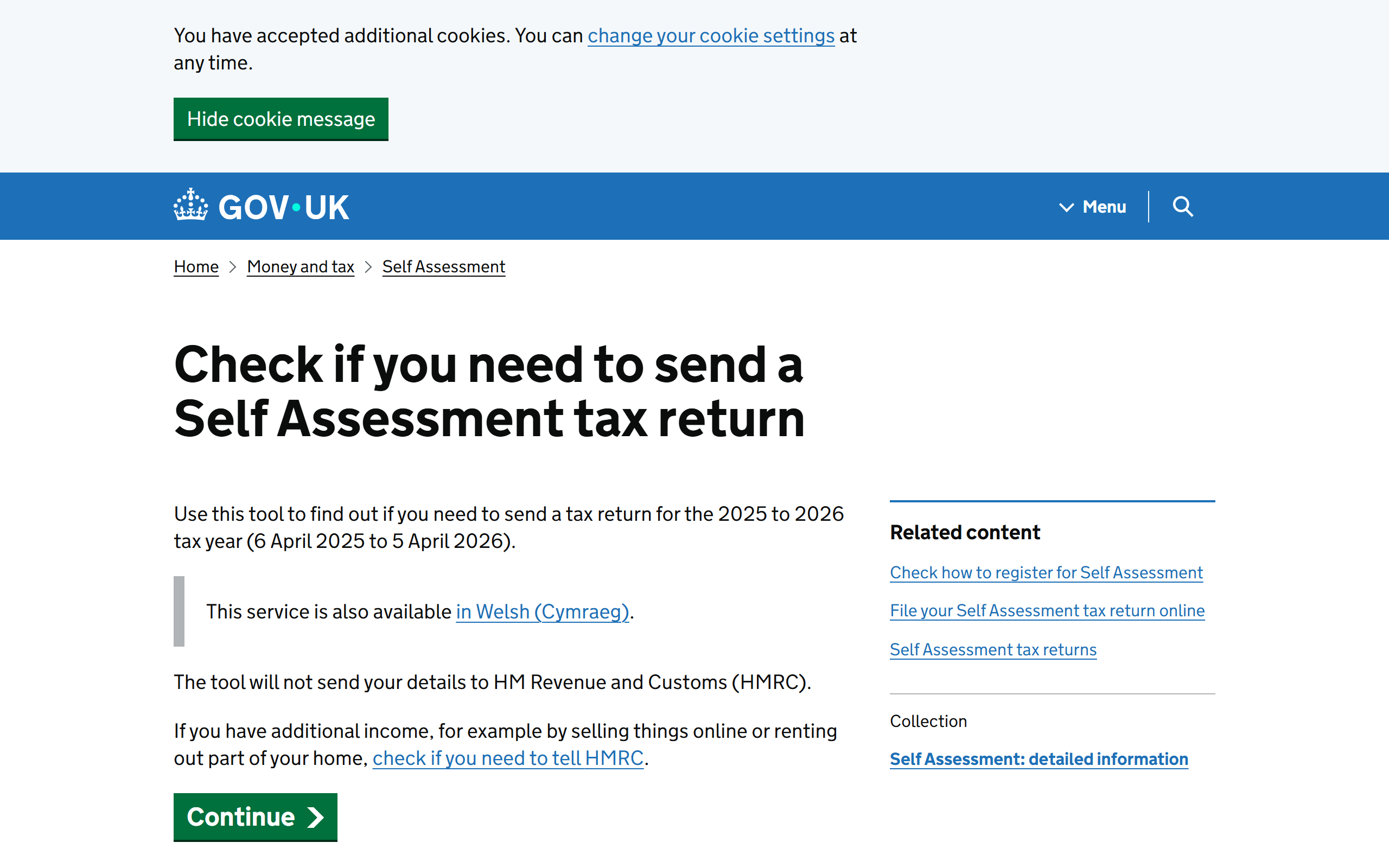
You need to file for the 2025/26 tax year (return due 31 January 2027) if any of the following are true:
- Self-employment or side hustle gross income over £1,000. The £1,000 trading allowance covers casual sellers below the threshold with no registration. Above it, you must file.
- Rental income over £1,000. Same logic, separate £1,000 property allowance.
- Untaxed savings interest above the Personal Savings Allowance. £1,000 for basic-rate taxpayers, £500 for higher-rate, £0 for additional-rate. Banks now report your interest directly to HMRC, and amounts above the allowance must go on a return.
- Dividends above £500. The 2026/27 dividend allowance is £500. Above that, dividends are taxable.
- Capital gains above £3,000. Sold shares in a GIA, second property, or crypto with more than £3,000 of gains in the year? File. Read the Capital Gains Tax UK guide for the rates.
- Total income above £150,000. Filing was previously triggered at £100,000; HMRC raised the threshold to £150,000 from 2023/24. Below £150,000, PAYE-only earners may drop out of Self Assessment.
- High Income Child Benefit Charge applies. If you or your partner earn over £60,000 and the household claims Child Benefit, you owe a clawback. See the High Income Child Benefit Charge guide.
- Foreign income, partnership income, trust income, or you were a company director with untaxed income.
If none of these apply, you do not need to file. If you filed last year but no longer meet any trigger, you still need to tell HMRC to take you out of Self Assessment, otherwise the system will keep expecting a return and penalising you for not sending one.
The Deadlines That Matter
There are four. Three of them are forgiving. One of them is not.
- 5 October following the tax year of first earnings - register for Self Assessment if you have never filed before. Missing this triggers a "failure to notify" penalty of up to 30% of the tax eventually due.
- 31 October - paper return deadline. Almost no one needs this. More on why below.
- 30 December - file online by this date and HMRC can collect a tax bill of less than £3,000 through next year's PAYE tax code instead of demanding a single payment. This is the deadline almost everyone misses and it is the cheapest one to hit.
- 31 January - the famous one. Online return must be in, and the tax due must be paid, by 23:59 on this date. A return filed at 00:01 on 1 February costs you £100, even if you owe nothing.
For the 2025/26 tax year (6 April 2025 to 5 April 2026), the relevant deadlines fall on 5 October 2026, 31 October 2026, 30 December 2026, and 31 January 2027. Anyone reading this in May 2026 has time on all four.
The penalty regime for missing the 31 January online deadline:
- £100 immediately, even if you owe no tax
- £10 per day from 1 May, capped at 90 days (£900 maximum)
- 5% of tax due or £300 (whichever is greater) at 6 months late
- The same 5% / £300 again at 12 months late
- Interest accrues on unpaid tax at HMRC's published rate (7.75% from 9 January 2026)
A return filed a full year late with £2,000 of tax owed costs roughly £1,600 in penalties on top of the tax and interest. That is the genuine downside. Everything else is paperwork.
What You Need Before You Start
Gather these in one sitting and the actual filing is the easy bit:
- Unique Taxpayer Reference (UTR). Ten-digit number, posted to you after you registered. Lost it: log in to your Government Gateway account and it is there.
- National Insurance number. On your payslip or P60.
- Government Gateway login. Set up at gov.uk/log-in-register-hmrc-online-services. Two-factor codes go to your phone.
- P60 from your employer. Issued by 31 May 2026 for the 2025/26 tax year. Confirms gross pay, tax paid, NI paid.
- P45 if you changed jobs during the year.
- P11D for any benefits in kind (company car, private medical, gym membership).
- Bank interest statements showing untaxed interest received. Most banks now provide a "tax certificate" specifically for this.
- Dividend vouchers from any UK shareholding, plus a record of dividends from your investment platform if you hold a GIA. Read the Dividend Tax UK guide for what to report.
- Self-employment records: invoices, business bank statements, expense receipts, mileage log.
- Rental income records: rent received per property, allowable expenses (letting agent fees, maintenance, insurance, mortgage interest for 20% relief).
- Crypto exchange CSVs if you sold, swapped, or earned any crypto. The Cryptocurrency Tax UK guide covers the disposal rules.
- Pension contribution evidence if you paid into a SIPP outside of salary sacrifice and need to claim higher-rate or additional-rate relief.
- Gift Aid donation totals if you are a higher-rate taxpayer.
With all of the above on a single spreadsheet, the actual form is a guided walkthrough that takes most filers between two and four hours.
Online vs Paper in 2026
Paper filing is a trap. The 31 October paper deadline is three months earlier than the online deadline for no benefit you will ever notice. HMRC encourages online filing because it cuts their costs, but it also genuinely makes the return easier:
- The online form hides sections that do not apply to you. Paper makes you read through them.
- Calculations are done automatically. Paper requires you to do them yourself, on a worksheet, with a calculator.
- You can save progress and come back. Paper requires you to do it in one sitting.
- Online provides an immediate confirmation. Paper relies on Royal Mail not losing it.
The only people who genuinely need to file on paper are those without internet access, those whose return type is not supported online (rare partnerships, certain trustees), and ministers of religion. Everyone else: file online.
Deductions Most People Miss
These are the items first-time filers commonly overlook. Eligibility depends on your circumstances; what follows is general information, not personal tax advice. If a deduction is material to your bill, get a qualified accountant to confirm it applies to you before claiming.
- Higher-rate and additional-rate pension relief. If you pay into a SIPP personally and you are a higher-rate taxpayer, basic-rate relief is added at source. The additional 20% (higher rate) or 25% (additional rate) is claimed through the return. A £4,000 net contribution becomes £5,000 gross, with up to £1,000 of further relief available at 40%. This is one of the biggest under-claimed reliefs in the UK system.
- Working from home. Self-employed only since 2022 for most workers. £6 per week flat rate, or actual proportional costs (heating, electricity, broadband) based on rooms used and hours worked.
- Professional subscriptions to bodies on HMRC's approved list. CIPD, BCS, GMC, BMA, ACCA all qualify if they are required for your current role.
- Business mileage at 45p per mile for the first 10,000 miles in the tax year and 25p thereafter (rising to 55p / 25p from 6 April 2026 onwards), where you use your own car for work and your employer reimburses less than that. See HMRC's approved mileage rates.
- Training relevant to your current trade. Generally not allowable where the course qualifies you for a new field. A web developer doing a React course is typically deductible; the same developer doing a plumbing course typically is not.
- Equipment under £1,000 via the Annual Investment Allowance for self-employed workers.
- Gift Aid donations at the higher-rate differential. A £100 donation costs the donor £80 net of basic-rate relief. A higher-rate taxpayer can reclaim a further £20 through the return.
Complex deductions are where mistakes happen. For anything material - significant rental losses, capital allowances on a furnished holiday let, or anything six-figure - get an accountant to sign it off rather than guess from a blog.
The Four Mistakes That Trigger an HMRC Enquiry
HMRC opens around 300,000 enquiries a year out of roughly 12 million returns. Most are triggered by the same four patterns. Avoid these and the realistic chance of an enquiry drops sharply.
1. Round-number estimates. HMRC's risk-scoring software flags returns where every figure ends in 00 or 000. £5,000 of "office expenses" against £40,000 of self-employed income looks made up because it usually is. Use the real numbers from your receipts, even if the totals are £4,827.43 and £39,261.18.
2. Missing untaxed bank interest. This is the most common cause of a "we've recalculated your tax" letter. Since 2016 banks have reported interest paid directly to HMRC. The Personal Savings Allowance gives basic-rate taxpayers £1,000 of untaxed interest per year, but in a 5% rate environment a single £30,000 cash account is over the threshold. HMRC already knows what your accounts paid out. If your return omits it, the system flags the discrepancy automatically.
3. Forgetting dividends, crypto, or platform side income. Investment platforms now report dividends to HMRC. Major crypto exchanges will report user data under the Crypto-Asset Reporting Framework from 2026. Side-hustle platforms (eBay, Vinted, Etsy, Airbnb, Uber) have been reporting since January 2024. Omitting any of these from a return that HMRC already has data on is the fastest way to a nudge letter.
4. Claiming personal expenses as business costs. The weekly Tesco shop is not "client entertainment." A new iPhone used 80% for personal use is not 100% deductible. HMRC enquiries that uncover personal expenses dressed up as business costs treat them as deliberate, not careless, which moves the penalty band from 0-30% of tax due to 30-70%.
The pattern across all four: HMRC has the data on the other side of the return before you file it. Self Assessment is increasingly a cross-check, not a disclosure.
Payment on Account Explained
This is the part of Self Assessment that catches every first-time filer off guard.
If your tax bill is over £1,000 and less than 80% of it was already collected through PAYE, you owe two "payments on account" towards next year's tax bill, each equal to half of this year's bill. The first is due 31 January (alongside your actual tax bill), the second on 31 July.
A worked example. You file your 2025/26 return showing £4,000 of tax owed beyond PAYE. On 31 January 2027 you owe:
- £4,000 balancing payment for 2025/26
- £2,000 first payment on account for 2026/27
- Total: £6,000
Then on 31 July 2027 you owe a further £2,000 second payment on account for 2026/27. By the time you file your 2026/27 return in January 2028, you have already paid £4,000 of next year's bill. The balancing payment on that return tops it up or refunds the difference.
Payment on account is not paying tax twice. It is the Treasury borrowing from you in exchange for spreading next year's bill across the year, interest-free in both directions. The shock the first time it appears - because nobody warned you - is roughly the value of your tax bill arriving twice in one go.
If you genuinely expect next year's income to drop sharply, you can apply to reduce your payments on account through your HMRC account. Underestimate it and HMRC charges interest on the shortfall.
When to Pay an Accountant
Most people can file their own Self Assessment. The system is built for it. The cases where paying £200-£600 for an accountant earns its keep:
- Income above £100,000. You are now navigating the 60% tax trap, the personal allowance taper, the £60,000 pension annual allowance taper, and potentially the High Income Child Benefit Charge. The savings from getting these right routinely cover the fee several times over.
- Combined self-employment, rental income, and significant dividends. Three different schedules on the return, three different sets of expense rules, and several optimisation choices that interact (which expenses go where, how to allocate household costs).
- First year of a serious self-employed venture where the rules around capital allowances, opening-year basis periods, and trading losses can save real money but require knowing they exist.
- Anything involving a limited company you control. Corporation tax, dividends from your own company, salary vs dividend split - the optimisation here pays for the accountant every year.
- You earn over £125,140 and have not modelled whether bringing yourself back below the additional-rate threshold via pension contributions is worth it. Read the New UK Tax Year Allowance Checklist for the moves to model first.
Below that threshold, with a single income source and clean records, a £400 accountant fee for a 90-minute job is solving a problem you do not have. The Take-Home Pay Calculator at /tools/take-home-pay-calculator will show you the marginal rate you are paying and the bands you are sitting in, which is enough to make the decision.
Frequently Asked Questions
When should I submit Self Assessment for 2025/26?
The 2025/26 tax year covers 6 April 2025 to 5 April 2026. Online returns and tax payment are due by 23:59 on 31 January 2027. Paper returns are due by 31 October 2026. First-time filers must register by 5 October 2026. File earlier than 30 December 2026 if you want HMRC to collect a sub-£3,000 bill through next year's PAYE tax code.
How long does it take to get a tax refund from HMRC Self Assessment?
Most online refunds clear within 5 to 10 working days of the return being filed and processed. Bank transfer is the fastest payment method. Cheques take longer. Refunds can be delayed if the return contains anything unusual that HMRC wants to check, or if you are flagged for security verification. Returns filed in the first week of April after the tax year ends tend to be processed fastest because HMRC's systems are quieter.
Who needs to do an HMRC Self-Assessment tax return?
You need to file if you have self-employment or side income over £1,000, rental income over £1,000, untaxed savings interest above your Personal Savings Allowance, dividends over £500, capital gains over £3,000, total income over £150,000, foreign or partnership income, or if the High Income Child Benefit Charge applies. Standard PAYE employees with none of these triggers do not need to file.
What are the common Self Assessment mistakes that trigger an HMRC enquiry?
Round-number estimates, omitting untaxed bank interest (banks report it directly to HMRC), forgetting dividends or crypto disposals on platforms that report to HMRC, and claiming personal expenses as business costs. HMRC has data on the other side of most return entries before you file, so omissions and inflations are picked up by automated cross-checks.
Is Self Assessment changing in 2026?
The major change on the horizon is Making Tax Digital for Income Tax Self Assessment (MTD ITSA). From April 2026 it applies to self-employed workers and landlords with combined gross income over £50,000. The threshold drops to £30,000 from April 2027, and £20,000 from April 2028. Affected filers will need to keep digital records and submit quarterly updates through compatible software, replacing the single annual return. PAYE-only filers and those below the income threshold are not affected.
Can I claim tax relief on a SIPP through Self Assessment?
Yes. Basic-rate relief is added at source by your SIPP provider. If you are a higher-rate or additional-rate taxpayer, claim the difference (20% or 25% of the gross contribution) through the "Tax reliefs" section of your return. A £4,000 net contribution becomes £5,000 gross; a higher-rate taxpayer can reclaim £1,000 of further relief.
What happens if I file my Self Assessment late?
£100 fixed penalty as soon as 31 January passes, even if you owe no tax. After 3 months, £10 per day for up to 90 days (£900 maximum). At 6 months late, 5% of the tax due or £300, whichever is greater, on top. The same 5% / £300 again at 12 months late. Interest accrues on unpaid tax at HMRC's published rate (7.75% from 9 January 2026). A return filed a year late with £2,000 of tax owed costs roughly £1,600 in penalties.
Read Next
- New UK Tax Year: Your 2026/27 Allowance Checklist - the pillar guide to every allowance and threshold you should reset in April.
- Frozen Tax Thresholds: The Silent UK Tax Rise - why your Self Assessment bill keeps growing even when your real income does not.
- Side Hustle Tax UK - the £1,000 trading allowance, when it stops working, and what HMRC sees about your eBay or Vinted income.
This article is general information about the UK tax system, not personal tax advice. Tax rules and allowances change, and how they apply depends on your circumstances. For anything material - significant self-employment, rental losses, foreign income, or six-figure earnings - speak to a qualified accountant or tax adviser. Investment-related figures cited may move with markets and policy; capital at risk where investments are involved.
Prefer to watch?
We turn these money breakdowns into short videos
A few a week, plain-English UK money. If you would sooner watch than read, follow along:
Enjoying the content?
If this site has been useful, a coffee goes a long way.
Browse more articles
Browse all