


Teachers' Pension UK 2026: What You Actually Get
Your Teachers' Pension carries a 28.68% employer top-up, McCloud protection, and CPI indexation in payment. It is worth £200k+ in annuity terms. Most teachers underrate it.
Cite this article
Freedom Isn't Free (2026) Teachers' Pension UK 2026: What You Actually Get. Available at: https://freedomisntfree.co.uk/articles/teachers-pension-uk (Accessed: 10 October 2026).
Italicise the article title in your bibliography. Accessed date set to today.
TLDR
- The Teachers Pension Scheme pays roughly 1/57th of every years salary back as guaranteed indexed retirement income, with a 28.68% employer top-up that no private pension can match
- Almost every active teacher is now in the 2015 Career Average scheme, with legacy Final Salary benefits protected for service before April 2022 under the McCloud remedy
- Member contributions for 2026/27 sit at six tiered bands from 7.4% to 11.7%, set by salary and indexed to CPI
- Opting out to invest the contributions in a SIPP is almost always the wrong call - the employer match plus CPI guarantee is worth more than any DC pot you could realistically build
Teachers' Pension member contribution tiers, 2026/27
| Annual salary | Member rate |
|---|---|
| Up to £33,000 | 7.4% |
| £33,001 to £44,400 | 8.6% |
| £44,401 to £52,700 | 9.6% |
| £52,701 to £69,800 | 10.2% |
| £69,801 to £95,200 | 11.3% |
| £95,201 and above | 11.7% |
Thresholds indexed to CPI each April. Employer pays 28.68% on top (28.6% rate + 0.08% admin levy), regardless of band.
Teachers' Pension UK 2026: What You Actually Get
If you teach in a state school in England or Wales and you are weighing up your Teachers' Pension UK options, the honest answer most pages will not give you is this: it is one of the last genuinely good defined-benefit pensions left in the UK economy, and opting out of it to invest the money yourself is almost always a mistake.
That is not a hedge. The Teachers' Pension Scheme (TPS) pays guaranteed retirement income for life, indexed to CPI both before and after you retire, with an employer contribution of 28.68% sitting on top of whatever comes off your payslip. No SIPP, no Lifetime ISA, no robo-advisor product gets close to that on a like-for-like basis. The catch is that the scheme is genuinely complicated, the McCloud remedy adds another layer, and almost nobody explains the numbers in pounds rather than fractions. This guide does that, with 2026/27 figures.
Contents
- Which Teachers' Pension scheme are you in?
- Member contribution rates for 2026/27
- What your employer pays, and why it matters
- A worked example for a classroom teacher
- Normal pension age and the early retirement penalty
- The lump sum: should you commute pension for tax-free cash?
- The McCloud remedy in one paragraph
- Phased retirement, re-employment, and the abatement trap
- Should you ever opt out?
- Frequently asked questions
Which Teachers' Pension scheme are you in?
The honest answer for almost every working teacher reading this: the 2015 Career Average Revalued Earnings (CARE) scheme. Since 1 April 2022, every active TPS member builds pension under the 2015 scheme, regardless of when they joined the profession. That is the post-McCloud rule, and it applies whether you trained in 1991 or last September.
What matters for retirement is which legacy section your earlier service sits in:
- Joined teaching before 1 January 2007: your pre-2015 service is in the Final Salary 1/80th section. Normal pension age (NPA) 60. Accrual of 1/80th of final salary per year plus an automatic lump sum of 3/80ths.
- Joined between 1 January 2007 and 31 March 2015: your pre-2015 service is in the Final Salary 1/60th section. NPA 65. Accrual of 1/60th of final salary per year, no automatic lump sum (you can commute later).
- Service from 1 April 2015 onwards: the 2015 CARE scheme. Every year of pensionable salary buys you 1/57th of that year's salary as an annual pension at NPA, with all earlier accrual revalued each April by CPI plus 1.6%.
The NPA on the CARE scheme is your State Pension age, which is 66 today and moving to 67 between 2026 and 2028. That gap between Final Salary NPA60/65 and CARE NPA67 is one of the most important numbers in your retirement plan, and most people only notice it the first time they actually request a benefit statement. For the wider context of how this fits with the State Pension, ISAs, and any private SIPPs you might hold, the UK pensions explained guide walks through the full UK pension stack.
Member contribution rates for 2026/27
From 1 April 2026, the TPS tiered contribution bands are indexed with CPI. The structural bands have been the same since 2015: six tiers, with the rate set by salary.
| Annual salary | Member contribution rate |
|---|---|
| Up to £33,000 | 7.4% |
| £33,001 to £44,400 | 8.6% |
| £44,401 to £52,700 | 9.6% |
| £52,701 to £69,800 | 10.2% |
| £69,801 to £95,200 | 11.3% |
| £95,201 and above | 11.7% |
Source: Department for Education TPS member contributions schedule, 2026/27 indexed figures.
Two things every teacher should notice. First, the rate steps up sharply once you cross from main scale into upper pay range, and a pay rise that puts you into a higher band can mean a small drop in take-home pay before it recovers. Second, every pound you contribute attracts marginal-rate income tax relief at source through net pay arrangement, which is the most efficient possible relief mechanism. A higher-rate teacher on £55,000 paying 10.2% effectively gets 40% of that back through reduced taxable income. The take-home pay calculator shows the full breakdown for any salary, including the pension contribution effect.
What your employer pays, and why it matters
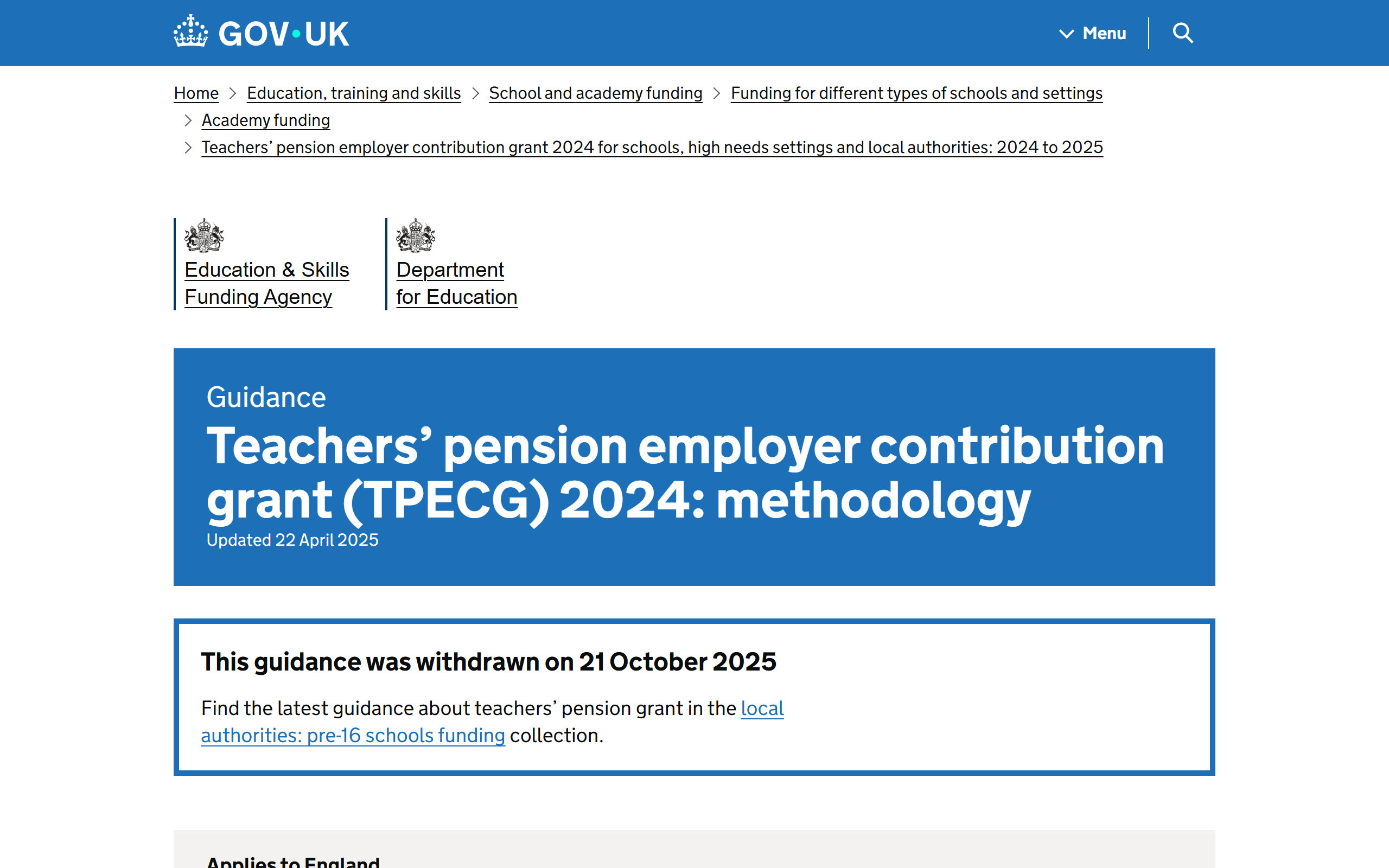
The employer contribution to TPS rose to 28.68% of pensionable salary on 1 April 2024, made up of the 28.6% base scheme rate plus a 0.08% administration levy. The 5 percentage point increase was confirmed by the Department for Education following the 2020 valuation outcome, and the rate is locked in until the next valuation (using 2024 data) takes effect from April 2027.
To put 28.68% in context, the average private-sector workplace pension employer contribution in 2024 was around 4-5% of qualifying earnings under auto-enrolment. A typical generous private employer might match up to 6% or 8%. The single most popular FTSE-100 employer pension is around 10%. The closest comparable public-sector deal is the NHS pension scheme, where the employer contribution is 23.7%. The Teachers' Pension Scheme tops that, every year you teach, automatically.
This is the number that should drive every decision about whether to stay in the scheme. A teacher on £45,000 has roughly £12,906 of employer pension contribution going into the scheme on their behalf every year. That is not a notional figure. It is the actuarial cost of buying the benefits you are accruing, and the Treasury writes that cheque (via the Teachers' Pension Employer Contribution Grant for state schools) whether you notice or not.
UK marginal tax rate by gross income
England, Wales and NI. Combined income tax + employee NI. 2026/27.
Source: HMRC income tax rates 2026/27. NI primary threshold £12,570, upper earnings limit £50,270.
A worked example for a classroom teacher
Numbers do the work prose cannot. Take Sarah, who starts teaching at 25 on M1 (£32,000) and retires at 67 having worked 40 years. Assume her career progresses through main scale, into upper pay range, then to a head of department role, with an average pensionable salary over her career of £48,000 in today's money.
Under the 2015 CARE scheme, Sarah builds 1/57th of each year's salary, revalued by CPI plus 1.6% each April she remains active. Over 40 years at an average of £48,000:
- Annual pension at NPA 67: roughly £48,000 x 40 / 57 = £33,684 per year.
- Indexed in payment by CPI for life.
- Survivor's pension of around 37.5% for an eligible partner.
That is before any commuted lump sum, before any State Pension on top (which she still gets in full because TPS members pay full Class 1 National Insurance), and before any private SIPP or ISA savings she has built alongside.
To replicate £33,684 of CPI-indexed annual income through a private pension, Sarah would need a pot of roughly £900,000 to £1.1 million at retirement, depending on annuity rates and how aggressively she wanted to protect against inflation. That is the actuarial value of what the scheme has been buying her, one classroom year at a time.
Normal pension age and the early retirement penalty
The 2015 CARE scheme NPA is your State Pension age. Take benefits earlier and they are reduced by Actuarially Reduced Benefits (ARB), which is currently 5% per year of early access. Take CARE pension five years early at 62 and you take roughly a 25% permanent cut. Take it ten years early at 57 (the earliest you can access TPS as standard) and you take closer to a 50% cut.
For legacy 1995 section service, NPA is 60 and ARB applies similarly to anything taken before then. For 2007 1/60th section service, NPA is 65. Many teachers do not realise they have three different NPAs running in parallel inside the same scheme. The benefit statement at age 55+ is the first time most people see this clearly, by which point retirement planning is already meant to be locked in.
There is no penalty for leaving the scheme deferred and drawing later. Pension already accrued is uplifted by CPI each year until you draw it. Continuing to teach into your sixties also continues to build accrual at 1/57th of current salary, which at age 65 on a head of department salary of £58,000 is buying roughly £1,000 of annual pension per year of continued service. Few private DC schemes accrue value that quickly at that age.
The lump sum: should you commute pension for tax-free cash?
TPS lets you exchange (commute) part of your annual pension for a tax-free lump sum, at a fixed ratio of £12 of lump sum for every £1 of annual pension given up. The Lifetime Allowance was abolished in April 2024 and replaced with the Lump Sum Allowance of £268,275 plus the Lump Sum and Death Benefit Allowance of £1,073,100.
The 12:1 commutation ratio is poor value if you live an actuarially average post-retirement life. To match £1 a year of CPI-indexed income for 25 years, you would need to invest the £12 lump sum at roughly 6.5% real per year and draw it down. That is achievable but not guaranteed, and you have given up the inflation protection that came free with the pension.
For most teachers, the commutation question is really a cash-flow question. Take some lump sum to clear a mortgage or fund a big-ticket retirement expense, but do not over-commute simply because tax-free cash feels good. The pension is more valuable than the cash on a per-pound basis.
The McCloud remedy in one paragraph
Between 1 April 2015 and 31 March 2022, the Government moved younger members into the new CARE scheme while letting older members stay on the legacy Final Salary scheme. The courts ruled in 2018 (McCloud) that this was age discrimination. The remedy is that every member with TPS service in that seven-year window will be deemed to have been in their legacy section (1995 or 2007) for the whole period, then given a one-time choice at retirement of whether to take that service as legacy Final Salary or as 2015 CARE benefits.
For most affected members, the choice is worth between £20,000 and £60,000 of present value, and which option wins depends on final salary growth, length of service, and family circumstances. The Department for Education will run the comparison for you and present both options before you draw benefits. It is not a decision you need to take now, but it is one you should be aware exists.
Phased retirement, re-employment, and the abatement trap
TPS allows phased retirement from age 55, where you reduce hours and draw a portion of accrued pension while continuing to teach. You can do this twice before final retirement. It is one of the most useful features of the scheme and almost nobody outside the profession knows it exists.
The trap is the abatement rule. If you fully retire, start drawing your pension, and then return to TPS-eligible employment (supply teaching, examining, multi-academy trust consultancy), your annual pension can be reduced or stopped if the combined value of pension plus new salary exceeds your salary of reference (broadly, the pay you were drawing at retirement, indexed). The exact calculation depends on which scheme section your pension comes from. The Department for Education estimates abatement catches several thousand re-employed teachers a year, most of whom were unaware the rule existed until their next pension payment arrived short.
If you are likely to return to any TPS-eligible role after retiring, get the abatement calculation done in writing before you accept the work.
Should you ever opt out?
Almost never. The maths against opting out is brutal once you write it down.
Take a teacher on £40,000 contributing 8.6% (£3,440 a year) into the scheme. The employer puts in 28.68% (£11,472). Combined annual input: £14,912. That is buying 1/57th of £40,000 = £701 of annual pension, revalued and CPI-indexed for life, plus survivor benefits.
To match that with a private DC pension, the teacher would need to invest the £3,440 their own contribution buys (after losing higher-rate relief inside salary, not net pay), and put the £11,472 employer match somewhere else (it does not exist outside the scheme). To replicate the £701 of CPI-indexed annual pension via a SIPP, they would need a marginal contribution of roughly £14,000 a year of personal money at 5% real returns over a 40-year career. Nobody opts out of the Teachers' Pension and then invests £14,000 a year of their own salary into a SIPP. They take the take-home pay rise and lose the employer match forever.
The one scenario where opting out becomes arguably defensible is for very senior teachers approaching the £268,275 Lump Sum Allowance or the £1,073,100 Lump Sum and Death Benefit Allowance, where additional CARE accrual would simply generate excess charges. Even then, the answer is usually not "opt out" but "accept the charge as a worthwhile tax cost on a still-cheap benefit", because the employer 28.68% does not get redirected to your salary if you opt out. It goes back to the Treasury.
For everyone else: stay in.
The Teachers' Pension Scheme is one of the few corners of the UK financial system that is unambiguously designed in favour of the person doing the work rather than the institutions selling them products. The 28.68% employer rate is not a corporate marketing decision. It is the actuarial cost of buying the benefits, paid for by general taxation, which means every taxpayer in the country contributes a small amount each year to making sure UK state school teachers retire with dignity. That is a deliberate policy choice and a good one. The fact that the system is complicated enough to put off the people it was designed to help is the problem worth fixing, not the existence of the scheme itself.
Further Reading:
Die With Zero - Bill Perkins - The retirement-spending counterweight to the standard "maximise accumulation" advice. Particularly useful for teachers sitting on a guaranteed income floor and a paid-off mortgage at 67, where the question stops being "do I have enough" and starts being "what is enough for". (Affiliate link - we may earn a small commission at no extra cost to you.)
Frequently Asked Questions
How much pension does a teacher get in the UK?
A full-career classroom teacher (40 years of service, average pensionable salary around £48,000) accrues roughly £33,000 to £35,000 a year of CPI-indexed pension under the 2015 CARE scheme, payable from State Pension age, plus full State Pension on top. Shorter careers and lower average salaries scale proportionately.
Is a teacher pension a good pension?
By any reasonable standard, yes. The TPS has a 28.68% employer contribution, CPI indexation in payment, defined-benefit guarantee, and survivor benefits. Replicating it through a private SIPP would cost roughly three times what most teachers contribute and would carry investment risk the TPS member never has to take.
How many years do you have to work to get full teacher pension?
There is no "full pension" in the way the State Pension has 35 qualifying years. The Teachers' Pension Scheme pays out based on accrual: every year you contribute buys 1/57th of that year's salary as annual pension. A 40-year career produces a larger pension than a 20-year career, but the 20-year teacher is not penalised - they get half as much pension for half as much service.
Do teachers get a full State Pension as well?
Yes. Teachers pay full Class 1 National Insurance throughout their teaching career, so years of TPS service also count as qualifying years for the new State Pension. A 35-year teaching career covers the full State Pension entitlement of £230.25 per week (£11,973 per year) from 2025/26 onwards, stacked on top of the TPS pension. The how much is State Pension UK guide explains the qualifying-year rules in detail.
How much is the teacher pension going up in 2026?
Pensions in payment increased by 1.7% from April 2026, in line with the September 2025 CPI figure used for public sector pensions. Active members' accrued CARE benefits revalued by 3.3% (CPI plus 1.6%) in the April 2026 revaluation.
Should I transfer my Teachers' Pension to a SIPP?
For almost every teacher, no. Transferring a defined-benefit pension to a defined-contribution SIPP requires regulated advice for any transfer above £30,000, and the FCA's working assumption is that DB-to-DC transfers are not in the member's interest. The TPS is one of the strongest cases for staying put: the guaranteed income, employer contribution, and CPI link are not replicable in a SIPP. The few legitimate transfer cases (terminal illness, very small benefit values, specific estate-planning needs) are rare enough that "should I transfer" should be answered "no" by default until proven otherwise.
This article is general information about the Teachers' Pension Scheme and is not financial or tax advice. Pension rules, contribution rates, and tax thresholds can change. Specific decisions about opting out, transferring, or drawing benefits should be made with a regulated UK financial adviser, particularly for transfers above £30,000 where FCA rules require it. Capital values of any private investments held alongside the TPS can fall as well as rise.
Prefer to watch?
We turn these money breakdowns into short videos
A few a week, plain-English UK money. If you would sooner watch than read, follow along:
Enjoying the content?
If this site has been useful, a coffee goes a long way.
Browse more articles
Browse all