








Capital Gains Tax UK: Complete 2026/27 Guide
Your CGT allowance used to be £12,300. It's now £3,000. That's a 76% cut in three years and the clearest stealth tax on the books.
Cite this article
Freedom Isn't Free (2026) Capital Gains Tax UK: Complete 2026/27 Guide. Available at: https://freedomisntfree.co.uk/articles/capital-gains-tax-uk-guide (Accessed: 10 October 2026).
Italicise the article title in your bibliography. Accessed date set to today.
TLDR
- The 2026/27 Capital Gains Tax annual exempt amount is just £3,000, down from £12,300 three years ago.
- CGT rates are 18% within your basic-rate band and 24% above it, applied uniformly to shares, crypto, and property.
- ISAs, pensions, your main home, gilts, and Premium Bonds are CGT-exempt, so most retail investors should never pay CGT if they plan ahead.
- Bed-and-ISA, spousal transfers, and harvesting gains within the £3,000 allowance each tax year are the three highest-impact ways to legitimately cut your bill.
Capital Gains Tax UK: Complete 2026/27 Guide
If you've sold shares, crypto, a buy-to-let, or even a chunk of gold in the last year, Capital Gains Tax UK rules probably apply to you. And after three consecutive cuts to the annual allowance plus a rate hike in October 2024, the bar for getting caught is far lower than it used to be.
This is your full 2026/27 walkthrough. You'll learn what counts as a disposal, how the new rates work, what's exempt, and the legitimate planning moves that keep more of your gains in your pocket.
The CGT-free allowance is now £3,000. That's a quarter of what it was in 2022/23.
Contents
- What Is Capital Gains Tax?
- The 2026/27 CGT Annual Exempt Amount
- Current CGT Rates for 2026/27
- How to Calculate Your Capital Gain
- What Counts as a Disposal?
- Assets That Are Exempt from CGT
- Strategies to Reduce Your CGT Bill
- Reporting and Paying CGT
- Frequently Asked Questions
What Is Capital Gains Tax?
Capital Gains Tax (CGT) is the tax you pay on the profit when you sell or otherwise dispose of an asset that has gone up in value. You're not taxed on the sale price, only on the gain.
Sell a share portfolio you bought for £20,000 for £35,000? The gain is £15,000. That gain is what HMRC wants a slice of, not the £35,000.
CGT applies to:
- Shares and funds held outside an ISA or pension
- Crypto-assets (Bitcoin, Ethereum, and the rest)
- Second homes and buy-to-let property
- Business assets
- Personal possessions worth over £6,000 (think art, antiques, jewellery)
- Foreign currency held for investment
It does not apply to your salary, dividends, or interest. Those are taxed as income under separate rules.
The 2026/27 CGT Annual Exempt Amount
Every UK resident gets an annual exempt amount (AEA) of £3,000 in the 2026/27 tax year. Gains under that figure are tax-free.
To put the squeeze in context:
| Tax year | Annual exempt amount |
|---|---|
| 2022/23 | £12,300 |
| 2023/24 | £6,000 |
| 2024/25 | £3,000 |
| 2025/26 | £3,000 |
| 2026/27 | £3,000 |
That's a 76% cut in three years. It's one of the clearest examples of stealth taxation on the books, and it pushes far more ordinary investors into the CGT net than ever before.
CGT Annual Exempt Amount, 2022/23 to 2026/27
Source: HMRC Capital Gains Tax rates and allowances
Trusts get a separate, smaller AEA (typically half the personal figure). The allowance can't be carried forward. Use it or lose it.
Current CGT Rates for 2026/27
Since 30 October 2024, CGT rates have been simplified across asset classes. There's no longer a separate (lower) rate for shares versus property.
| Your tax position | CGT rate |
|---|---|
| Gain falls within your basic-rate band | 18% |
| Gain falls into higher- or additional-rate | 24% |
The way it works: your taxable gain stacks on top of your taxable income. Whatever portion sits inside the basic-rate band (up to £50,270 of total income plus gains) is taxed at 18%. Anything above is taxed at 24%.
UK Capital Gains Tax rate by total income plus gains, 2026/27
Harmonised across shares, crypto and property since 30 October 2024
Source: HMRC CGT rates 2026/27, Autumn Budget 2024
Worked example. You earn £40,000 of salary and realise a £20,000 gain on a stock-market portfolio.
- Taxable income after personal allowance: £40,000 - £12,570 = £27,430
- Headroom in basic-rate band: £37,700 - £27,430 = £10,270
- Gain after AEA: £20,000 - £3,000 = £17,000
- £10,270 of the gain taxed at 18% = £1,848.60
- £6,730 of the gain taxed at 24% = £1,615.20
- Total CGT: £3,463.80
Business Asset Disposal Relief (BADR)
If you're selling a qualifying trading business or shares in your own personal trading company, BADR cuts the rate. The relief was 14% in 2025/26 and rises to 18% from 6 April 2026, with a £1m lifetime limit on qualifying gains. By 2026/27, BADR offers no rate advantage at the bottom of the bracket, only at the top.
How to Calculate Your Capital Gain
The basic formula is simple. Where it gets fiddly is the share pooling rules HMRC uses to work out your cost base.
Step 1. Work out the disposal proceeds (what you sold for, less dealing costs).
Step 2. Subtract the allowable cost (what you paid, plus stamp duty, plus other allowable expenses).
Step 3. Apply any reliefs (such as private residence relief on a property).
Step 4. Subtract the £3,000 AEA.
Step 5. Apply the 18% / 24% rate to whatever is left.
Section 104 holdings and the 30-day rule
Most retail investors hold the same fund or share across multiple purchases at different prices. HMRC pools all these into a single Section 104 holding with one weighted-average cost. When you sell, you use that average.
There are two anti-avoidance rules to know:
- Same-day rule. Buys and sells on the same day are matched first.
- 30-day "bed-and-breakfasting" rule. If you buy back the same asset within 30 days of selling, the buyback is matched against the sale rather than feeding into the pool. This blocks the old trick of selling on 5 April and buying back on 6 April just to crystallise an AEA-sized gain.
The 30-day rule applies only to the same asset in the same account. It does not block selling a share in your General Investment Account (GIA) and buying it back inside an ISA. That's a Bed-and-ISA, and it's how serious investors mop up their AEA every year.
What Counts as a Disposal?
A disposal is broader than a simple sale. You trigger CGT when you:
- Sell an asset
- Gift it to anyone other than your spouse, civil partner, or a registered charity
- Swap it for another asset
- Receive compensation for it (such as an insurance payout)
- Crypto-to-crypto trades (yes, swapping ETH for SOL is a disposal of ETH)
Transfers between spouses or civil partners are not disposals. The receiving partner inherits the original cost base. This is the single most powerful planning tool for couples and we'll come back to it.
Assets That Are Exempt from CGT
A surprisingly large chunk of the typical UK portfolio is exempt by design:
- Stocks and Shares ISAs. Every gain inside an ISA wrapper is tax-free, full stop. See our ISA guide for how to use the £20,000 allowance properly.
- Pensions (SIPPs, workplace pensions). Tax-free growth inside the wrapper.
- Your main home (Private Residence Relief). Sell the house you actually live in and there's normally zero CGT.
- UK government bonds (gilts) and most qualifying corporate bonds.
- Premium Bonds and National Savings & Investments products.
- Cars (genuine personal-use cars, not classic-car investments held for resale).
- Personal possessions worth £6,000 or less when sold (the chattels exemption).
- Foreign currency for personal use.
- ISA-held crypto? No. Crypto can't be held inside an ISA. It's always a chargeable asset.
For most retail investors, sticking to ISA, pension, and your main home means CGT never enters the picture. The problem starts when GIA holdings, crypto, or rental property are in the mix.
Strategies to Reduce Your CGT Bill
Six legitimate moves, ordered roughly by how much they typically save.
1. Use your ISA and pension allowances first
You get £20,000 of ISA contributions and (for most people) up to £60,000 of pension contributions per tax year. Anything growing inside those wrappers is permanently outside the CGT net. Building a GIA before you've maxed your wrappers is rarely the right move - see our ISA vs pension guide for how to split contributions between the two.
2. Bed-and-ISA every April
Sell GIA holdings up to the £3,000 AEA, then immediately rebuy inside your ISA. You crystallise the gain tax-free, reset the cost base higher, and shift the asset into the tax-free wrapper. Done annually, you can transfer six figures into an ISA over a working life without ever paying CGT.
3. Use both spousal allowances
Married couples and civil partners can transfer assets between themselves with no CGT consequence. That doubles your effective AEA to £6,000, gives you two basic-rate bands to soak up gains at 18%, and lets the lower earner sell on the higher earner's behalf.
4. Harvest gains in low-income years
A sabbatical, parental leave, or your first year of early retirement is when to crystallise large gains. With less salary income, more of your gain falls inside the basic-rate band at 18% rather than 24%.
5. Offset losses
CGT is calculated on net gains. Losses on shares, crypto, or a failed business asset can be set against gains in the same year, and unused losses can be carried forward indefinitely (provided you register them with HMRC within four years of the tax year of loss).
6. Gift to charity
Gifts to UK-registered charities are exempt disposals and can also generate Gift Aid relief on your income tax. A useful route for highly appreciated assets you no longer need.
Reporting and Paying CGT
You need to report gains via Self Assessment if either:
- Your total gains for the year exceeded the £3,000 AEA, or
- Your total disposal proceeds exceeded £12,000 (4 x AEA), even with gains under £3,000.
That second trigger catches a lot of investors out. If you sold £15,000 of a fund at a £500 profit, you still have to report.
Residential property has its own faster regime. Gains on UK residential property must be reported and the tax paid within 60 days of completion through HMRC's online "real-time" CGT service. Miss it and you'll face penalties even before the Self Assessment deadline.
Frequently Asked Questions
Do I pay Capital Gains Tax on crypto in the UK?
Yes. HMRC treats crypto-assets as chargeable property, not currency. Selling, swapping, spending, or gifting crypto (other than to your spouse) is a disposal, and gains over the £3,000 AEA are taxed at 18% or 24%. Keep careful records of every transaction including swaps between coins.
How much can I gain before paying CGT in 2026/27?
The annual exempt amount is £3,000 per individual. Realised gains below that are tax-free and don't need to be reported, unless your total disposal proceeds exceed £12,000, in which case you must still file a return.
Do I pay CGT when I sell my house?
Generally no, if it's been your only or main home for the entire ownership period. Private Residence Relief covers the gain. You may owe CGT on a second home, a buy-to-let, or a property that was your main home for only part of the time you owned it.
What's the difference between CGT and income tax on shares?
Dividends are income and taxed under the dividend tax regime (with a £500 dividend allowance in 2026/27). Capital gains arise when you sell the share for more than you paid and are taxed under CGT. The same investment can produce both, so the same shareholder might owe both taxes in the same year on the same holding.
Can I avoid CGT by holding investments forever?
Yes, but with caveats. CGT is only triggered by a disposal, so unrealised gains keep growing tax-free. On death, your estate's CGT liability is wiped (the assets get a "tax-free uplift" to market value), though Inheritance Tax may apply instead. For most investors, the better answer is to use ISAs and pensions to make the question moot.
The Bottom Line
The £3,000 allowance and 18% / 24% rates have made CGT a real cost for ordinary UK investors for the first time in a generation. The good news is that the rules around ISAs, pensions, spousal transfers, and Bed-and-ISA make it almost entirely avoidable if you plan a year ahead.
If you're holding meaningful sums in a GIA or in crypto, the action items are straightforward: max your ISA, max your pension, harvest your AEA every April, and split holdings with your partner. Do those four things consistently and the CGT bill more or less takes care of itself.
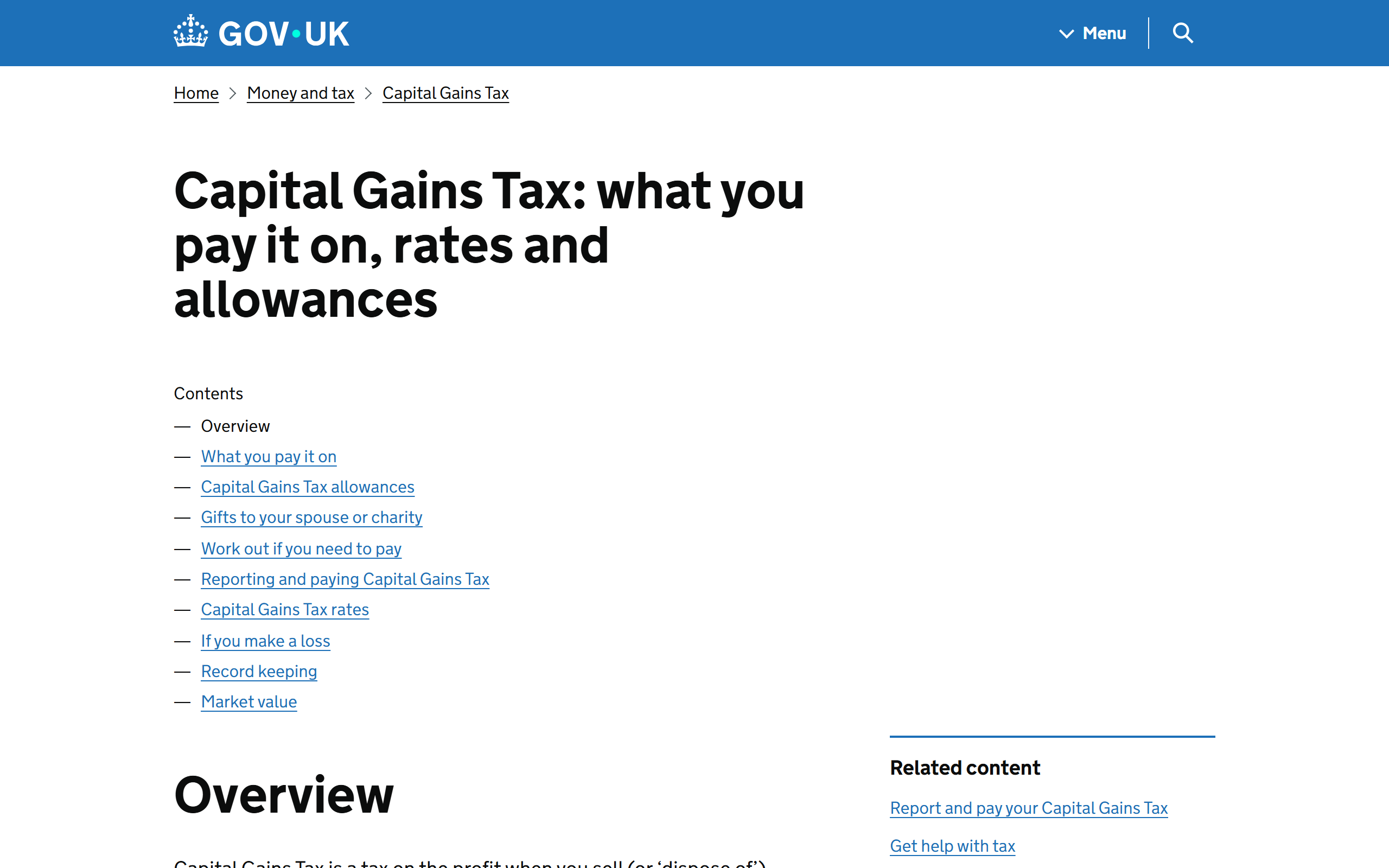
Sources:
This article is general information, not personal tax advice. Individual circumstances vary and CGT rules can change. Consult a qualified UK tax adviser before making decisions.
Read Next
- Stealth Taxes UK: How Frozen Thresholds Quietly Drain Your Wealth
- Dividend Tax UK: A Complete Guide for 2026/27
- Stocks and Shares ISA: The UK Investor's Most Powerful Wrapper
- ISA vs Pension: Which Should You Prioritise?
- New Tax Year UK Investor Checklist
Further Reading
Smarter Investing - Tim Hale - Hale's evidence-based playbook for UK investors covers tax-efficient wrapper use and asset location, the same principles that make CGT mostly avoidable. (Affiliate link - we may earn a small commission at no extra cost to you.)
Prefer to watch?
We turn these money breakdowns into short videos
A few a week, plain-English UK money. If you would sooner watch than read, follow along:
Enjoying the content?
If this site has been useful, a coffee goes a long way.
Browse more articles
Browse all