



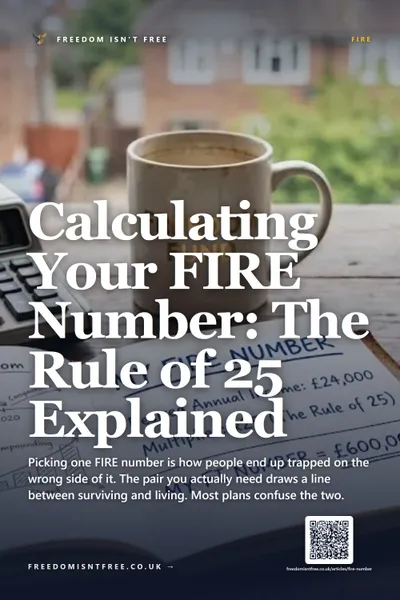




Calculating Your FIRE Number: The Rule of 25 Explained
Picking one FIRE number is how people end up trapped on the wrong side of it. The pair you actually need draws a line between surviving and living. Most plans confuse the two.
Cite this article
Freedom Isn't Free (2026) Calculating Your FIRE Number: The Rule of 25 Explained. Available at: https://freedomisntfree.co.uk/articles/fire-number (Accessed: 21 September 2026).
Italicise the article title in your bibliography. Accessed date set to today.
TLDR
- Calculate your FI number using the Rule of 25 by multiplying your annual expenses by 25.
- Consider two lifestyle targets: Lean FI (minimum survival costs) and Standard FI (current lifestyle).
- Adjust your calculations for the UK context, aiming for a 3.3% withdrawal rate if planning to retire early.
- Use tools like ISAs, SIPPs, and low-cost index funds to maximise your savings and reach your FI number faster.
- Start by calculating your Lean FI number immediately to begin your journey to financial independence.
FIRE number by UK lifestyle tier (Rule of 25)
| Lifestyle | Annual spend | FIRE number (25x) | Safer (30x) |
|---|---|---|---|
| Minimalist | £18,000 | £450,000 | £540,000 |
| Median UK life | £30,000 | £750,000 | £900,000 |
| Comfortable | £40,000 | £1,000,000 | £1,200,000 |
| Sovereign | £50,000 | £1,250,000 | £1,500,000 |
25x is the 4% rule. 30x (3.3% withdrawal) is the safer rate for early retirees.
Calculating Your FIRE Number: The Rule of 25 Explained
If the "Great Debt of Birth" is the weight holding you down, your FI Number is the exact amount of capital required to cut the chain.
In the FIRE (Financial Independence, Retire Early) movement, we don't guess. We don't "hope" to retire. We treat our freedom as a mathematical certainty. Your FI Number is the point at which your invested capital generates enough passive growth to cover your cost of existence indefinitely.
Step 1: The "Survival Floor" vs. The "Freedom Ceiling"
Before you can calculate your number, you must be honest about what it costs to keep you alive and functional. Most people identify two distinct targets:
- Lean FI: The absolute minimum. This covers your "subsistence fees": shelter (mortgage/rent), basic calories, utilities, and taxes. This is your "break glass in case of emergency" number.
- Standard FI: This is your current lifestyle, including the things that make life worth living: travel, hobbies, and social connection.
The Tactical Exercise: Look at your last 12 months of bank statements. Total every penny. Subtract costs that vanish when you stop working (commuting, expensive city lunches, work attire). This is your Annual Expense ($E$).
Step 2: The Math of the "Rule of 25"
The standard global benchmark for financial independence is the 4% Rule. It suggests that if you withdraw 4% of your total investment portfolio in year one, and adjust that amount for inflation every year after, your money has a 95% chance of lasting at least 30 years.
To find your "Ransom Price," you simply perform the inverse: Multiply your annual expenses by 25.
FI Number = Annual Expenses x 25
The Escape Benchmarks (UK Context)
Based on average UK spending patterns, here is what those milestones look like:
| Lifestyle Tier | Annual Spend | FI Number (25x) | Outcome |
|---|---|---|---|
| The Minimalist | £18,000 | £450,000 | Basic survival; zero reliance on employers. |
| The Median | £30,000 | £750,000 | A comfortable, modest UK life. |
| The Sovereign | £50,000+ | £1,250,000+ | Total lifestyle design without compromise. |
Step 3: Adjusting for the "UK Buffer"
While 25x is the standard, the UK system has specific quirks. If you plan to retire in your 30s or 40s, a 30-year window isn't enough, you need 50+ years. For maximum safety, many in the movement aim for a 3.3% withdrawal rate, which means multiplying your expenses by 30.
The State Pension Bridge
The UK system provides a "State Pension" (currently approx. £12,500/year) starting at age 67. You can use this to lower your "Phase 2" FI number.
- Phase 1 (Pre-67): You need your portfolio to cover 100% of your costs.
- Phase 2 (Post-67): You only need your portfolio to cover your costs minus the State Pension.
Step 4: Weaponising the Tools
This site provides the tools to reach these numbers faster than the "standard" 40-year career path. Knowing your number is just the beginning. You can calculate your personal FI number here. To hit it, we focus on:
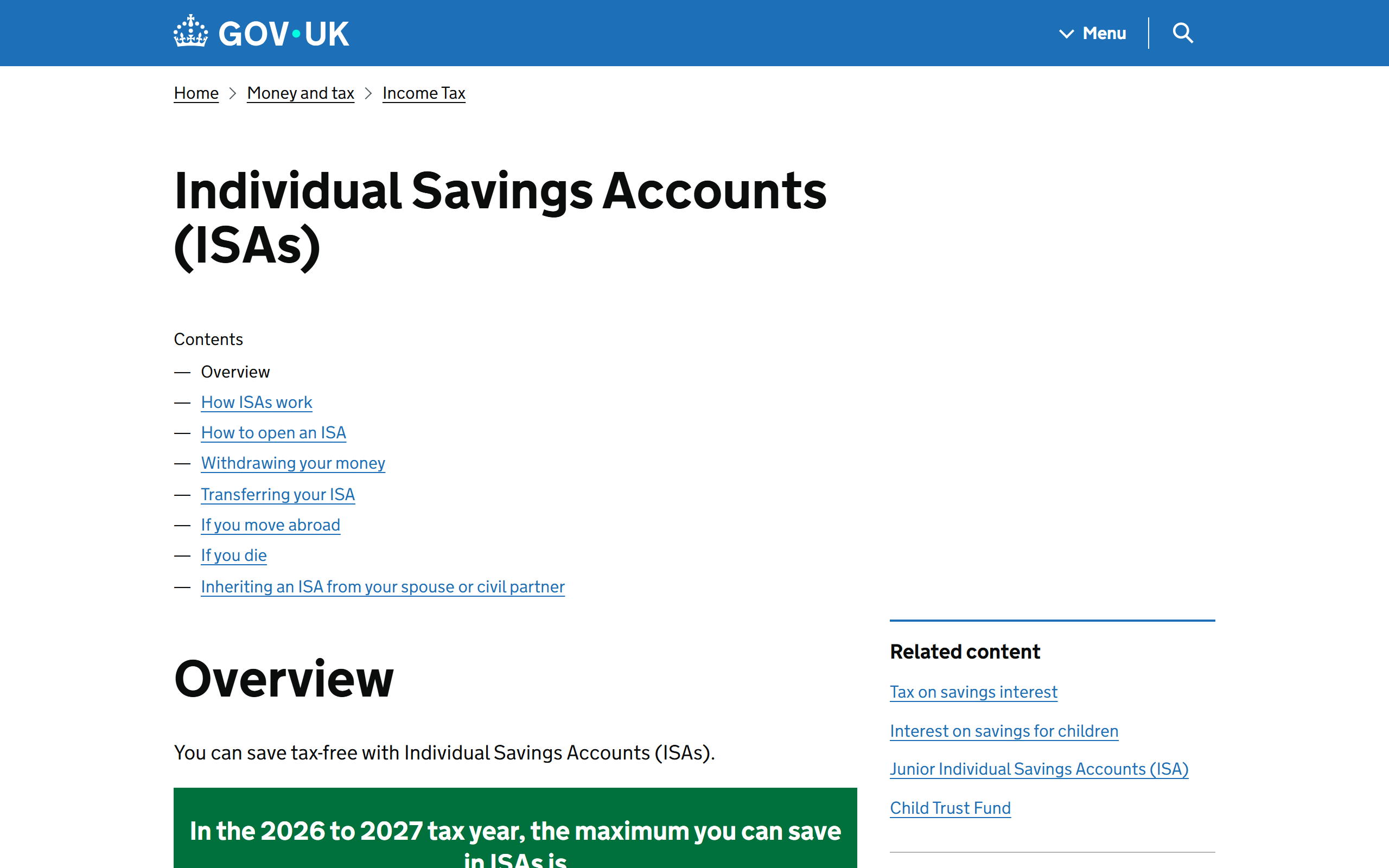
- Tax Shielding: Using ISAs and SIPPs to ensure the government doesn't take a "exit fee" from your freedom fund.
- The 7% Engine: Using low-cost S&P 500 index funds to let the compounding power of the global economy do the heavy lifting for you.
- The Savings Rate: Every 1% increase in your savings rate doesn't just add money to your pot, reducing the "Annual Expense" you need to fund and bringing your FI date closer from both ends.
Your First Directive
Your first goal is to calculate your Lean FI number today. Not tomorrow. Today. Once you have that number, the "game" officially begins. You are no longer working for a boss; you are working to buy back your life, one share at a time.
Frequently Asked Questions
What is the Rule of 25 for FIRE?
The Rule of 25 is the formula for calculating your FIRE number: multiply your annual expenses by 25. If you spend £30,000 a year, your target portfolio is £750,000. The rule derives from the 4% withdrawal rate - the inverse of 25. A £750,000 portfolio at 4% withdrawal produces £30,000 per year. Research from the Trinity Study found this rate sustainable in approximately 95% of historical 30-year retirement scenarios.
Is the 4% rule safe for early retirement?
For 30-year retirements, it has held up well historically. For early retirees with 40-50 year horizons, many FIRE practitioners use a more conservative 3.3% withdrawal rate (the Rule of 30 - multiply annual expenses by 30). The risk is not that the 4% rule is wrong but that early retirees face more years during which poor sequence of returns can permanently impair the portfolio.
How does the UK State Pension affect my FIRE number?
Significantly, and it is often underweighted in calculations. If you retire at 45 and spend £30,000 a year, you do not need your portfolio to fund £30,000 indefinitely. From age 67, the full new State Pension (approximately £12,548 per year as of 2026/27) covers a meaningful portion. Your portfolio only needs to fund the gap - roughly £17,450 from age 67. This can reduce the required portfolio size by £100,000 or more.
What is the difference between Lean FIRE and Fat FIRE?
Lean FIRE targets a minimalist lifestyle - typically £18,000-£25,000 per year in UK terms - requiring a smaller portfolio (£450,000-£625,000 at 4%). Fat FIRE targets a more comfortable or high-spending lifestyle (£50,000+ per year) requiring £1,250,000 or more. Most people land somewhere in the middle. The most important step is establishing your actual annual spending figure honestly, as the entire calculation depends on it.
How do I calculate my annual expenses for the FIRE number?
Review your last 12 months of bank statements and total everything. Then subtract costs that disappear when you stop working - commuting, work clothing, expensive city lunches. Add costs that may increase - healthcare, leisure, travel. The result is your annual expense figure. Most people are surprised to find their retirement spending is lower than their working spending once work-related costs are removed.
Further Reading:
Die With Zero - Bill Perkins - A powerful counterpoint to obsessive number accumulation, making the case for spending on experiences while you are young enough to enjoy them. (Affiliate link - we may earn a small commission at no extra cost to you.)
How Much Can I Spend in Retirement? - Wade Pfau - The most rigorous academic treatment of safe withdrawal rates, covering sequence of returns risk and dynamic withdrawal strategies for long retirements. (Affiliate link - we may earn a small commission at no extra cost to you.)
What to Read Next
Now that you know your number, here's where to go next:
- An Introduction to FIRE: A deeper look at the Financial Independence, Retire Early movement, the different flavours of FIRE, the community behind it, and what the path actually looks like in practice.
- How Much Is "Enough"?: A philosophical companion to the maths. Once you have a number, this article asks whether it's the right number and what you actually want your freedom to look like.
- Budgeting 101: Your FI Number is only useful if you know what you currently spend. This article walks you through building a budget from scratch so your Annual Expense figure is as accurate as possible.
- John Bogle's Investing Philosophy: "VOO and Chill": The "7% Engine" mentioned above runs on low-cost index funds. This article explains the philosophy behind passive index investing and why it's the default choice for most FIRE adherents.
Prefer to watch?
We turn these money breakdowns into short videos
A few a week, plain-English UK money. If you would sooner watch than read, follow along:
Enjoying the content?
If this site has been useful, a coffee goes a long way.
Browse more articles
Browse all