






Factor-Based Investing: The UK ETFs for Value and Size
Decades of academic research say value, size, momentum and profitability beat the market. The UK ETFs that capture each one, and whether the premium survives a 0.35% fee.
Cite this article
Freedom Isn't Free (2026) Factor-Based Investing: The UK ETFs for Value and Size. Available at: https://freedomisntfree.co.uk/articles/a-practical-guide-to-factor-based-investing-for-uk-investors (Accessed: 21 September 2026).
Italicise the article title in your bibliography. Accessed date set to today.
TLDR
- Factor-based investing focuses on specific stock characteristics like value, size, momentum, and profitability for better long-term returns.
- UK investors can use low-cost funds and ETFs to implement factor-based strategies, offering a middle ground between passive and active investing.
- Each factor, such as value, size, momentum, and profitability, has academic research supporting its potential to generate higher returns.
- UK investors can access factor-based ETFs like iShares MSCI UK Value UCITS ETF for value tilts, Vanguard FTSE All-World Small Cap UCITS ETF for size tilts, and HSBC MSCI World Momentum UCITS ETF for momentum tilts.
- Factor-based investing may outperform traditional market-cap weighted indexes if the associated premiums persist over time.
UK factor ETFs by tilt
| Factor | ETF | Ticker | TER |
|---|---|---|---|
| Value | iShares MSCI UK Value | IUKV | 0.35% |
| Size | Vanguard FTSE All-World Small Cap | VSSC | 0.29% |
| Momentum | HSBC MSCI World Momentum | HSMW | 0.30% |
| Profitability | Invesco S&P 500 High Profit Low Capex | SPHL | 0.20% |
Each ETF captures one academic premium. TERs verified against provider factsheets.
Factor-Based Investing: A UK Investor's Guide
Factor-based investing is a strategy that tilts a portfolio towards specific stock characteristics - such as value, size, momentum, and profitability - that academic research has linked to higher long-term returns. For UK investors, it offers a disciplined middle ground between pure passive indexing and active stock-picking.
"Your Complete Guide to Factor-Based Investing" by Larry Swedroe and Andrew Berkin lays out the evidence behind these premiums and explains how to capture them using low-cost funds. This article distils their main findings and maps them to ETFs and tax wrappers available in the UK.
What Is Factor-Based Investing?
Traditional index funds weight stocks by market capitalisation. Factor-based strategies take a different approach: they overweight stocks that share a characteristic historically associated with outperformance. The four primary factors are:
- Value - stocks trading below their fundamental worth, measured by metrics like price-to-earnings ratio or price-to-book.
- Size - small-cap companies, which have historically delivered higher returns than large caps over long periods.
- Momentum - stocks whose prices have been rising recently and tend to continue rising in the short term.
- Profitability - companies with high gross profit margins relative to assets.
The appeal is straightforward: if these premiums persist, a portfolio tilted towards them should outperform a plain market-cap index over time. The risk is that premiums can disappear for years, testing investor patience. If you are new to investing, our beginner's guide covers the fundamentals before diving into factor tilts.
The Academic Evidence Behind Each Factor
Swedroe and Berkin present decades of peer-reviewed research supporting these factors.
Value: Fama and French (1992) showed that stocks with low price-to-book ratios outperformed growth stocks over multi-decade periods. The value premium has been documented across international markets, not just the US.
Size: The small-cap effect, first identified by Rolf Banz in 1981, suggests that smaller companies compensate investors for their higher risk with higher average returns. The premium has been weaker in recent decades but remains significant when combined with value.
Momentum: Jegadeesh and Titman (1993) found that stocks which outperformed over the previous 3-12 months continued to outperform in the near term. Momentum is one of the most persistent factors, but also one of the most volatile - it can reverse sharply during market recoveries.
Profitability: Novy-Marx (2013) demonstrated that companies with high gross profitability delivered returns comparable to value stocks but with lower correlation, making it a useful diversifier within a factor portfolio.
How to Implement Factor Tilts With UK ETFs
UK investors can access each factor through UCITS-compliant ETFs. Below are practical options for each tilt.
Value Tilt
- ETF: iShares MSCI UK Value UCITS ETF (IUKV)
- TER: Approximately 0.35%
- Approach: Allocate a portion of your equity holdings to this ETF to overweight undervalued UK stocks. It pairs well with a broad global index fund as a satellite holding.
Size Tilt
- ETF: Vanguard FTSE All-World Small Cap UCITS ETF (VSSC)
- TER: Approximately 0.29%
- Approach: Add this ETF to capture the small-cap premium across global markets. Hold it inside a SIPP or ISA to shelter gains from tax.
Momentum Tilt
- ETF: HSBC MSCI World Momentum UCITS ETF (HSMW)
- TER: Approximately 0.30%
- Approach: Allocate a smaller portion (5-15%) to momentum. This factor requires more frequent rebalancing, so choose a platform with low or zero dealing fees.
Profitability Tilt
- ETF: Invesco S&P 500 High Profit Low Capex UCITS ETF (SPHL)
- TER: Approximately 0.20%
- Approach: This ETF is US-focused, so it works best as a complement to a UK value tilt. Combining both gives you two largely uncorrelated factor exposures.
Sample Factor Portfolio for a UK Investor
A straightforward factor-tilted portfolio might look like this:
| Holding | Allocation | Purpose |
|---|---|---|
| Global index fund (e.g. VWRP) | 50% | Core market exposure |
| IUKV (UK Value) | 15% | Value tilt |
| VSSC (Global Small Cap) | 15% | Size tilt |
| HSMW (World Momentum) | 10% | Momentum tilt |
| SPHL (US Profitability) | 10% | Profitability tilt |
This is illustrative, not a recommendation. Your allocation should reflect your risk tolerance, time horizon, and existing holdings. Use the compound interest calculator to model how different return assumptions compound over your investing timeline. To understand how factor tilts fit into a broader goal, our FI number calculator helps you work out how much you actually need.
Practical Considerations for UK Investors
Tax Efficiency
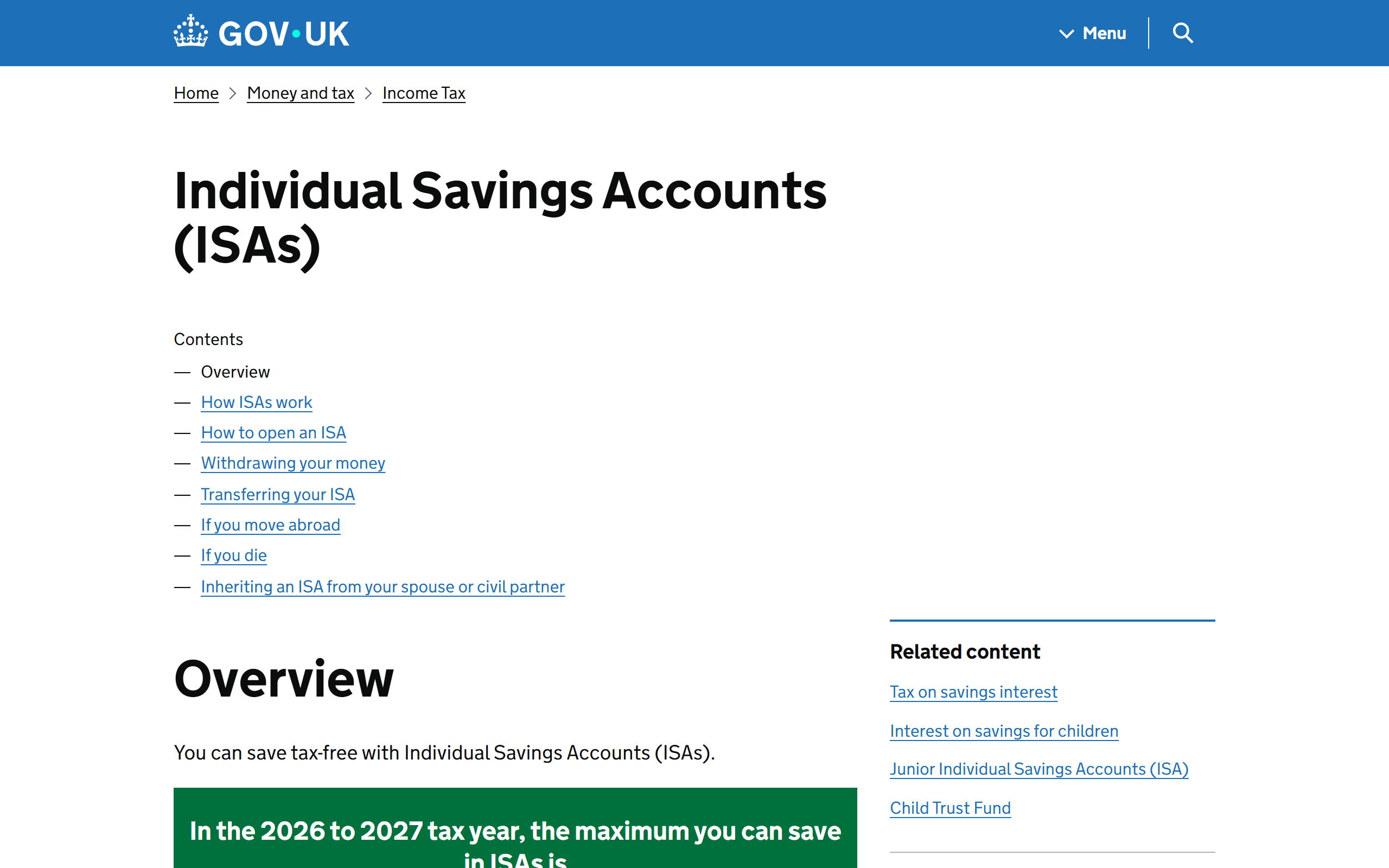
Hold factor ETFs inside ISAs and SIPPs to shelter dividends and capital gains from tax. The annual ISA allowance is £20,000 as of 2026/27. If you max out your ISA, a SIPP offers additional tax-relieved space, though funds are locked until age 57 (rising from 55 in 2028).
Keep Costs Low
Factor ETFs are more expensive than plain index trackers, but the gap has narrowed. Aim for ETFs with a Total Expense Ratio (TER) below 0.40%. Also consider platform fees - low-cost index fund platforms can make a meaningful difference over decades.
Rebalancing Discipline
Factor tilts drift over time as different parts of your portfolio grow at different rates. Set a rebalancing schedule - quarterly or semi-annually - and stick to it. Rebalancing forces you to sell recent winners and buy recent laggards, which is psychologically difficult but mechanically sound.
When Factors Underperform
Every factor goes through extended periods of underperformance. Value stocks lagged growth stocks for most of 2010-2020. Small caps can trail large caps for years. If you cannot tolerate a decade of tracking error against a simple index fund, factor investing may not suit your temperament. The premium is compensation for this discomfort.
Frequently Asked Questions
Is factor investing better than index investing?
Factor investing is a form of index investing - it just uses a different set of rules to select and weight stocks. Whether it is "better" depends on your willingness to accept periods of underperformance in exchange for a potentially higher long-term return. A plain global index fund is a perfectly sound choice for investors who want simplicity.
Can I combine multiple factors in one portfolio?
Yes, and Swedroe and Berkin argue you should. Because factors have low correlation with each other, combining them can smooth out returns. A portfolio tilted towards value, size, momentum, and profitability is more diversified than one tilted towards a single factor.
How much of my portfolio should be in factor ETFs?
There is no single right answer. A common approach is to keep 50-70% in a broad market index and allocate the remainder across factor tilts. The exact split depends on your conviction, time horizon, and tolerance for tracking error.
Are factor premiums guaranteed to continue?
No. Past performance is not a guarantee. However, the factors discussed here have been documented across multiple countries, time periods, and asset classes. Swedroe and Berkin argue that premiums rooted in risk (value, size) or behavioural biases (momentum) are more likely to persist than those that can be easily arbitraged away.
What are the risks of factor investing?
The main risk is prolonged underperformance relative to a market-cap index. Factors can also become crowded if too much money chases the same premium, which may compress future returns. Higher turnover in momentum strategies can also generate larger tax bills outside a tax-sheltered wrapper.
Further Reading:
Smarter Investing - Tim Hale - Hale's guide to evidence-based investing covers factor tilts alongside portfolio construction, and is written specifically for UK investors. (Affiliate link - we may earn a small commission at no extra cost to you.)
The Little Book of Common Sense Investing - John Bogle - Bogle makes the case for low-cost indexing, which is the foundation on which factor tilts are built. (Affiliate link - we may earn a small commission at no extra cost to you.)
Read Next:
Prefer to watch?
We turn these money breakdowns into short videos
A few a week, plain-English UK money. If you would sooner watch than read, follow along:
Enjoying the content?
If this site has been useful, a coffee goes a long way.
Browse more articles
Browse all