
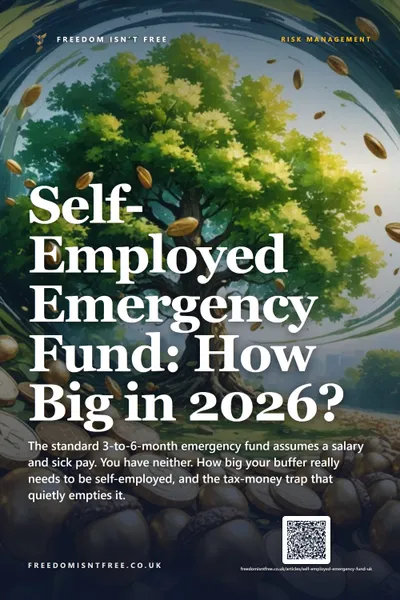


Self-Employed Emergency Fund: How Big in 2026?
The standard 3-to-6-month emergency fund assumes a salary and sick pay. You have neither. How big your buffer really needs to be self-employed, and the tax-money trap that quietly empties it.
Cite this article
Freedom Isn't Free (2026) Self-Employed Emergency Fund: How Big in 2026?. Available at: https://freedomisntfree.co.uk/articles/self-employed-emergency-fund-uk (Accessed: 21 September 2026).
Italicise the article title in your bibliography. Accessed date set to today.
TLDR
- The usual 3 to 6 months of expenses is built for employees with a salary and sick pay. The self-employed have neither, so 6 to 12 months is the sensible range.
- Keep the money you have set aside for your tax bill completely separate. It is not part of your emergency fund, and treating it as one is the classic self-employed mistake.
- Hold the buffer in cash you can reach instantly: an easy-access account or a flexible Cash ISA, not investments that can fall when you need them.
- For most self-employed people a bigger emergency fund does the job income protection claims to, with no premium and no claim to argue.
How big should a self-employed emergency fund be?
| Your situation | Months of expenses |
|---|---|
| Employee benchmark (salary + sick pay) | 3 to 6 months |
| Steady income, several clients, partner earns | 6 months |
| Lumpy income or one or two big clients | 9 months |
| Sole earner with volatile income | 9 to 12 months |
Self-Employed Emergency Fund: How Big in 2026?
A self-employed emergency fund needs to be bigger than the one the personal finance world tells everyone else to hold. The standard advice, three to six months of expenses, was written for people with a monthly salary and Statutory Sick Pay. You have neither. Your income arrives in lumps, some months are thin, and the day you are too ill to work is the day your income stops with nothing behind it.
So the buffer that is "sensible" for an employee is the bare minimum for you. This is how big a self-employed emergency fund should really be, the tax-money trap that quietly empties it, and where to keep it so it still earns its keep.
How big should a self-employed emergency fund be?
For an employee, three to six months of essential outgoings is a reasonable target. They have a predictable salary, and if they fall ill or lose the job there is sick pay, notice and often redundancy to soften the landing.
A self-employed person has none of those shock absorbers, so the honest range is six to twelve months of essential spending. Where you sit in that range depends on how lumpy your income is and how many clients you have:
- Six months if your income is fairly steady, you have several clients, and your partner has a stable salary.
- Nine to twelve months if your income swings hard, you rely on one or two big clients, or you are the only earner in the household.
Essential spending means the bills that do not stop when work does: rent or mortgage, council tax, utilities, food, insurance, minimum debt payments. Not holidays, not the nice-to-haves. Work out that monthly number and multiply.
The "3-6-9 rule" some people quote is just this idea with labels: three months as a starting floor, six as a solid position, nine-plus for the genuinely irregular. For the self-employed, treat the higher end as the target, not the ceiling.
Keep your tax money separate
This is the mistake that catches first-year sole traders, and it is worth more than any of the sizing advice: the money you have put aside for your tax bill is not your emergency fund.
When you are self-employed, a chunk of every payment you receive belongs to HMRC. By the 31 January after your first profitable year, that bill can be 150% of one year's tax once payments on account are added, as our how much to set aside for tax guide explains. If that money is sitting in the same pot as your emergency fund, you do not have the emergency fund you think you have. You have a tax bill in disguise.
Run two separate pots. One for tax, which you never touch. One for emergencies, which is genuinely yours. Mixing them is how a self-employed person can feel financially secure right up until the January demand lands and the buffer evaporates.
Where to keep a self-employed emergency fund
The buffer has one job: be there, in full, the instant you need it. That rules out investing it. An emergency fund in a global tracker is fine until the month you need it coincides with a 20% market drop, which is exactly when self-employed work tends to dry up too. Keep it in cash.
The best home is an account that is instant-access and still pays a competitive rate. An easy-access savings account works. A flexible Cash ISA works better, because the interest is tax-free and, if it is genuinely flexible, you can withdraw and replace money within the same tax year without losing your allowance. That matters once your savings interest would otherwise eat into your Personal Savings Allowance. Keep balances within the FSCS limit of £120,000 per banking licence and you are also protected if the bank fails.
How to build it from lumpy income
Building a buffer on an irregular income is a different exercise from saving a fixed amount each payday, and the trick is to save by percentage, not by fixed sum.
When a good payment lands, skim a set percentage straight into the emergency pot before you adjust your spending to the higher balance. In a lean month you save nothing and that is fine; the good months do the heavy lifting. This is the same discipline as drip-feeding money into the market, run in reverse: you are smoothing out the volatility of your income instead of the market's.
Prioritise the buffer over almost everything else early on. Before you increase pension contributions, before you overpay a mortgage, before you upgrade anything, get to at least six months. The emergency fund is the foundation the rest of a self-employed financial life is built on, and it is part of the wider self-employed safety net you have to assemble yourself because no employer will do it for you.
Frequently Asked Questions
What is the 3-6-9 rule for emergency funds?
It is a rough sizing guide: three months of essential expenses as a starting floor, six months as a solid position for most people, and nine months or more for those with irregular or insecure income. For the self-employed, who have no sick pay and lumpy earnings, the nine-month-plus end is the realistic target rather than the extreme.
Is 10k enough for an emergency fund?
It depends entirely on your essential monthly spending, not on the round number. If your unavoidable bills are £1,500 a month, £10,000 is about six to seven months, which is a reasonable self-employed buffer. If they are £3,000 a month, £10,000 is barely three months and too thin for someone with no sick pay. Work out your monthly essentials first, then judge.
Is 5k a good emergency fund in the UK?
For most self-employed households, £5,000 is a starting point rather than a finished emergency fund. It might cover two to three months of essentials, which is better than nothing but leaves you exposed to a longer illness or a quiet quarter. Treat £5,000 as the first milestone and keep building toward six to twelve months.
Is a 12-month emergency fund too much?
For an employee with secure work, often yes, because money sitting in cash is not growing as hard as it could. For the self-employed it is rarely too much, especially if your income is volatile or you have dependents and no other earner. The cost of holding it is a little lost investment growth; the cost of not having it is forced borrowing or selling investments at the worst possible time.
What is the 70/20/10 rule?
It is a budgeting split: 70% of take-home pay for living costs, 20% for saving and investing, 10% for debt repayment or giving. It is a reasonable starting framework, but for the self-employed it has to come after you have set aside money for tax, because that tax money was never really yours to budget with in the first place.
Sources
Prefer to watch?
We turn these money breakdowns into short videos
A few a week, plain-English UK money. If you would sooner watch than read, follow along:
Enjoying the content?
If this site has been useful, a coffee goes a long way.
Browse more articles
Browse all