

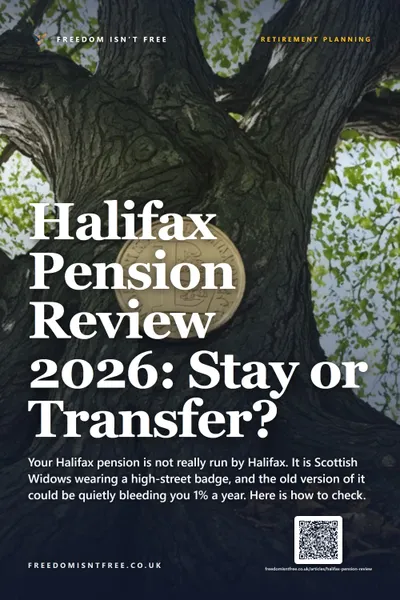


Halifax Pension Review 2026: Stay or Transfer?
Your Halifax pension is not really run by Halifax. It is Scottish Widows wearing a high-street badge, and the old version of it could be quietly bleeding you 1% a year. Here is how to check.
Cite this article
Freedom Isn't Free (2026) Halifax Pension Review 2026: Stay or Transfer?. Available at: https://freedomisntfree.co.uk/articles/halifax-pension-review (Accessed: 21 September 2026).
Italicise the article title in your bibliography. Accessed date set to today.
TLDR
- A Halifax pension is a Lloyds Banking Group product run by Scottish Widows, the group's pensions arm. The high-street brand on the front is marketing; the investing and administration happen at Scottish Widows behind it.
- The current Halifax Ready-Made Pension charges a 0.3% account fee (minimum 5 pounds a month) with Scottish Widows picking the funds, plus small fund and transaction costs on top. The Halifax Share Dealing SIPP charges 0.25% capped at 16.50 pounds a month for people who want to choose their own investments.
- The real enemy is not the new product, it is an old Halifax or Bank of Scotland legacy pension quietly charging 0.75% to 1% a year. On a 50,000 pound pot that fee gap is tens of thousands of pounds over a couple of decades.
- Before you move anything, check your statement for exit penalties and safeguarded benefits like a Guaranteed Annuity Rate or Guaranteed Minimum Pension. Destroy one of those by transferring out and no fee saving will ever make it back.
What a Halifax pension costs, and what a legacy pot costs
| Pension | Typical annual charge |
|---|---|
| Halifax Ready-Made Pension | Around 0.4% to 0.55% all-in |
| Halifax Share Dealing SIPP | 0.25%, capped at 198 pounds a year |
| Old legacy Halifax or Scottish Widows pot | 0.75% to 1% |
| Low-cost SIPP with a global tracker | 0.05% to 0.15% plus platform fee |
Halifax Pension Review 2026: Stay or Transfer?
A Halifax pension is not really run by Halifax. The name on the statement is a high-street badge; the pension behind it is set up and managed by Scottish Widows, with both brands sitting inside Lloyds Banking Group. That matters, because the honest question for most people reading this is not "is Halifax any good", it is "I have an old workplace or personal pension that ended up with Halifax or Scottish Widows, do I stay, transfer, or consolidate it". This review is built around that decision.
None of what follows is financial advice. It is general information for UK readers, and the figures are the ones Halifax and Scottish Widows publish themselves. Capital is at risk, and tax rules can change.
What a Halifax pension actually is
Halifax is a brand, not a pension company in its own right. It is part of Lloyds Banking Group, the same group that owns Lloyds Bank, Bank of Scotland and Scottish Widows. Scottish Widows is the group's pensions and retirement arm, with more than 200 years of history behind the name. When you open a Halifax pension today, Scottish Widows is the firm that builds and runs the investments.
So there are really two flavours of "Halifax pension" a reader might hold. The first is a current product, opened through the Halifax website in the last few years, with Scottish Widows quietly doing the work underneath. The second, and more common reason people search for this, is a legacy pot. Millions of UK workers hold savings with Scottish Widows through auto-enrolment, old personal pensions, or products taken out years ago with Halifax or Bank of Scotland. If your provider sounds like a high-street bank but your statement says Scottish Widows, that is the connection. Same group, different label. (If you are not even sure where your old pots are, start with how to find lost pensions in the UK and our explainer on how UK pensions actually work.)
The brand is solid and the firm is going nowhere. The interesting question is what you are paying for, and whether the specific pot you hold is a good long-term home for the money.
The two Halifax pension products
Halifax sells two very different pensions, and blurring them is where people make expensive mistakes.
The Halifax Ready-Made Pension is the hands-off option. You pay in, and Scottish Widows chooses and manages the investments for you, so there is no fund-picking required. It is aimed at people who want a pension to exist and grow without thinking about it. The trade-off is that you do not control what it holds; you get the Scottish Widows ready-made portfolio and that is the deal.
The Halifax Share Dealing SIPP is the opposite. It is a self-invested personal pension run through Halifax Share Dealing, where you pick your own shares, funds and ETFs. This is the product for someone who wants to hold a specific global tracker, build a portfolio, and run it themselves.
The two are not competing for the same person. One is a default you can ignore; the other is the steering wheel. Most people searching "halifax pension" hold the first kind, or an even older legacy version of it.
Fees, and what they quietly cost you
This is where a pension review earns its keep, because fees are the one thing nobody puts on a billboard.
The Ready-Made Pension carries a 0.3% account charge a year, minimum 5 pounds a month, with Scottish Widows managing the funds inside. On top of that sit a small ongoing fund charge of around 0.1% and transaction costs of up to roughly 0.16%, taken out of the fund rather than billed to you. All-in, that lands somewhere around 0.4% to 0.55%. Halifax does not charge to transfer in or out, top up, or take money out. For a managed, do-nothing pension, that is fair value, not a rip-off.
The Share Dealing SIPP works on a flat-fee model: a 0.25% account admin charge capped at 16.50 pounds a month, so 198 pounds a year however large the pot grows, plus 9.50 pounds per online trade. (Halifax is waiving that SIPP admin fee until November 2028, which is worth knowing but should not drive a long-term decision.) For a big pot held in a couple of cheap trackers, the cap stops the cost scaling with the pot, which can work out very competitive.
Here is the part that matters most, and it is not about the current products at all. The real damage is usually an old legacy Halifax, Bank of Scotland or Scottish Widows pension still charging 0.75% to 1% a year. That fee was normal a couple of decades ago and is now simply expensive. A 0.5% fee gap on a 50,000 pound pot, left for 20 years, is in the order of 17,000 pounds of lost growth at typical equity-return assumptions. Over 30 years it is bigger. That gap is the silent tax this whole article is about. It is the same pattern we found reviewing an old Reassure pension and a Standard Life workplace pension: the provider changes, the fee-drag problem does not.
Stay, transfer or consolidate: the decision
Right, the part you came for. This is a framework, not advice, and the answer depends on what is printed on your statement, not the brand on the envelope.
Before anything else, check two boxes. First, exit penalties: some older policies charge a percentage to leave, which can wipe out years of fee savings. Second, and far more important, safeguarded benefits. If your statement mentions a Guaranteed Annuity Rate (GAR), a Guaranteed Minimum Pension (GMP), protected tax-free cash above 25%, or a protected pension age below 55, stop. These guarantees can be worth two to three times the headline transfer value, and you can sign them away by accident. Any safeguarded-benefit pot worth more than 30,000 pounds legally requires advice from an FCA-regulated adviser with pension-transfer permission before any provider will move it.
With those two boxes checked, the decision falls out cleanly.
Stay if the pot is a current Ready-Made Pension at around 0.4% all-in and you genuinely want it managed for you, or if there is any safeguarded benefit attached. A competently-run managed pension at that price is not worth the faff of moving for a fraction of a percent.
Transfer if you are sitting in an old legacy pot charging 0.75% or more, there are no safeguarded benefits, no punishing exit fee, and you are years from retirement so the saving has time to compound. Moving that into a low-cost SIPP holding a global tracker at 0.05% to 0.15% is one of the cleanest hours of work you can do on your retirement. Our best SIPP comparison covers the low-cost providers worth looking at.
Consolidate if you have several scattered pots, including Halifax or Scottish Widows ones, and the admin of tracking them is itself the problem. Pulling them into a single SIPP gives you one login, one fee structure, and one investment decision to get right. Run the exit-fee and safeguarded-benefit check on every pot before you merge them, because the worst one in the pile is the one that catches you out.
The point is simple. The new Halifax products are fine. Inertia in an old, expensive legacy pension is the thing quietly costing you money, and it is the thing worth acting on.
Frequently Asked Questions
Is a Halifax pension run by Scottish Widows?
Yes, in effect. Halifax and Scottish Widows are both part of Lloyds Banking Group, and Scottish Widows is the group's pensions and retirement arm. The Halifax Ready-Made Pension is set up and managed by Scottish Widows behind the Halifax brand, and many older Halifax and Bank of Scotland pensions are administered by Scottish Widows too. The high-street name is the shop window; the pension expertise sits at Scottish Widows.
Can I view my Halifax pension online?
Yes. The Ready-Made Pension and the Share Dealing SIPP both have online accounts for checking the balance and managing the pension. An older legacy policy may instead sit in a Scottish Widows online account rather than the Halifax site, so check which login your statement points you to. Always reach the portal from the official halifax.co.uk or scottishwidows.co.uk address, never from a link in an unexpected email.
How do I contact Halifax about my pension?
Use the contact number on your annual statement or the support pages on halifax.co.uk, with your policy number ready. The Ready-Made Pension and the Share Dealing SIPP have separate support routes, and a legacy pot may be handled by Scottish Widows directly. Be wary of third-party sites posing as Halifax pension contact pages; they are usually intermediaries trying to sell you a transfer.
Should I transfer my Halifax pension?
It depends entirely on what you hold. If it is the current Ready-Made Pension at around 0.4% all-in with no guarantees, there is rarely a strong case to move. If it is an old legacy pot charging 0.75% to 1% with no safeguarded benefits and no large exit penalty, transferring to a low-cost SIPP often wins comfortably over the long run. Check for a Guaranteed Annuity Rate or Guaranteed Minimum Pension first; if either is present, get regulated advice before doing anything.
When can I take my Halifax pension?
The same rules apply as any UK personal pension. The normal minimum age is currently 55, rising to 57 from 6 April 2028. Some older policies carry a protected pension age below 55, which can be lost on transfer, so check your policy schedule first. Contributions get tax relief at your marginal rate on the way in, which is part of why leaving an expensive pension to drag on quietly wastes the help the system already gives you.
Disclosure: This article is general consumer information, not financial advice. Pensions are regulated long-term savings products; for advice specific to your circumstances, including any transfer involving safeguarded benefits or pots above £30,000 with a Guaranteed Annuity Rate or Guaranteed Minimum Pension, consult an FCA-authorised independent financial adviser with the appropriate pension-transfer permission. Capital is at risk: the value of any investment-based pension can fall as well as rise. The fee figures cited are based on publicly-quoted Halifax and Scottish Widows pricing as of June 2026 and will vary by scheme and fund selection; the fee-drag example using typical equity-return assumptions is illustrative only and past performance is not a reliable indicator of future returns. Tax rules, allowances and the normal minimum pension age change at UK fiscal events; figures are current at time of publication. Freedom Isn't Free is not FCA-authorised and is not affiliated with Halifax, Scottish Widows, or Lloyds Banking Group.
Sources
- Halifax Ready-Made Pension (charges and Scottish Widows management)
- Halifax Share Dealing SIPP (account charge and dealing fees)
- Lloyds Banking Group - Scottish Widows brand
- Scottish Widows - who we are (Lloyds Banking Group pensions arm)
- GOV.UK - increasing the normal minimum pension age to 57 from 6 April 2028
Prefer to watch?
We turn these money breakdowns into short videos
A few a week, plain-English UK money. If you would sooner watch than read, follow along:
Enjoying the content?
If this site has been useful, a coffee goes a long way.
Browse more articles
Browse all