





Bank of England Base Rate Explained
The single most important number in UK personal finance, and most people can't tell you what it actually is. Nine people in a room set the price of every mortgage you'll ever take.
Cite this article
Freedom Isn't Free (2026) Bank of England Base Rate Explained. Available at: https://freedomisntfree.co.uk/articles/bank-of-england-base-rate-explained (Accessed: 23 August 2026).
Italicise the article title in your bibliography. Accessed date set to today.
TLDR
- The Bank of England base rate is the interest rate the Bank pays commercial banks for reserves held with it. It sets the floor for every other rate in the UK economy.
- Decisions are made by the nine-member Monetary Policy Committee, which meets eight times a year and votes openly. The Bank publishes both the decision and the voting split.
- When the base rate moves, mortgages, savings accounts, business loans, gilts and even sterling all respond. The full effect on the real economy takes 12 to 18 months.
- You do not need to predict rate moves. You need to understand the direction of travel so you can decide whether to fix a mortgage, lock in a savings deal, or extend bond duration.
What a base rate move does to UK money
| Product | Pass-through | How fast |
|---|---|---|
| Tracker mortgage | Direct, base + margin | Immediate |
| Standard variable rate | Lender chooses | Up fast, down slow |
| Fixed mortgage | Via swap rates | At remortgage |
| Easy-access savings | Partial, slow | Weeks to months |
| Fixed-term savings | Near full | Days to weeks |
| Gilt yields | Tightly linked | Immediate |
Full effect of any base rate change works through the economy in 12 to 18 months.
Bank of England Base Rate Explained
The Bank of England base rate is the single most important number in UK personal finance, and most people could not tell you what it actually is. They know it goes up when inflation is bad and that mortgage rates seem to move with it. Beyond that, it is one of those terms that lives in the news but rarely gets explained.
Whether you are deciding when to fix your mortgage, where to park your emergency fund, or how to think about your bond holdings, the base rate is the tide that lifts or sinks every boat in the UK. This guide covers what it is, how the Bank decides it, why it moves, and what it means for your money.
Contents
- What is the Bank of England base rate?
- How is the base rate set?
- What the base rate does to your money
- What moves the base rate up or down
- How to position yourself when rates change
- Frequently Asked Questions
What is the Bank of England base rate?
The Bank of England base rate, officially called Bank Rate, is the rate of interest the Bank of England pays to commercial banks on the reserves they hold in their accounts at the Bank. That sounds technical, but the consequence is simple: it sets the price of money for everyone else.
Every UK bank holds an account at the Bank of England. They use these accounts to settle payments between themselves overnight. The interest the Bank pays on those reserves becomes the floor for what banks are willing to lend to each other, which in turn becomes the floor for what they charge you on a mortgage and what they pay you on a savings account.
If the Bank pays 4% on reserves, no commercial bank will lend to another bank for less than that. There would be no point. They would just leave the money parked at the Bank of England and earn the same return with zero risk. That is why the base rate ripples outwards into every other interest rate in the country.
UK Bank Rate, 2000-2026
The zero-bound era 2009-2021 and the 2022-2023 hiking cycle are the lived experience behind every recent mortgage decision.
Source: Bank of England Bank Rate database (bankofengland.co.uk/boeapps/database/Bank-Rate.asp)
A few things the base rate is not, despite common confusion:
- It is not the rate you pay on your mortgage. Lenders add a margin on top.
- It is not the rate you earn on your savings. Banks rarely pass on the full amount.
- It is not a rate set by the government. The Bank of England has been operationally independent since 1997, and rate decisions are made by an unelected committee.
What the base rate actually is, more than anything, is a signal. When the Bank changes it, the message is "money is now more or less valuable than it was yesterday."
How is the base rate set?
Rate decisions are made by the Monetary Policy Committee, or MPC. It is a nine-member committee chaired by the Governor of the Bank of England (Andrew Bailey, as of 2026). The other members include the Bank's deputy governors, the chief economist, and four external members appointed by the Chancellor.
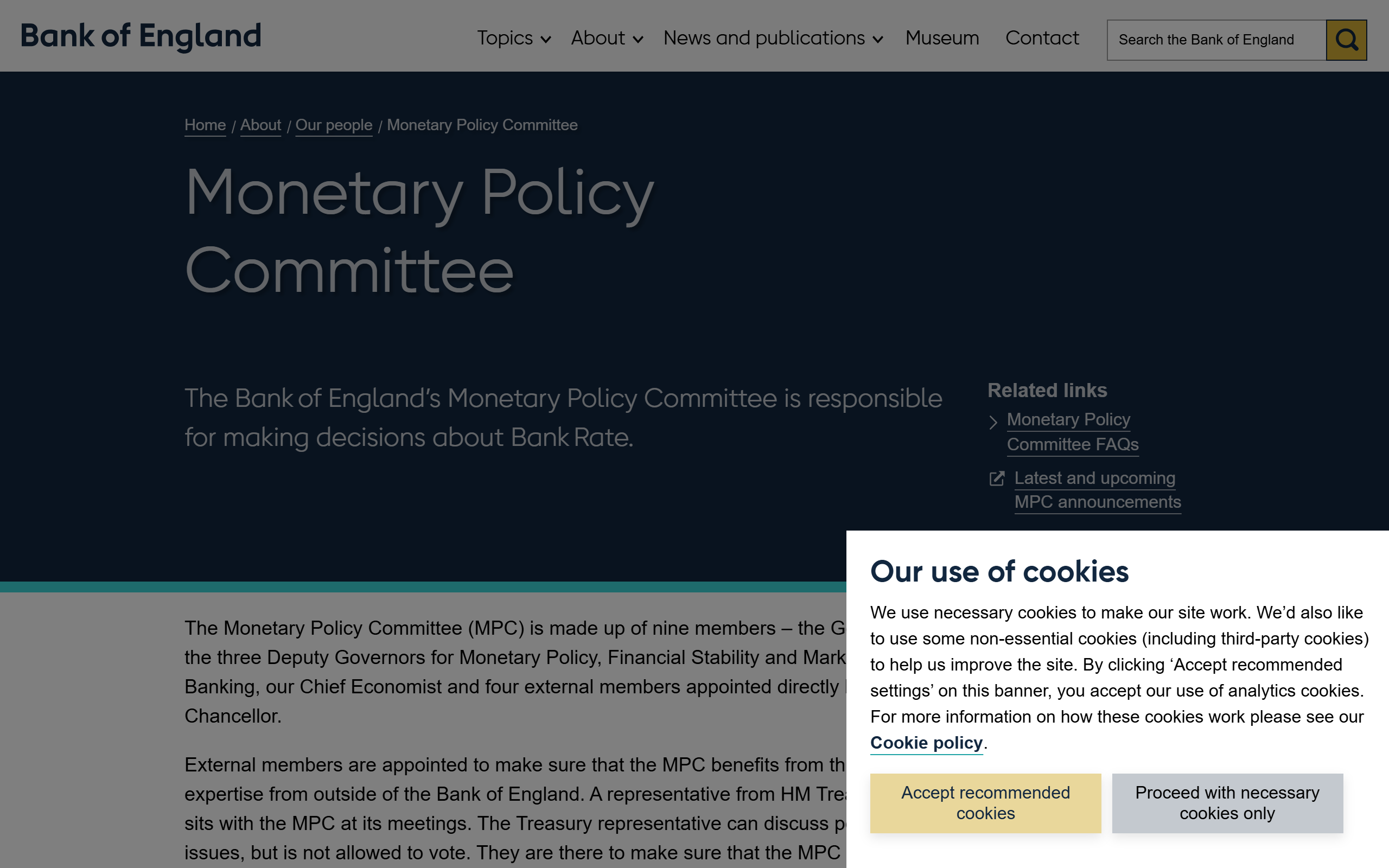
The MPC meets eight times a year, roughly every six weeks. The committee votes and the decision is published at noon along with a written summary. The voting split is published openly. A 5-4 split signals genuine disagreement and tends to move markets more than a unanimous decision because it suggests the next meeting could swing the other way.
The MPC has a single legal target: keep CPI inflation at 2% over the medium term. If inflation strays more than one percentage point either side of 2%, the Governor has to write an open letter explaining why and what the Bank plans to do about it. Bailey has had to write several of these in recent years.
The committee also pays attention to growth, employment, and financial stability, but inflation is the anchor. Everything feeds into the question: is inflation likely to be at 2% in around two years? If the answer is "no, too high," they raise rates. If "no, too low," they cut. If "roughly on track," they hold.
What the base rate does to your money
The base rate changes the price of money, and the price of money changes almost every financial decision a household, business, or investor makes. A higher base rate means borrowing costs more and saving pays better. A lower base rate runs the logic in reverse: borrowing is cheap, savings are punished, and asset prices tend to rise. This is why central banks use rate cuts as the standard medicine for recessions.
The transmission from a rate change to the real economy is slow. The Bank of England estimates the full effect takes 12 to 18 months to work through. Mortgage holders on fixed deals only feel it when their fix expires. That lag is also why markets care so much about the path of rates, not just today's level: bond yields, swap rates, and mortgage pricing are built around expectations of where the base rate will be in one, two, and five years time.
Here is how the main products respond.
Mortgages
If you are on a tracker mortgage, your rate moves directly with the base rate, usually with a fixed margin on top. Base rate +0.99% means a base rate hike of 0.25 lifts your payment by the same amount, immediately.
If you are on a standard variable rate (SVR), your lender chooses when and how much to pass on. SVRs tend to rise quickly after hikes and fall slowly after cuts, which is why they are usually the most expensive option.
If you are on a fixed-rate mortgage, today's base rate does not affect your payments at all. What matters is the rate when you remortgage. Fixed deals are priced from swap rates, which are market-traded contracts reflecting expectations of where the base rate will average over the fix period. If markets expect the base rate to rise, two-year and five-year swaps move first, and mortgage rates follow.
For a deeper look at the different products, our UK mortgage types guide covers the trade-offs.
Savings
Savings rates move with the base rate, but not perfectly. Banks have an incentive to widen their margins when rates rise. The pass-through to easy access savings is usually slow and partial. The pass-through to fixed-term savings (bonds, fixed-rate ISAs) is much closer to one-for-one because banks have to compete for the deposits to fund their fixed-rate lending.
If you want to track where the best deals sit at any time, see our best savings account UK guide.
Credit cards and personal loans
Credit card APRs are typically far above the base rate (often 19-29%), so a 0.25 percentage point move barely registers in the headline rate. What matters more is the underlying funding cost banks charge each other, which feeds into how generous they are with introductory offers. When the base rate is high, 0% balance transfer windows shorten and the post-promo rates rise.
Personal loan rates move more closely with the base rate, especially for prime borrowers. A 1 point hike in the base typically adds 0.5 to 0.8 points to a representative APR within a few months.
Gilts and corporate bonds
Gilt yields and the base rate are tightly linked at the short end. The two-year gilt yield is essentially a forecast of where the average base rate will sit over the next two years. The ten-year gilt yield reflects a longer view plus a term premium for taking on duration risk.
When the base rate rises, existing bonds with lower coupons fall in price so their yield matches the new market level. This is why bond funds can lose money in a hiking cycle even if you do not sell. Our UK bonds guide goes into how this works in practice and where to buy gilts directly.
Equities
The relationship between rates and stocks is messier. In theory, a higher base rate makes future earnings less valuable today, which should pull share prices down. In practice, rate hikes often happen when the economy is strong, which supports earnings and offsets some of the discount-rate effect.
Sectors respond differently. Banks usually benefit from higher rates because their net interest margins widen. Highly indebted companies and growth stocks priced on far-future cash flows tend to suffer.
Sterling
Higher base rates attract foreign capital. International investors can earn a better return holding gilts, so they buy sterling to do it, and the pound rises. Lower rates do the opposite. Sterling strength and weakness then feed back into UK inflation through import prices, especially energy and food.
What moves the base rate up or down
Five things dominate MPC thinking. Understanding them is most of what you need to read rate decisions sensibly.
Inflation versus the 2% target. This is the headline driver. If CPI is running well above 2% and looks like staying there, the bias is to hike. If CPI is below 2% with weak growth, the bias is to cut. The MPC's own forecast in the Monetary Policy Report matters more than the latest inflation print, because policy works on a lag and the committee is targeting where inflation will be, not where it is.
The labour market. Tight labour markets push wages up, which feeds into services inflation. The MPC watches employment, vacancies, and wage growth closely. When wage growth is running well above productivity growth, that is a hawkish signal. Loosening labour markets pull in the other direction.
Energy and commodity prices. External shocks like oil price spikes can drive inflation without any underlying demand pressure. This is the cost-push problem we covered in our piece on oil prices, inflation and interest rates. The MPC tries to look through one-off price shocks but has to act if they risk de-anchoring inflation expectations.
Growth and credit conditions. If banks are pulling back lending and businesses are shelving investment, that is a recessionary signal. The MPC will be more reluctant to hike into weakness and more inclined to cut. Stagflation, where growth is weak and inflation is high, traps the committee in a no-win position. We covered this in stagflation explained.
The exchange rate. A weaker pound makes imports more expensive and adds to inflation. A stronger pound does the reverse. The MPC does not target sterling, but they pay attention because exchange rate moves can shift the inflation outlook fast.
The MPC publishes a Monetary Policy Report alongside its February, May, August, and November meetings. If you want primary sources, that is the document. It lays out the Bank's view of the economy and includes fan charts showing the range of inflation and growth outcomes the committee considers plausible.
How to position yourself when rates change
You do not need to predict the next move. The MPC itself struggles to do that. What you need is a framework for adjusting your decisions to the direction of travel.
When rates are rising or expected to rise:
- Lock in fixed-rate mortgages early. Two-year and five-year swap rates move ahead of the base rate, so the best deals tend to disappear before the hike is announced.
- Move savings into fixed-term products. Easy access pass-through is slow, but fixed-rate ISAs and bonds tend to price in expected hikes immediately.
- Be cautious adding long-duration bonds to your portfolio. Their prices fall when yields rise.
- Pay down variable-rate debt aggressively. Each hike makes the balance more expensive to carry.
When rates are falling or expected to fall:
- Avoid locking in long fixed-rate mortgages. A tracker can pay off, especially if the deal allows switching to a fix later.
- Lock in savings while rates are still high. Fixed-rate ISAs taken out now will keep paying their original rate for the term, even as easy access rates collapse.
- Consider extending bond duration. Longer-dated gilts gain more in price when yields fall.
- Refinance expensive debt while underwriting is still generous.
When the path is uncertain:
- Avoid concentrated bets either way. Split mortgages across different fix lengths if the option is available. Hold a mix of cash, bonds, and equities. The benefit of a diversified portfolio is precisely that you do not need to be right about the next rate decision.
- Build a margin in your budget. Stress-test your finances against a base rate two percentage points higher than today using a mortgage calculator. If you cannot survive that, you have too much rate risk.
The base rate cycle is one of the few things in finance that genuinely repeats. Households that survive a full cycle without forced selling, panic-fixing, or capitulation tend to come out wealthier than those who try to time each move.
Frequently Asked Questions
What is the current Bank of England base rate?
The base rate changes through the year as the MPC decides. The most reliable source is the Bank of England's official Bank Rate page, which lists the current rate, the date of the next decision, and the full history going back to 1694. Avoid relying on news articles older than a few weeks because rate moves can be quick.
How often does the base rate change?
The MPC can change the rate at each of its eight scheduled meetings. In quiet periods it can stay still for a year or more. Emergency cuts outside the schedule are rare but happen, as they did in March 2020 during the early Covid panic.
Does the base rate directly affect my mortgage payment?
Only if you are on a tracker or standard variable rate. Fixed-rate mortgages are unaffected by today's base rate but priced from market expectations of where it will be over the term, which is why fixed deals can change daily even when the headline rate has not moved for months.
Can the base rate go below zero?
Technically yes. The ECB, the Swiss National Bank, and the Bank of Japan have all run negative rates at various points. The Bank of England has stayed above zero so far but reviewed the operational feasibility of negative rates in 2020-2021. The bar is high because negative rates create awkward incentives for banks and savers.
Read Next
- UK mortgage types compared - tracker, fixed, SVR and which to pick at the current point in the cycle.
- Best savings accounts UK - where to park cash when the base rate is moving.
- UK bonds explained: gilts and premium bonds - how rate moves change the price of bonds you already own.
- Stagflation explained - what happens when the MPC cannot cut and cannot hike.
Further Reading:
The Psychology of Money - Morgan Housel - Why behaviour matters more than spreadsheets when rates move and headlines panic. The best primer on staying steady through a rate cycle. (Affiliate link - we may earn a small commission at no extra cost to you.)
Devil Take the Hindmost - Edward Chancellor - A history of speculation that shows how loose money fuels bubbles and tight money pops them. Useful context for what monetary policy is actually trying to manage. (Affiliate link - we may earn a small commission at no extra cost to you.)
Prefer to watch?
We turn these money breakdowns into short videos
A few a week, plain-English UK money. If you would sooner watch than read, follow along:
Enjoying the content?
If this site has been useful, a coffee goes a long way.
Browse more articles
Browse all