



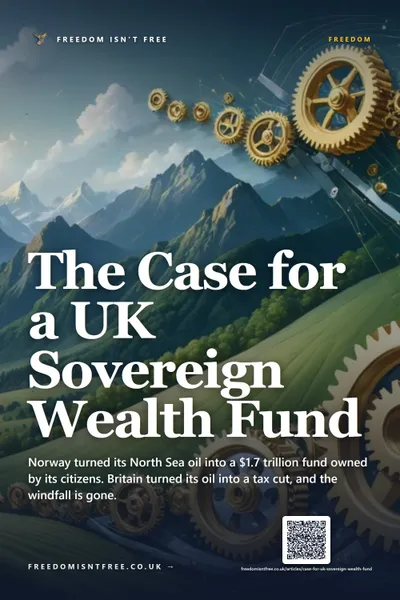



The Case for a UK Sovereign Wealth Fund
Norway turned its North Sea oil into a $1.7 trillion fund owned by its citizens. Britain turned its oil into a tax cut, and the windfall is gone.
Cite this article
Freedom Isn't Free (2026) The Case for a UK Sovereign Wealth Fund. Available at: https://freedomisntfree.co.uk/articles/case-for-uk-sovereign-wealth-fund (Accessed: 10 October 2026).
Italicise the article title in your bibliography. Accessed date set to today.
TLDR
- Britain extracted hundreds of billions of pounds of North Sea oil from the late 1970s onwards. Norway, with similar geological luck, built a sovereign wealth fund now worth around $1.7 trillion. Britain has no fund. The Thatcher governments used the revenue for tax cuts and unfunded liabilities, and the windfall is gone.
- A sovereign wealth fund is collective ownership of productive capital. Norway pays its returns into general government finances. Alaska pays a yearly dividend directly to every resident. Both create a stake for ordinary citizens that no working person can lose by missing a tax bracket or running short on savings.
- A UK fund could be capitalised today through a wealth tax, mining royalties on lithium and tidal energy, the QE bond holdings the Bank of England already owns, the privatisation receipts that have not yet been spent, or a managed slice of corporate tax revenue.
- The political fight is whether the dividend goes to citizens directly, into general spending, or into individual capitalised accounts. Each model has trade-offs and each is already running somewhere in the world. None of this is fantasy.
Three working sovereign wealth fund models
| Country | Fund size | Started | Dividend route |
|---|---|---|---|
| Norway (GPFG) | $1.7tn | 1990 | Into government finances |
| Alaska (APF) | $80bn | 1976 | Direct citizen cheque |
| Singapore (CPF) | $400bn+ | 1955 | Individual capitalised accounts |
| United Kingdom | Nothing comparable | - | n/a |
Sources: NBIM, Alaska Permanent Fund Corporation, CPF Board.
The Case for a UK Sovereign Wealth Fund
Britain has spent the past forty years arguing about how to redistribute income. It has barely begun the argument about how to redistribute capital. Only the second addresses the deep imbalance the UK now lives with - the wealthiest 10% of households hold around half of the country's wealth, the share has been rising for two decades, and the political mechanisms designed to slow it are not working.
A sovereign wealth fund is the simplest, oldest, and most durable answer to that imbalance. It is collective ownership of productive capital, run for the benefit of citizens, paying a return that flows back into the population either as a direct dividend, into government finances, or into individual capitalised accounts. It has been done. It is being done. Britain just chose not to do it.
This piece makes the case that the UK should build one now, explains the three working models already operating around the world, sets out what a British fund could realistically be capitalised with in 2026, and is honest about the political fight required to make it happen.
Contents
- What a sovereign wealth fund actually is
- Norway, Alaska, Singapore: three working models
- Britain's missed sovereign wealth moment
- How a UK fund could be funded today
- How the dividend could reach citizens
- The political economy
- Frequently Asked Questions
What a sovereign wealth fund actually is
A sovereign wealth fund is a state-owned investment vehicle. Its capital is built from public sources - resource royalties, surplus tax revenue, privatisation receipts, central bank reserves - and invested in productive assets, typically a globally diversified portfolio of equities, bonds, and real estate.
The defining features:
- The capital is collectively owned. Citizens of the country are the ultimate beneficiaries, not individual shareholders or political donors.
- The returns are recycled. Earnings go either to government spending, to citizen dividends, or to long-term reinvestment, depending on the fund's mandate.
- The mandate is intergenerational. A well-run fund is built to outlast any single government, with rules on contributions, withdrawals, and investment that are difficult to change without legislative supermajorities.
That last point matters. A wealth fund is harder to raid than a tax revenue stream because it has its own legal structure, its own board, and a public mandate that creates political cost to undermining it. Norway's Government Pension Fund Global is the world's most prominent example. Its rules cap government withdrawals at 3% of fund value per year, allowing the principal to compound. After thirty years of contributions, the fund is now worth more per Norwegian than the entire UK GDP per capita.
This is what genuine collective ownership of capital looks like in practice. Not state-run companies. Not nationalised industries. A diversified investment portfolio held in trust for the population, run on the same principles a serious pension fund would use.
Norway, Alaska, Singapore: three working models
Three live examples show what a sovereign wealth fund actually delivers when implemented.
Norway's Government Pension Fund Global (GPFG) is the largest in the world. It was started in 1990, capitalised over the following decade with surplus oil and gas revenue, and now holds around $1.7 trillion in assets. The fund owns roughly 1.5% of every listed company on earth. Norway's withdrawals are capped at 3% of fund value per year, which currently funds roughly 20% of total Norwegian government spending. That is the dividend: the fund pays for hospitals, schools, infrastructure, and tax cuts, indefinitely. Each Norwegian citizen has a notional share of around $300,000 in the fund. None of them can withdraw it. All of them benefit from it.
The Alaska Permanent Fund takes a different approach. Established in 1976, capitalised with oil royalties, it now holds around $80 billion. Crucially, the fund pays a direct annual dividend to every Alaskan resident. Each year, every man, woman, and child who has lived in Alaska for the qualifying period receives a cheque - typically $1,000-$2,000 in a normal year, sometimes higher. That dividend has paid uninterrupted for over four decades. It is the closest existing approximation to a universal basic capital dividend, funded by collectively owned natural resources.
Singapore's Central Provident Fund (CPF) is a hybrid. Each citizen has an individual account funded by mandatory contributions from both employer and employee. The accounts are managed centrally with state-guaranteed minimum returns, and balances can be drawn down for housing, healthcare, and retirement. It is technically not a sovereign wealth fund in the strict sense (Singapore has separate funds, GIC and Temasek, that play that role), but the CPF model is widely cited as a way to give citizens individual capital ownership while pooling investment management at scale.
The three models illustrate the design space:
- Norway: pool the capital, distribute via government spending
- Alaska: pool the capital, distribute via direct citizen cheque
- Singapore: individualise the capital, pool the management
A UK fund could in principle adopt any of the three, or a hybrid. None of them is theoretical. All have decades of operating history.
Britain's missed sovereign wealth moment
In 1976, the same year the Alaska Permanent Fund was established, Britain began commercial production from the North Sea. Over four decades the UK extracted around 45 billion barrels of oil and gas equivalent, generating somewhere between £350 billion and £600 billion in nominal revenue - one of the largest resource windfalls in modern European history. Norway, sitting next to the same field on similar geological terms, captured its share in a sovereign wealth fund. Britain spent its share on income tax cuts, subsidised privatisations, and the unfunded liabilities of an ageing workforce.
Norway's fund has compounded for thirty years and now finances a fifth of all government spending. Britain's 1980s tax cuts were absorbed into the baseline within a decade. Every Norwegian citizen is the beneficial owner of around $300,000 of capital that no British citizen possesses. The mistake cannot be undone, but it can be partially recovered if Britain decides to start today.
How a UK fund could be funded today
There is no longer a North Sea windfall to capture. The remaining UK oil and gas reserves are modest and declining. But there are several other sources that could capitalise a UK sovereign wealth fund without raising income tax on working people.
Mining and resource royalties. The UK has commercially significant lithium reserves in Cornwall and Devon, with extraction projects already underway. Tidal and offshore wind generation produces revenue streams that could be tithed. Geothermal heat extraction is starting to scale. Each of these is a natural-resource flow that should, by Norwegian logic, be partly captured by the public.
A wealth tax above a high threshold. As argued in our piece on why Britain won't tax wealth, an annual levy on net wealth above £10 million would raise tens of billions per year with no impact on the bottom 99% of households. Hypothecating that revenue to a sovereign wealth fund (rather than into general spending) creates a virtuous cycle: wealth taxed from concentrated holdings is reinvested into a fund that gives every citizen a stake.
The Bank of England's QE holdings. The Asset Purchase Facility currently owns over £800 billion of UK government bonds (down from £895 billion at peak). These were created out of nothing during the financial crisis and Covid. The capital gains on the eventual sale of those bonds, plus the coupon income, could be transferred to a sovereign wealth fund rather than back to the Treasury. This was a one-time monetary experiment; using the proceeds to seed a permanent capital pool is more defensible than using them to plug a year-by-year fiscal gap.
Capitalised privatisation receipts. Future privatisations (or part-floats of state-owned assets like NS&I, the Crown Estate, or Channel 4) could route the proceeds into a fund rather than into general spending.
A small slice of corporate tax revenue. A 1-2 percentage point top-up to corporation tax, ring-fenced for the fund, would build the capital base over a decade without an immediate fiscal hit.
A combination of these sources could realistically capitalise a UK fund at £200-400 billion within a decade. That is not Norwegian scale, but it is enough to fund a meaningful annual citizen dividend or a substantial offset to the tax burden on working people.
How the dividend could reach citizens
The political fight is not just over whether to build the fund but how the returns reach the population. Three credible options:
The Norway model: into general government finances. Returns flow to the Treasury and reduce the need for income or consumption tax. This is the easiest model to administer and the most politically durable, because every spending department becomes a beneficiary and a defender of the fund. The downside is that citizens do not feel the dividend directly. It is invisible.
The Alaska model: a direct citizen dividend. Each year, every UK adult resident receives a cheque or bank credit equal to their per-capita share of the year's fund return, capped at a ceiling. A £200 billion fund earning 5% real returns and paying out 3% of value would distribute roughly £6 billion a year, or about £100 per adult. That is a modest figure but a tangible one, and it grows with the fund. Politically, the Alaska dividend has proved almost impossible to abolish - once people receive money directly, they vote to keep it.
The Singapore model: capitalised individual accounts. Each citizen has a notional share in the fund, built up over their working life from their own contributions and from public capital. The accounts can be drawn down for housing, education, retirement, or medical costs at defined life stages. This combines a sovereign wealth fund with a pension reform, and is closer to giving every citizen genuine ownership of capital rather than a periodic income stream.
A British fund could pick one or combine them. The choice has real consequences for behavioural and political outcomes, but each is workable.
The political economy
The argument against a UK sovereign wealth fund is not technical. It is political.
The case made by opponents is that a large state-controlled capital pool will be mismanaged, raided by future governments, used for politically motivated investment, or become an opaque slush fund. Each concern has historical examples. State investment vehicles in less democratic countries have indeed been mismanaged and politicised. Britain's own state holdings have at times been used for industrial policy that produced poor returns.
These concerns are real but solvable. Norway's GPFG operates under tight rules: an independent investment manager (NBIM, part of the central bank), a public ethics framework, a parliamentary oversight committee, and statutory caps on government withdrawals. The fund has survived eight changes of government and three international financial crises without a serious raid. The institutional design is well-understood.
The deeper political opposition is structural. A sovereign wealth fund of meaningful scale would shift power. It would create a stake for ordinary citizens in the productive economy, alongside (or in place of) the stake currently concentrated in the inherited capital of the wealthiest 10%. That is not an outcome the major British political parties have an obvious incentive to deliver. The wealthy donate. The asset-poor do not.
But the maths is moving. The fiscal pressure on the UK is real and worsening. The triple lock alone is consuming an ever-larger share of national income, as covered in our piece on its unsustainability. The income tax base is squeezed. The wealth that could be taxed is concentrating faster than the political tools to reach it. At some point - within a decade if the trajectory holds - Britain will have to make a serious decision about whether to keep transferring resources from working-age people to a narrow asset-owning class, or whether to give working-age people a stake in the country's productive capital instead.
A sovereign wealth fund is one of the few mechanisms that does the second. It would not be quick. It would not be politically easy. But every comparable country that has built one is, on balance, a richer, fairer, and more stable place than the UK in 2026. The model exists. The question is whether Britain still has the political imagination to copy it.
Frequently Asked Questions
Does the UK have a sovereign wealth fund?
Not in the conventional sense. The Crown Estate, local authority pension funds, and the Bank of England's Asset Purchase Facility all hold public assets, but none is a true sovereign wealth fund of the Norwegian or Alaskan type. The 2024 "National Wealth Fund" is a green-economy project finance vehicle in the British Investment Bank tradition, not a citizen-dividend or general-purpose SWF.
What is the Alaska Permanent Fund Dividend?
An annual cash payment made by the State of Alaska to every qualifying resident, funded by the investment returns of the Alaska Permanent Fund. The dividend has been paid every year since 1982. The amount varies with fund performance and political decisions, but typically falls between $1,000 and $2,000 per person.
Wouldn't a UK SWF just get raided by future governments?
It is a real risk and the central design challenge. Norway has avoided it through statutory caps on withdrawals (3% per year), an independent investment manager, public reporting, and cross-party consensus. A British equivalent would need similar protection: a statutory cap, an independent board, public reporting, and a parliamentary supermajority requirement to change the mandate.
Could a UK SWF replace income tax?
Not entirely. Norway's fund finances roughly 20% of government spending, not 100%. A UK fund of plausible size would offset perhaps 5-15% of total tax revenue over a decade or two, depending on capitalisation pace and returns. That is meaningful but not transformative on its own. The bigger effect is structural: it shifts a portion of national income from working-age earners to all citizens equally, including those who own no capital today.
Why didn't Thatcher save the North Sea oil revenue?
The Thatcher government's economic philosophy was that fiscal surpluses should be returned to taxpayers via tax cuts rather than retained in state-owned investment vehicles. The decision was ideologically consistent and politically popular at the time. The contrast with Norway is now starkly visible in per-capita national wealth and fiscal strength.
Further Reading:
Debt: The First 5,000 Years - David Graeber - Graeber traces how monetary systems through history have either concentrated capital in narrow hands or recycled it into the population. The case for a sovereign wealth fund sits squarely in this tradition. (Affiliate link - we may earn a small commission at no extra cost to you.)
A Short History of Financial Euphoria - John Kenneth Galbraith - Galbraith's tight account of how financial systems concentrate gains in the hands of those who already hold capital, and why the political response has so often failed. Useful context for why a sovereign wealth fund is the unusual mechanism that has actually worked. (Affiliate link - we may earn a small commission at no extra cost to you.)
Prefer to watch?
We turn these money breakdowns into short videos
A few a week, plain-English UK money. If you would sooner watch than read, follow along:
Enjoying the content?
If this site has been useful, a coffee goes a long way.
Browse more articles
Browse all