






Gary Stevenson's Wealth Tax: The Missing Manifesto
A Citi trader spent his twenties betting against the economy he grew up in and won. Now he's on the BBC arguing Britain needs a wealth tax. The bit of his case that doesn't land.
Cite this article
Freedom Isn't Free (2026) Gary Stevenson's Wealth Tax: The Missing Manifesto. Available at: https://freedomisntfree.co.uk/articles/gary-stevenson-wealth-tax (Accessed: 21 September 2026).
Italicise the article title in your bibliography. Accessed date set to today.
TLDR
- Gary Stevenson is a former Citibank FX trader from East London who now runs the GarysEconomics YouTube channel and argues that inequality is the defining economic problem of our generation.
- His core claim is that working-age households are losing wealth to a small asset-owning class, and that without a wealth tax this divergence will accelerate into a permanent rentier economy.
- We agree with the diagnosis. The data on UK wealth concentration backs him up and the political class has avoided the question for decades.
- Stevenson's stated position is that his job is to shift public opinion and leave the legislative detail to politicians - a defensible division of labour for an economist. Our reservation is narrower: the campaign would still land harder paired with at least one worked manifesto somewhere in the wealth tax movement, even if it doesn't come from Stevenson himself.
UK net wealth distribution by household decile
Source: ONS Wealth and Assets Survey. The bottom half own roughly 5% of UK net wealth.
Gary Stevenson's Wealth Tax: The Missing Manifesto
Gary Stevenson's wealth tax campaign is the loudest left-economic voice in Britain in 2026. His core claim is that inequality is no longer a side issue for British economic policy. It is the central one.
We broadly agree. The wealth concentration data, the stagnant wages, the asset-price inflation that has locked a generation out of housing - the diagnosis is correct. Britain has a wealth problem that income tax cannot fix.
Where we'd push back is narrower, and Stevenson can fairly push back at us in return. His stated role is to shift public opinion and leave the legislative detail to politicians, which is a defensible division of labour for an economist who is not running for office. Our reservation: a movement at this scale lands harder when there is at least one specific worked example to point at, even if it doesn't come from the campaign's most visible voice.
Contents
- Who Gary Stevenson actually is
- From Citi trading floor to YouTube channel
- What Gary Stevenson argues about inequality
- Why his case is largely right
- The missing manifesto
- What an implementation plan needs to contain
- Frequently Asked Questions
Who Gary Stevenson actually is
Gary Stevenson grew up in Ilford, in working-class East London. He won a scholarship to the London School of Economics and, while studying there, won Citibank's annual trading game competition. The prize was a fast-tracked place on the bank's foreign-exchange and interest-rate desk in Canary Wharf. He spent the next several years trading short-dated rates in the period immediately after the 2008 financial crisis, by his own account becoming one of the most profitable traders on the desk during those years.
He left the bank in his late twenties. The reason he gives in his memoir is that he could no longer reconcile the trade he was putting on (interest rates would stay low for years because ordinary households would never recover their pre-crisis spending power) with the consequences he saw in the country he had grown up in. The bet was a winning one. The country it was a bet against was the same country his family still lived in.
He published the memoir, The Trading Game, in 2024. It became a Sunday Times bestseller and put him on the BBC, in the Guardian, and on a long list of finance and politics podcasts. The combination of biography (working-class kid, beat the system, walked away) and economic claim (the system is broken and concentrating wealth) is the source of his reach. Most economic commentators in Britain either grew up wealthy or work inside an institution that requires them to be careful. Stevenson is neither.
From Citi trading floor to YouTube channel
The platform he built after leaving the bank is GarysEconomics on YouTube, at youtube.com/@garyseconomics. It has crossed 1.5 million subscribers and is, by some distance, the most-watched UK economics channel aimed at ordinary viewers. The format is plain: Stevenson talking to a camera (occasionally a co-host), explaining wealth concentration, government debt, asset prices, or central bank policy from the perspective of a former trader who profited from the system he is now criticising. No graphics-heavy explainer style, no softened conclusions.
The reach has been large enough that mainstream political parties have started to respond. Senior figures in the Labour left and the Greens have cited his arguments. Critics on the centre and right have written rebuttals. The campaign has moved from internet niche to political background noise faster than most economic movements do.
What Gary Stevenson argues about inequality
The argument Stevenson makes is consistent across his videos and his book. Stripped to the load-bearing claims:
- Inequality, not growth, is the central problem. Britain's productivity has stagnated for fifteen years, but more importantly the gains that have been produced have flowed almost entirely to the top 10% of households. The bottom 50% own a tiny fraction of national wealth and that share has been shrinking.
- Government deficits transfer wealth upwards. When the state runs a deficit and the central bank funds it through asset purchases, the immediate beneficiaries are asset holders. Quantitative easing inflated house prices, equity prices, and bond prices. The people who already owned those assets in 2010 are now substantially wealthier. The people who did not are now locked out of them.
- The trajectory is self-reinforcing. Once wealth concentrates above a certain level, it can earn more from passive ownership than the median worker earns from labour. That divergence accelerates over time. Without intervention, Britain ends up as a rentier economy where ownership of assets, not work, determines material outcomes.
- The only real solution is a wealth tax. Income tax cannot fix the problem because the wealth at the top does not flow as income. It sits in capital appreciation, family trusts, and inherited property. A tax on net assets above a high threshold is, in Stevenson's argument, the only mechanism that addresses the actual source of the inequality.
Each claim is contested in detail, but the direction is supported by data the Office for National Statistics' Household Total Wealth in Great Britain bulletin, the Resolution Foundation, and the IFS have all published independently. Britain's wealth-to-income ratio has roughly doubled since the 1980s. The top 10% of households hold around half of all wealth; the bottom 50% hold around 5%.
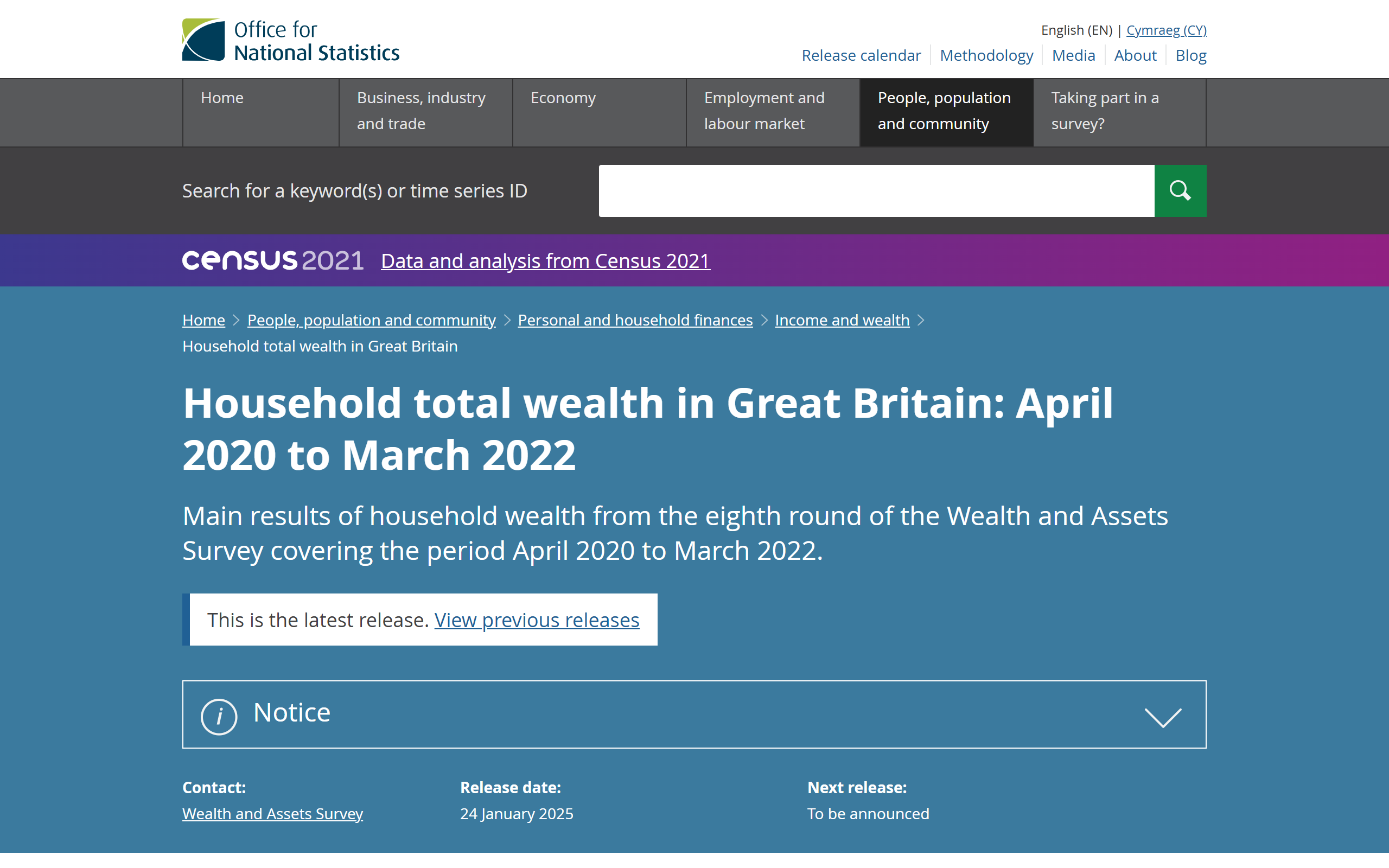
Top 10% share of UK net household wealth, 2006-2022
ONS Wealth and Assets Survey, biennial waves
Source: ONS Wealth and Assets Survey (Total wealth in Great Britain bulletins, waves 1-8). LSE Politics and Policy adjusted estimates note ONS figures may understate the true top-share by 2-3pp because the survey under-represents the wealthiest households.
The reason a wealth tax debate keeps coming back is that the official series above is the conservative one. Researchers at LSE and Warwick have shown the ONS survey under-samples the wealthiest households, so the true top-10% share is likely 2-3 percentage points higher than this chart shows, and the trend is more strongly upward once business equity is included.
Why his case is largely right
We have made several of the same arguments in different language: why the UK won't tax wealth, the case for a UK sovereign wealth fund, and stealth taxes on working-age earners. YouGov polling on wealth taxes targeted at the largest fortunes has consistently shown 70%+ support for the past three years. The opposition is not coming from the electorate. It is coming from the political class that filters which arguments reach it. If the goal is to make wealth taxation a mainstream political demand in Britain, Stevenson has done more in three years than any think tank or party manifesto in the previous twenty.
The missing manifesto
Here's the fair counter to our position, and where Stevenson can reasonably push back. His stated job is to make the public case for change, not to draft the legislation that delivers it. For an economist with a large audience, that's a defensible split: build the political space first, and let politicians, civil servants, and think tanks argue out the technical detail once the space exists. Plenty of historic policy shifts followed exactly that pattern - the case was made in the country before the bill was drafted in Westminster.
Our reservation is narrower. Once a movement is at scale, opponents attack the missing detail precisely because it is missing, and the abstract case has fewer answers than a specific worked example would. Six questions any worked example has to answer, whether Stevenson drafts it himself or someone else in the movement does:
- What is the threshold? Net wealth above £1 million? £10 million? £100 million? Each figure produces a different revenue estimate, a different political coalition, and a different set of administrative challenges. The argument that "the rich should pay more" does not answer this question.
- What is the rate? A flat 1% per year on net wealth above the threshold raises a very different amount, and a very different political reaction, than a graduated rate climbing to 3-5% on the largest fortunes.
- What is the asset base? Does the tax include primary residence value? Pensions? Business equity? Family trusts? Art and other illiquid assets? Each inclusion or exclusion changes both the politics and the yield.
- How are illiquid assets valued? A landed estate, a private company, or an art collection does not have a daily market price. The valuation method is the single largest source of administrative complexity and abuse risk in any wealth tax. Any serious proposal has to specify it.
- What is the enforcement and anti-avoidance plan? Wealth above the threshold is mobile and well-advised. Without a credible exit-tax regime, an anti-trust-avoidance provision, and international cooperation on residency, the tax becomes a list of fortunes that left.
- What is done with the revenue? General spending? Hypothecated to a sovereign wealth fund? A citizen dividend? The choice of destination changes both the political appeal and the structural effect.
Stevenson's content has gestured at most of these questions but has not consolidated the answers into a single document, and he is open about that being a deliberate choice rather than an oversight. The campaign has the energy and the audience. What it does not yet have, anywhere in the movement, is a credible worked policy document the public can be pointed at.
The opponents of a wealth tax in Britain already have a manifesto: the status quo. Until somewhere in the campaign for change publishes a specific implementable alternative, the policy debate keeps defaulting back to the existing tax code by default. That manifesto can come from a think tank, a sympathetic MP, an independent wealth tax commission, or Stevenson himself - the source matters less than its existence.
What an implementation plan needs to contain
If we were drafting a manifesto for the wealth tax movement Stevenson has built, the structure would be roughly:
- A threshold of £10 million in net household wealth, chosen because it excludes the entire 99% of UK households and concentrates the political fight on a small, well-defined group of households.
- A graduated annual rate starting at 1% from £10m to £50m, 2% from £50m to £250m, and 3% above £250m. Modest enough that productive businesses can absorb it from yield, steep enough that the largest fortunes contribute meaningfully.
- An inclusive asset base covering equities, bonds, property, private business equity, art, and family trust assets above the threshold. Pensions excluded up to a generous cap to avoid double-taxing existing retirement provision.
- A valuation regime built around five-yearly professional valuations for illiquid assets, with safe-harbour formulae for private company equity tied to multiples of audited earnings.
- An exit-tax provision modelled on the US expatriation tax, charging a deemed-disposal capital gains hit on any non-domiciled or relocating individual whose net wealth crossed the threshold in the previous decade.
- A revenue destination of 50% to a UK sovereign wealth fund (building a compounding citizen stake) and 50% to fund the abolition of the 60% tax trap and the frozen-threshold fiscal drag on working-age households.
The details above are one plausible version. Reasonable people in the movement will disagree about thresholds, rates, and revenue destinations. A wealth tax that survives published policy detail is one the country can actually pass. A movement that only ever operates in principles risks winning arguments online while the existing tax code wins the policy fight by default.
Frequently Asked Questions
What is Gary Stevenson's wealth tax proposal?
Stevenson argues that a meaningful tax on net wealth above a high threshold is the only mechanism that can reverse the upward concentration of UK wealth since 2008. He has not published a single specific proposal with a threshold, rate, asset base, and enforcement regime; his general position is that the tax should fall on the largest fortunes and the revenue should fund redistribution to working-age households.
Is Gary Stevenson right about UK inequality?
The empirical claims are largely supported by independent data from the ONS, Resolution Foundation, and IFS. The top 10% of households hold roughly half of UK net wealth, and that share has risen substantially since the 1980s. The mechanism is accepted across the political spectrum. The policy response is what is contested.
Has Gary Stevenson published a manifesto?
Not in the form of a single document specifying threshold, rate, asset base, valuation method, anti-avoidance regime, and revenue destination. His stated position is that drafting legislation is not his job, which is a defensible division of labour. Our argument is that the campaign as a whole would still land harder paired with at least one worked example somewhere in the movement.
Will the UK ever introduce a wealth tax?
Public support has polled above 70% for wealth taxes targeting the largest fortunes, but the political class has avoided the question for decades. Whether that changes depends on fiscal pressure, the persistence of campaigns like Stevenson's, and whether a major party adopts a specific implementable proposal. See our analysis of why the UK won't tax wealth.
Further Reading:
Debt: The First 5,000 Years - David Graeber - Graeber's history of how monetary systems through the ages have either concentrated capital in narrow hands or recycled it back into the population. Useful background for Stevenson's central claim that the current settlement is a political choice, not a natural state. (Affiliate link - we may earn a small commission at no extra cost to you.)
A Short History of Financial Euphoria - John Kenneth Galbraith - Galbraith's tight account of how financial systems repeatedly concentrate gains in the hands of those who already hold capital, and why the political response so often fails. The historical companion piece to the wealth tax argument. (Affiliate link - we may earn a small commission at no extra cost to you.)
Prefer to watch?
We turn these money breakdowns into short videos
A few a week, plain-English UK money. If you would sooner watch than read, follow along:
Enjoying the content?
If this site has been useful, a coffee goes a long way.
Browse more articles
Browse all