

Plum App Review 2026: Fees, Safety, Verdict
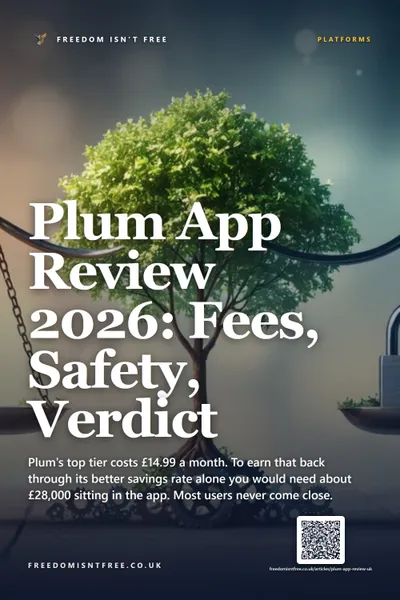
Plum's top tier costs £14.99 a month. To earn that back through its better savings rate alone you would need about £28,000 sitting in the app. Most users never come close.
Cite this article
Freedom Isn't Free (2026) Plum App Review 2026: Fees, Safety, Verdict. Available at: https://freedomisntfree.co.uk/articles/plum-app-review-uk (Accessed: 21 September 2026).
Italicise the article title in your bibliography. Accessed date set to today.
TLDR
- Plum is an auto-saving app that nudges money out of your current account using a set of transfer rules it markets as AI. The nudge works; the branding oversells it.
- The free Basic tier (auto-save plus around 3% easy-access interest) and the Cash ISA (around 4.44% AER including a 12-month bonus) are the bits worth using.
- The paid tiers (Plus £3.99, Boost £7.99, Max £14.99 a month) rarely pay for themselves: to recoup the £14.99 Max fee on its rate uplift alone you would need roughly £28,000 in the app.
- A flat monthly subscription is brutal maths on a small pot - check what your money actually earns versus what the subscription costs before you upgrade.
Plum subscription tiers and break-even (2026)
| Tier | Monthly cost | Easy-access rate | Balance to break even on rate alone |
|---|---|---|---|
| Basic | Free | about 3.00% | n/a |
| Plus | £3.99 | about 3.00% | rate not the reason to buy |
| Boost | £7.99 | about 3.20% | about £48,000 |
| Max | £14.99 | about 3.63% | about £28,000 |
Plum App Review 2026: Fees, Safety, Verdict
Plum is a perfectly decent auto-saving app wrapped in a subscription model that, for most people, costs more than it gives back. That tension runs through this Plum review, because the free tier and the Cash ISA are genuinely worth using while the paid subscriptions are where the app makes its money off you.
Here is the short version. The paid tiers - £3.99, £7.99 and £14.99 a month - are the bit to think hard about before tapping upgrade. A flat monthly fee on a savings pot is one of the more punishing pricing structures in UK fintech, and almost nobody actually works out whether it pays for itself. Spoiler: usually it does not.
What is Plum?
Plum is an app that connects to your current account, watches your income and spending, and automatically moves small amounts into savings using a set of rules it markets as artificial intelligence. In practice the "AI" is an automated transfer algorithm: it skims a few pounds here and there on days you can afford it and drops the money into a Plum pocket. You can also set round-ups and fixed weekly deposits.
Strip away the branding and Plum is doing the same behavioural job as Moneybox or a standing order you set yourself: it removes the friction and the willpower from saving. That nudge is real and useful. What it is not is a clever robot growing your money. It is a transfer rule with good marketing.
On top of the auto-saver, Plum offers interest-bearing pockets, a Cash ISA, investing through mutual funds and stocks, and a pension. Most of the better features sit behind a monthly subscription.
Plum subscription tiers and fees
Plum restructured its pricing in July 2025. As of June 2026 there are four tiers:
- Basic - free. Auto-saving, round-ups, and an easy-access pocket paying around 3% AER.
- Plus - £3.99 a month. Mainly cheaper investing fees.
- Boost - £7.99 a month. Adds a Plum Visa debit card, spending insights, a slightly better easy-access rate (around 3.20%), a wider fund range, and a 0.30% investment management fee.
- Max - £14.99 a month. The best easy-access rate (around 3.63%), a 95-day notice pocket at a higher rate, the most funds, unlimited free stock trades, a 0.15% management fee, and lifestyle perks like travel insurance and cinema deals.
The first month of any paid tier is free, and you can switch or cancel whenever you like. So far, so reasonable. The problem is what those monthly fees do to your actual return.
The subscription maths nobody runs
A percentage fee scales with your pot. A flat monthly fee does not, and that is what makes Plum's pricing quietly expensive. Max at £14.99 a month is £179.88 a year, whether you have £500 in the app or £50,000.
Now weigh that against what you get for it. The headline reason to pay for Max is the better easy-access rate: around 3.63% versus 3% on the free tier, an uplift of about 0.63%. To earn back £180 a year on a 0.63% advantage, you need roughly £28,000 sitting in that pocket. Below that balance, the subscription costs you more than the rate uplift gives you.
Boost is worse on this measure. At £7.99 a month (£95.88 a year) for a 0.20% rate advantage, the break-even balance is around £48,000. And here is the kicker: if you genuinely have £28,000 or £48,000 in easy-access cash, you should not be holding it in a Plum pocket at all. You should be in a Cash ISA to shelter the interest from tax, or in fixed-rate savings for a better return. The balance at which the subscription starts to pay for itself is the same balance at which a smarter saver has already moved the money somewhere better.
Which means you are not really buying the rate. You are buying the debit card, the perks and the cheaper investing - things you can get free elsewhere. A Trading 212 card gives cashback and free withdrawals at no monthly cost. A global tracker in a cheap ISA beats Plum's managed funds on fees. The £14.99 is paying for convenience and a NordVPN subscription you probably already have.
Plum Cash ISA: the bit worth using
The Cash ISA is the strongest product in the app. As of June 2026 it pays around 4.44% AER (variable), built from a base rate of roughly 2.54% plus a bonus of about 1.9% for the first 12 months. The ISA wrapper shelters the interest from tax, and unlike the subscription tiers there is no flat fee eating into the return.
The structure is the same trap every bonus account sets: the rate looks great for a year, then the bonus drops off and you are on the base rate unless you move. Set a calendar reminder for month 11 and switch if it has slipped. Treated that way, it is a competitive home for cash you want to keep liquid and tax-free, and it stands up well against the best easy-access savings accounts when the bonus is live.
Is my money safe with Plum?
This is the question that matters most, and it has a more careful answer than "yes". Plum is regulated by the Financial Conduct Authority, but how your money is protected depends on which pocket it is in.
The Cash ISA is held with partner banks - Citibank and Lloyds - and is covered by the Financial Services Compensation Scheme up to £120,000 per banking licence (the limit rose from £85,000 in December 2025). The interest-bearing pockets are similarly placed with FSCS-protected banks. But Plum's basic everyday balance is held as electronic money, which is safeguarded under e-money rules rather than FSCS-protected. Safeguarding means your cash is ring-fenced from Plum's own finances, but it does not carry the same compensation guarantee as an FSCS-covered bank deposit.
In plain terms: money in the Cash ISA and the interest pockets is protected like a normal savings account; money sitting in the basic auto-save balance is protected differently. If you are holding a meaningful sum, keep it in the Cash ISA or an interest pocket rather than the everyday balance, and check which partner bank holds it so you do not accidentally double up on the £120,000 limit with savings you already hold there.
Frequently Asked Questions
Is Plum a trustworthy app?
Plum is authorised and regulated by the FCA and has millions of UK users, so it is a legitimate, regulated business rather than a scam. The criticisms in forums tend to be about transparency - bonus rates that lapse, withdrawal timings, and the value of the paid tiers - rather than safety. Read the small print on fees and protection and you will know what you are signing up for.
Is Plum or Monzo better?
They do different jobs. Monzo is a full current account with a banking licence and FSCS-protected deposits; Plum is a savings-and-investing layer that sits on top of whatever current account you already have. If you want everyday banking, Monzo. If you want automated saving and a competitive Cash ISA without switching banks, Plum's free tier does that. Many people use both.
Is my money safe with Plum?
It depends on the pocket. The Cash ISA and interest-bearing pockets are held with partner banks (Citibank and Lloyds) under FSCS protection up to £120,000 per banking licence. The basic everyday balance is safeguarded e-money, which is ring-fenced but not FSCS-covered in the same way. Keep larger sums in the Cash ISA or an interest pocket rather than the basic balance.
Why can't I withdraw all my money from Plum?
Usually it is a settlement delay, not a block. Cash from the easy-access pockets is normally available within a couple of hours, though it can take up to a working day. Money in investments or mutual funds has to be sold first, which takes several working days to settle before it reaches your bank. If a withdrawal looks stuck, check whether the money is in cash or invested.
Is the Plum subscription worth it?
For most people, no. The free Basic tier covers auto-saving and a competitive Cash ISA. The paid tiers rarely earn back their flat monthly fee through the rate uplift alone unless you hold tens of thousands in the app, at which point you would be better off in a dedicated Cash ISA or fixed savings anyway. Pay for a tier only if you specifically want the debit card, the perks, or the cheaper investing - and even then, compare them against free alternatives first. For investing in particular, a cheap investment platform will almost always beat Plum's managed funds once the subscription is in the picture.
This article is for general information, not financial advice. When you invest, your capital is at risk and the value of investments can fall as well as rise. Subscription prices and interest rates quoted are variable and correct as of June 2026; check Plum for current figures. Tax and ISA rules can change, and how they affect you depends on your circumstances.
Sources
Prefer to watch?
We turn these money breakdowns into short videos
A few a week, plain-English UK money. If you would sooner watch than read, follow along:
Enjoying the content?
If this site has been useful, a coffee goes a long way.
Browse more articles
Browse all