

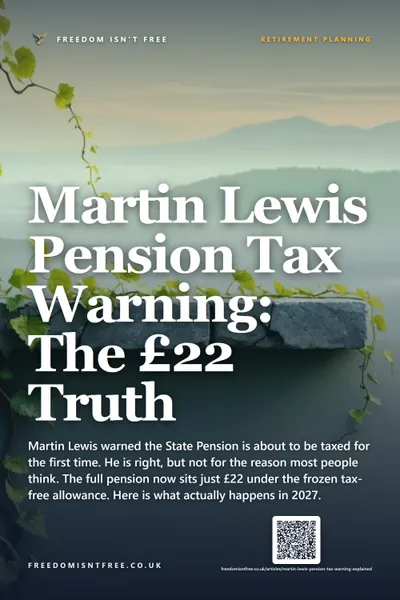


Martin Lewis Pension Tax Warning: The £22 Truth
Martin Lewis warned the State Pension is about to be taxed for the first time. He's right, but not for the reason most think. It now sits just £22 under the frozen tax-free allowance. What actually happens in 2027.
Cite this article
Freedom Isn't Free (2026) Martin Lewis Pension Tax Warning: The £22 Truth. Available at: https://freedomisntfree.co.uk/articles/martin-lewis-pension-tax-warning-explained (Accessed: 23 August 2026).
Italicise the article title in your bibliography. Accessed date set to today.
TLDR
- Martin Lewis's pension tax warning is really a frozen-threshold story. The triple lock keeps raising the State Pension while the £12,570 tax-free Personal Allowance stays frozen until April 2031.
- The full new State Pension for 2026/27 is £12,547.60 a year, just £22 below the allowance. On current projections it crosses the line in 2027/28, taxing the full State Pension for the first time.
- At the November 2025 Budget the Chancellor told Martin Lewis that people whose only income is the State Pension will not be chased for tax this Parliament. That is an admin promise, not a permanent carve-out.
- The levers that actually help: Marriage Allowance worth up to £252, salary sacrifice while you are still working, filling National Insurance gaps, and checking your tax code is right.
The State Pension vs the frozen tax-free allowance
| Tax year | Full new State Pension | Personal Allowance |
|---|---|---|
| 2024/25 | £11,502.40 | £12,570 |
| 2025/26 | £11,973.00 | £12,570 |
| 2026/27 | £12,547.60 | £12,570 |
| 2027/28 (projected) | ~£12,861 | £12,570 |
The triple lock keeps pushing the State Pension up. The Personal Allowance is frozen at £12,570 until April 2031. The lines cross in 2027/28. 2027/28 figure assumes the 2.5% triple-lock floor and is illustrative.
Martin Lewis's Pension Tax Warning: The £22 Truth
The Martin Lewis pension tax warning lands every few months and gets read as the same scary headline: the government is coming for your pension. That is not what he is saying, and the gap between the headline and the actual mechanism is where most people get the wrong idea. The warning is real. It is also far more boring, and far more fixable, than "they are taxing your pension" makes it sound.
Here is the honest version. The State Pension is not being singled out for a new tax. It is being dragged into an old one, because the triple lock keeps pushing it up while the tax-free allowance sits frozen. That is fiscal drag, the quietest tax rise in the book, and the State Pension is now close enough to the line that the full amount alone is about to tip over it. Lewis has been flagging the exact year. So will this article.
Contents
- What is Martin Lewis's pension tax warning?
- Why the State Pension is about to be taxed for the first time
- What the Chancellor actually promised
- The other warning: do not panic over your tax-free lump sum
- How much can a pensioner earn before paying tax?
- What you can actually do about it
- Frequently Asked Questions
What is Martin Lewis's pension tax warning?
Strip away the headline and the warning is a collision between two numbers that move in opposite directions.
The first number is the full new State Pension. It rises every April under the triple lock, which guarantees an increase of the highest of price inflation, average earnings growth, or 2.5%. In April 2026 earnings growth won at 4.8%, so the full new State Pension rose to £241.30 a week, or £12,547.60 a year.
The second number is the Personal Allowance, the slice of income you can earn before income tax starts. It is £12,570. It has not moved since 2021, and at the November 2025 Budget the freeze was extended again, this time to 5 April 2031. So while the State Pension climbs every year, the tax-free line stays nailed to the floor.
Put the two side by side and the warning explains itself. The full new State Pension is now £12,547.60. The allowance is £12,570. The gap is £22. One more triple-lock rise and the full State Pension on its own pokes above the tax-free threshold for the first time in history. That is the warning. Not a new tax. A frozen one finally biting.
Why the State Pension is about to be taxed for the first time
The triple lock has a floor of 2.5%, so even in a bad year the State Pension cannot rise by less than that. Apply 2.5% to £12,547.60 and you get roughly £12,861 for 2027/28. The allowance is still £12,570. The full State Pension would clear it by around £290, and around £58 of tax would be due on that excess at the basic 20% rate.
When the full State Pension crosses the frozen tax-free allowance
Source: gov.uk State Pension rates and Income Tax thresholds. 2027/28 State Pension assumes the 2.5% triple-lock floor and is illustrative.
The amounts are small at first. We are talking tens of pounds, not a wholesale raid. But the direction is fixed: the allowance is frozen until 2031, the triple lock keeps climbing, so the taxable slice grows every year after the crossover. This is the same frozen tax thresholds mechanism quietly pulling millions of workers into higher bands, applied to pensioners. A pensioner with the full State Pension and nothing else goes from paying nothing, to paying a few pounds, to paying a bit more each year, purely because Westminster left the allowance where it was.
And remember this only describes the worst-affected, simplest case: someone with the full new State Pension and no other income at all. Anyone with a private or workplace pension on top has been paying tax on that top slice for years already, because the State Pension swallows most of the allowance first. The 2027 milestone is the moment the floor itself becomes taxable.
What the Chancellor actually promised
This is where the headline and the reality split hardest. At the November 2025 Budget, and then on a live ITV special with Martin Lewis the day after, Chancellor Rachel Reeves addressed exactly this. She confirmed that people whose only income is the State Pension will not be made to pay income tax on it during this Parliament, and will not be dragged into filling out a tax return for the sake of a few pounds. Reeves herself put the crossover at "2027".
Fair enough as far as it goes. But read the small print, because Lewis did. Three things matter.
First, it is a promise for this Parliament only. Reeves declined to commit beyond it. A future government, or this one after the next election, is not bound by it.
Second, it is administrative relief, not a tax cut. Nobody is raising the allowance or carving the State Pension out of income tax. The plan is to spare State-Pension-only pensioners the hassle of a Simple Assessment bill for a trivial sum. The underlying liability does not disappear, it just is not chased.
Third, it does nothing for the millions with a private pension on top. If you have any other taxable income, you are already over the line and this promise was never about you.
My honest take: the cleanest way to read the whole saga is that the triple lock and the frozen allowance are two halves of the same policy. One hands pensioners a visible rise every April that makes a good headline. The other quietly claws a sliver of it back through a threshold nobody updated. Calling it a "pension tax" makes it sound deliberate and targeted. "Fiscal drag" is uglier and more accurate.
The other warning: do not panic over your tax-free lump sum
There is a second pension warning Lewis repeats, and it is worth separating from the first because people blur them. Before almost every Budget, rumours swirl that the Chancellor is about to cut the 25% tax-free lump sum you can take from a private pension. Every time, savers panic and rush to pull the 25% out early to "lock it in".
The rules have not changed. You can normally take 25% of your private pension pot tax-free, capped by a lump sum allowance of £268,275, frozen since the Lifetime Allowance was scrapped in April 2024. The November 2025 Budget left it untouched.
The general guidance Lewis gives here is the sensible one: do not blow up a perfectly good plan over a rumour. Pulling a big lump sum out of a tax-sheltered pension and parking it in a taxable account, just because a newspaper ran a speculative front page, can cost you far more than the change you were scared of, especially if the lump sum drags you into a higher tax band in a single year. The pension wrapper is doing a job. Wrenching the money out early to dodge a tax that has not been announced is usually the actual mistake.
How much can a pensioner earn before paying tax?
£12,570 of total income in 2026/27, the Personal Allowance, and not a penny more before income tax starts. Above that, income tax applies at 20% in the basic-rate band, the same as for everyone else. The State Pension is taxable income, it is just not subject to National Insurance.
What confuses people is how the tax gets collected, because the State Pension is paid gross, with no tax deducted at source. HMRC recovers any tax due in one of two ways:
- If you have another income source taxed through PAYE, such as a workplace or private pension, HMRC lowers the tax code on that income to collect the tax owed on your State Pension as well. This is why people say "I am suddenly paying tax on my pension", when really the code on their private pension was adjusted to mop up the State Pension liability.
- If you have no PAYE income to adjust, HMRC sends a Simple Assessment, which is a bill calculated from the information it already holds. No tax return required.
For how the State Pension sits inside the wider system of workplace and private pots, see UK pensions explained. For the structural detail on the State Pension itself, the dates and the qualifying years, the companion piece is State Pension at 66 UK, and to check your own number start with State Pension forecast UK.
What you can actually do about it
The warning is real, but the "they are taxing your pension" framing leaves readers feeling there is nothing to be done. There is. The levers are small individually and they stack.
- Claim Marriage Allowance. If one of a couple is a non-taxpayer and the other is a basic-rate taxpayer, the non-taxpayer can transfer £1,260 of unused Personal Allowance, worth up to £252 a year, and it can be backdated four years. For a retired couple where one has little income, this is free money most people leave on the table. The mechanics, and who qualifies, are in Marriage Allowance UK.
- Salary sacrifice while you are still working cuts your taxable income now and your National Insurance, and it builds the private pot that funds the years before and around State Pension age. The mechanics are in salary sacrifice pension UK.
- Filling National Insurance gaps is often the highest-return move available to anyone near retirement, because the State Pension you get depends on your NI record. Start from find lost pensions UK and your forecast.
- Check your tax code is actually right. When HMRC adjusts a code to collect State Pension tax, it sometimes gets the sums wrong, and you only find out if you look. A wrong code is the single most common reason a pensioner overpays.
None of this stops the frozen allowance doing its slow work. But it is the difference between watching the warning happen to you and doing something about the part you control.
Frequently Asked Questions
Are they going to start taxing the State Pension?
Not as a new, separate tax. The State Pension is already taxable income. What is changing is that the full new State Pension is about to exceed the frozen £12,570 Personal Allowance, on current projections in 2027/28, so for the first time the full amount on its own becomes partly taxable. Anyone with other pension income on top has been over the line for years.
What is Martin Lewis's advice on the pension tax warning?
In short: understand that this is fiscal drag, not a targeted raid, and do not panic. Check your tax code, claim Marriage Allowance if you qualify, and ignore pre-Budget rumours telling you to rush money out of your tax-free lump sum. The State-Pension-only promise the Chancellor made covers this Parliament only.
What is the maximum a pensioner can earn before paying tax?
£12,570 of total income in 2026/27, the same Personal Allowance as everyone else. The full new State Pension uses £12,547.60 of that, so any meaningful income on top is taxed from the first pound. A pensioner with only the State Pension stays just inside the allowance for 2026/27.
Why am I suddenly paying tax on my pension?
Usually because HMRC has lowered the tax code on your private or workplace pension to collect the tax due on your State Pension as well. The State Pension is paid without tax taken off, so the tax gets recovered through the code on your other income. It can feel like a new tax on the private pension when it is really the State Pension liability being collected.
Will I be taxed on my State Pension in 2026?
If the State Pension is your only income, no. For 2026/27 the full amount is £12,547.60, which sits £22 under the £12,570 allowance. The crossover is projected for 2027/28, and even then the Chancellor has said State-Pension-only pensioners will not be chased for the small amount due during this Parliament. If you have other taxable income, your total is what counts, and you may already be over the allowance.
This article is general educational content, not financial, tax, or pensions advice. Tax thresholds, allowances, the lump sum allowance, and State Pension rates change between tax years and at successive Budgets, and the 2027/28 figures here are projections based on the 2.5% triple-lock floor. Verify any specific amount, date, or threshold against gov.uk before acting on it, and consider speaking to a regulated adviser or MoneyHelper for material decisions about Marriage Allowance, salary sacrifice, voluntary National Insurance contributions, or taking your tax-free lump sum.
Sources
- gov.uk - Over 12 million pensioners to receive State Pension boost (2026/27 rates)
- gov.uk - Income Tax rates and Personal Allowance
- gov.uk - Maintaining Income Tax thresholds until 5 April 2031
- MoneySavingExpert - Martin Lewis: Chancellor confirms State Pension income tax position
- gov.uk - Tax on your private pension: lump sum allowance
- gov.uk - Marriage Allowance
Prefer to watch?
We turn these money breakdowns into short videos
A few a week, plain-English UK money. If you would sooner watch than read, follow along:
Enjoying the content?
If this site has been useful, a coffee goes a long way.
Browse more articles
Browse all