
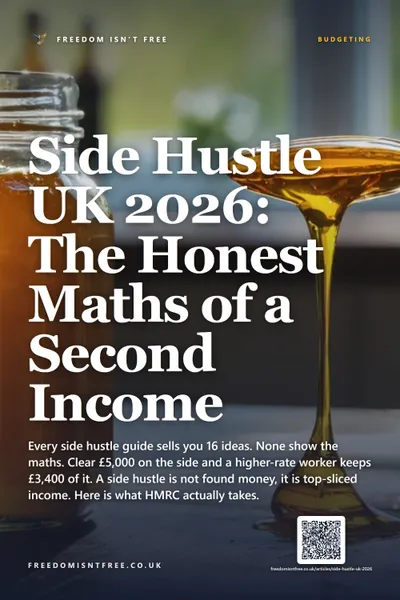



Side Hustle UK 2026: The Honest Maths of a Second Income
Every side hustle guide sells you 16 ideas. None show the maths. Clear £5,000 on the side and a higher-rate worker keeps £3,400 of it. A side hustle is not found money, it is top-sliced income. Here is what HMRC actually takes.
Cite this article
Freedom Isn't Free (2026) Side Hustle UK 2026: The Honest Maths of a Second Income. Available at: https://freedomisntfree.co.uk/articles/side-hustle-uk-2026 (Accessed: 21 September 2026).
Italicise the article title in your bibliography. Accessed date set to today.
TLDR
- A side hustle in the UK is a second income taxed at your marginal rate, so the same £5,000 leaves a basic-rate worker £4,200 and a higher-rate worker £3,400.
- The £1,000 trading allowance is your real tax-free line. Earn less than that from trading and you do not need to tell HMRC. Earn more and you must register for Self Assessment.
- The platform reporting rule (30 sales or about £1,700 a year) is a disclosure trigger, not a tax-free allowance. Selling your own second-hand things is not trading and is not taxed.
- A £3,000 reporting threshold is coming this Parliament, but it is not live yet. Until it is, the £1,000 figure still decides whether you file.
What £5,000 of side-hustle income actually clears (2026/27)
| Basic-rate worker | Higher-rate worker | |
|---|---|---|
| Side hustle profit | £5,000 | £5,000 |
| Trading allowance | -£1,000 | -£1,000 |
| Taxable profit | £4,000 | £4,000 |
| Tax due | £800 (20%) | £1,600 (40%) |
| You keep | £4,200 | £3,400 |
Assumes your day job already uses your Personal Allowance and the side income sits within the basic or higher band. No Class 4 National Insurance until profit tops £12,570. 2026/27 rates.
Side Hustle UK 2026: The Honest Maths of a Second Income
A side hustle in the UK gets sold to you the same way every time: a listicle of sixteen ideas, a stock photo of someone smiling at a laptop, and a vague promise of "extra cash". What none of them show you is the part that actually decides whether it is worth your evenings, which is the maths after HMRC takes its cut. So that is what this article does.
Here is the reframe that matters before any of the ideas. A side hustle is not found money. It is a second income, stacked on top of your day job, and taxed at your top marginal rate from the first pound over £1,000. The £200 you cleared selling on Etsy is not £200. It is £200 minus 20%, or minus 40% if your salary already pushes you into the higher band. Get that in your head first and every "make £500 a month on the side" headline reads differently.
Contents
- What counts as a side hustle, and what HMRC actually taxes
- Will HMRC know about my side hustle? The platform reporting rules
- The £1,000 trading allowance: your real tax-free line
- The maths: what a side hustle actually clears
- When you have to register for Self Assessment
- Frequently asked questions
What counts as a side hustle, and what HMRC actually taxes
The first thing to get straight is that HMRC does not tax "side hustles". It taxes trading, and the two are not the same thing.
If you buy or make things to sell at a profit, drive for Uber, let a room on Airbnb, walk dogs, freelance, or run an online shop, you are trading. That income is taxable. If you are clearing out your loft and selling old clothes, a broken games console and the kids' outgrown toys on Vinted or eBay, you are not trading, you are selling your own second-hand possessions, and that is generally not taxable no matter how much the total adds up to. HMRC's own wording is blunt: "You're unlikely to pay tax if you sell personal items from your home."
The one trap in the personal-items rule is high-value single objects. Sell a single item or a set for more than £6,000, say an antique, a piece of jewellery or a painting, and you can owe Capital Gains Tax on the profit. For the contents of a normal garage, you will never get near it.
So the test is not "did money come in", it is "was I trading". Hold that distinction, because the next section is where most people get scared by the wrong number.
Will HMRC know about my side hustle? The platform reporting rules
Since January 2024, online platforms have had to collect data on their sellers and report it to HMRC, with the first reports landing in January 2025. Vinted, eBay, Etsy, Airbnb, Uber, Deliveroo and the rest now hand over your details once you pass a threshold: roughly 30 sales of goods in a year, or total receipts of about £1,700 (the rule is set in euros, at 2,000).
This is the number that sent everyone into a panic, and it is the number everyone misreads. The platform reporting threshold is not a tax-free allowance. It is a disclosure trigger, nothing more. HMRC says it plainly: passing it "does not automatically mean that you owe tax". All it means is that HMRC now holds the same figures you do.
The two numbers do two different jobs:
- The £1,700 / 30-sales rule decides whether the platform tells HMRC about you.
- The £1,000 trading allowance decides whether you owe tax and have to file.
You can blow past the platform threshold flogging your own wardrobe and owe nothing, because that is not trading. You can stay under it while quietly running a profitable little trading business and still owe tax, because the £1,000 trading line is what counts. HMRC holding your numbers is a long way from HMRC taxing them. The takeaway is simpler than the scare stories: if you are genuinely trading and clearing more than £1,000 of it, declare it, and the platform data becomes irrelevant because you were going to tell them anyway.
The £1,000 trading allowance: your real tax-free line
The trading allowance is the figure that actually matters, and it has been around since 2017. It works like this: the first £1,000 of gross trading income in a tax year is tax-free, and if that is all you make, you do not have to tell HMRC at all.
Two details people miss:
- It is gross income, not profit. If you turned over £1,200 selling handmade candles, you are over the line even if your materials cost £400, because the £1,000 test is on the £1,200, not the £800 you kept.
- It is the allowance or your actual expenses, never both. You either knock £1,000 off your income and ignore your real costs, or you deduct your genuine expenses and ignore the allowance. For a low-cost hustle, the £1,000 allowance usually wins. For one with real overheads, deducting actual expenses usually does.
Cross past £1,000 of gross trading income and you have to register for Self Assessment and declare the lot, paying tax on the profit above the allowance. That is the trigger. Not £1,700, not 30 sales. £1,000.
The maths: what a side hustle actually clears
This is the section the idea-lists never include. Say your side hustle clears £5,000 of profit in a year, on top of a day job that already uses your Personal Allowance.
Use the £1,000 trading allowance and £4,000 is taxable. What you keep depends entirely on what your salary already is:
- A basic-rate worker pays 20% on the £4,000, so £800 in tax, and keeps £4,200.
- A higher-rate worker pays 40% on the £4,000, so £1,600 in tax, and keeps £3,400.
Same hustle. Same hours. Same £5,000. The higher earner keeps £800 less, because the side income stacks on top of a salary that is already in the 40% band. That is what "taxed at your marginal rate" means in pounds, and it is the single most important thing to understand before you decide a hustle is worth it.
National Insurance is the part that catches people once a hustle gets bigger. Class 2 National Insurance stopped being a mandatory charge in April 2024, so most self-employed people no longer pay it. Class 4 kicks in once your self-employed profit tops £12,570, at 6% up to £50,270 and 2% above. A £5,000 hustle is well under that, so no Class 4. A £20,000 hustle is not, and the NI starts to bite on the slice above £12,570.
When you have to register for Self Assessment
If your gross trading income clears £1,000, you need to register for Self Assessment, and the deadlines are not optional.
- Register by 5 October following the end of the tax year you started. Miss it and the penalties compound.
- File and pay by 31 January for an online return. So for income earned in the 2025/26 tax year, you register by 5 October 2026 and file by 31 January 2027.
The mechanics of that first return trip up almost everyone, so it is worth reading how to do a Self Assessment tax return in the UK before the deadline rather than the night before.
There is a change coming that will help smaller hustles. The government has announced that the trading-income reporting threshold will rise from £1,000 to £3,000 gross, with a new simple online service replacing the full Self Assessment return for people earning between the two. It is a real plan, expected within this Parliament, and it would take an estimated 300,000 people out of filing. But it is not live yet. As of 2026, the £1,000 threshold is still the one that decides whether you file, so do not plan around the £3,000 figure until HMRC switches it on.
For the deeper detail on declaring a second income, the companion piece is side hustle tax UK, and if your hustle is turning into a proper business, limited company vs sole trader UK covers the point where incorporating starts to pay. And if the whole point of the extra income is to buy yourself out of full-time work sooner, how to FIRE without a high income makes the case that a modest side income plus a high savings rate beats chasing a bigger salary.
Frequently Asked Questions
What is the best side hustle in the UK?
The one that pays well per hour or builds something that keeps earning, not the one with the most exciting headline. Freelancing a skill you already have at work, renting out a spare room, or selling a product with real margin tends to beat gig-app driving and survey sites once you account for tax and your own time. The "best" hustle is the one whose after-tax hourly rate beats whatever else you would do with the hours.
How can I make £200 a week in the UK?
£200 a week is roughly £10,400 a year of gross income, which is comfortably into taxable trading territory, so budget for tax from the start. Realistic routes are freelancing a professional skill, tutoring, renting a room under the Rent a Room scheme, or a product business with decent margins. Remember the £200 is pre-tax: a higher-rate worker keeps about £120 of it once it stacks on their salary.
How do I earn an extra £500 a month in the UK?
£500 a month is £6,000 a year, so you will clear the £1,000 trading allowance in your second month and need to register for Self Assessment. After the allowance and basic-rate tax, you keep around £5,000 of it; as a higher-rate taxpayer, closer to £4,000. The planning number that counts is the after-tax figure, not the headline.
Will HMRC know about my side hustle?
If you use an online platform and pass about 30 sales or £1,700 a year, the platform reports your details to HMRC automatically. But that is a disclosure rule, not a tax rule. If you are genuinely trading and clearing over £1,000, you should be declaring it through Self Assessment regardless of what any platform reports, and if you are only selling your own second-hand belongings, there is usually nothing to tax in the first place.
Do I have to pay tax on a side hustle under £1,000?
No. The £1,000 trading allowance means that if your gross trading income for the year is £1,000 or less, it is tax-free and you do not have to tell HMRC. The moment your gross trading income exceeds £1,000, you must register for Self Assessment and declare it, paying tax on the profit above the allowance.
This article is general information about the UK tax system, not personal tax advice. Tax rules, allowances and thresholds change, and how they apply depends on your own circumstances. The earnings figures used here are illustrative pre-tax examples, not a promise of what any particular side hustle will pay. For anything material - a fast-growing side business, multiple income sources, or six-figure earnings - speak to a qualified accountant or tax adviser.
Sources
- gov.uk - Tax-free allowances on property and trading income
- gov.uk - Selling goods or services on a digital platform
- HMRC - Tax help for hustles campaign
- gov.uk - Self Assessment tax return deadlines
- gov.uk - Self-employed National Insurance rates
- gov.uk - 300,000 people to be taken out of tax returns (£3,000 threshold)
Prefer to watch?
We turn these money breakdowns into short videos
A few a week, plain-English UK money. If you would sooner watch than read, follow along:
Enjoying the content?
If this site has been useful, a coffee goes a long way.
Browse more articles
Browse all