
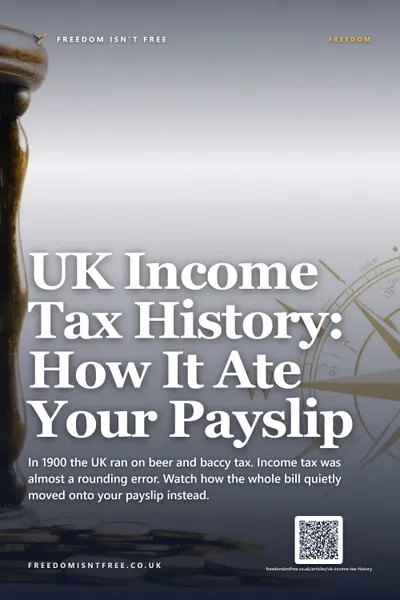

UK Income Tax History: How It Ate Your Payslip
In 1900 the UK ran on beer and baccy tax. Income tax was almost a rounding error. Watch how the whole bill quietly moved onto your payslip instead.
Cite this article
Freedom Isn't Free (2026) UK Income Tax History: How It Ate Your Payslip. Available at: https://freedomisntfree.co.uk/articles/uk-income-tax-history (Accessed: 23 August 2026).
Italicise the article title in your bibliography. Accessed date set to today.
TLDR
- In 1900 the UK government ran mostly on duty from drink and tobacco (around 34% of receipts), with customs, death duties and land tax close behind. Income tax was a minor line at about 16%.
- Income tax was not absent from the empire - it was reintroduced in 1842. It was just small. Two world wars and the arrival of PAYE in 1944 turned it into the giant it is today.
- Income tax, National Insurance and VAT now raise around 63% of everything the Treasury collects. The old taxes on consumption and inherited wealth have shrunk to slivers.
- Frozen thresholds are the modern version of the same shift: the OBR expects them to raise £42.9bn a year and pull nearly 4 million more people into income tax, without a single rate rising.
Alcohol and tobacco duty: share of UK tax receipts
The single biggest tax in 1900 is now a rounding error. Source: IFS, OBR, ONS.
UK Income Tax History: How It Ate Your Payslip
Ask most people about UK income tax history and they picture a permanent fixture, something Britain has always leaned on the way it leans on the weather. It has not. In 1900, at the height of an empire that governed a quarter of the planet, the single biggest tax the government collected was the duty on beer, spirits and tobacco. Income tax was a bit-part player. The story of the last 126 years is the story of how the whole bill quietly moved off the pub and onto your payslip.
We built a 126-second chart to show it happening. The dry pages that rank for this topic give you a list of rates by decade. What they never do is draw the line that matters: the tax base was rebased, off consumption and inherited wealth and onto wages. That is not an accident of history. It is the most important thing about how you are taxed today.
Contents
- What Britain actually ran on in 1900
- No, we did not run the empire without income tax
- The three moments that moved the tax onto wages
- What shrank: the taxes on drink, death and land
- Fiscal drag: the same shift, happening right now
- Frequently asked questions
What Britain actually ran on in 1900
Strip out the non-tax income and look at where a tax pound came from at the turn of the century. Excise duty on drink and tobacco was the biggest single line, around 34% of tax receipts. Customs duties on imports added another fifth or so. Death duties on estates ran into the low teens. There was even a land tax still trundling along, a Georgian survival worth a few per cent. Income tax? Roughly one pound in six.
So the Edwardian state was funded, overwhelmingly, by what people bought and what they left behind when they died. A tax system built on the pint, the pipe and the probate file. It was regressive as anything - a docker and a duke paid the same duty on the same pint - but it was cheap to collect and nobody had to fill in a form.
That is the shape you need to hold in your head, because almost every part of it has since been demolished.
No, we did not run the empire without income tax
There is a seductive line doing the rounds that Britain built a global empire without an income tax, so why do we need one now. It is a good pub argument and it is wrong on the facts.
Income tax was introduced by Pitt the Younger in 1799 to fund the war against Napoleon, dropped after Waterloo, then brought back for good by Sir Robert Peel in 1842. It has been with us, continuously, ever since. Through the entire imperial high noon of the late Victorian and Edwardian era, income tax existed. It was simply small, and it fell on a narrow band of the well-off. The empire did not run without income tax. It ran with a tiny one.
That distinction is the whole point. The question is not "why do we tax income at all", it is "how did a minor tax on the rich become the single largest source of government revenue, paid by almost every working adult in the country". Three moments did most of the work.
The three moments that moved the tax onto wages
The People's Budget and the wars. Lloyd George's 1909 Budget put the politics of taxing income on the map with a super-tax on high earners and the machinery that would become National Insurance. Then the two world wars did what wars always do: they forced the state to reach much deeper into the population's pockets. The share of tax coming from income roughly doubled across the First World War. By 1945, income tax alone was worth about a fifth of the entire economy.
PAYE, 1944. This is the quiet giant of the story. Pay As You Earn meant the tax was deducted at source, by your employer, before the money ever reached you. It turned income tax from a bill a minority of people paid once a year into an automatic, invisible skim off every wage packet in the country. Mass income tax is only possible because you never see the money. PAYE locked in the wartime ratchet and it never came back down.
VAT, 1973. When Britain joined the EEC it swapped its old purchase tax for Value Added Tax. VAT started at 8%, was hauled up to 15% in 1979, to 17.5% in 1991, and to 20% in January 2011, where it sits. It is a tax on spending, but a modern, broad, hard-to-dodge one - and it grew into the third pillar of the system.
Put those three together and you have the modern settlement. Income tax, National Insurance and VAT - a tax on earning, a second tax on earning wearing a different name, and a tax on spending what is left - now raise around 63% of everything the government collects. The whole load sits on working and spending.
How UK tax moved onto wages (% of receipts)
Source: IFS, OBR, ONS. Pre-1948 figures indicative.
What shrank: the taxes on drink, death and land
The mirror image of income tax's rise is the collapse of nearly everything else. Alcohol and tobacco duty, the giant of 1900, is down to around 2% of receipts. Some of that is healthier habits, but most of it is simple arithmetic: the base grew far more slowly than wages did, so its share was bound to wither.
Customs duty all but vanished after Britain joined the European common market and tariffs came down. And the taxes on wealth - the death duties and land tax that once brought in a low-teens share - shrank to a sliver. Inheritance tax today raises well under 1% of the total. The land tax is gone entirely.
Look at what that means. A century ago, a meaningful chunk of the state was funded by taxing the transfer of accumulated wealth and the ownership of land. Today, almost none of it is. The burden did not just move from consumption to income. It moved off capital and onto labour. Work is taxed hard, immediately, and at source. Owning assets is taxed lightly, later, and often only when you choose to sell.
Fiscal drag: the same shift, happening right now
If you think this is all history, look at your last three payslips.
The modern turn of the ratchet does not need a new tax or a higher headline rate. It just needs the government to leave the thresholds where they are while your pay creeps up with inflation. Freeze the personal allowance and the higher-rate threshold, wait, and wages quietly carry more people over the lines. This is fiscal drag, the quietest of the stealth taxes, and it is doing exactly what PAYE and the wars did before it: pulling ever more of the population into income tax without anyone having to vote for a rise.
The numbers are not small. The Office for Budget Responsibility expects the current freezes to raise about £42.9bn a year by 2027-28, roughly 1.4% of GDP. Between 2022-23 and 2028-29, nearly 4 million more people are dragged into paying income tax at all, and around 3 million more into the higher rate. At the Autumn Budget in November 2025, Rachel Reeves extended the freeze to April 2031, three years further than the original plan.
It is the cleanest example you will find of the whole 126-year pattern in miniature: a slow tightening that needs no vote and no new headline rate, and lands squarely on wages. The tax base moved onto your payslip a long time ago. Fiscal drag is simply the latest, quietest way of squeezing it.
Frequently asked questions
When were income taxes introduced in the UK?
Income tax was first introduced by William Pitt the Younger in 1799 to help fund the war against Napoleonic France. It was repealed in 1816 after the war, then reintroduced by Sir Robert Peel in 1842 and has run continuously since. So the modern income tax dates from 1842, not from the 20th century - it just stayed small until the world wars and PAYE turned it into a mass tax.
When was income tax 90% in the UK?
Top marginal rates really did reach eye-watering levels, but only on the highest slices of the very largest incomes. During the Second World War the top combined rate hit around 99%. As recently as the 1970s, the top rate on earned income was 83%, and an investment income surcharge pushed the rate on unearned income to 98%. These never applied to ordinary earners - they hit the top few thousand incomes in the country, on the pound above a high threshold, not on the whole salary.
Is Britain the most heavily taxed country in the world?
No. UK taxes as a share of GDP are historically high for Britain, at around 35 to 37%, but that puts the UK mid-table among advanced economies. France, Denmark, Sweden, Belgium and Italy all take a noticeably larger share of national income in tax. The honest claim is "the highest UK tax burden since the 1940s", not "the highest in the world".
Why does income tax raise so much more than it used to?
Two reasons. First, PAYE from 1944 made it possible to collect income tax automatically from every worker, which turned a minority tax into a universal one. Second, the taxes it competed with - drink and tobacco duty, customs, death duties, land tax - all shrank as their bases grew slowly or were abolished. Income tax did not just grow; the things around it got smaller, so its share of the total climbed on both counts.
What is fiscal drag and how does it affect me?
Fiscal drag is what happens when tax thresholds are frozen while wages rise. Because the personal allowance and higher-rate threshold do not move with inflation, pay rises push you over fixed lines and into paying tax, or into the higher rate, even though your real spending power has not improved. The OBR estimates the current freezes, now extended to 2031, will raise tens of billions a year and pull millions more people into income tax without any rate ever changing.
Read Next
- Why the UK Won't Tax Wealth - the political economy behind a system that taxes earning far harder than owning, and why that is unlikely to change.
- Am I a Higher-Rate Taxpayer? What 40% Really Costs - the practical end of fiscal drag, and the one legal lever that pulls you back under the line.
- How War Debt Felled the British Empire - the companion piece on how imperial finance actually worked, and where the money went.
Further Reading:
Tax-Free Wealth - Tom Wheelwright - An insider's account of how tax codes are written to reward people who own and borrow rather than people who earn a wage. It is the asymmetry this whole article describes, seen from the other side of the desk. (Affiliate link - we may earn a small commission at no extra cost to you.)
This article is general information, not financial or tax advice. Tax rates, thresholds and reliefs change from year to year and with each Budget, so check the current position on gov.uk before acting.
Sources
Prefer to watch?
We turn these money breakdowns into short videos
A few a week, plain-English UK money. If you would sooner watch than read, follow along:
Enjoying the content?
If this site has been useful, a coffee goes a long way.
Browse more articles
Browse all