





Is the Economy a Zero Sum Game?
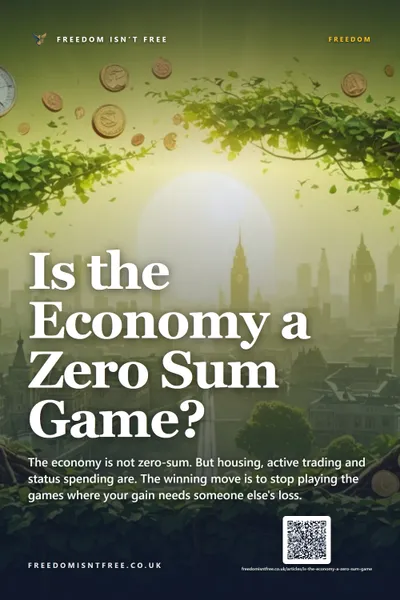
The economy is not zero-sum. But housing, active trading and status spending are. The winning move is to stop playing the games where your gain needs someone else's loss.
Cite this article
Freedom Isn't Free (2026) Is the Economy a Zero Sum Game?. Available at: https://freedomisntfree.co.uk/articles/is-the-economy-a-zero-sum-game (Accessed: 10 October 2026).
Italicise the article title in your bibliography. Accessed date set to today.
TLDR
- The economy as a whole is positive-sum, not zero-sum. Production, trade and compounding grow the total pie, which is why UK real output per person has more than tripled since the 1950s even as the population rose.
- The gut instinct that it feels zero-sum is not simply wrong. Positional goods like housing, elite school catchments and prime postcodes are near-fixed in supply, so one buyer winning does mean another being priced out.
- Active investing is the cleanest zero-sum trap. Before fees the average actively managed pound can only match the market; after fees it must trail it. That is arithmetic, not opinion.
- The personal-finance move is to stop playing the zero-sum games (stock-picking, market-timing, status spending) and pour your money into the positive-sum one: broad, low-cost, productive capital that compounds.
Which economic games are positive, zero or negative sum?
| The game | Sum | Why |
|---|---|---|
| Global stock market, long run | Positive | Companies produce real earnings; the pie grows |
| A voluntary trade between two people | Positive | Both value what they get more than what they give |
| Active trading against other traders | Zero (before costs) | One trader beats the average only if another lags it |
| Active trading after fees | Negative | The fee skim leaves the group with less than the market gave |
| Housing and other positional goods | Near zero | Supply is near-fixed, so your gain is another buyer being priced out |
| Rent extraction and monopoly fees | Zero to negative | Money transfers without anything being produced |
The aggregate economy grows. Specific arenas inside it do not, and those are the ones that dominate a normal person's financial life.
Is the Economy a Zero Sum Game?
Ask whether the economy is a zero sum game and you get two confident answers that cannot both be right. The gut-instinct answer is yes: the rich got rich by taking it off everyone else, every pound in a billionaire's account is a pound missing from yours, and the game is rigged so that a winner needs a loser. The economics-textbook answer is a flat no: trade is win-win, the pie grows, and thinking in zero-sum terms is a rookie fallacy that any first-year undergraduate is taught to drop.
Both answers are half right, which is why the argument never ends. In aggregate the economy is genuinely positive-sum. The pie really does grow. But a large and growing share of the game an ordinary Briton actually plays is closer to zero-sum than the textbook lets on, and mistaking the second thing for the first is an expensive error. This is the split nobody draws cleanly.
Contents
- What a zero sum game actually means
- Why the economy as a whole is positive sum
- Where the zero-sum instinct is dead right
- Why it feels more zero-sum than it is
- What this means for your money
- Frequently Asked Questions
What a Zero Sum Game Actually Means
A zero sum game is a situation where one person's gain is exactly balanced by another person's loss, so the total for everyone involved always adds up to nothing. Poker is the clean example. No wealth is created at a poker table. Chips just move from the people who played badly to the people who played well and the ones who got lucky. Whatever you win, someone else lost by exactly the same amount. Total change: zero.
The opposite is a non-zero-sum game, and it comes in two flavours. A positive sum game is one where the total can grow, so everyone can end up ahead at once. Two people making a swap that leaves both better off is the simplest version. A negative sum game is one where the total shrinks, which is what poker becomes once the house takes a rake off every pot: the players as a group walk away with less than they sat down with, even though within the game there are still winners.
Hold those three shapes in your head. The whole question of whether the economy is zero-sum comes down to which shape you are actually looking at, because the economy is thousands of games stacked on top of each other, and they are not all the same shape.
Why the Economy as a Whole Is Positive Sum
Start with the part the textbook gets right, because it matters.
When you buy a coffee for £3, you did not lose £3 and hand the coffee shop a win. You valued the coffee more than the £3, or you would not have bought it. The shop valued the £3 more than the coffee, or it would not have sold it. Both sides walked away richer in the only sense that counts, which is that both got something they wanted more than the thing they gave up. Voluntary trade creates value out of thin air by moving things to the people who value them most. No chips changed hands. New value appeared.
Scale that up and you get economic growth. A worker who learns a skill, a factory that makes more per hour, a new drug, a cheaper way to move goods: each one adds output that did not exist before. The result over time is not a fixed pie being resliced. It is a bigger pie.
UK real output per person (1955 = 100)
Source: ONS and Bank of England, A Millennium of Macroeconomic Data
UK real GDP per head has more than tripled since the mid-1950s, and that is after adjusting for inflation and despite the population growing by millions. If the economy were zero-sum, that chart would be a flat line and the only way anyone could get richer would be to make someone else poorer. It slopes up instead. Compounding productivity is a positive-sum force, and it is the single most important fact in personal finance, because it is what lets a low-cost index fund turn a modest monthly contribution into a large pot without anybody having to lose for you to win. Run the numbers on a compound interest calculator and the shape of that curve is the whole argument in one screen.
So the billionaire-took-it-off-you instinct is wrong as a description of the whole system. Jeff Bezos getting rich did not empty your account. Most of the wealth was created, not transferred. This is really the question hiding behind "is capitalism a zero-sum game", and the answer is that as a whole system it grows the pie, even where individual fortunes look like a straight grab.
Most. Not all. And the difference is where your money actually lives.
Where the Zero-Sum Instinct Is Dead Right
Here is the reframe. The aggregate economy is positive-sum, but several of the specific arenas that dominate a normal person's financial life are not. The gut instinct is not a fallacy. It is a misfiling. People feel the zero-sum games they are stuck in and wrongly conclude the whole economy is one.
Positional goods are close to zero-sum. A positional good is one whose value comes from being scarce relative to other people: a house in a good catchment, a flat in zone 2, a place at an oversubscribed school. You cannot manufacture more central London. When the pie of money chasing those fixed things grows, the things do not multiply, the price does. Your winning bid on the house is, quite literally, another family being priced out of it. That is a zero-sum contest wearing the clothes of a growing market, and it is why housing feels like a war rather than a rising tide.
Active investing is the purest zero-sum trap of the lot. The economist William Sharpe proved this in four pages in 1991, in a paper called The Arithmetic of Active Management, and the logic is airtight. Every pound invested in the market earns the market return. Passive money, by definition, earns the market return minus a tiny fee. So the actively managed money, taken as a group, must also earn the market return, because the two groups together are the whole market. That means for every active manager who beats the market, another must lag it by the same amount, before costs. Active management as a whole is zero-sum. After you subtract the fees, the trading costs and the fund charges, it is negative-sum. The group of people trying to beat the market keeps less than the people who did not bother.
The market itself is positive-sum, because companies produce real earnings that grow over time. But the game of trying to beat other traders inside that market is a poker table with a rake. Both statements are true at once, and confusing them is the single most expensive mistake retail investors make.
Rent extraction is a transfer, not a creation. When a monopoly raises prices because you have nowhere else to go, when a platform takes a bigger cut because it owns the pipes, when a savings provider drops your rate hoping you will not notice, no new value is produced. Money moves from you to them. That is the zero-sum part of the economy the pro-worker lens has always cared about, and it is real: the rip-off Britain of dropped savings rates and creeping platform fees. See rentier capitalism for the full anatomy of it.
Why It Feels More Zero-Sum Than It Is
Put the two halves together and you can explain why so many people are certain the game is rigged even though the pie is bigger than ever.
The positive-sum engine, productivity growth, has kept running. But since 2008 the surplus it produces has mostly stopped reaching wages. UK real pay has been roughly flat for the best part of two decades, while the positional goods, above all housing, have run away. House prices in England now sit at well over seven times average earnings, against roughly four times in the late 1990s. The growth is real. It just stopped landing in the part of the economy where most people earn, and piled into the part where they compete. That divergence, and the reason the tax system keeps missing it, is the whole subject of why the UK won't tax wealth.
So the lived experience of a working-age Briton is dominated by the zero-sum arenas. The deposit race. The school catchment. The fixed number of decent postcodes. It genuinely feels like a game where you can only win by beating someone else, because in those specific arenas it is. The mistake is generalising from the games you play to the system as a whole. The system is still positive-sum. Your slice of it just happens to play like poker.
What This Means for Your Money
Once you can see which games are which, the personal-finance strategy writes itself. Stop volunteering for the zero-sum tables, and route your money into the positive-sum one.
Own the market, do not trade against it. Buying and selling individual shares in the hope of beating other investors is Sharpe's negative-sum poker table, and the other players include full-time professionals with faster data than you. Buying a low-cost global tracker and holding it is not playing that game at all. You step out of the zero-sum contest and simply own the positive-sum one: the real, compounding earnings of thousands of companies. See passive investing for why the losers at the trading table fund the winners, and why you want to be at neither seat.
Do not time the market. Trying to jump out before a fall and back in before a rise is another attempt to beat other traders. Time in the market beats timing it because the compounding engine is positive-sum and the timing game is not.
Watch the rake. In a negative-sum game the size of the rake decides who survives, and in investing the rake is fees. A wealth manager charging 1% a year on a global tracker you could hold for 0.15% is skimming the pot for a service the arithmetic says cannot, on average, beat the index. Fee discipline is how you refuse to sit at a negative-sum table, which is why it matters far more than it looks.
Spend on life, not on position. A lot of expensive spending is an entry ticket to a zero-sum status contest you cannot win, because the goalposts move the moment anyone else spends more. Converting wage income into capital that compounds is the opposite move, and the same logic that says you are not a horse in the AI economy says it here: own a slice of the growing pie rather than relying on selling your time into a shrinking wage share. It is the one game where your gain does not require anyone else's loss.
The Little Book of Common Sense Investing - John Bogle - Bogle spent a career making the same point Sharpe proved on paper: trying to beat the market is a loser's game after costs, and owning the whole market is the winner's one. It is the clearest case ever written for stepping out of the zero-sum contest and into the positive-sum one. (Affiliate link - we may earn a small commission at no extra cost to you.)
Frequently Asked Questions
Is investing a zero sum game?
It depends which kind. The stock market as a whole is positive-sum over the long run, because the companies in it produce real, growing earnings. But active trading, the attempt to beat other investors by buying and selling the right things at the right time, is zero-sum before costs and negative-sum after fees. Owning a broad index fund lets you capture the positive-sum part without playing the zero-sum part.
What are examples of zero-sum games?
Poker and most betting are the textbook examples: the winners' gains equal the losers' losses. Dividing a fixed inheritance, two firms fighting over a fixed pool of customers, and a penalty shootout are all zero-sum. In finance, the cleanest example is active trading against other traders, where beating the average requires someone else to lag it. Building a business, inventing something or making a voluntary trade are not zero-sum, because they create new value rather than moving existing value around.
Is trade a zero sum game?
No. A voluntary trade only happens because both sides value what they receive more than what they hand over, so both walk away better off. This is the core reason the economy grows rather than just reshuffling a fixed amount of wealth. The idea that trade must have a loser is the zero-sum fallacy, and it is the single most common mistake people make about how the economy works.
Is the housing market a zero sum game?
Close to it, and that is why it feels so brutal. Housing in desirable areas is a positional good with near-fixed supply, so when more money chases it the price rises rather than the number of homes. Your successful offer is another buyer being priced out. Building more homes is one of the few things that can turn it back into a positive-sum market.
Does one person getting rich make someone else poorer?
Usually not, but it depends on how. If the wealth was created, by building a company, inventing something, or producing goods people want, the pie grew and nobody had to lose. If it was extracted, through monopoly pricing, rent-seeking or fees skimmed off other people's returns, then it was a transfer and someone did lose. Both happen. The honest answer is that the economy is mostly positive-sum with a real zero-sum layer running through it.
This article is for general education, not financial advice. Investing puts your capital at risk and the value of investments can fall as well as rise, so you may get back less than you put in. Past growth is not a guide to future returns. If you are unsure what is right for your circumstances, speak to an FCA-regulated adviser.
Sources
Prefer to watch?
We turn these money breakdowns into short videos
A few a week, plain-English UK money. If you would sooner watch than read, follow along:
Enjoying the content?
If this site has been useful, a coffee goes a long way.
Browse more articles
Browse all