


What Is Financial Nihilism?
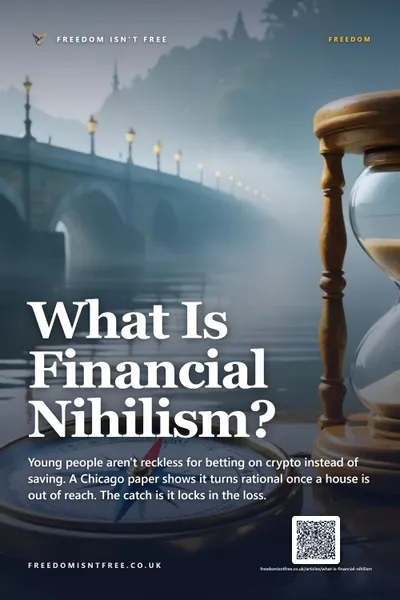
Young people aren't reckless for betting on crypto instead of saving. A Chicago paper shows it turns rational once a house is out of reach. The catch is it locks in the loss.
Cite this article
Freedom Isn't Free (2026) What Is Financial Nihilism?. Available at: https://freedomisntfree.co.uk/articles/what-is-financial-nihilism (Accessed: 10 October 2026).
Italicise the article title in your bibliography. Accessed date set to today.
TLDR
- Financial nihilism is the belief that the system no longer rewards saving, so the rational move is to spend now, gamble on lottery-ticket assets, and stop trying
- A 2025 Chicago and Northwestern paper models it precisely: as the odds of ever owning a home fall, people consume more, invest riskier, and work less
- It is a reasonable response to a genuinely rigged game, but it is the one response that widens the exact wealth gap that caused it
- The way out is not to pretend the game is fair, it is to take the boring asymmetric bet (a global tracker) that actually compounds in your favour
The door that closed
| England | House price vs earnings |
|---|---|
| 1997 | 3.5x |
| 2007 | 7.2x |
| 2021 (peak) | 9.0x |
| 2024 | 7.7x |
Average house price divided by average earnings, ONS. Still roughly double the late-1990s multiple.
What Is Financial Nihilism?
Financial nihilism is the belief that the financial system no longer rewards playing by the rules, so the sensible response is to stop. Stop saving for a deposit you will never reach, stop deferring, and instead spend what you have now or throw it at a lottery-ticket asset that might, just might, change everything in one go. The usual reaction to young people doing this is a lecture about avocado toast and discipline. That reaction is lazy, and the maths is against it.
Because here is the uncomfortable part: given the numbers a 25-year-old is actually looking at, giving up is not stupid. It can be the rational move. Bloomberg's explainer on financial nihilism lays out the mechanism, and a recent economics paper models it so cleanly that the behaviour everyone tuts at falls straight out of the equations. This article takes the diagnosis seriously and then tells you why, even so, the nihilist plays the one hand that guarantees they lose.
Contents
- What financial nihilism actually means
- Why giving up is rational, not stupid
- The British version of the same maths
- The trap: giving up is the one bet you are sure to lose
- What to do if you refuse to pretend the game is fair
What financial nihilism actually means
The term was coined in 2021 by Demetri Kofinas of the Hidden Forces podcast, and it went mainstream through markets people like the hedge-fund manager Travis Kling. Kling's motto for the mindset is the tell: "Don't trust it, but prices are heading higher." That is the whole psychology in nine words. You do not believe in the asset. You do not believe the system is fair or sane. You buy anyway, because the alternative, patiently saving into a game you think is rigged, feels more foolish than the gamble.
This is disillusionment turned into a strategy, not recklessness for its own sake. The nihilist has looked at wages, rent, house prices and the cost of a normal life, decided the traditional ladder has had its bottom rungs sawn off, and concluded that only a moonshot has any chance of closing the gap. Crypto, meme stocks, zero-day options, prediction markets, sports betting. The GameStop saga in early 2021 is usually treated as the starting gun, the moment a generation worked out that the casino was at least honest about being a casino.
Why giving up is rational, not stupid
This is where it stops being a vibe and becomes economics. In November 2025, Seung Hyeong Lee and Younggeun Yoo, of Northwestern and the University of Chicago, published a paper with the blunt title "Giving Up". They built a standard life-cycle model of how a household saves and spends over time, then added one variable: the perceived probability that you will ever own a home.
When they turn that probability down, three behaviours pop out of the model on their own, no hand-waving required:
- People consume more relative to their wealth. If the big goal is gone, why hold back?
- People take riskier investments. The safe, slow path only makes sense if it gets you somewhere. If it does not, you may as well swing for the fences.
- People work less. Effort you were putting in to hit a target you no longer believe in gets quietly withdrawn.
Read that back. Spend more, gamble more, try less. That is the entire caricature of the feckless young, produced not by a moralising columnist but by a coldly logical model responding to one input: the door to ownership closing. The behaviour is the symptom. The closed door is the disease.
The paper adds a projection that should stop the lecture dead. The cohort born in the 1990s is on track to reach retirement with a homeownership rate roughly 9.6 percentage points below their parents' generation. And it warns of "substantially greater wealth dispersion between those who retain hope of homeownership and those who give up." Hold onto that line. It is the twist the whole article turns on.
The British version of the same maths
The research is American, but a British reader does not need it translated. The door here is the same door.
In 2024 the average home in England cost 7.7 times average earnings, according to the ONS. In the late 1990s that multiple was about 3.5. It briefly touched roughly nine times earnings at the 2021 peak. Prices have eased back a little since, but "a bit better than the worst it has ever been" is not the same as affordable.
House price to earnings ratio, England
Source: ONS, Housing affordability in England and Wales, 2024 (average house price / average earnings)
Put a number on the door. The average first-time buyer in England now needs a deposit north of £60,000 and does not complete until around age 34, while median full-time pay is roughly £39,000. Real wages have been broadly flat since 2008, so the younger you are, the more of your adult life you have spent watching the home you are meant to buy sprint away from the income you are meant to buy it with. It is a kind of shadow debt you are born into, and none of it is your fault, but the arithmetic still has to be done from where you are standing.
So it is no surprise the escape hatches are busy. The FCA found around 12% of UK adults held cryptoassets in 2024, roughly seven million people, with ownership skewing young and the average holding under £2,000. Meanwhile the gambling industry booked a gross yield of £16.8 billion in the year to March 2025. Online slots alone took more than £4 billion. The state has noticed who is being hit: since May 2025 the online-slots stake limit for 18 to 24-year-olds is capped at £2 a spin, an admission in regulation that young men in particular are being quietly hoovered.
The trap: giving up is the one bet you are sure to lose
Now the twist. Everything above says the nihilist has read the situation correctly. The ladder is genuinely broken. So why not swing for the fences?
Because of that line in the paper about wealth dispersion. When some people give up and some hold on, the gap between the two groups gets wider, not narrower. The person who keeps buying the boring asset pulls away from the person who cashes out into lottery tickets. Giving up does not close the gap that made you give up. It is the single behaviour most reliably guaranteed to widen it.
And look at who is standing on the other side of the trade. Every crypto punt, every accumulator, every options lottery ticket has a counterparty, and on average the counterparty is the house: the exchange, the bookmaker, the market maker, the people who already own the assets and the platforms. The nihilist thinks they are opting out of a rigged system. They are opting into its most extractive room. The £2 slots cap exists precisely because that room reliably transfers money from people who cannot spare it to people who already have plenty.
What to do if you refuse to pretend the game is fair
The answer is not to tell you the system is fine and you should knuckle down, because it is not fine. The pro-worker reading of financial nihilism is that the anger is earned and the diagnosis is broadly right. What it gets wrong is only the last step: the response.
There is a middle path between deluded optimism and self-destructive nihilism, and it is almost annoyingly boring.
First, take the asymmetric bet that is actually available to a normal person. A low-cost, global index tracker is the closest thing to a game where the odds sit with you: you own a slice of every large company on earth, and the long-run return has been positive across a century of wars and crashes, though past performance is no guarantee and your capital can still fall. The fee is a rounding error. That is your "number go up," minus the part where the house takes its cut. It will not 50x in a weekend. It does not need to. Regular buying into it is the version of "taking more shots" that compounds rather than combusts, and you can watch what boring monthly buying does over decades in the compound interest calculator.
Second, separate spending now from gambling now. The nihilist instinct to actually live now, rather than defer every pleasure to a retirement that feels imaginary, is a good one. You should die with memories, not dreams. The error is only in routing that money through a slot machine instead of a life.
Third, build the floor before you swing at the ceiling. An emergency fund is dull and it is also the thing that stops one bad month turning into a catastrophe. If you genuinely cannot resist a punt, wall off a tiny, pre-agreed "fun" budget you can afford to lose and treat it as entertainment, not a plan. The plan is the tracker. The plan is the floor. Everything else is a hobby with a cost.
Financial nihilism is right that the game is rigged. It is wrong that the winning move is to stop playing the parts that still pay you. Owning the boring asset is not surrender to a broken system. It is the quietest available form of revenge on it.
Frequently Asked Questions
What is financial nihilism in simple terms?
It is the belief that saving and long-term planning no longer pay off, so the rational thing is to spend now or gamble on a big, risky bet instead. It usually comes from feeling locked out of milestones like home ownership, and it shows up as heavy use of crypto, meme stocks, options, prediction markets and sports betting.
Is financial nihilism actually rational?
The diagnosis often is. A 2025 paper by economists at Northwestern and the University of Chicago found that as the perceived chance of owning a home falls, people rationally consume more, invest more riskily and work less. The response is the flaw: the same research shows that giving up widens the wealth gap rather than closing it.
Who coined the term financial nihilism?
The phrase was coined in 2021 by Demetri Kofinas, host of the Hidden Forces podcast, and it spread through markets via investors like the hedge-fund manager Travis Kling, whose motto for the mindset is "Don't trust it, but prices are heading higher." The GameStop episode in early 2021 is usually treated as the moment it went mainstream.
Why do young people prefer crypto to a pension?
Because a pension only makes emotional sense if you believe the slow, steady path leads somewhere, and many young people no longer do. Crypto and similar bets offer the one thing a pension cannot: a small chance of a life-changing jump, fast. The problem is that the odds and the fees favour the other side of the trade.
Is investing just gambling then?
No, though speculation can be. Buying a diversified, low-cost global index fund is ownership of real productive companies with a positive long-run expected return. Betting your savings on a single coin, a meme stock or an options play is closer to gambling, because the expected value is against you. The line is whether you are an owner or a punter.
How do I avoid financial nihilism without pretending everything is fine?
Accept that the system is genuinely tilted, then refuse the one move that makes your position worse. Automate buying a global tracker, keep an emergency fund as your floor, allow yourself to spend on real experiences now, and cap any speculative "fun money" at an amount you can lose without it mattering.
Further Reading:
The Psychology of Money - Morgan Housel - Housel's chapters on luck, risk and the difference between getting wealthy and staying wealthy are the calm antidote to financial nihilism: they explain why the boring, tortoise-paced approach quietly beats the moonshot most of the time. (Affiliate link - we may earn a small commission at no extra cost to you.)
This article is education, not financial advice. Investing puts your capital at risk and past performance is not a guide to future returns. Crypto is largely unregulated in the UK and you can lose everything you put in. Gambling carries a high risk of loss. Do your own research, or speak to an FCA-regulated adviser, before acting.
Sources
Prefer to watch?
We turn these money breakdowns into short videos
A few a week, plain-English UK money. If you would sooner watch than read, follow along:
Enjoying the content?
If this site has been useful, a coffee goes a long way.
Browse more articles
Browse all