







Machiavelli's Virtue and Fortune: Skill vs Luck
Ten brilliant candidates, one job. The one who wins probably went to university with the boss's sister. Machiavelli knew skill was only ever half the game.
Cite this article
Freedom Isn't Free (2026) Machiavelli's Virtue and Fortune: Skill vs Luck. Available at: https://freedomisntfree.co.uk/articles/machiavelli-virtue-and-fortune (Accessed: 10 October 2026).
Italicise the article title in your bibliography. Accessed date set to today.
TLDR
- Machiavelli split success into virtù (skill, nerve, adaptability) and fortuna (luck and circumstance), and said fortune decides roughly half of it
- Skill gets you into contention, but in crowded fields where everyone is already skilled, luck is what separates the winner from the runners-up
- Tiny variables decide binary outcomes: a shared connection or an interviewer having a bad day can settle a job between ten equally able people
- Machiavelli's answer was to build barriers before the flood: take more shots so luck has more chances to land, and keep buffers so a bad roll cannot ruin you
Your odds of at least one yes
| Attempts (5% each) | Chance of a yes |
|---|---|
| 1 go | 5% |
| 5 goes | 23% |
| 10 goes | 40% |
| 20 goes | 64% |
| 30 goes | 79% |
You cannot change the odds of a single attempt. You can change how many attempts you take.
Machiavelli's Virtue and Fortune: Skill vs Luck
Machiavelli's virtue and fortune, or virtù and fortuna, are the two forces he said decide whether anyone rises or falls, and five centuries later they still explain more about success than the meritocracy story we tell ourselves. The modern version goes: work hard, get good, and you will be rewarded. Machiavelli would have called that half true. Half, almost exactly.
He wrote that fortune "is the arbiter of one half of our actions, but that she still leaves us to direct the other half." Skill gets a vote. So does luck. And in the places where the stakes are highest and the competition is fiercest, it is usually luck that casts the deciding one.

Skill gets you into the room. Fortune shuffles the deck and decides between equals, so you build your dykes before the flood.
Contents
- What Machiavelli meant by virtue and fortune
- Why brilliance is necessary but never enough
- How small variables decide big outcomes
- Case study: Warren Buffett and the ovarian lottery
- Build your dykes against fortune
What Machiavelli meant by virtue and fortune
Virtù is not virtue in the moral sense. It is closer to skill, nerve and adaptability: the capacity to act well and boldly when the moment demands it. It is everything you bring to the table that is genuinely yours, from talent and preparation to judgement and the years of work nobody saw.
Fortuna is everything you do not control. The timing of your birth, the state of the economy when you graduate, who happens to be in the room, whether the person judging you slept well. Machiavelli's image for it is a river in flood: when it rises, it "sweeps away the trees and the buildings" and nobody can stand against it.
But he did not stop there, and this is the part people forget. The river only drowns the unprepared. When "the weather becomes fair", he wrote, men can "make provision, both with defences and barriers, in such a manner that, rising again, the waters may pass away by canal". You cannot stop the flood. You can dig the channels that decide where it goes. Hold that thought, because it is the whole practical point of this article.
Why brilliance is necessary but never enough
Virtù is the price of entry, not the prize. You need real skill to be in contention at all. Nobody lucks into a consultant surgeon's post or a tenured chair without the work. But here is the uncomfortable structure: at the top of any competitive field, everyone has done the work. The final round is not brilliant people against mediocre ones. It is ten brilliant people, all of whom cleared the bar, competing for one chair.
When the field is that tight, virtù stops being a differentiator, because everyone has it. The variance in outcomes has to come from somewhere, and it comes from fortune. Robert Frank, the Cornell economist, makes exactly this case in Success and Luck: in winner-take-all markets, where tiny differences in input produce enormous differences in reward, luck becomes not a footnote but the deciding factor. The more crowded the top, the more a sliver of good fortune is worth.
This is why the meritocracy story is comforting and slightly dishonest. It is true that you cannot win without the skill. It is false that the skill is what separates the winner from the nine other people who also had it.
How small variables decide big outcomes
Picture the real version. Ten candidates, all excellent, all interviewed, all capable of doing the job well. One of them went to university with the hiring manager's sister. You already know who gets the offer. Not because they were better (the whole premise is that they were not measurably better) but because a warm personal connection is a thumb on a finely balanced scale, and the scale was balanced enough for a thumb to settle it.
Now change nothing except the day. One candidate draws the interview slot after lunch, when the interviewer is sharp and fed. Another draws the last slot before home time, when the same interviewer is tired, behind on email, a little hungover from a leaving do, and has just tipped coffee down his shirt. Same candidate, same answers, two different verdicts. The decision was never as objective as the org chart pretends.
This is not cynicism, it is documented. A widely cited 2011 study of Israeli parole judges found that the share of favourable rulings began each session at roughly 65% and fell towards zero right before a meal break, then jumped back up once the judges had eaten. The effect size has been argued over since, but the direction surprises nobody who has ever been hungry and made a decision. If a trained judge ruling on someone's liberty drifts that far on an empty stomach, an interviewer choosing between equals is not immune.
The maths of it is brutal because the input is tiny and the output is binary. A 2% edge from a shared connection does not get you 2% of the job. It gets you the whole job, or none of it. In highly competitive spaces the reward is lumpy: there is a winner and there are runners-up, so a marginal difference in fortune produces a total difference in result. Years of equal effort, decided by a coffee stain.
Case study: Warren Buffett and the ovarian lottery
If you want to stress-test the virtù and fortuna split, run it on the most celebrated self-made investor alive. Warren Buffett is the patron saint of the meritocracy story: start with a paper round, read the right books, be patient, get rich. The catch is that Buffett himself does not tell it that way, and his own account is the most candid audit of luck you will find anywhere.
Start with the fortuna, because there is a great deal of it. He was born in Omaha in 1930, and by his own reckoning that alone was a jackpot. He has said the odds of being born in the United States at that moment were roughly 50 to 1 against, and he calls the accident of when and where you arrive the "ovarian lottery," the single most important event of your life. He was also born a boy, which in 1930 was worth more than any qualification. His two sisters, he has pointed out, had every bit of his intelligence and drive and none of his runway.
Then there is the timing nobody chooses. Being born in 1930 made him a schoolboy through the Second World War, far too young for the draft that swallowed the men born a decade earlier. It also meant he reached investing age just as the longest bull market in history was getting under way. He did not build the post-war American boom. He was simply standing in the right spot, capital ready, when it arrived. And he was born into the right house: his father, Howard Buffett, was a stockbroker who later became a Nebraska congressman, so the family air was equal parts capital and financial literacy. Warren was loitering on a brokerage floor before he was ten, visited the New York Stock Exchange at ten, and bought his first shares at eleven. Most children that age do not know what a preferred share is. He grew up inside the machine.
None of that is a slight on him, because the virtù is every bit as real. The man is genuinely brilliant, with a near-photographic memory for numbers and a temperament that is arguably rarer than the intelligence: the patience to compound for eight decades and the nerve to stay rational when everyone around him has lost the plot. Fortune laid the table. He is the one who played the hand almost perfectly for seventy years, and hardly anyone else could have.
The Benjamin Graham chapter is where virtù and fortuna get tangled, which is exactly why it repays a closer look. Buffett was rejected by Harvard Business School, a bad roll that turned out to be the luckiest thing that ever happened to him, because he then chose Columbia specifically because Graham, the father of value investing, taught there. He sought out the best mind in the field and offered to work for him for nothing. Graham turned him down, more than once, and Buffett kept asking until he landed the job in 1954. The initiative, the persistence, the picking of the right teacher: pure virtù. But Graham had to exist, be alive, be teaching, and be within reach at the one moment Buffett was ready to learn from him. You cannot apprentice yourself to the greatest investor of the age if he happens to be born in the wrong century or teaching on the wrong continent. Buffett supplied the effort. Fortune supplied the teacher.
The clincher is that Buffett is the star witness for his own defence. "If you stick me down in the middle of Bangladesh or Peru or someplace," he once said, "you'll find out how much this talent is going to produce in the wrong kind of soil." He has said his gift for allocating capital is only worth anything because he was born into a society that happens to reward it lavishly, and that the same wiring dropped into a tribe of hunters would be useless. When the most successful capitalist of the century tells you that most of his edge was the ground he was planted in, the meritocracy story has lost its best possible spokesman. Enormous virtù, genuinely his. Enormous fortuna, none of it his doing. And no clean way to say which one built Berkshire Hathaway, because the honest answer is both, in a proportion nobody can separate.
Build your dykes against fortune
Here is where Machiavelli stops being a diagnosis and becomes a strategy, and where this turns from philosophy into something you can do with your money and your career.
If fortune decides half, and you cannot control which way it breaks, there are two rational responses, and they are the canals in the flood metaphor.
The first is to take more shots. Luck is a numbers game, and you get to choose how many times you roll. One job application, one pitch, one interview is a single spin. Twenty is a different proposition. If any one attempt has just a 5% chance of landing, one go leaves you at 5%. Twenty goes, at the same odds each, put you at 64%. You did not get better between attempt one and attempt twenty. You gave fortune more chances to find you.
Chance of at least one yes, by number of attempts (5% each)
Source: Probability of at least one success = 1 minus (0.95) to the power n
This is why putting more work into the world beats polishing one thing to perfection. More applications, more connections made before you need them, more content published, more swings. You are not trying to be lucky on any given try. You are widening the surface area so that luck, when it lands, lands on you.
The second response is the one this site is built on: make sure a bad roll cannot ruin you. This is the barrier against the flood. You cannot stop a redundancy, a market crash, or a business that fails through no fault of your own. You can build the buffers that turn a catastrophe into a setback. An emergency fund is a dyke. A diversified portfolio instead of one heroic stock pick is a dyke. Not depending on a single employer, a single client or a single income stream is a dyke. None of it improves your luck. All of it decides what your luck is allowed to do to you.
That is the pro-worker reading of Machiavelli, and it cuts both ways. It should make you gentler on yourself when a roll goes against you, because the system genuinely is not the clean meritocracy it advertises. And it should make you relentless about the two things you control: the volume of shots you take, and the size of the buffer that protects you when most of them miss. Virtù to get into the room. Dykes for when fortune floods anyway.
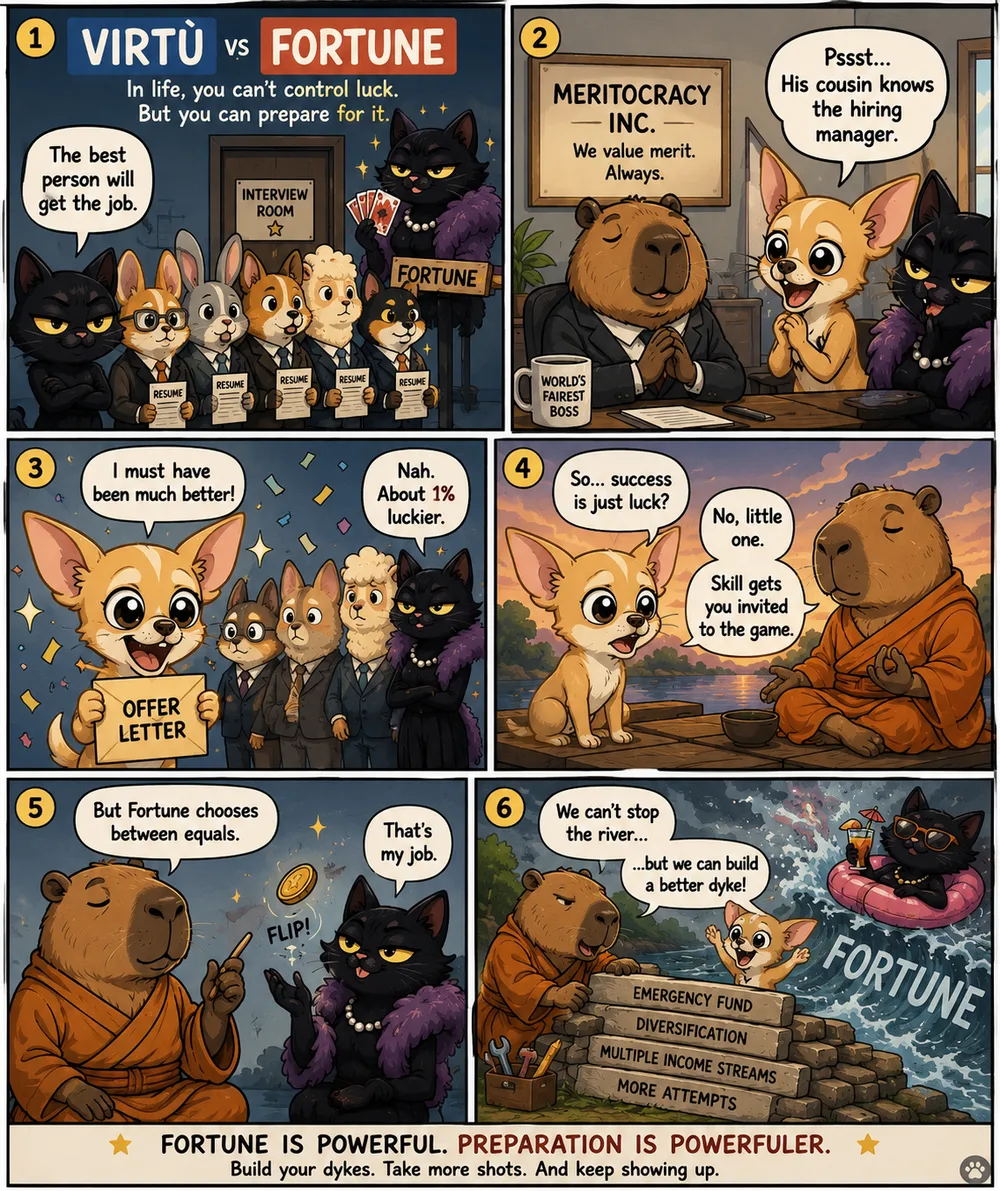
The same lesson, with capybaras: when everyone is equal, luck picks the winner, so build a better dyke.
Frequently Asked Questions
What is the difference between virtù and fortuna in Machiavelli?
Virtù is skill, nerve and adaptability, everything you bring that is genuinely yours. Fortuna is luck and circumstance: timing, connections, the mood of the person judging you. Machiavelli argued that success needs both, and that fortune decides roughly half of what happens to us while the other half is left to our own effort.
Does luck really matter more than skill?
Not more, but often decisively at the margin. Skill is necessary to compete at all. In crowded, winner-take-all fields where everyone is already skilled, the remaining difference between the winner and the runners-up is usually fortune, because a tiny edge produces a total difference in reward.
If success is mostly luck, why bother working hard?
Because skill is the ticket that lets you play, and hard work is what lets you take more shots. You cannot control the outcome of any single roll, but you can control how many times you roll and how prepared you are when your moment arrives. Effort does not guarantee the win. It buys the tickets.
How do you protect yourself against bad luck financially?
Machiavelli's answer was to build barriers before the flood. In money terms that means an emergency fund, a diversified portfolio rather than one concentrated bet, and more than one source of income. None of it improves your luck. It caps the damage a bad run can do to you.
Is meritocracy a myth?
Partly. The claim that you cannot succeed without skill is true. The claim that skill alone explains who succeeds is not, because it ignores the fortune that separates equally able people. Meritocracy is real as a filter and misleading as a full explanation.
Read Next
- Why the UK Won't Tax Wealth - the political economy behind the meritocracy story, and why the luck that builds fortunes stays out of the tax net.
- Rentier Capitalism in the UK - how much UK wealth comes from owning the right asset at the right time rather than from effort or skill.
- Why Boomers Had It Easier - the clearest example of fortuna at scale: an entire generation carried by the decade it was born into.
Further Reading:
The Psychology of Money - Morgan Housel - Housel's chapter on luck and risk is the modern companion to Machiavelli's fortuna: two people can make identical decisions and get opposite outcomes, and pretending otherwise warps how you judge success. (Affiliate link - we may earn a small commission at no extra cost to you.)
Thinking, Fast and Slow - Daniel Kahneman - The research behind why a tired, hungry or distracted decision-maker reaches a different verdict on the same evidence, which is the mechanism that turns a coffee stain into a hiring decision. (Affiliate link - we may earn a small commission at no extra cost to you.)
Sources
Prefer to watch?
We turn these money breakdowns into short videos
A few a week, plain-English UK money. If you would sooner watch than read, follow along:
Enjoying the content?
If this site has been useful, a coffee goes a long way.
Browse more articles
Browse all